-
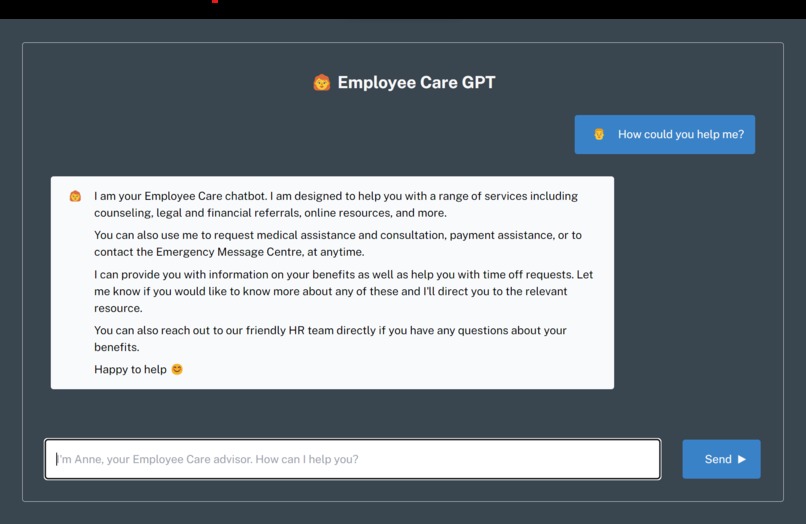
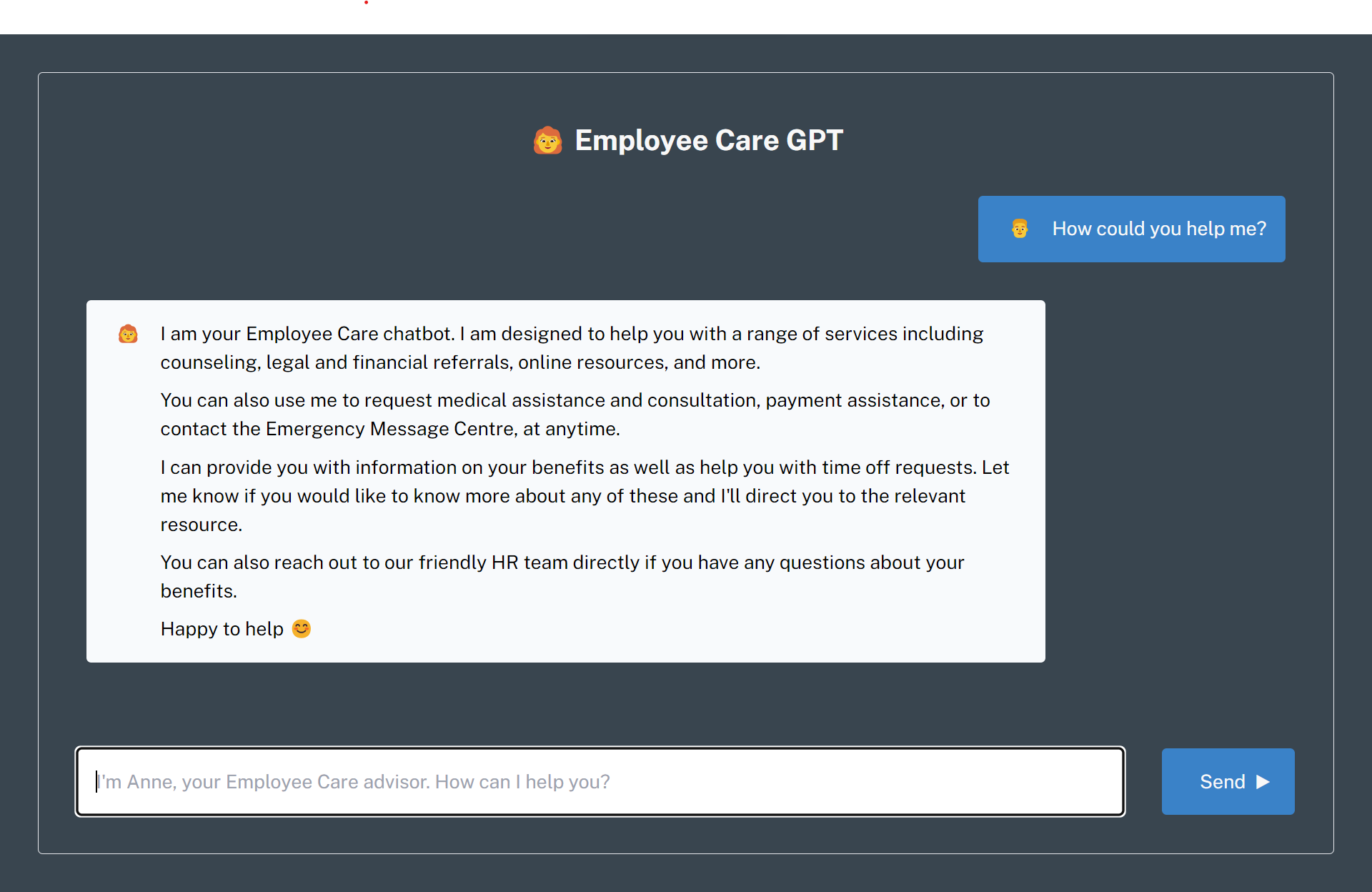
CareGPT is here for you
-
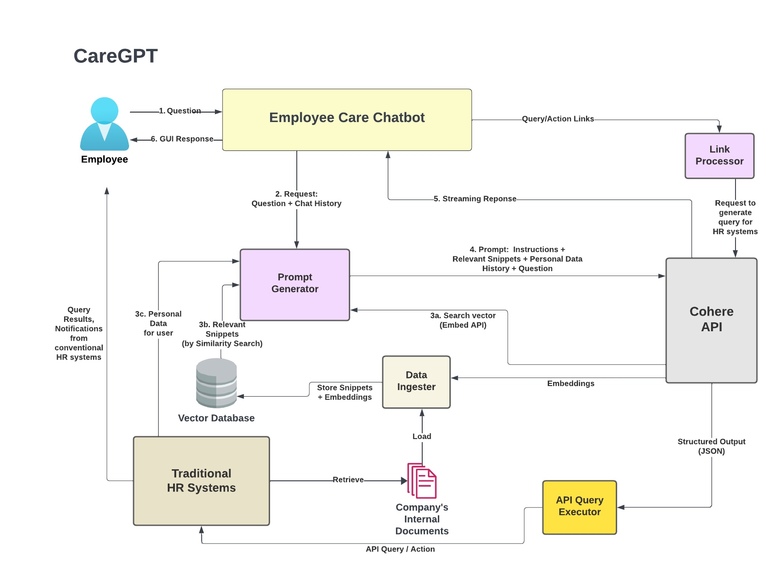
Architecture Diagram

Inspiration
Today, potential employees assess job opportunities based not only on salary but also on the comprehensive benefits offered. These benefits encompass various aspects of work-life balance, including wellness programs, flexible work arrangements, professional development, family planning, and notably, mental health support. A robust commitment to employee well-being creates a positive work culture and fosters loyalty. It acts as a magnet that attracts and retains talents, who are seeking not just a job, but a supportive environment where they can thrive both professionally and personally. Understanding the significance of this issue, our goal is to create a solution that surpasses traditional methods of employee support. We aim to revolutionize how companies approach employee well-being by harnessing AI technology to provide personalized, accessible, and empathetic support. CareGPT is more than just a tool. It's a companion - an understanding, non-judgmental presence that employees can turn to at any time, ensuring they feel heard and valued. Unlike a human HR representative, this Chatbot operates 24x7, serving as a game-changer by providing immediate support and guidance to employees whenever they need it, regardless of time zones or working schedules. CareGPT demonstrates a commitment to employee wellness, making the workplace a more attractive and productive environment for talents. This solution potentially has the power to reshape how companies worldwide support their most valuable asset: their people.
What it does
- 24/7 AI-Powered Support: Offers uninterrupted, round-the-clock assistance to employees, accommodating all time zones and working hours.
- Personalized Employee Interaction: Adapts conversations and advice to individual employee
- profiles using Cohere RAG for tailored understanding and response.
- Comprehensive Well-being Focus:
- Covers various aspects of work-life balance including mental health, wellness programs, and family planning.
- Supports professional development and flexible work arrangements.
- Empathetic and Non-Judgmental Engagement:
- Offers a safe, understanding space for employees to express concerns and seek guidance.
- Designed to provide empathetic responses and support.
- Enhanced Accessibility and Inclusivity:
- Accessible to all employees, fostering an inclusive work environment.
- Removes barriers associated with traditional HR availability.
- Real-time Response and Guidance:
- Delivers immediate assistance and advice, reducing wait times associated with HR queries.
- Capable of handling a wide range of queries instantly.
- Culture and Loyalty Building:
- Contributes to a positive work culture by showing commitment to employee well-being.
- Aids in building loyalty and attracting talent seeking supportive work environments.
Architecture

Note: the link processing part is part of future enhancements of CareGPT.
How we built it
- Integration of Cohere Command Model with RAG: Our project leverages the powerful combination of Cohere's Command model and the Retrieval-Augmented Generation (RAG) framework. This integration enables the system to access and utilize diverse data sources, ensuring that the information generated is both current and contextually relevant. Data Source Utilization for Contextual Responses: We employ a variety of data sources to provide responses that are not only up-to-date but also tailored to the specific context of the user's input. This includes considering the user's personal information, company-specific data, and specific hints or directions given in the user prompt.
- Efficient Data Processing and Conversion: Source data, including PDFs and PPTX files, is processed with a focus on preserving content integrity. The processing involves converting these files into markdown text, ensuring that the format is uniform and easily accessible for further processing.
- Use of Cohere’s English Model for Embedding Generation: Our system uses Cohere's english-model-v3 for embedding generation. This step is crucial for understanding and segmenting the information. The data is carefully chunked, and these chunks are then transformed into embeddings, preparing them for effective utilization by the RAG system. Optimization Through Experimental Settings: After extensive testing with various configurations, we identified and selected the most effective settings for our system. This optimization process was key to enhancing the accuracy and relevance of the information generated by our model.
Challenges we ran into
- Challenge in Model Response Relevance: A significant challenge was constraining and guiding the large language model (LLM) to respond with the most relevant information. Ensuring that the model's responses were both accurate and pertinent required meticulous tuning and adjustments.
- Data Collection and Processing Hurdles: The project faced the daunting task of collecting, cleaning, and processing a vast and diverse dataset. Utilizing prompt engineering techniques with Cohere's Command model was crucial. This process included carefully analyzing source data, embedding it effectively, and pruning irrelevant data to enhance the chatbot's accuracy.
- Overcoming Outdated Plugin Limitations: We encountered a major setback with LangChain's Cohere plugin being outdated and not compatible with Cohere's latest API. To resolve this, I developed a custom adapter that facilitates communication with Cohere's new API, including support for streaming. This adaptation allowed us to leverage the strengths of both Cohere's state-of-the-art LLM and LangChain's extensive range of plugins.
What's next for CareGPT
- Access Live Data in Company's HR System
- Utilize existing HR infrastructure (e.g., payroll, benefits, HR systems).
- Leverage AI with Cohere RAG to enhance system capabilities.
- Implement a chatbot for handling user requests efficiently.
- Customize System Prompts and RAG Data Based on User Context
- Differentiate between authenticated and unauthenticated users.
- Integrate context-aware prompts reflecting individual user data.
- Simplify Form Accessibility and Usability
- Embed directly fillable forms within the application UI.
- Avoid directing users to external, hard-to-navigate websites.
- Design Continuous Model Verification System
- Establish mechanisms for regular updates and verification of model data.
- Enable Employee-Driven Information Enhancement
- Create channels for employees to suggest improvements and additional information.
Built With
- cohere
- langchain
- next.js
- react
- supabase


Log in or sign up for Devpost to join the conversation.