Inspiration
In Brazil, the sales conversation happens on WhatsApp. Around 70% of Brazilian companies already use it to sell, and small businesses are ~97% of all companies in the country. But the tooling those businesses actually have is a phone passed between employees. No pipeline. No history. No idea which ad produced which sale.
The software to fix that exists — it is called a CRM, and it has existed for twenty years. The reason it never reached these businesses is not the software. It is the service around it: implementation, training, support, analysis. That service costs more than a five-person clinic can pay.
AI is the first thing that actually collapses that cost. CareGlyph is what happens when you build a CRM assuming the service layer is AI from day one, instead of bolting a chatbot onto a CRM designed for enterprises.
What it does
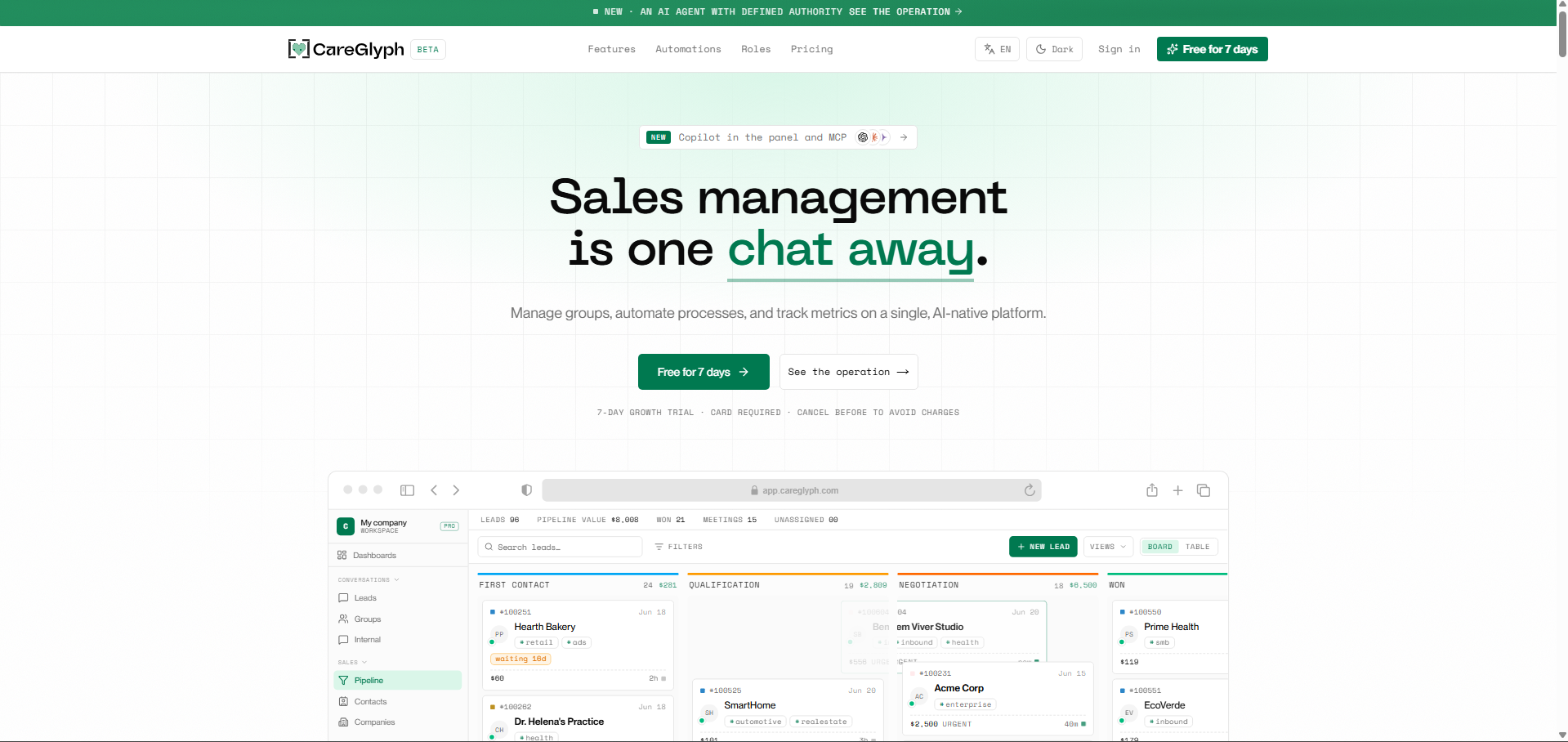
CareGlyph is an AI-native CRM for small businesses that sell through WhatsApp.
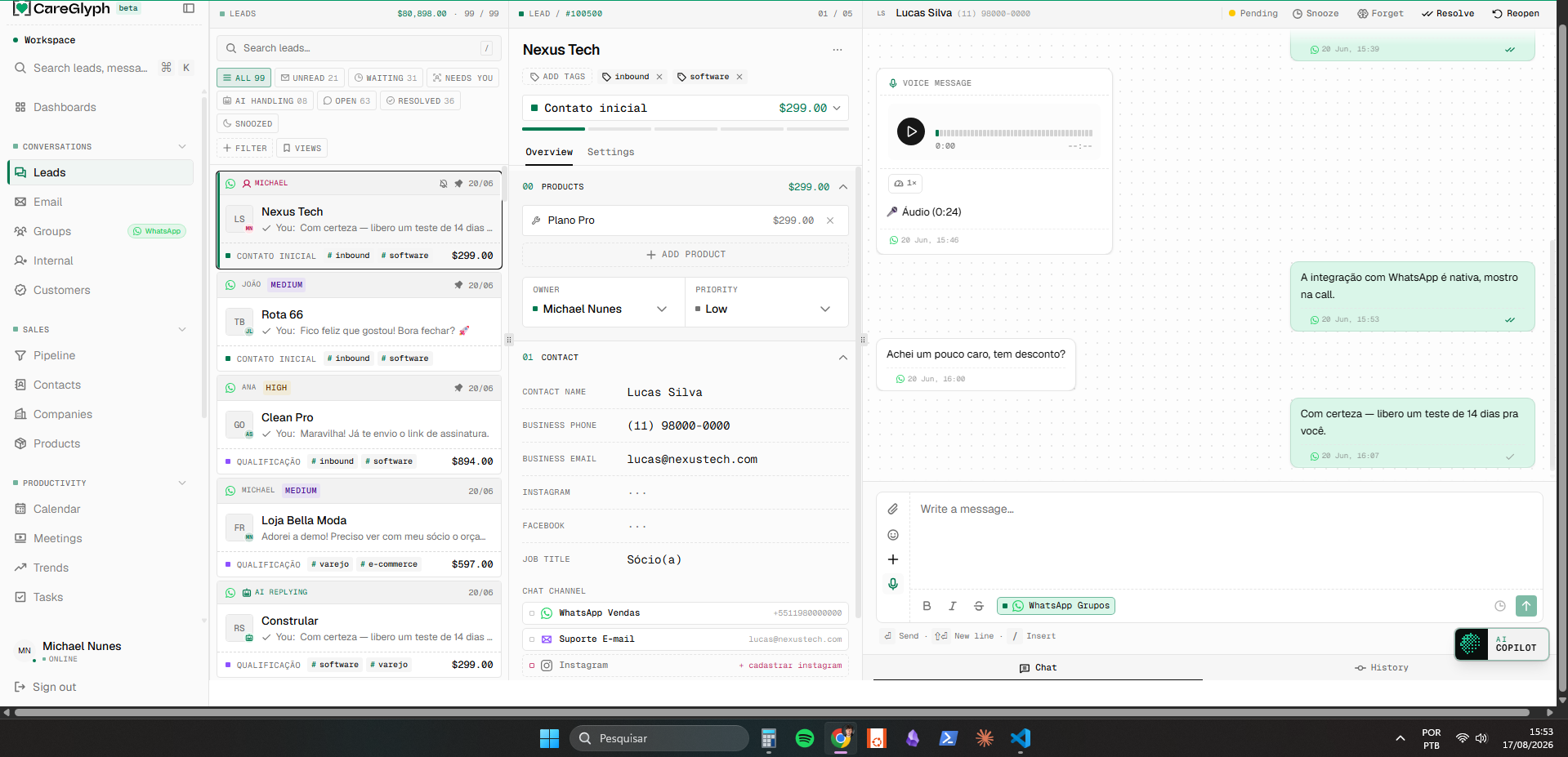
Conversations across every channel. A single inbox for WhatsApp (official Meta Cloud API and an alternative QR-code channel), Gmail and SMS. Media, voice notes, replies, forwards, scheduled messages, snooze, read receipts, group administration, message templates, product catalogs and interactive WhatsApp forms.
AI that actually works the conversation. An AI attendant answers customers autonomously, grounded in the company's own knowledge base and the full thread. It deliberately stays silent when a reply would only add noise. It goes quiet the instant a human types. Every sensitive action it proposes waits for a human to approve or reject — and it learns from those corrections. Each agent runs with a persona, a tool allowlist, working hours and a hard spend cap.
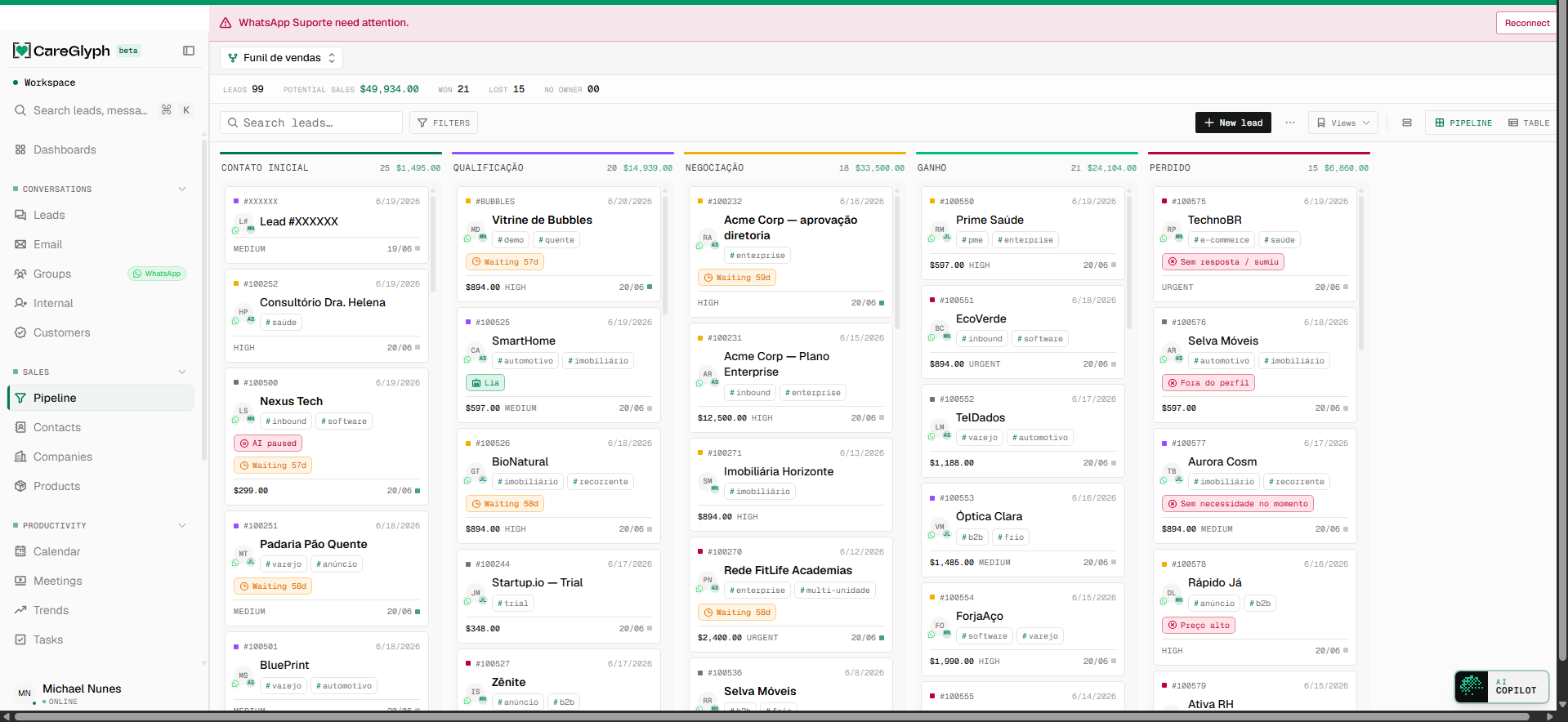
A sales pipeline built for actual selling. Drag-and-drop stages, loss reasons captured on the way out, custom fields, tags, saved filtered views, spreadsheet import that creates missing fields on the fly, duplicate detection and merge, bulk actions, and a buying-committee model so you know who the decision maker is.
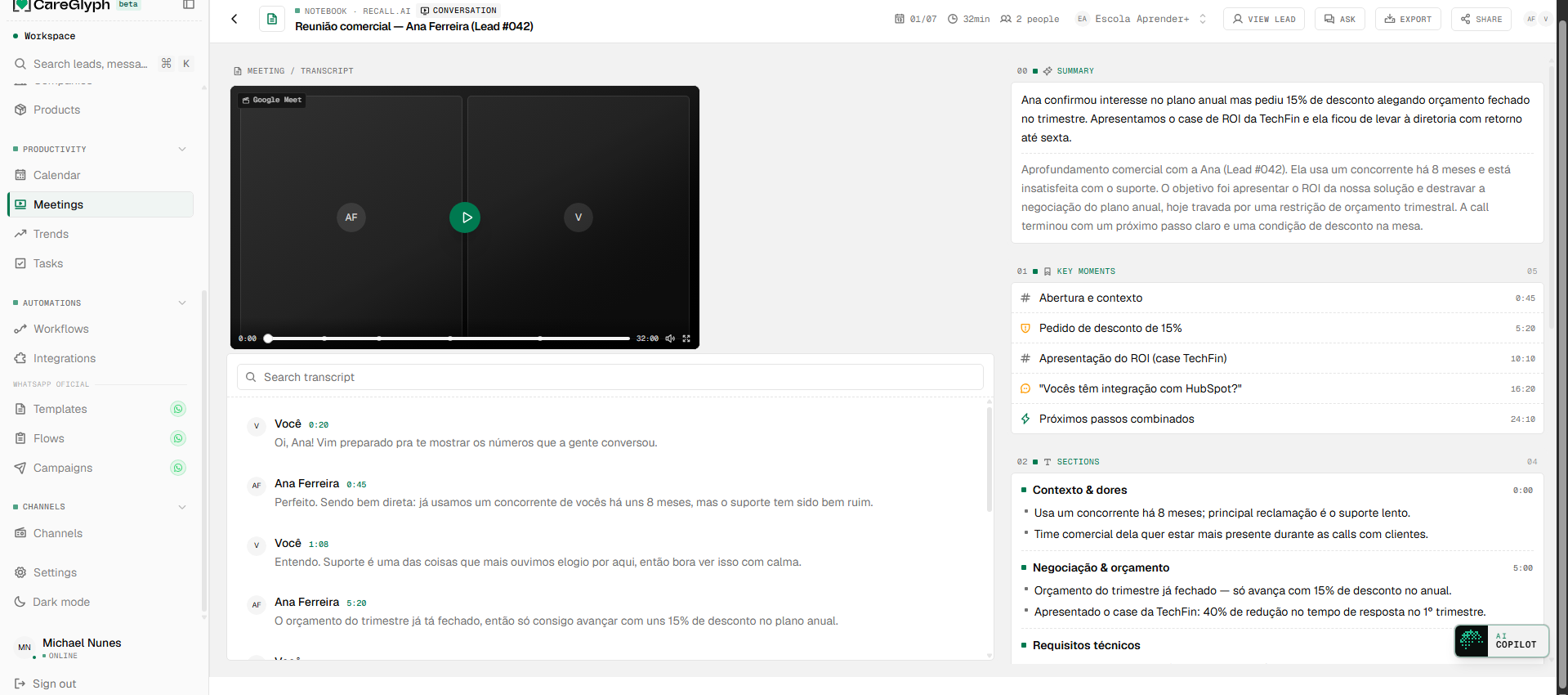
Meetings that take their own notes. An assistant auto-detects calendar events with a video link, joins, records, transcribes, writes the summary, topics and action items, shows conversation dynamics, and answers questions about what was said — grounded only in that recording.
Automations a non-developer can build. A visual builder with 12 triggers and 19 actions: move stages, edit fields, create tasks, send WhatsApp/SMS/email, call external systems, drop an AI agent into the flow, hand off to a human and back. Plus branching, waits, wait-for-event with a timeout, and loops over matched leads. Test a single step, dry-run the whole thing on one lead, publish, and replay failed runs from the point they broke.
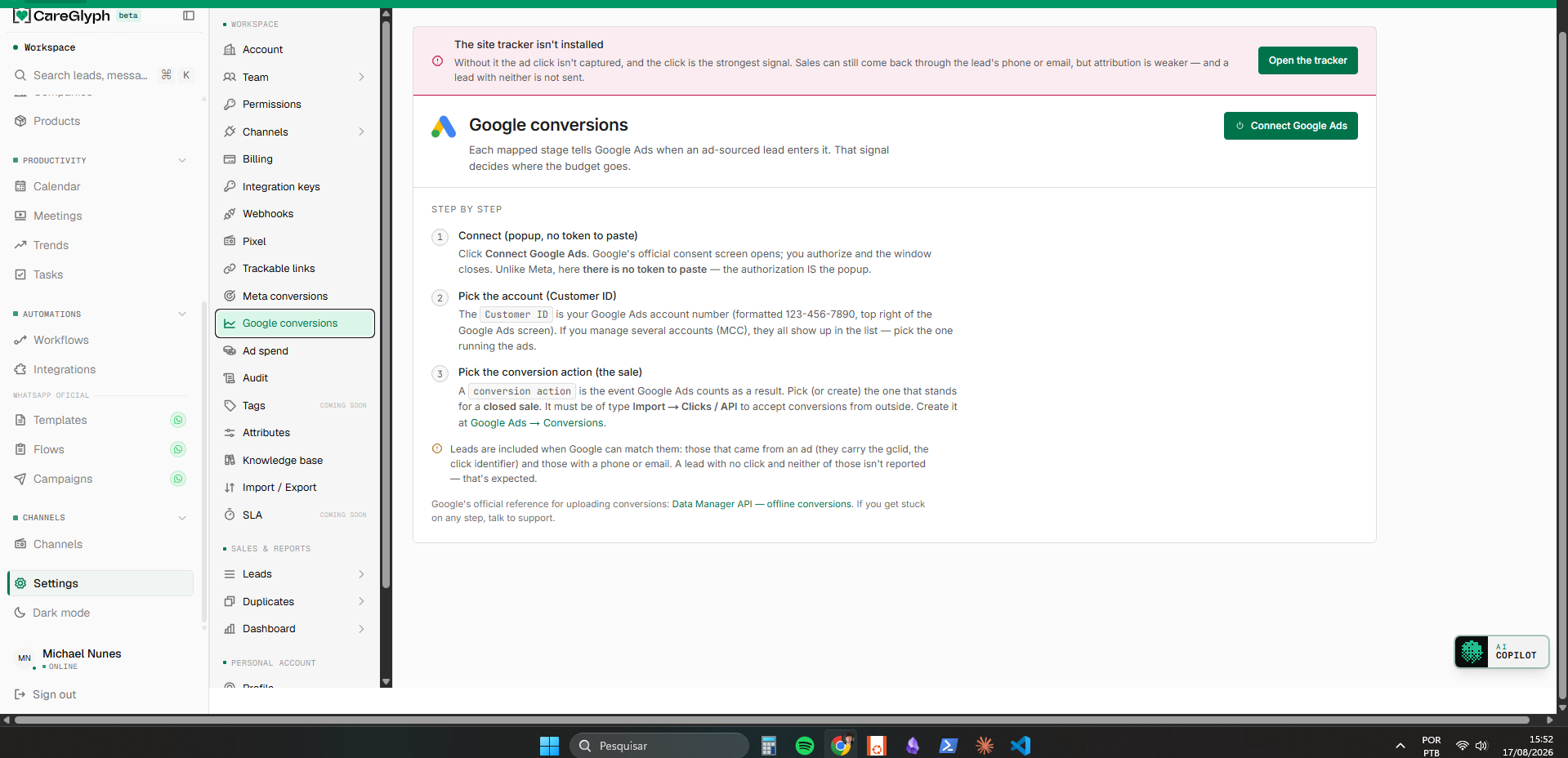
Closed-loop ad attribution — the wedge. A site pixel and trackable WhatsApp links stitch the anonymous first click to the closed deal. Four attribution models you can switch between and watch the credit move. Real conversions pushed back server-side to Meta and Google Ads, so the platforms optimize on sales instead of clicks. Google Ads spend syncs itself daily. Tools that do only this charge around R$197/month in Brazil.
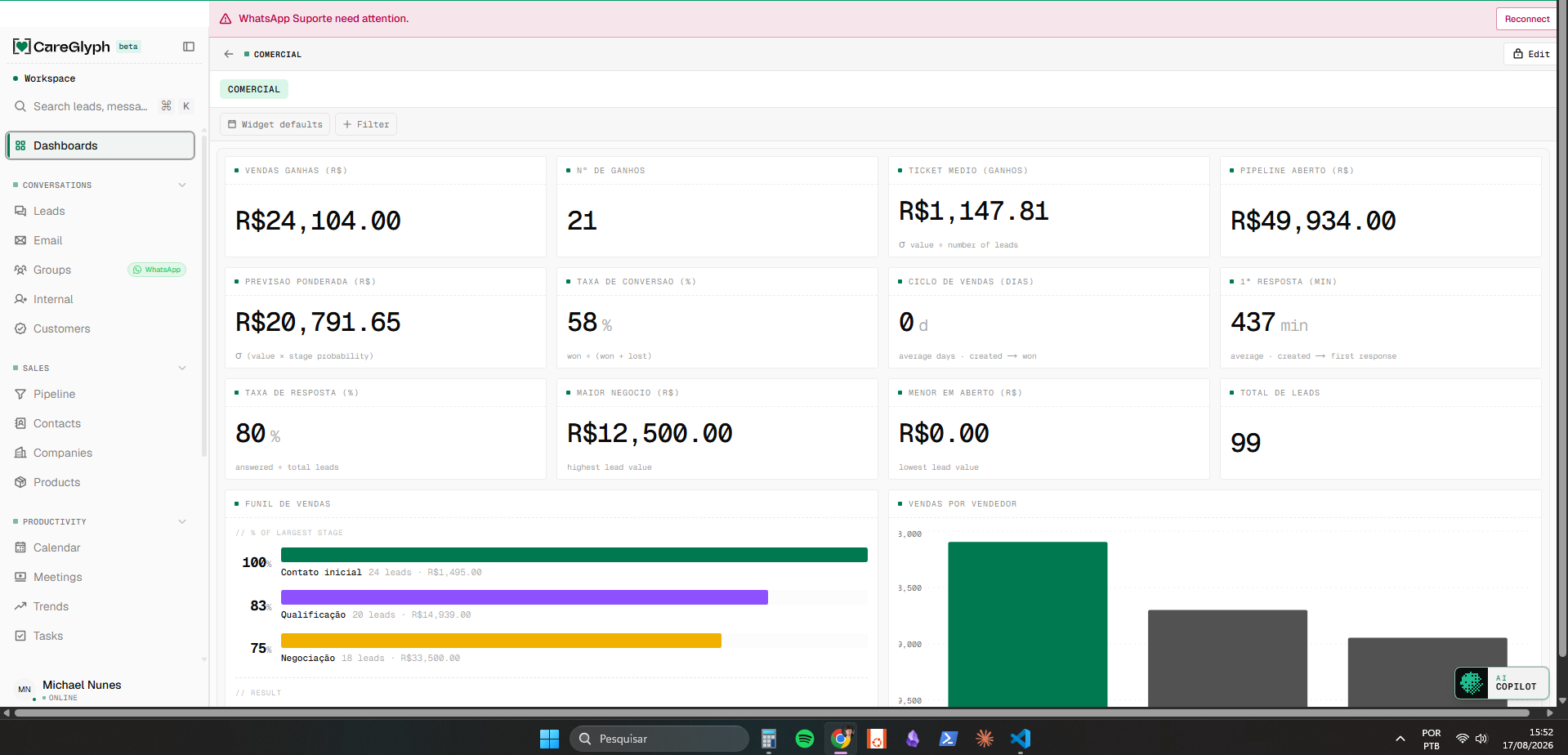
Dashboards you assemble yourself. Drag-and-drop blocks, seven ready-made templates, cross-tabs, period comparison, and click-through from any chart slice into the filtered lead list.
Plus tasks, calendar with two-way Google sync, contacts and companies, teams with custom roles and granular permissions, 2FA, audit log, billing, an API with interactive docs, webhooks, and consent-gated access for external AI tools.
How I built it
Solo, with AI as the implementer. Claude Code wrote the codebase; my job was specification, architecture and review. 1,080+ commits, all inside the hackathon window — first commit June 8, 2026.
The stack runs on a single VPS: Next.js and TypeScript, Postgres, a WhatsApp gateway and a workflow engine, with encrypted off-host backups to Cloudflare R2. Total fixed infrastructure is under US$20/month.
The AI layer is a model catalog: every agent role is bound to a model by configuration, not by code. Gemini 3.7 Flash, through the Gemini API on Google Cloud, is wired into three production paths — conversation title generation, agent memory compaction, and the post-conversation learning review that re-reads each AI-handled thread and decides what that workspace's agent should remember. Flash was chosen deliberately for that path: it is long-context, high-frequency and latency-sensitive, and implicit prefix caching is what makes re-reading entire conversations on every single one economically possible at all. Gemini 3.1 Pro and 3.7 Flash are also selectable for customer-facing automation agents via Vertex AI. Claude and GPT serve other agent roles through the same catalog. A note on honesty about volume: the beta is invite-gated with 0 users, so these Gemini paths have run on internal conversations only. Call volume in the attached observability dashboard reflects development and internal testing, not customer traffic.
Other Google platform integrations: OAuth sign-in, two-way Calendar sync, and the Google Ads + Data Manager APIs for spend sync and server-side conversion upload.
Challenges I ran into
Teaching an AI when not to speak. The first version of the attendant answered everything. That is worse than silence — customers can tell, and it burns trust in one message. Getting it to decide not to reply, and to yield the moment a human joins, took more iteration than getting it to reply well.
Autonomy without recklessness. An agent that can move deals and message customers needs a brake. The answer was the proposal/approval gate: sensitive actions are proposed and held. That turned out to be a feature, not a compromise — the approval rate is the trust signal, and the rejections are the training data.
Attribution is genuinely hard. Stitching an anonymous first click to a WhatsApp conversation to a closed deal, across four attribution models, then emitting that back to two ad platforms server-side, was the single hardest subsystem in the product.
Cost control as a product surface. LLM cost per conversation can quietly destroy the unit economics of a low-price SMB product. Metering every call, capping spend per agent, and routing cheap models to high-volume paths had to be built in, not retrofitted.
Being one person. Mitigated structurally: a deep automated test suite (unit, integration, live end-to-end) and infrastructure-as-code deploys, so operations do not live in my head.
Accomplishments that I'm proud of
The scope, honestly — one person shipped an omnichannel inbox, an autonomous WhatsApp agent with human-approval gates, a meeting agent, a visual automation engine, multi-touch attribution with conversion feedback to two ad platforms, a dashboard builder, and live metered billing, inside the hackathon window.
But the thing I am actually proud of is the audit I ran on the product before submitting: I went feature by feature and only counted something as shipped if there was server code that truly reads or writes the database and a screen a user can reach. Everything that failed either test — demo screens, orphaned components, declared-but-not-calculated metrics — I documented in a "what did not make it" list rather than counting it. That list is uncomfortable to write and it is the reason I trust the rest of the claims here.
What I learned
That the marginal cost of building an AI-native product has collapsed. Total spend for this entire period was US$116 — US$100 of AI developer tooling and US$16 of hosting. Model inference fit inside free tiers.
And the commercial lesson underneath it: if one person can build and operate something this size, then the low-price high-volume SMB model finally works — because that model has never died on software cost, it dies on service cost. That is not just how CareGlyph was built. It is the thesis being sold to the customer.
What's next for CareGlyph
Revenue during the hackathon period was $0 and there are 0 paying customers. The beta is invite-gated, and claiming product-market fit right now would be dishonest — what exists is a complete product with billing live, not validated demand.
So the next phase is not more building. It is: open the invite-gated beta to paying design partners, run the AI attendant on real live traffic, and publish the before/after numbers — each business against its own 30 days prior, reported as a distribution rather than a best case. Engineering shifts from breadth to reliability: channel uptime, inference cost per account, observability.
If design partners run it on live traffic and still do not convert to paid, the hypothesis is wrong, and the honest read is that this market wants an agency, not software. I would rather find that out with a shipped product than with a pitch deck.
Built With
- amazon-bedrock
- anthropic-claude
- cloudflare-r2
- deepgram
- gemini-api
- google-ads-api
- google-calendar-api
- google-cloud
- google-gemini
- next.js
- node.js
- openai
- postgresql
- react
- stripe
- typescript
- vertex-ai
- whatsapp-api

Log in or sign up for Devpost to join the conversation.