Inspiration
We built this with Joe.
Joe is 60. He's a lawyer (Columbia Law) and a physicist (UPenn). He has lived with a progressive neuromuscular condition since he was 20, and he survived the 1993 World Trade Center bombing. He is now fully quadriplegic and can barely speak. He needs live-in caregivers seven days a week to live safely at home.
Care agencies failed him too many times. New people showed up without the right training. They didn't know his routines. They upcharged him 40%. They didn't know how he communicates. For Joe, hiring caregivers himself isn't optional - it's how he stays safe and independent.
Before this, Joe was tracking applicants from Craigslist and Facebook, and most of the process lived in his head. We sat with him and built the tool he actually needed.
And it turns out the problem Joe faces is the same problem faced by millions of people with disabilities (quadriplegics, people who can't use their hands, people living with ALS, MS, TBI, or spinal cord injuries) and the families who manage their care. The hiring process is broken everywhere: applicants flood in from email, Craigslist, Facebook, and job boards, with no real system to manage them, dedupe them, or screen them against complex, high-dependency care needs.
What it does
CareFind AI is an AI-powered hiring platform built for people with disabilities and the families managing their care.
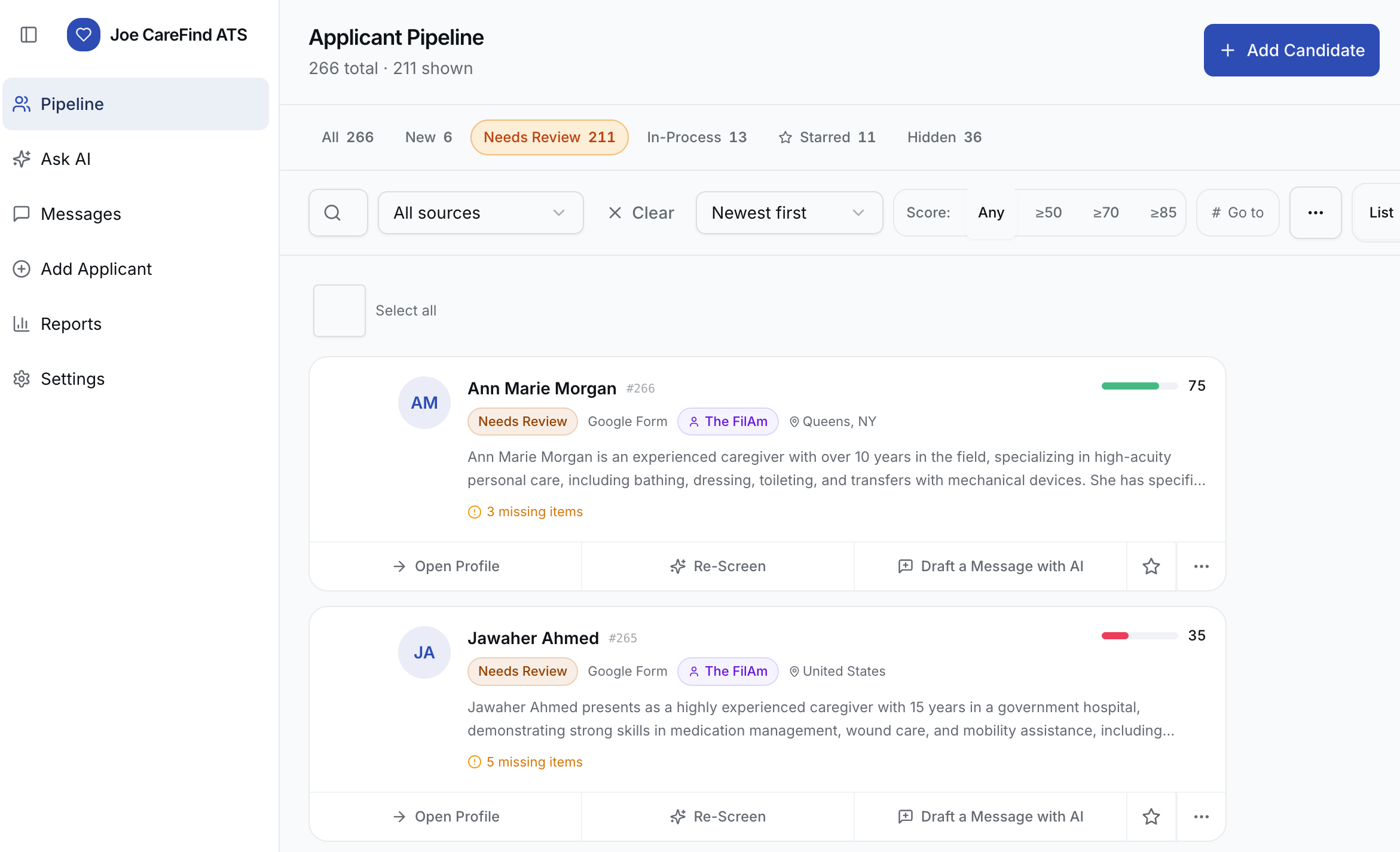
It automatically pulls caregiver applicants in from every source (email, web forms, ads, and job boards) into a single pipeline. Then AI does the heavy lifting:
- Smart intake: parses free-form applications and emails to automatically extract availability, certifications, and care experience.
- AI screening: scores every candidate against a configurable, disability-specific care rubric (non-verbal communication, repositioning, comfort with high-dependency care) surfacing the people who can actually do the job.
- Intelligent deduplication: recognizes when "Maria G." and "Maria Garcia" are the same person across sources, even with missing or mismatched data.
- One pipeline: New → Screened → Interview → Trial → Hired, with every candidate's notes, status, and message history in one record.
Because the people relying on it often can't use a keyboard, and the assistants helping them change often, the product is designed to be obvious to use with zero training: exactly what Joe needed.
What AI does for you
CareFind AI isn't "AI-powered" as a buzzword. AI actually runs across the entire application, from the moment someone applies to the moment they're hired.
Intake
- Paste anything: a Care.com profile, a Facebook message, an email, or raw notes and AI fills out the candidate form for you.
- Inbound emails become candidate records automatically.
- Resumes and attachments are read and parsed on arrival.
- Junk and non-applicants are filtered out before they ever hit your pipeline.
Screening
- A 9-signal AI score on every candidate: experience, certifications, live-in fit, availability, location, communication, and more.
- One overall 0–100 fit score, with highlights and red flags called out automatically.
- Screening runs on its own — on every new application, every Gmail import, and every night for anyone missed.
- Type what you want to say and AI writes the full email.
- Reply drafting reads the whole thread and continues it naturally.
- Stage-change emails send themselves when a candidate advances.
Pipeline hygiene
- Duplicates are caught and merged across every intake path.
- Out-of-region candidates are bucketed automatically by location.
Ask AI
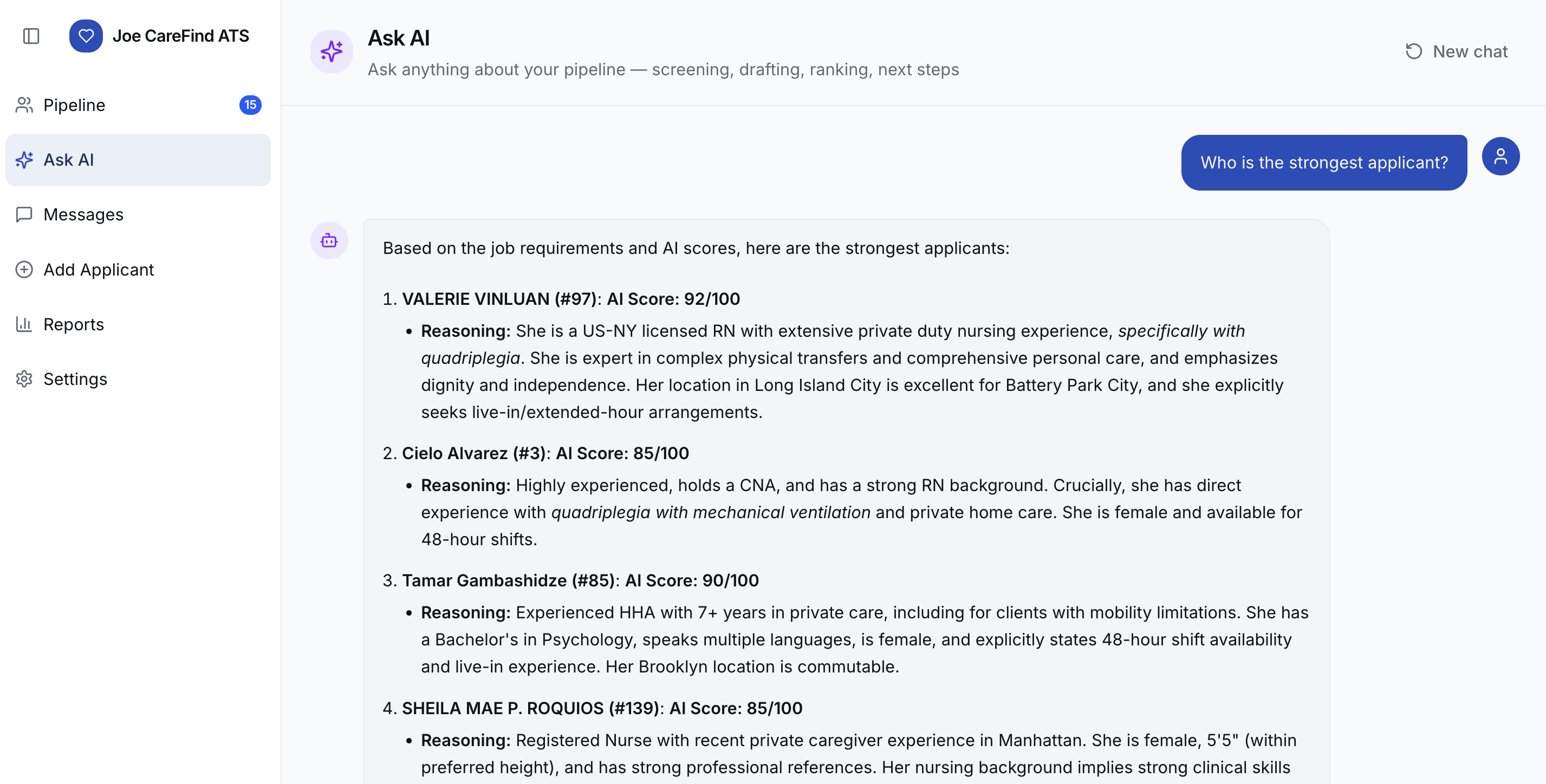
- Ask your pipeline anything in plain English.
- Get live answers drawn from every candidate, score, note, and email in your account.
- Fully multi-turn — follow-up questions just work.
How we built it
The backend runs on Python, FastAPI, and MySQL. The frontend is React, TypeScript, and TailwindCSS.
We connected the Gmail API with OAuth 2.0 so applicants flow in automatically, and used the Concentrate AI API with various AI models to read unstructured application text and score it against a care rubric. For deduplication, we built weighted fuzzy matching with rapidfuzz across names, emails, phone numbers, and message content.
The architecture is multi-tenant from the ground up. Each individual or family gets their own isolated pipeline, rubric, and data.
The market
In-home care is a $100B+ market in the US alone, growing fast as the population ages and as more people with disabilities choose to live independently at home. Millions of individuals and families self-manage this hiring — almost all with email, spreadsheets, and guesswork. Existing ATS products are built for corporate recruiting, not for disability care: messy multi-source inflow, role-specific screening, and non-technical operators under real pressure.
CareFind AI is purpose-built for this market, with disability-specific AI screening as the core differentiator.
Business model
CareFind AI is a SaaS platform. Individuals and families pay a simple monthly subscription. Down the line, disability-care agencies and case managers pay per-seat or per-active-pipeline pricing that scales with the number of clients they serve. AI screening and automated sourcing integrations form the premium tier.
Accomplishments that we're proud of
We took a problem that lived in one person's head and turned it into an AI system that scales. The hardest and most valuable part isn't the pipeline — it's everything between "someone applied" and "this person can safely care for Joe," and that's exactly where our AI screening adds value. We validated it with a real, high-stakes user before generalizing it into a platform.
What we learned
AI is most powerful when it's tied to a specific, structured definition of "good." Generic screening is noise; rubric-driven AI screening built around real disability-care needs — like Joe's — is the product. Assistive technology has to fit into the reality of care, not add dashboards and complexity.
What's next for CareFind AI
- Direct integrations with Care.com and Indeed so applicants flow in automatically.
- SMS and WhatsApp messaging built into every candidate record.
- Automated reference checks and trial-shift scheduling.
- Expansion across the full range of disability and high-dependency care — ALS, MS, TBI, spinal cord injury, and elder care — plus an agency- and case-manager-facing tier to capture the B2B side of the market.

Log in or sign up for Devpost to join the conversation.