-
-
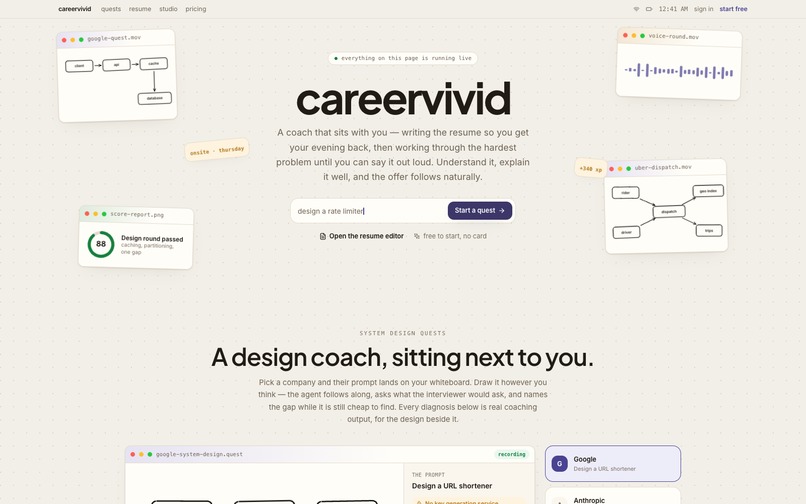
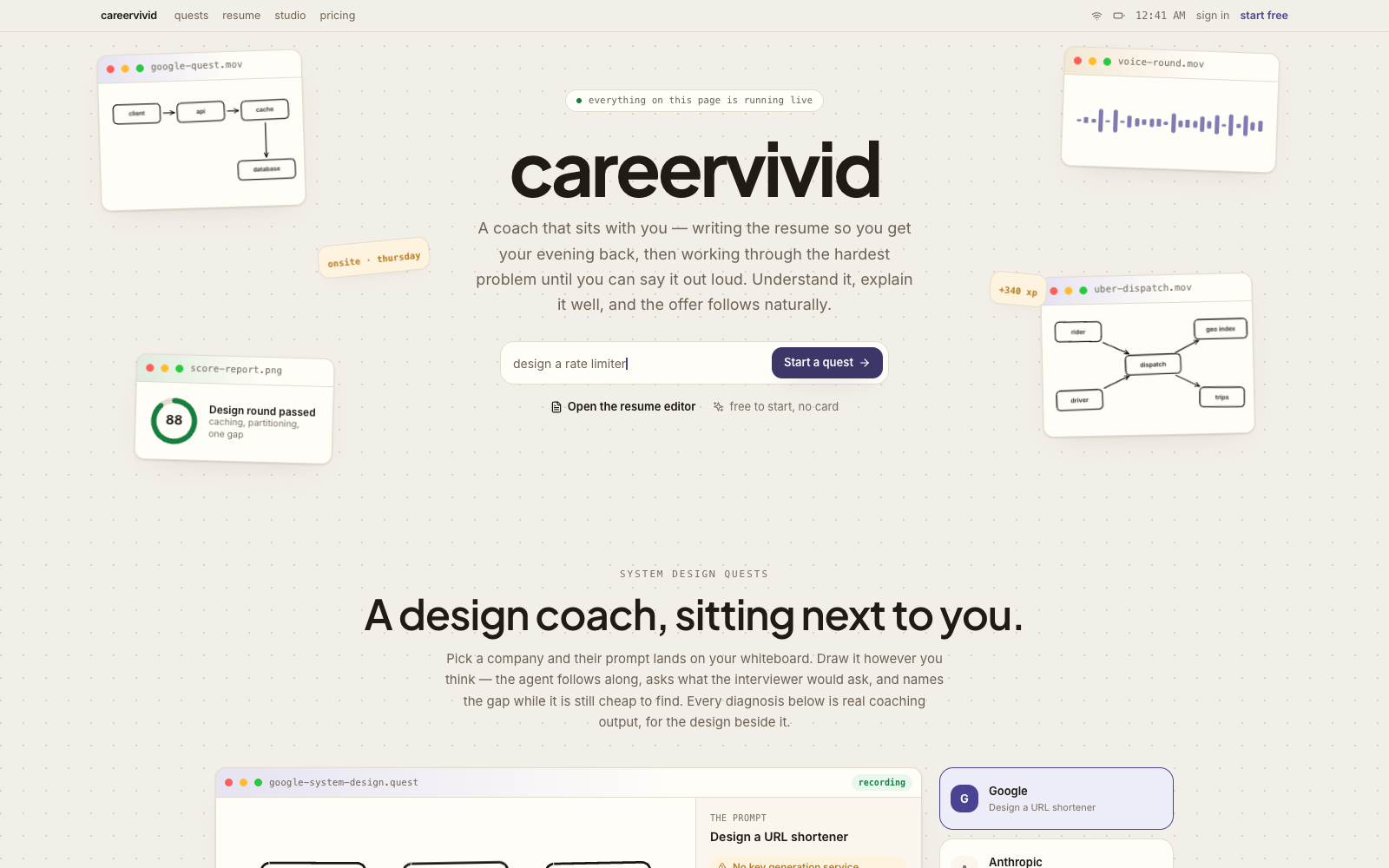
CareerVivid: rehearse the hiring loop — a round by voice or text, a graded whiteboard, a scored report.
-
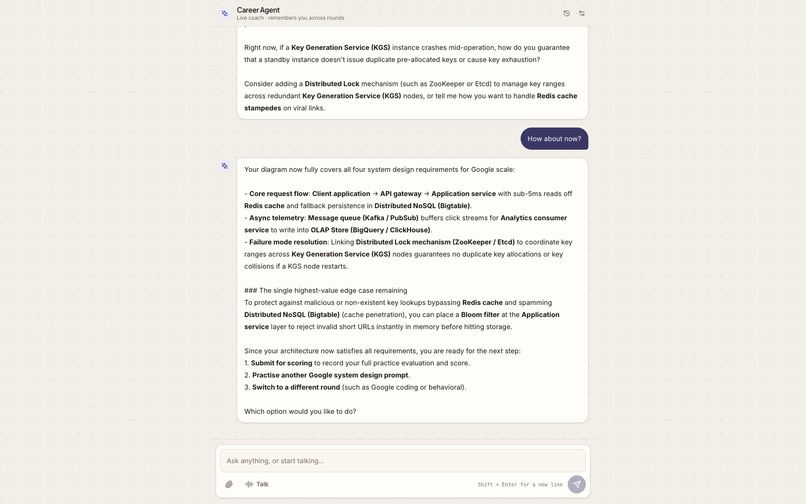
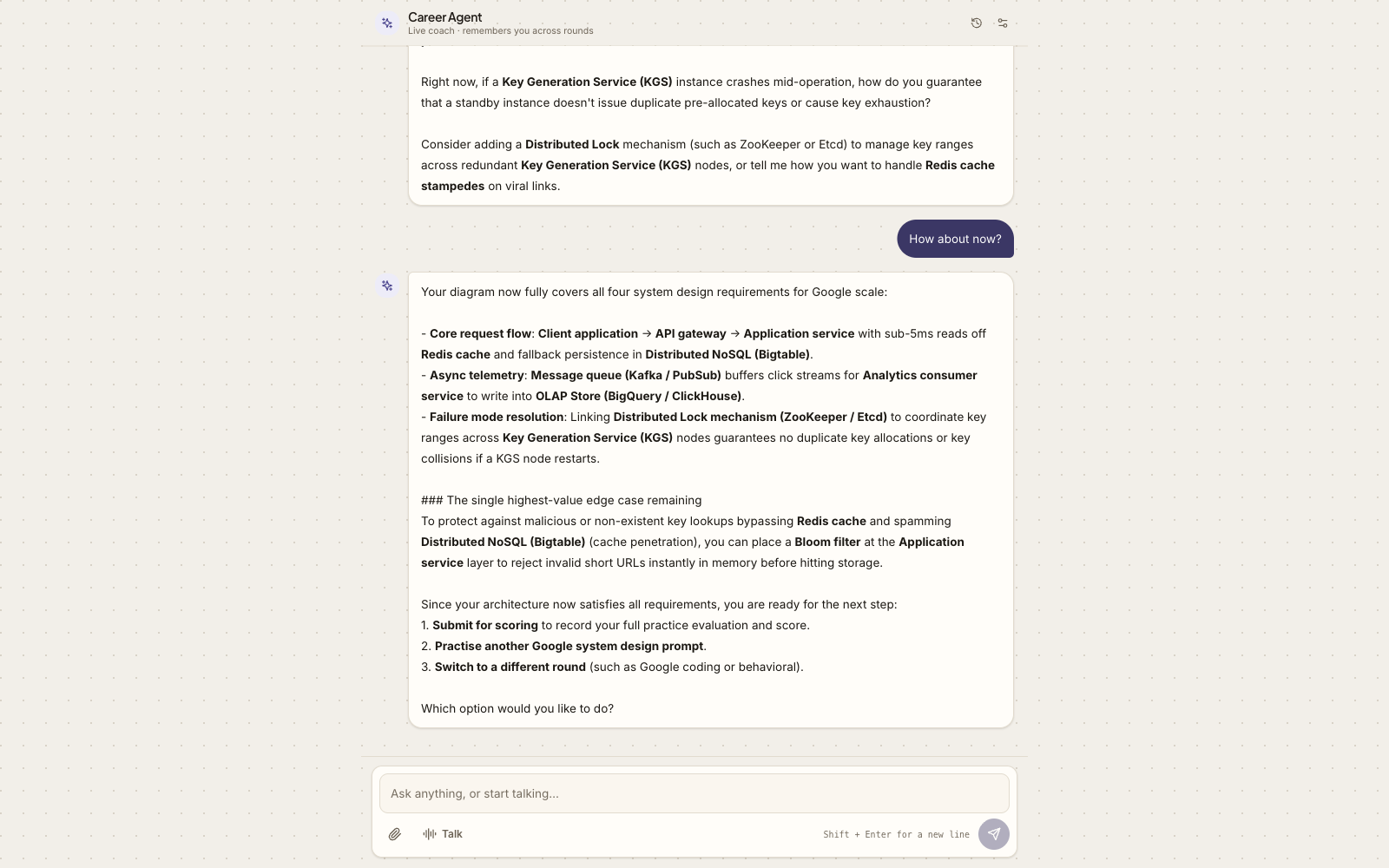
The Career Agent: 29 tools, up to 12 iterations a turn, and no write access without explicit approval.
-
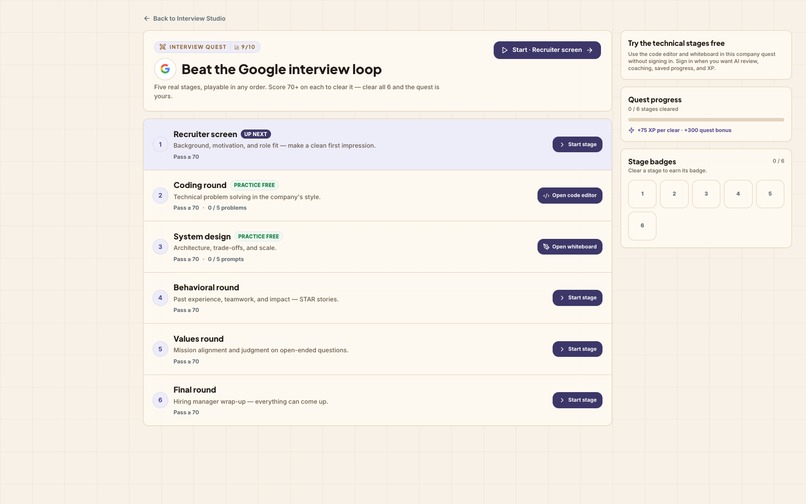
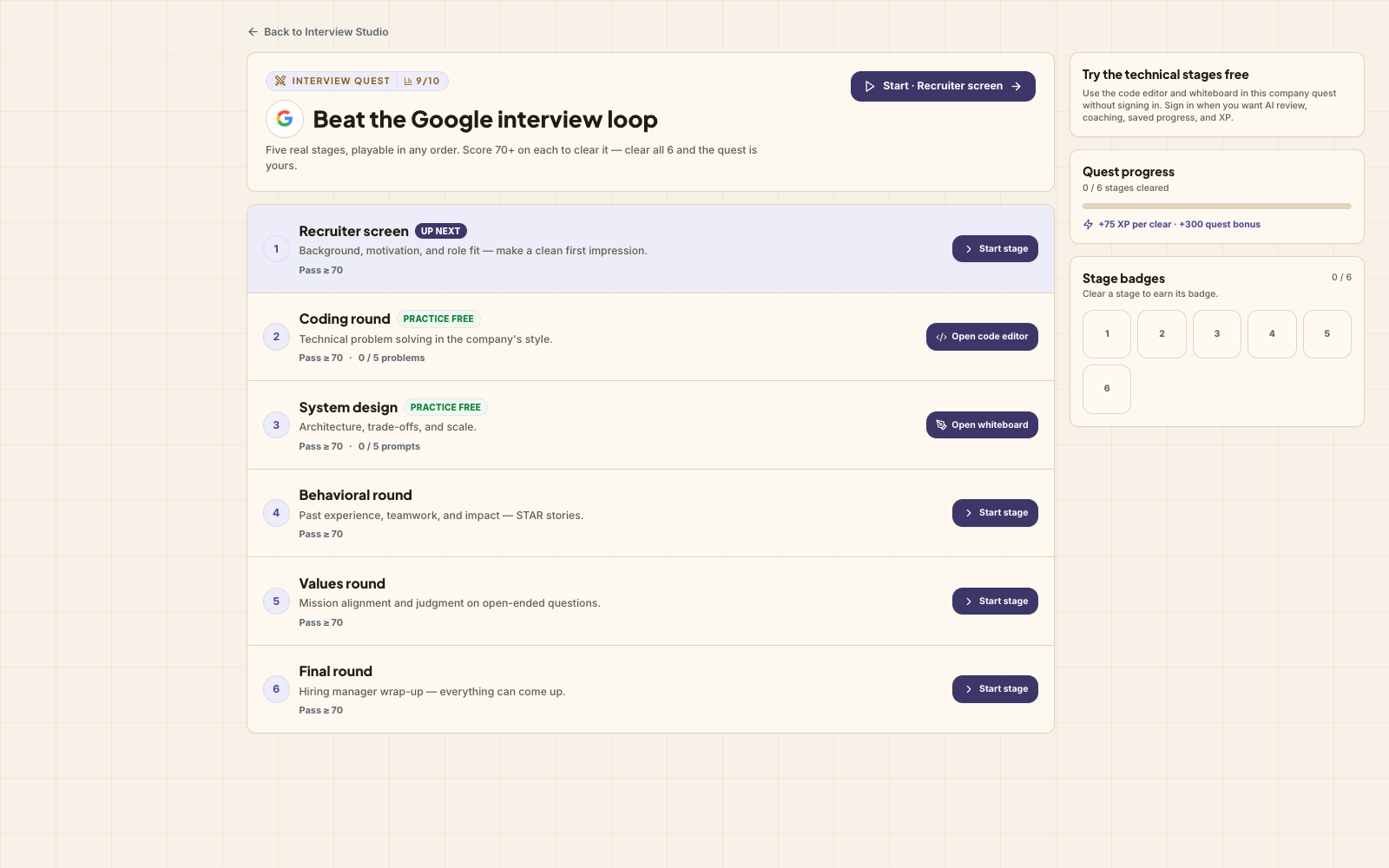
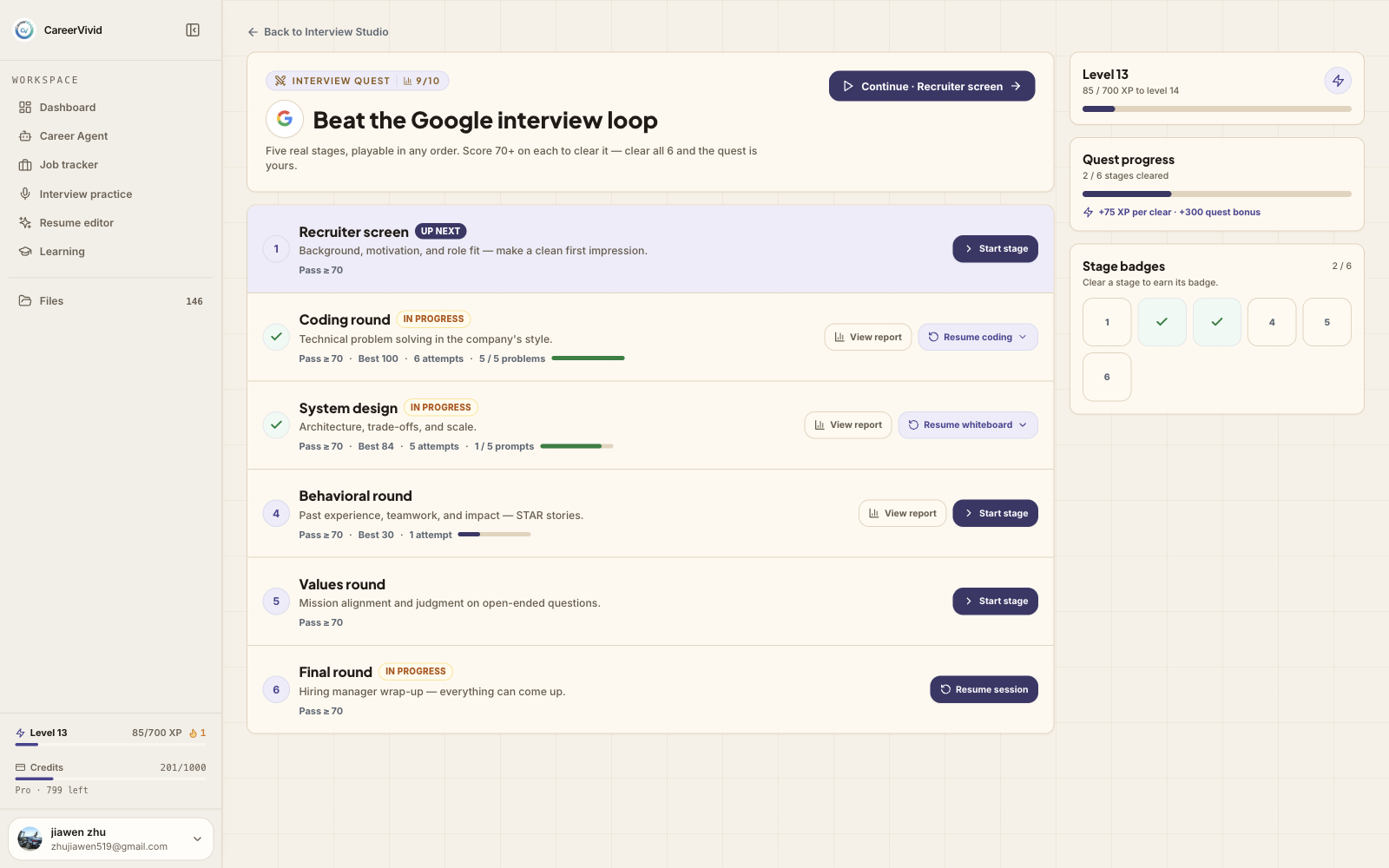
Google's interview ladder: six stages, each needing 70/100, built from documented questions.
-
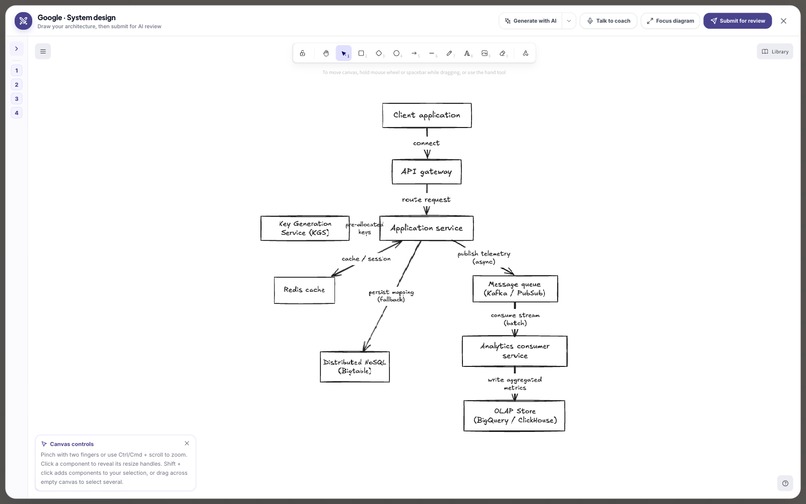
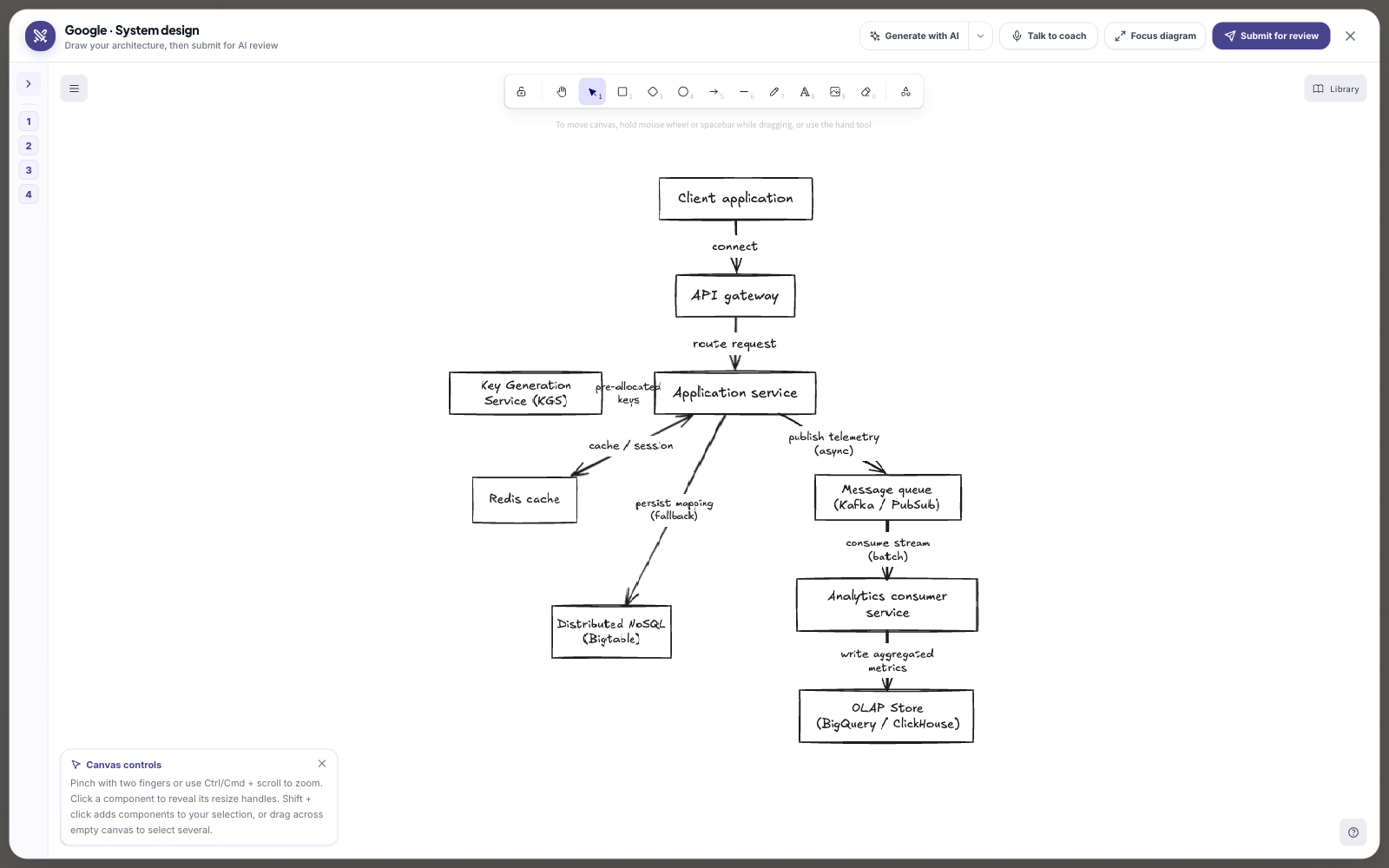
Diagrams go to Gemini with a numeric rubric and come back with a weighted score and named gaps.
-
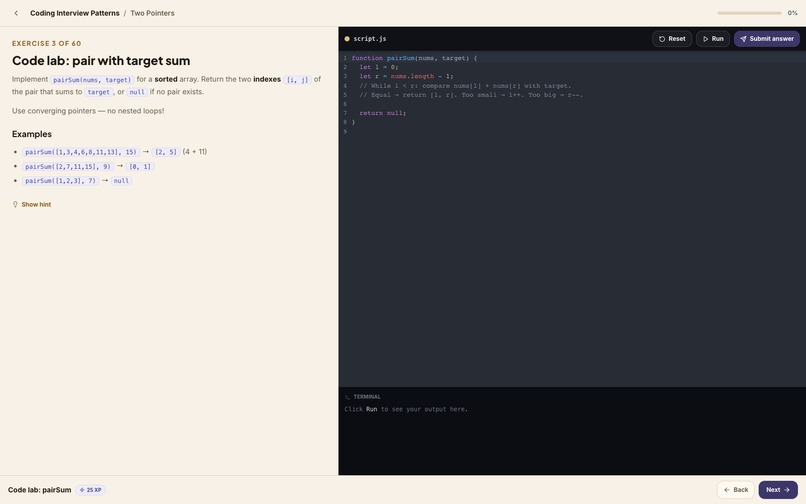
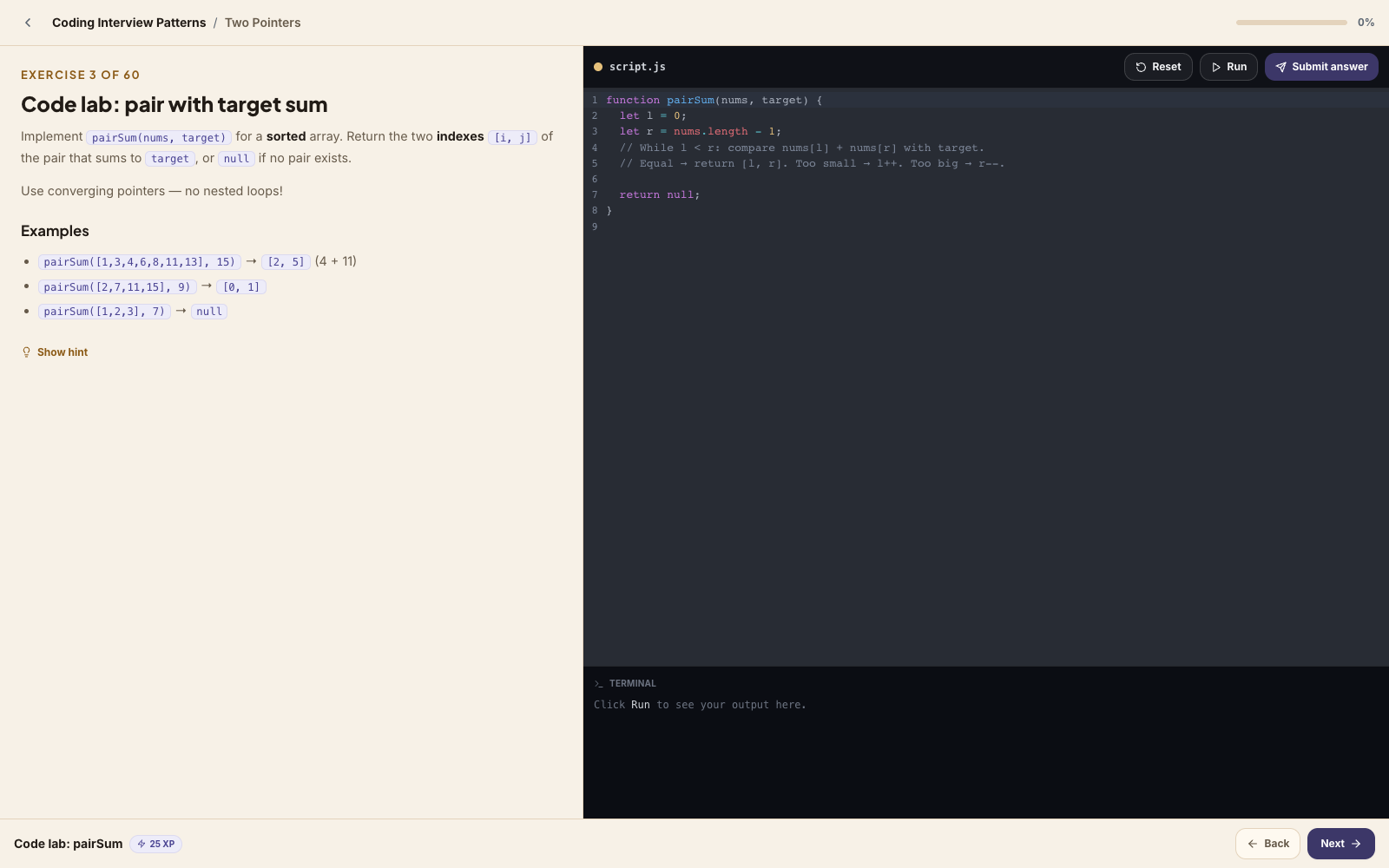
Coding lessons run Python in the browser via Pyodide. The pass rate is measured from the actual run.
-
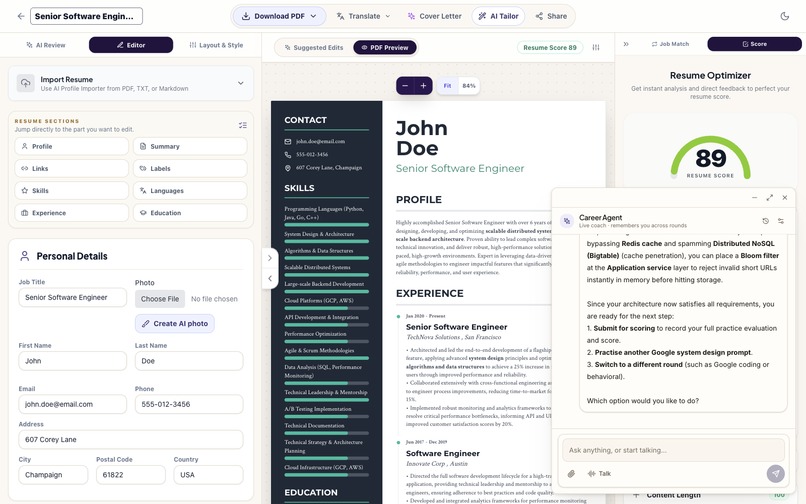
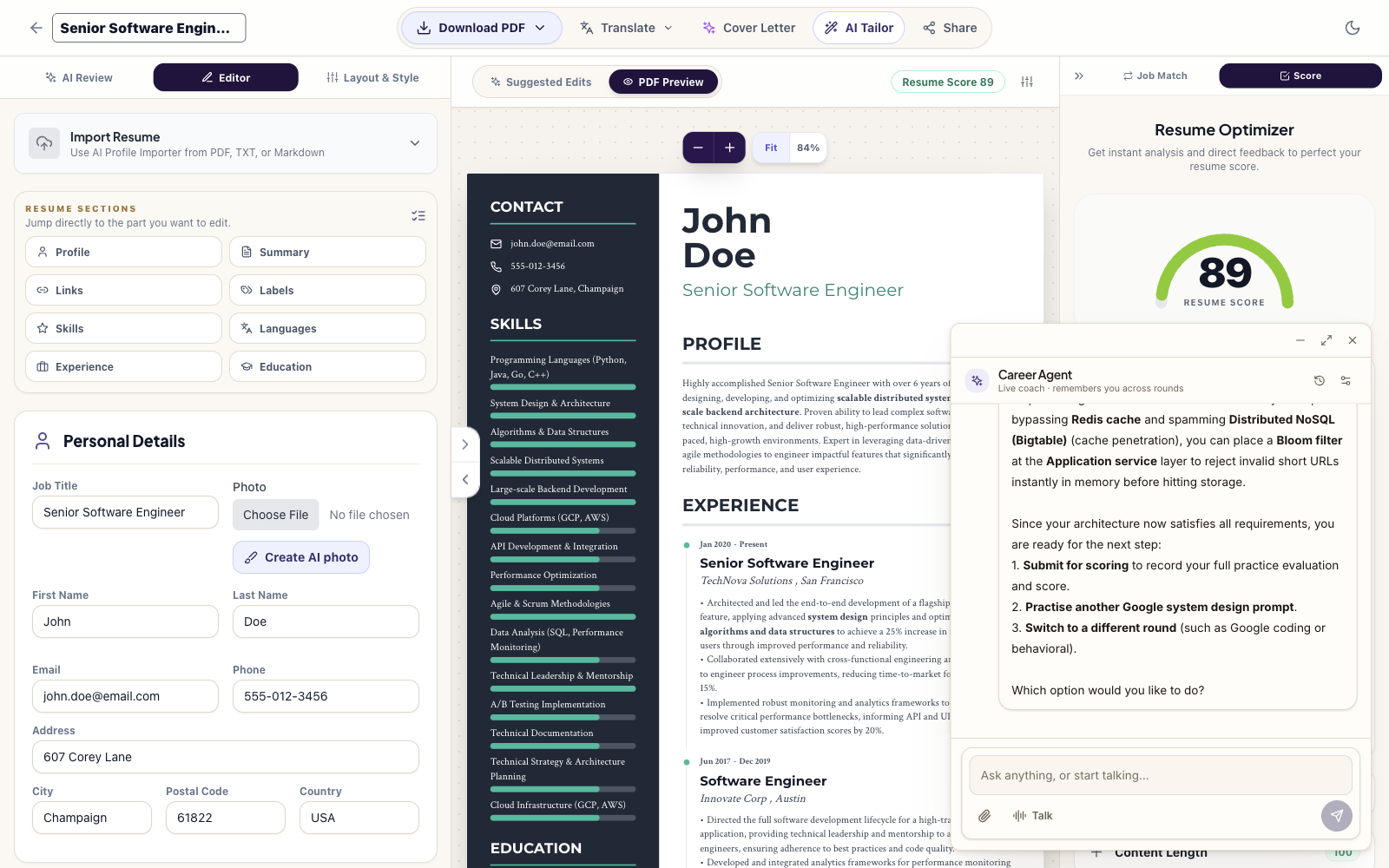
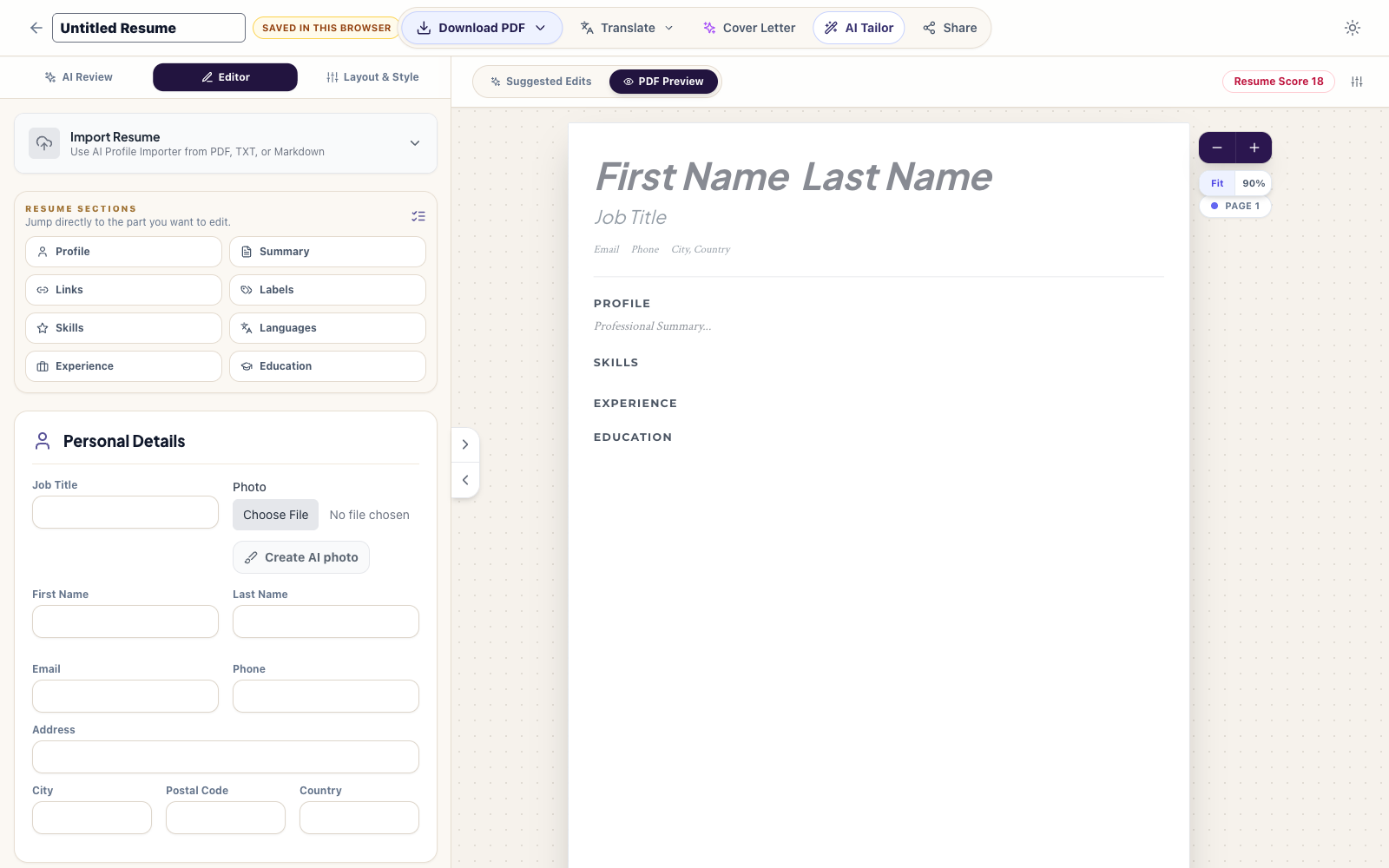
Resume editor: 36 templates, live PDF preview, AI tailoring, and a match score across four categories.
-
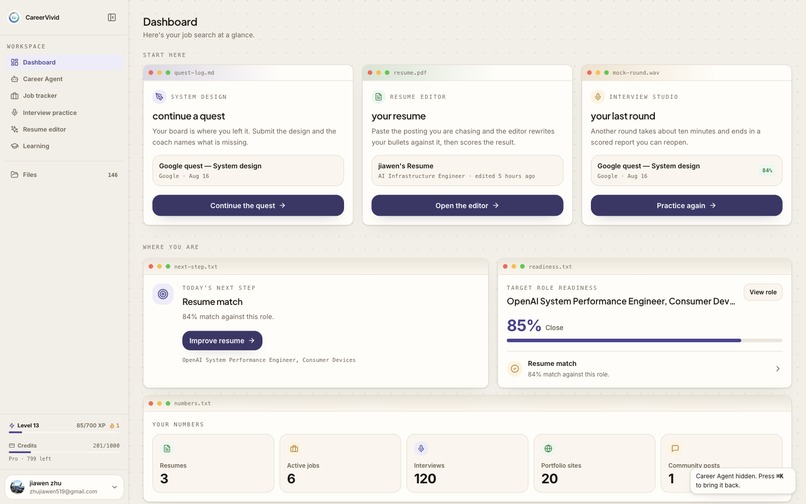
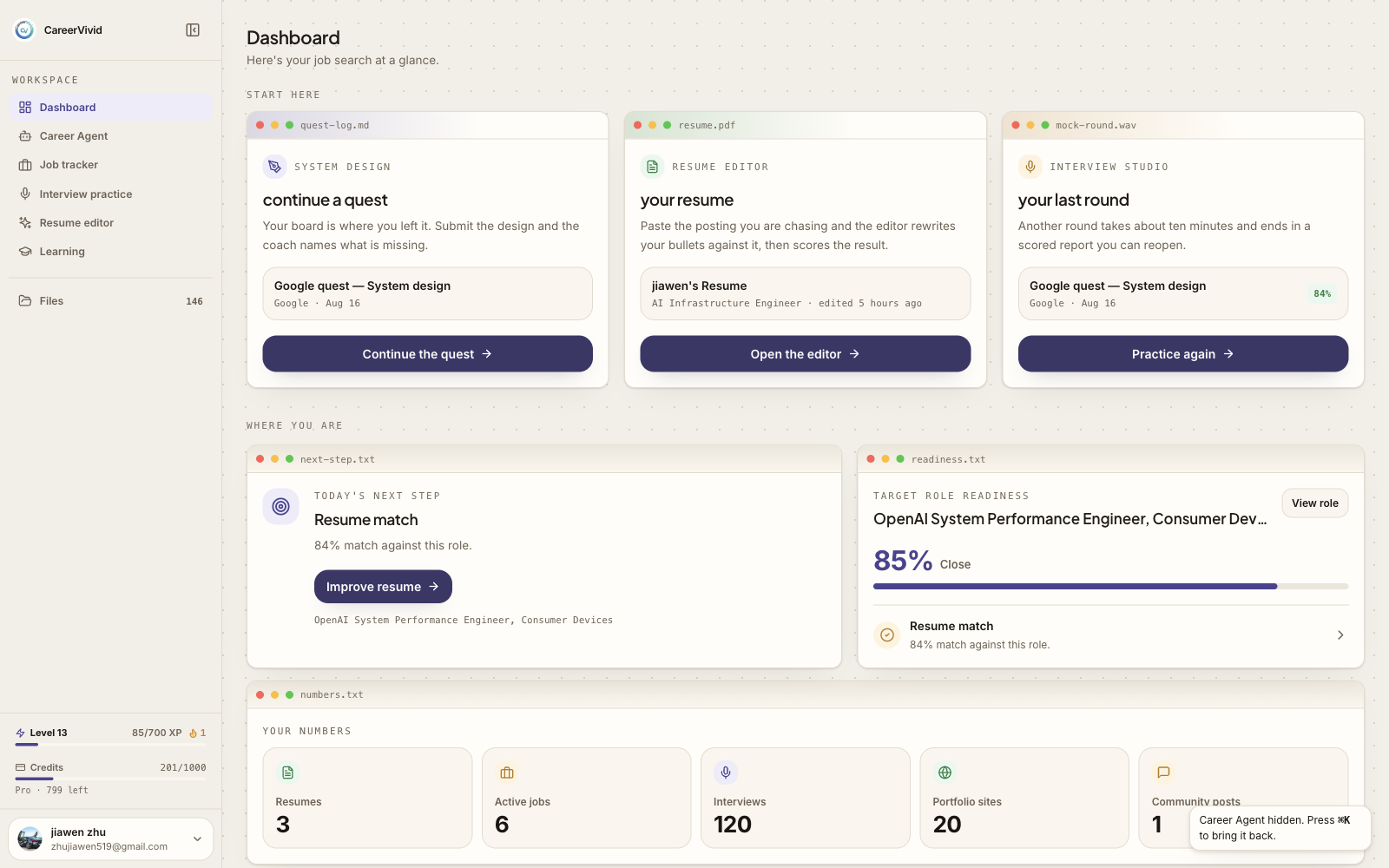
The dashboard: quest in progress, current resume, last scored round, and target-role readiness.
-
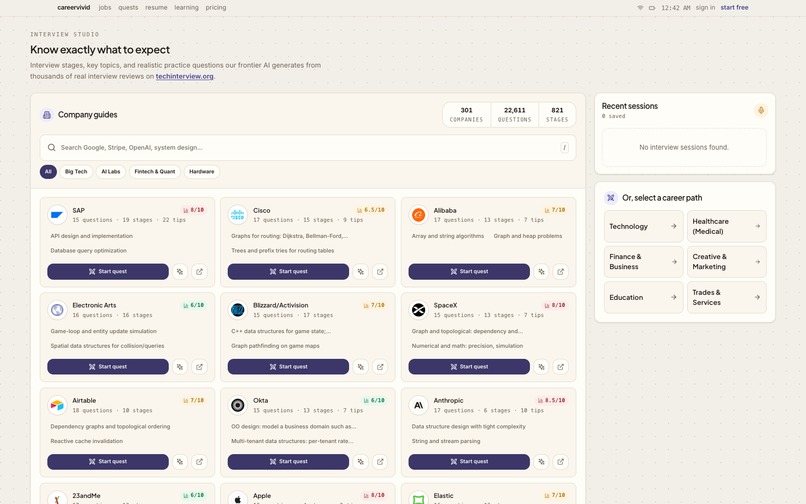
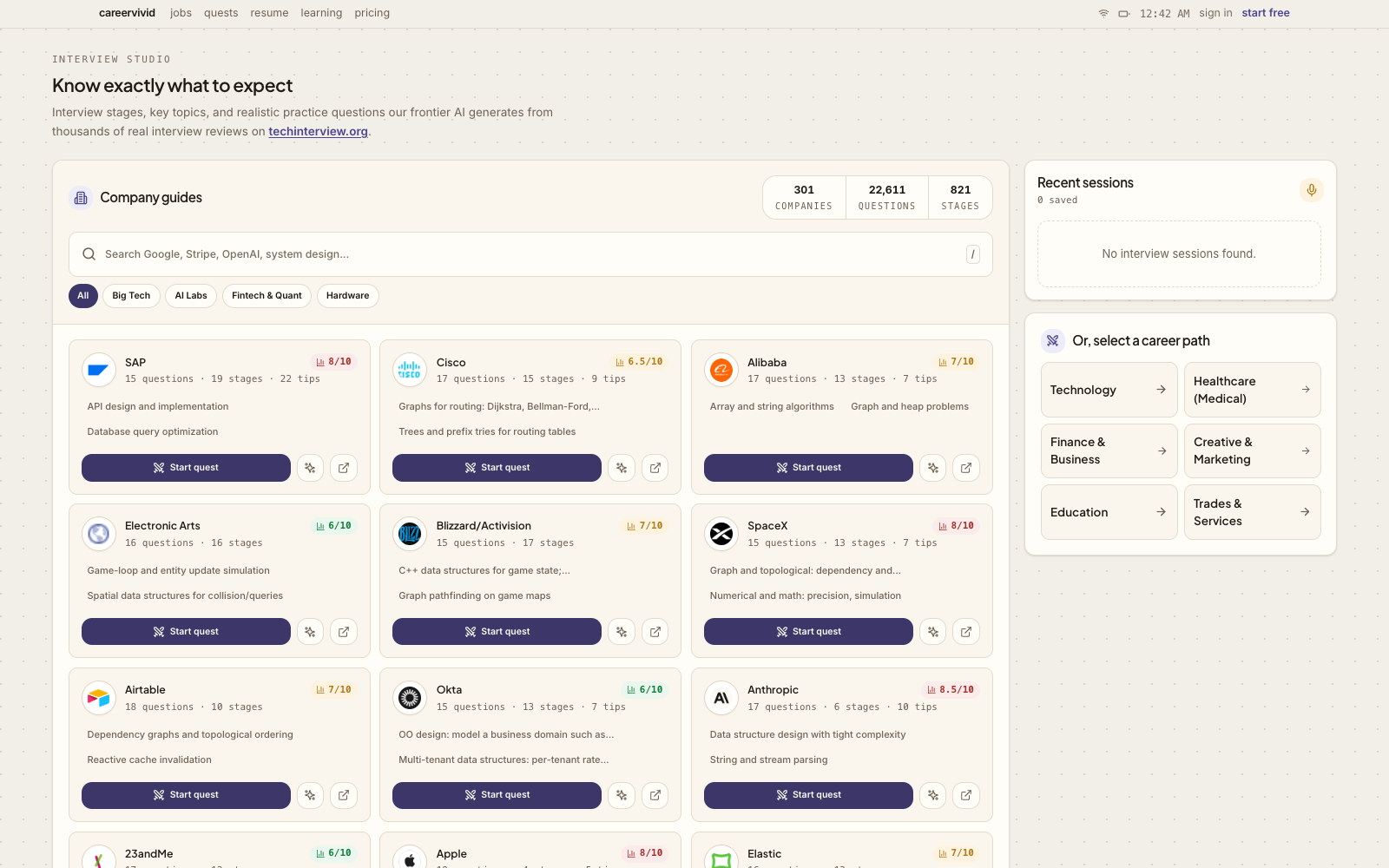
Interview Studio: 301 company guides, 22,611 questions, 821 stages — searchable without an account.
-
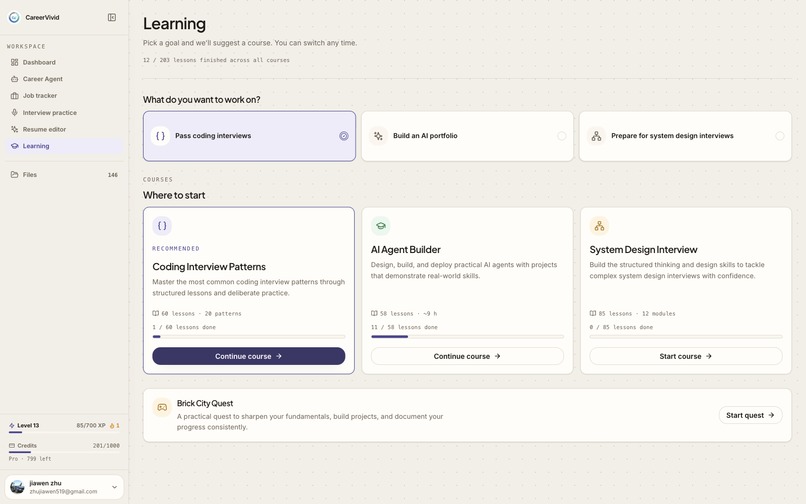
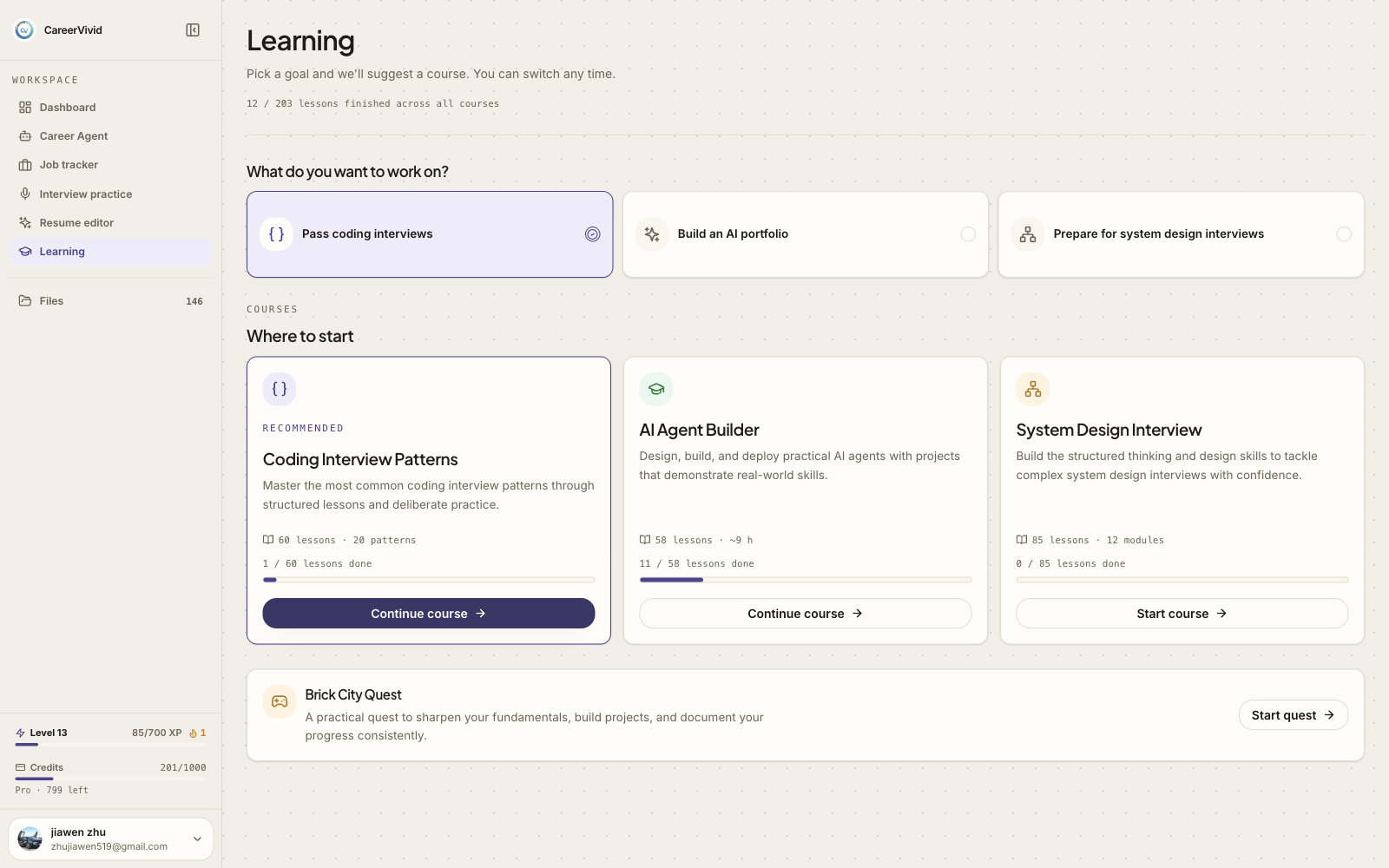
12 published courses, 56 chapters, 203 interactive lessons with saved progress.
-
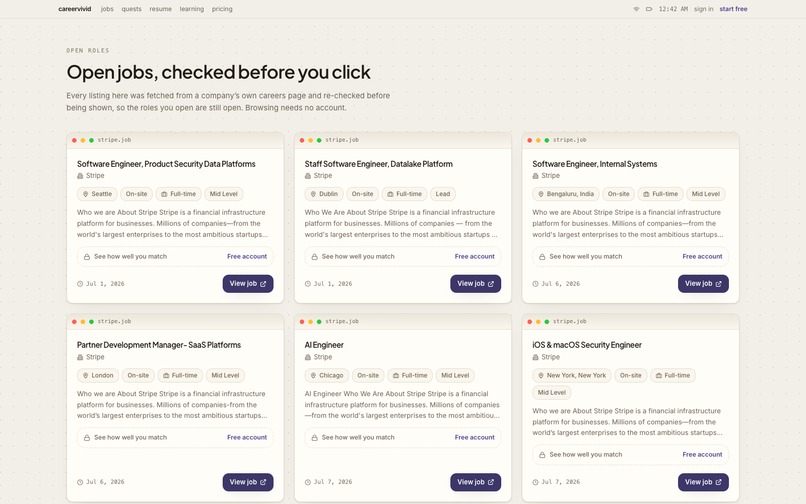
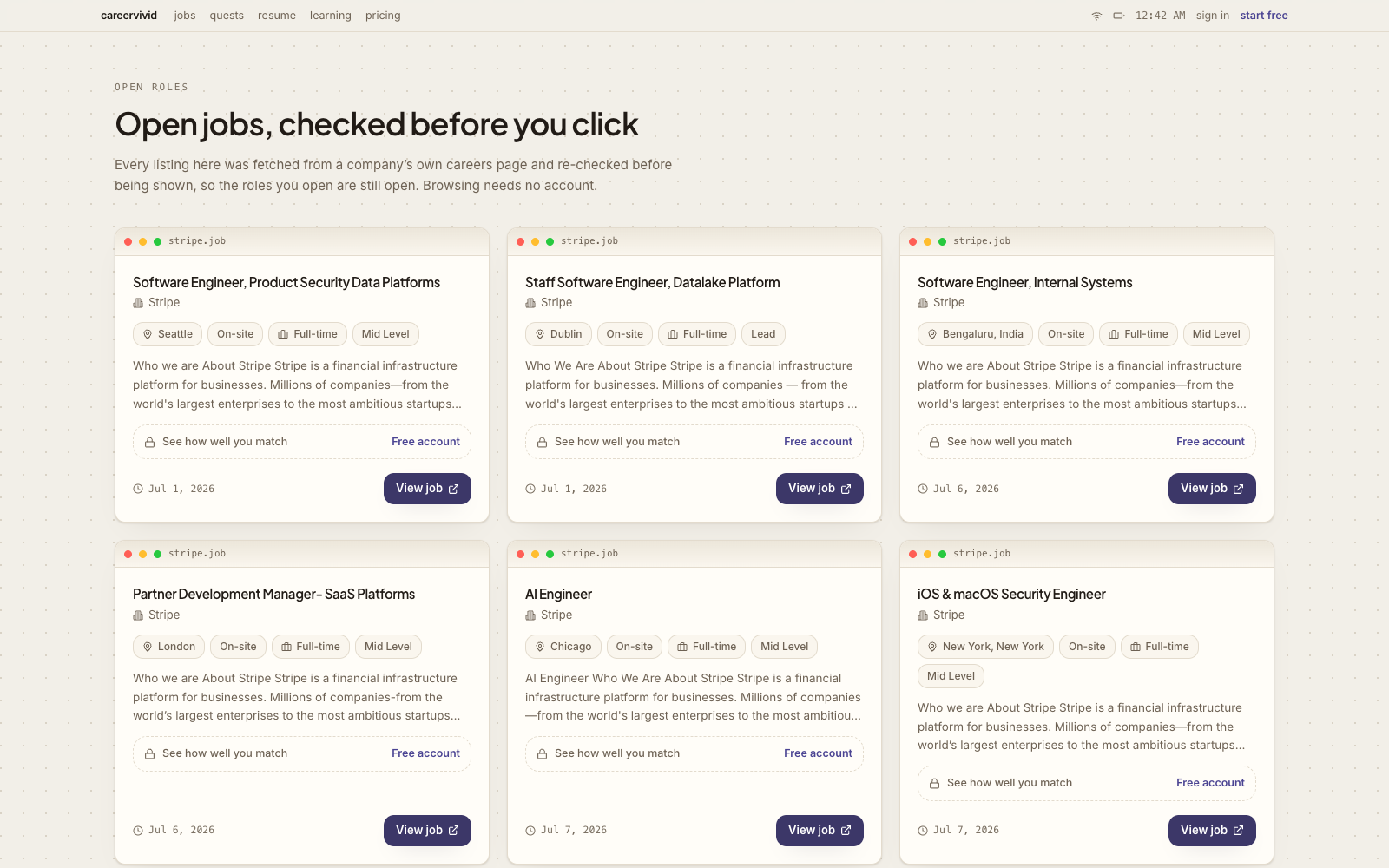
Live postings from 161 company ATS boards, re-checked to confirm the role is still open.
-
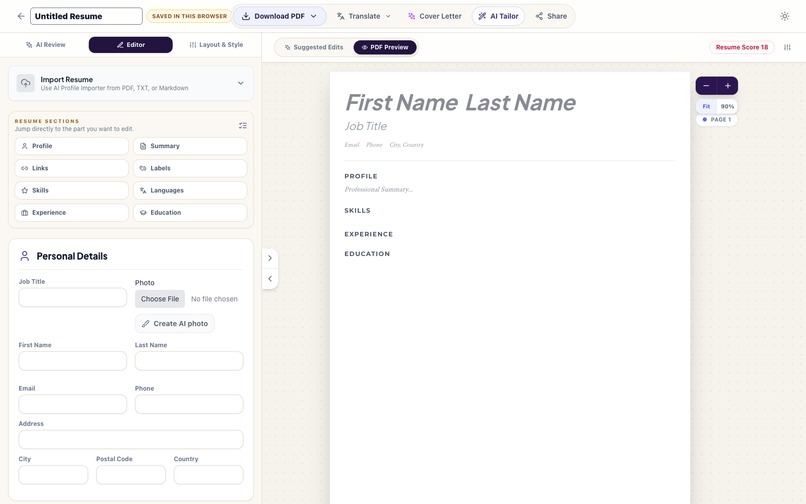
The resume editor is open to guests: 36 templates, exports to PDF, Google Docs or .docx, no login required.
-
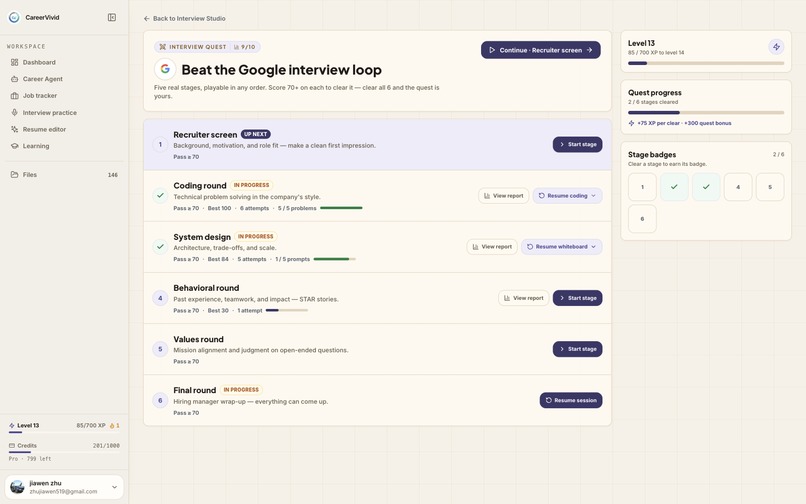
Quest progress: XP, stages cleared, and stage badges across a company's six-round loop.
-
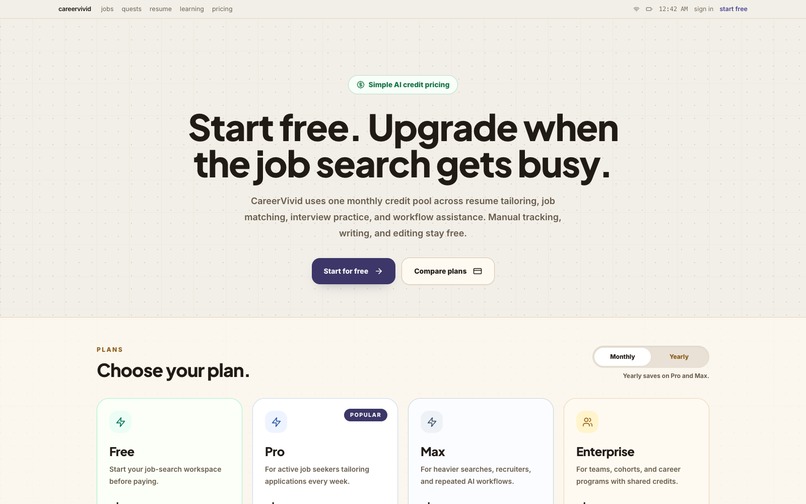
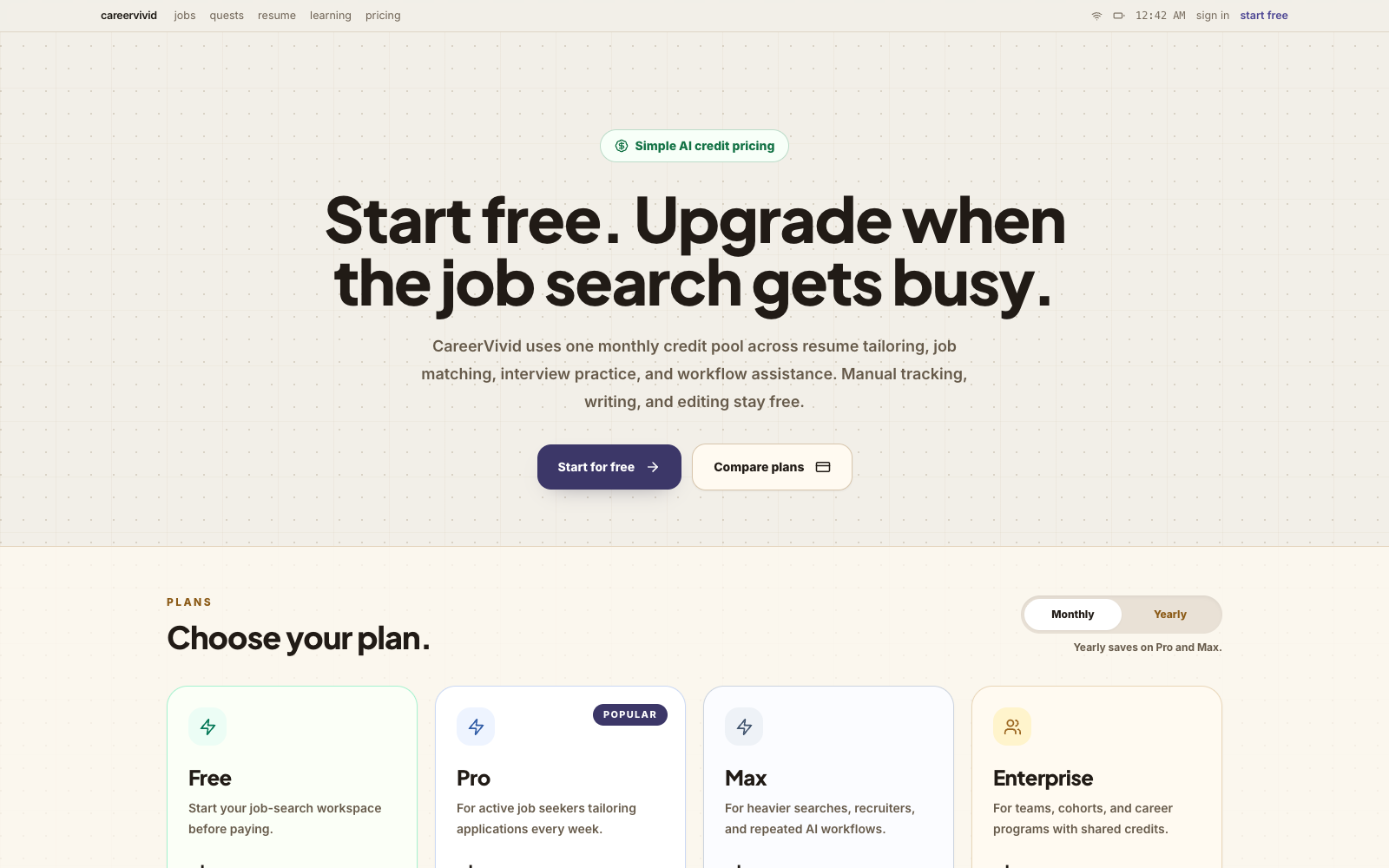
One credit pool across every AI surface. The free plan runs on 100 credits a month, no card.
CareerVivid
A mock interview that answers back, code that really runs, and a whiteboard graded against a rubric — then the resume gets rewritten from what the round exposed.
▶ Watch the 3-minute Video · Live Product Link · Live Earnings · Github Repo
Try it now — no login required
CareerVivid works without an account. Signing in unlocks sync, AI tools and sharing.
These four links open the real product, running live:
1. Google interview questions — start here Six real stages: recruiter screen, coding, system design, behavioural, values, final. Each needs 70/100 to pass to unlock the next question.
2. Run TypeScript/JavaScript or Python in a coding lesson Press Run. The code executes in the browser and the output is diffed against the expected result.
3. Search 301 companies 4,551 documented questions across 821 documented stages, searchable by company name.
4. Build a resume 36 templates. Export to PDF, Google Docs or .docx without signing in.
Free — $0/month, 100 credits. All 36 templates, all 301 company guides. Pro — $12/month ($10 billed annually), 1,000 credits. Max — $35/month ($31 billed annually), 4,500 credits. Enterprise — $12 per seat/month, 1,500 credits per seat, pooled, two-seat minimum.
By the numbers
| Companies with real interview guides | 301 |
| Documented interview questions | 4,551 |
| Documented interview stages | 821 |
| Per-stage quest questions | 22,611 |
| Courses / chapters / lessons | 12 / 56 / 203 |
| Resume templates | 36 |
| Company job boards scraped live | 161 |
| Cloud Functions deployed | 139 |
| UI languages | 7 |
Each figure above is read from a file in the repo.
The problem
AI has made the surface of this work easy. Anyone can generate a resume, a cover letter, or an answer that reads well. Those skills no longer separate candidates, because the whole field has them.
What still separates candidates is depth: designing a system that holds under load, defending the trade-offs behind it, and shipping something a company can actually run. That is what a senior interview tests, and it is the hardest part to rehearse, because it takes a second party — someone to push back on the architecture, run the code, and score the result.
Most job-search tools optimise the other end of the funnel: apply faster, send more. That helps with getting seen. It does nothing for clearing a system-design round.
CareerVivid is built for the depth problem. Rounds run by voice or by text. Code executes. Architecture is scored against a numeric rubric with the gaps named. The agent that reviewed the round then rewrites the resume it produced.
What it does
🧠 Context-Aware Autonomous Career Agent: Working directly inside the candidate’s active workspace, the Career Agent inspects live code, whiteboard topologies, and career history in real time. Equipped with 29 specialized tools, it can reason through and chain up to 12 autonomous actions per turn—proposing surgical edits, pipeline updates, and interview counterpoints as interactive decision cards that preserve 100% user control.
📐 Multimodal Whiteboard Vision & Rubric Scoring: Candidates design distributed architectures on a freeform, reactive digital canvas. The rendered system topology is evaluated multimodal-first against rigorous FAANG hiring rubrics—instantly returning weighted dimension scores, identifying single points of failure, and generating adaptive pushback on architectural trade-offs.
⚡ Zero-Latency In-Browser Code Execution Sandbox: Code is never mocked or hallucinated. JavaScript runs natively inside a dedicated Web Worker; Python runs in that same worker via Pyodide (CPython compiled to WebAssembly). The model grades candidates against real test executions, raw stdout, edge cases, and runtime complexity.
🎯 Closed-Loop Resume & Narrative Synthesis: Every insight, architectural breakthrough, and coding metric discovered during practice flows straight into the candidate’s application assets. With 36 ATS-optimized templates and 4-category role matching, candidates tailor their narratives to any job posting and export instantly to clean PDF, Google Docs, or Word formats.
AI in production
The Gemini API backs all seven scored surfaces. Google Cloud in production: Firebase Auth, Cloud Firestore, Cloud Functions (139 deployed), Firebase Hosting, Vertex AI.
| What the model decides | Model |
|---|---|
| Runs a spoken interview, decides when it ends | gemini-live-2.5-flash-native-audio |
| Scores the transcript, writes the report | gemini-3.6-flash |
| Grades the whiteboard image against a rubric | gemini-3.6-flash |
| Grades code on top of a measured pass rate | gemini-3.6-flash |
| Runs the 29-tool agent loop | gemini-3.6-flash |
| Scores a resume against a posting | gemini-2.5-flash |
| Tailors a resume to a posting | gemini-2.5-flash |
The unit economics are real. One credit costs $0.003 in model spend. The free tier's 100 credits is about $0.30 of cost. Pro's 1,000 credits is about $3.00 against $12 of revenue.
Why Education & Human Potential
The global job market has never been more difficult or unequal. Millions of capable engineers and job seekers are trapped in an opaque, high-stakes hiring system—spending hundreds of hours firing resumes into automated black holes, receiving zero actionable feedback, and watching their confidence drain in silence. Traditional interview prep is broken because passive reading cannot prepare anyone for the pressure of a live technical dialogue.
CareerVivid exists to collapse the gap between human potential and real-world opportunity. We replace passive memorization with a real-time, closed-loop execution environment: voice-driven technical sparring, interactive system design whiteboards, instant rubric scoring, and context-aware resume engineering. By offering a comprehensive, frictionless preparation engine in 7 languages—completely free and accessible without a barrier to entry—CareerVivid democratizes elite engineering mentorship, empowering anyone, anywhere, to prove what they can build and land life-changing roles.
How it is built
React + TypeScript (Vite)          →  Firebase Hosting
Cloud Functions (139 exported)     →  AI calls, ATS ingestion, SEO rendering
Cloud Firestore                    →  user data, sessions, agent proposals
Firebase Auth                      →  accounts
Vertex AI Live API                 →  realtime voice (raw BidiGenerateContent WS)
Gemini API                         →  grading, agent, resume, job scoring
Web Worker + Pyodide               →  in-browser execution: JS natively, Python on WASM
Three decisions worth calling out:
- The agent writes nothing directly. Mutating tools emit server-stored proposals; the client approves by ID. Prompt injection cannot mutate data.
- Agent transcripts live outside
users/{uid}on purpose — that namespace has an owner-write rule a compromised client could use to forge history. - One question follows across surfaces. The agent returns a route carrying the exact question ID, so "practise this one" lands on that question.
Challenges We Overcame Multimodal Vision Diagnostics vs. Aesthetic Bias: Grading arbitrary freeform drawings is fundamentally harder than parsing text. Early vision models suffered from "tidy-canvas bias"—rewarding neatly drawn diagrams over architecturally sound ones. We engineered a strict chain-of-thought scratchpad protocol: the model is forced to map data paths, identify single points of failure, and trace capacity limits before computing scores. By binding evaluation to rigid dimension caps and constrained JSON schemas, we eliminated arbitrary scoring and ensured every grade is anchored in genuine systems engineering principles.
Full-Duplex Real-Time Voice & Instant Barge-In: Building a natural conversational interview partner required conquering browser-level audio latency. Handling client-side microphone downsampling, low-latency audio chunk streaming, and seamless acoustic interruption (barge-in)—enabling the candidate to cut in while the AI is mid-sentence without clipping or echo loops—demanded extensive audio buffer optimization and WebSocket state orchestration.
What I Learned Ground-truth data beats synthetic generation every time. We initially experimented with AI-generated interview prompts, but generic questions produced generic coaching. The breakthrough came when we pivoted to empirical engineering: curating and verifying 4,551 real-world questions from documented hiring loops. This ground-truth foundation instantly elevated the entire platform—powering authentic quest progressions, razor-sharp diagnostic reports, and agent advice that actually mirrors what hiring managers look for.
What’s Next for CareerVivid Expanded Polyglot Execution: Extending the client-side WebAssembly execution environment beyond JavaScript and Python to support Java, C++, and Go. Persistent Episodic Agent Memory: Upgrading the Career Agent with a cross-session memory graph that tracks a candidate’s weaknesses, pacing, and behavioral growth across weeks of preparation rather than isolated rounds. Broader Enterprise Loop Coverage: Ingesting and calibrating diagnostic rubrics for 50+ additional tier-1 and hyper-growth tech companies.
Source, screenshots and competition provenance: github.com/JiawenZhu/CareerVivid
Built With
- cloud-functions
- firebase
- firestore
- gemini
- gemini-api
- google-cloud
- node.js
- python
- react
- tailwind-css
- typescript
- vertex-ai
- vite
- webassembly


Log in or sign up for Devpost to join the conversation.