-
-
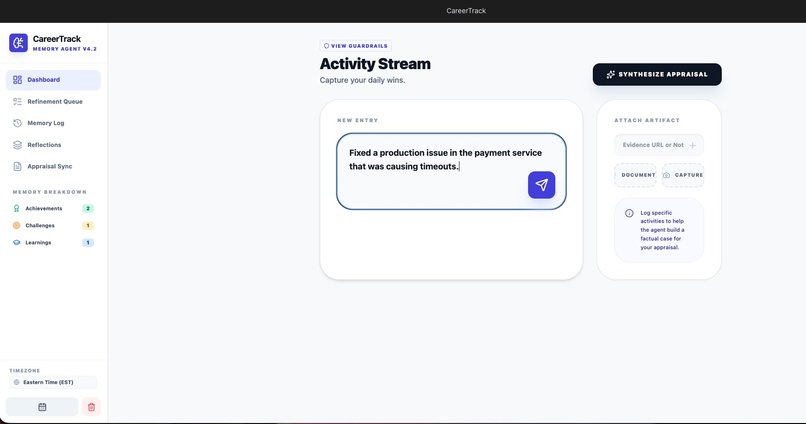
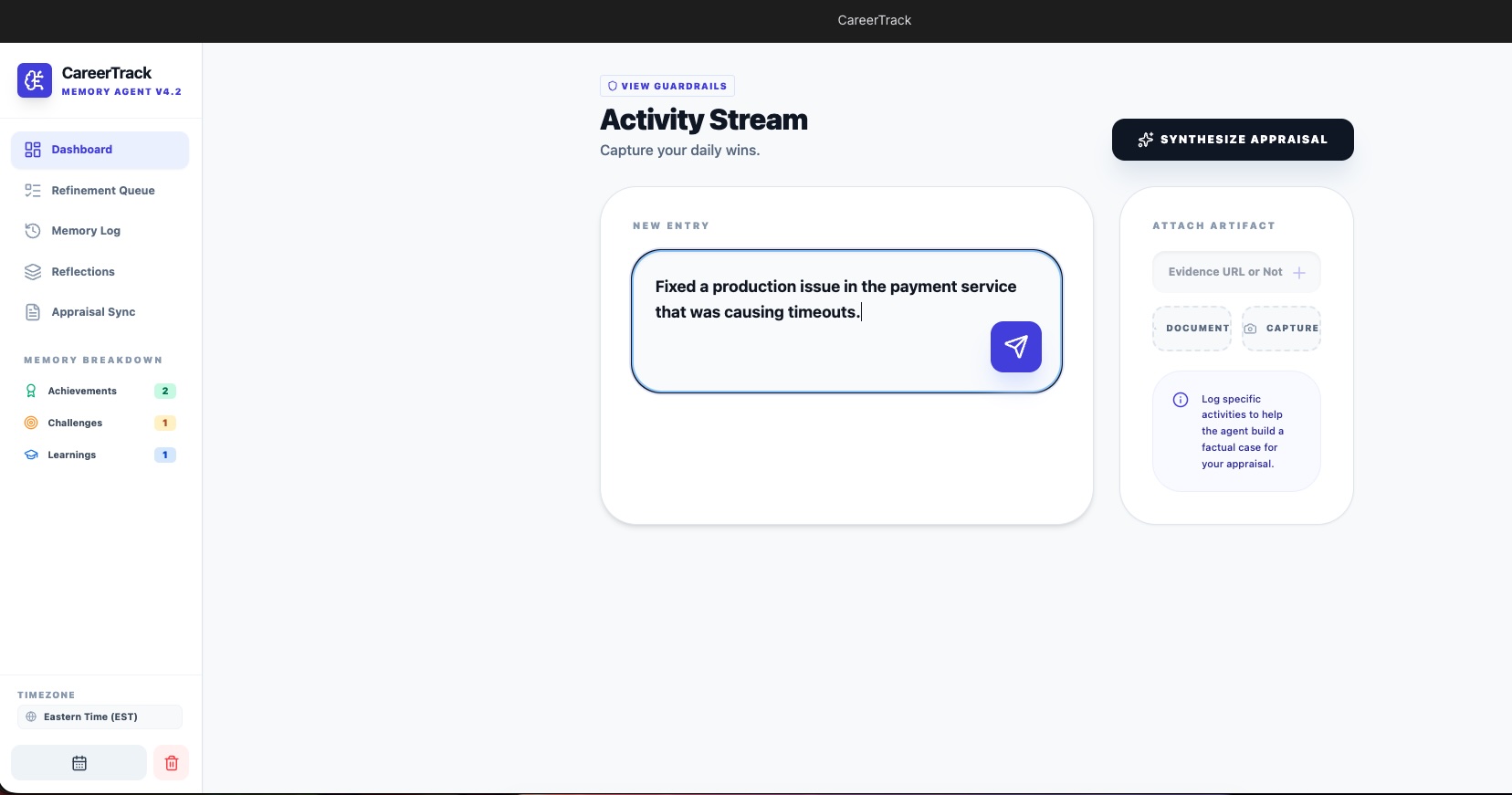
Log Entries
-
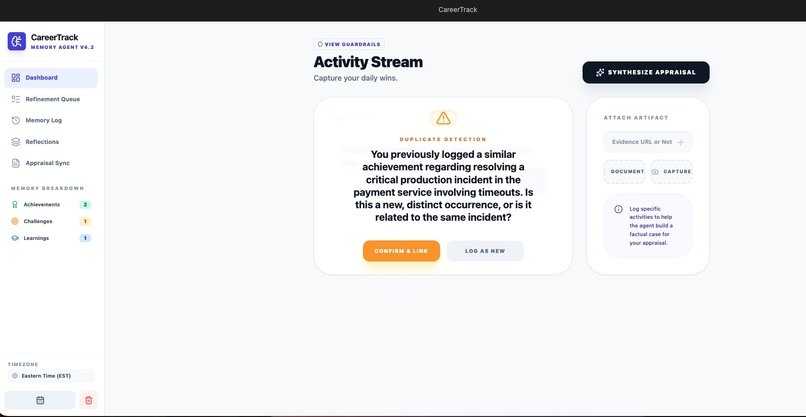
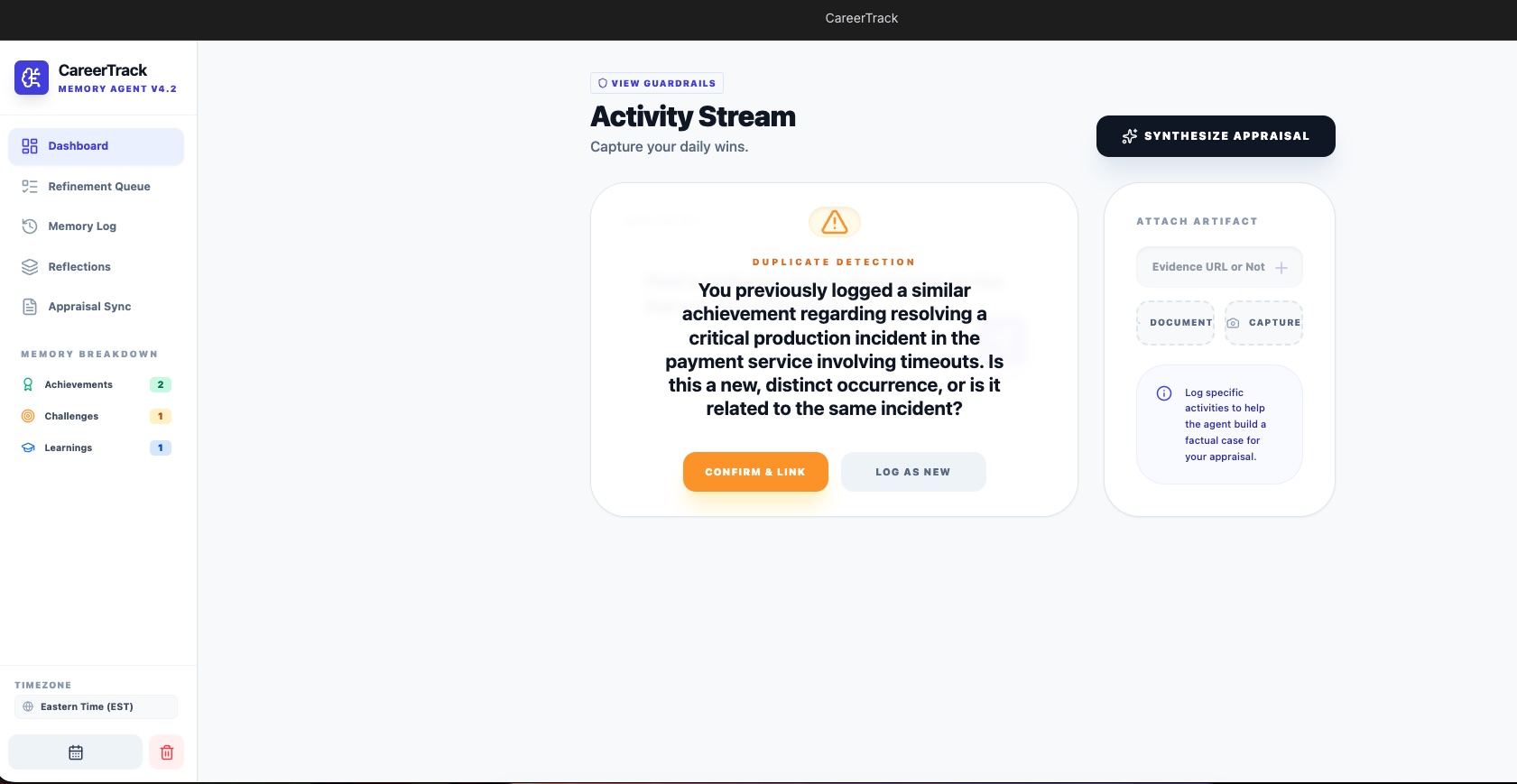
Merge duplicate entries with user confirmation
-
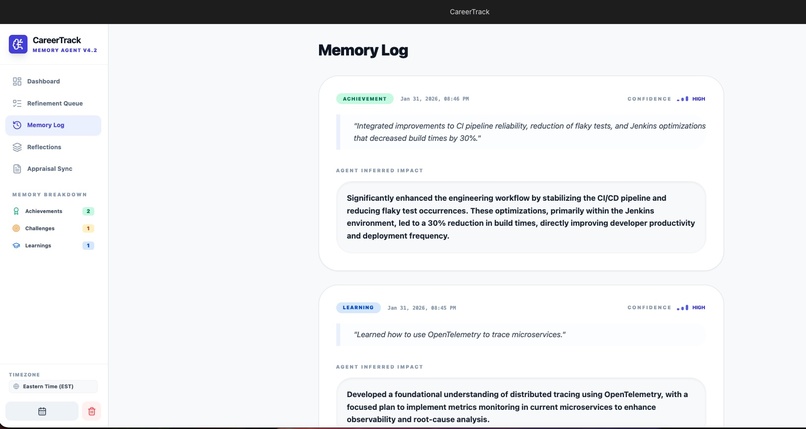
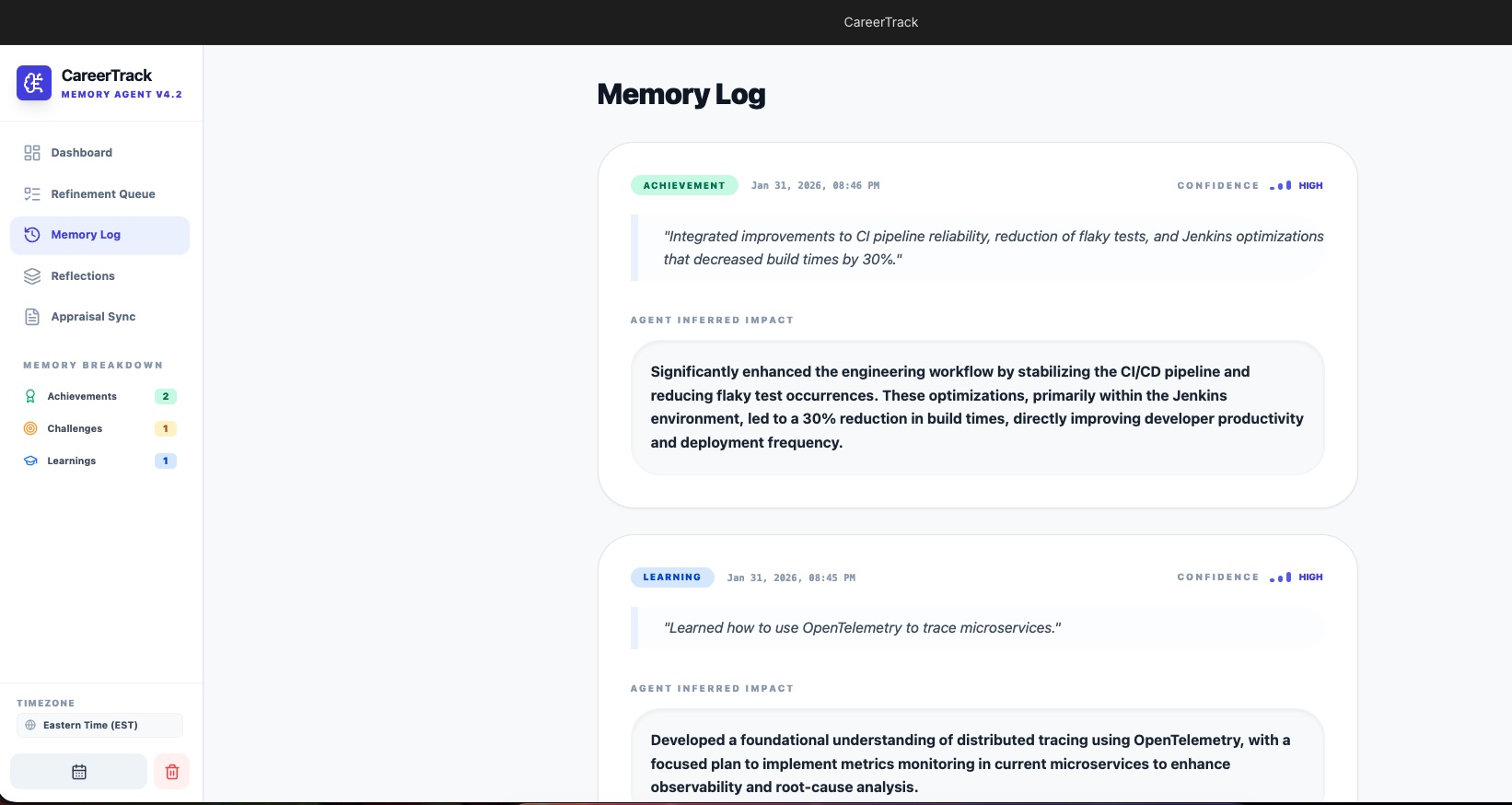
Memory log
-
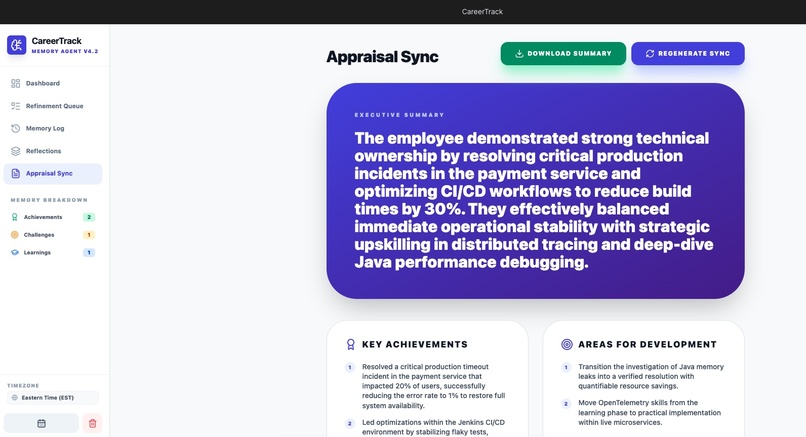
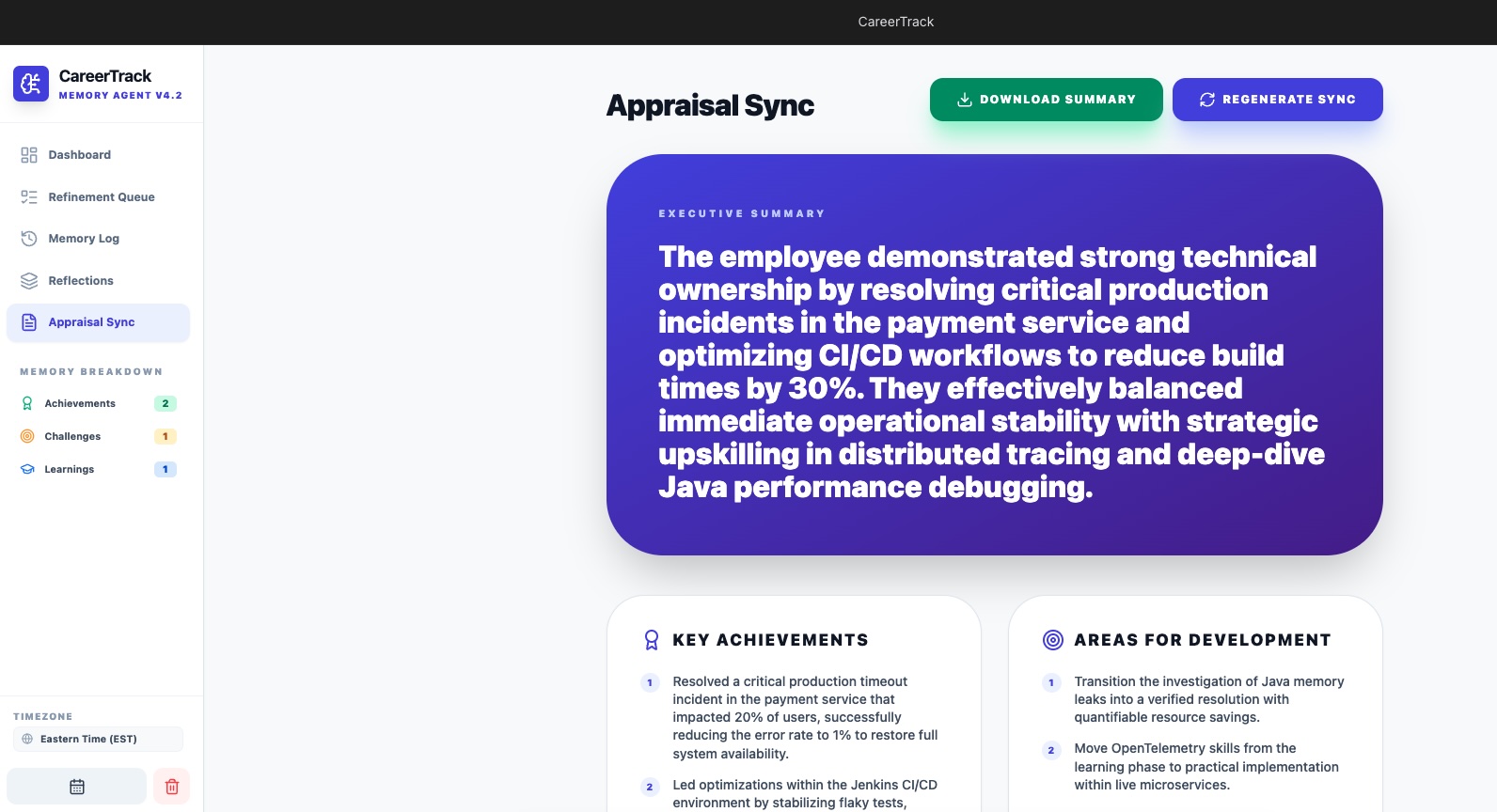
Final appraisal
Inspiration
Many employees do excellent work throughout the year, but their efforts often go undocumented due to the lack of a simple, standard tracking system. This leads to incomplete or unfair appraisal discussions. CareerTrack was inspired by the need to help individuals consistently capture their achievements and make performance reviews stress-free and accurate.
What it does
CareerTrack helps employees log their work, achievements, challenges solved, and learnings throughout the year. It creates a structured, searchable record that can be easily summarized during appraisal cycles, ensuring no contribution is missed.
How we built it
I designed CareerTrack with a user-first approach, focusing on simplicity and consistency. The system uses structured inputs for achievements and challenges, backed by automation to organize entries and generate appraisal-ready summaries.
Challenges we ran into
- Ensuring agents interpreted real user logs and signals, not generic or random prompts, while preserving context and intent.
- Designing thought chaining to reliably link evidence, merge related entries, and maintain long-term continuity.
- Determining the right number of tools and triggers to synchronize capture, refinement, and appraisal without over-engineering.
- Balancing autonomous self-correction with minimal user interruptions.
- Running extensive test cases to validate that the agent consistently captured accurate details, avoided hallucinations, and correctly understood its role across scenarios.
- Finalizing guardrails
Accomplishments that we're proud of
- Built a Gemini-powered autonomous agent that captures and refines career data over time with minimal user input.
- Designed a non–prompt-based system using multi-step orchestration, long-term memory, and self-correction loops.
- Successfully implemented thought chaining to link evidence, merge related work, and maintain continuity across entries.
- Enabled appraisal-ready summaries that are fully traceable to documented work, preventing hallucinations.
- Created a clean, judge-friendly UI that demonstrates Gemini’s reasoning and autonomy within a short demo window.
What we learned
- Less input, better design: Users are more consistent when they can log work in seconds, letting the agent handle structure and refinement.
- Autonomy beats interaction: Long-running agents with background reasoning provide more value than prompt-driven experiences.
- Confidence scoring is critical: Explicit uncertainty handling helps avoid hallucinations and guides when clarification is truly needed.
- Memory needs structure: Thought signatures and chaining are essential for merging related work and maintaining long-term context.
- Testing defines trust: Running diverse real-world scenarios is key to ensuring the agent understands its role and produces reliable outputs.
What's next for CareerTrack
- Add AI-generated goal alignment to map daily work against role expectations and performance frameworks.
- Introduce manager and reviewer views for shared visibility and feedback without manual reporting.
- Expand evidence ingestion (PRs, tickets, docs) with deeper reasoning over artifacts.
- Enable cross-cycle comparisons to track growth and impact over multiple appraisal periods.
- Integrate with work tools (Git, Jira, Slack) to capture signals automatically while keeping user effort minimal.
Built With
- browser-local-storage
- html/css
- javascript
- react
- typerscript
- vite

Log in or sign up for Devpost to join the conversation.