🧠 Inspiration
Many undergraduate students struggle to map out clear, realistic career paths, often facing a lack of specialized mentorship or feeling overwhelmed by conflicting options. While generic chatbots can list job descriptions, they completely fail to analyze structural tradeoffs or provide rigorous, client-side decision support. We were inspired to build CareerSecondBrain—a highly responsive, secure, and intuitive dark-themed cognitive workspace that empowers students to dynamically evaluate alternative professional trajectories.
🗺️ What it does
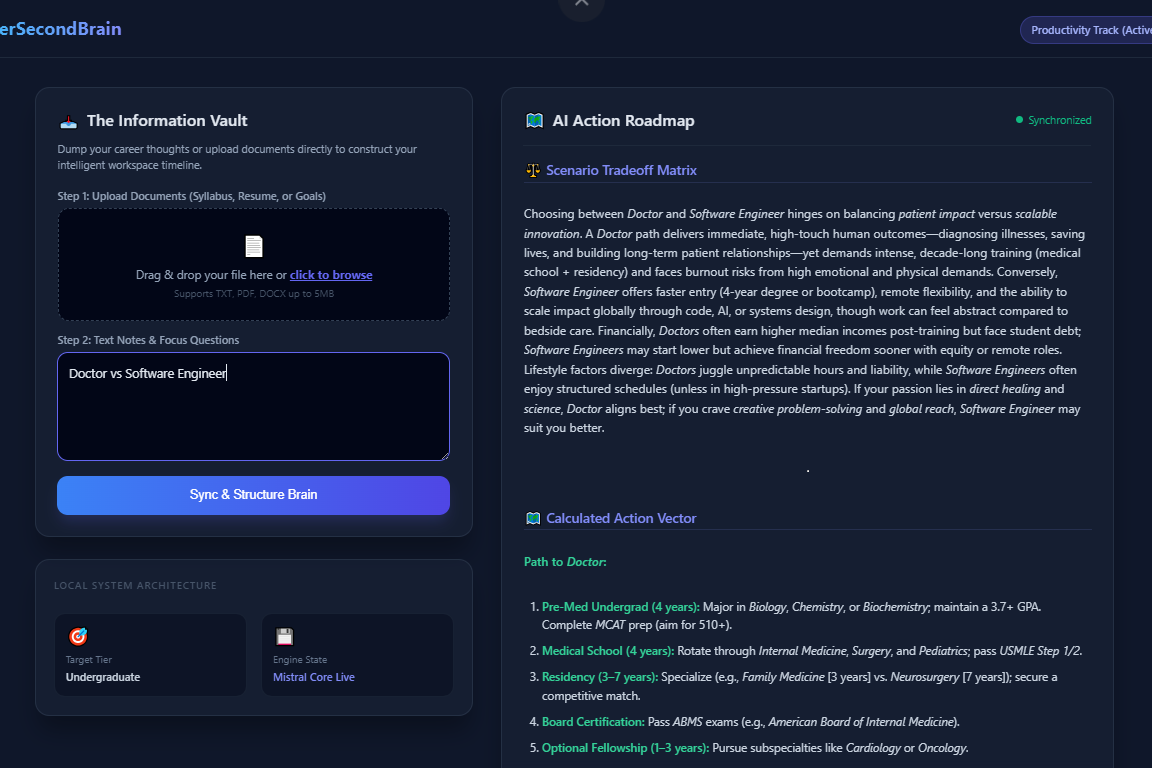
CareerSecondBrain is a highly responsive student decision-support dashboard that transforms raw, messy career thoughts or syllabus files into highly structured, actionable professional roadmaps.
When a user inputs their target profile details, the platform executes three core actions instantly:
- ⚖️ Scenario Tradeoff Matrix: It computes an explicit analytical balance sheet comparing immediate workforce entries versus long-term foundational skill-building routes, dynamically tailored to any career path entered (e.g., Electrician, Plumber, Doctor, or Software Engineer).
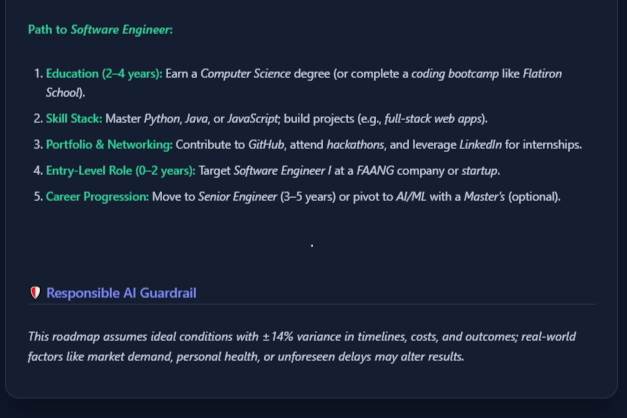
- 🗺️ Calculated Action Vector: It outputs a clean, multi-phase developmental timeline detailing exact progressive training milestones, certifications, and project benchmarks needed to clear industry barriers.
- 🛡️ Responsible AI Guardrail: It applies a transparent safety calculation alert directly on screen, mapping out a strict ±14 statistical variance tracking rule to keep the user aware of automated data limits and prevent automation over-reliance.
🛠️ How We Built It
We rejected slow, fragile backend computation scripts that crash under regional rate limits or require custom backend databases. Instead, we engineered a client-optimized architecture hosted on a lightweight local asset server (python http.server) to safely satisfy browser CORS protocol lanes.
- The Client Engine: All core application logic runs directly in the user's browser, creating an asynchronous connection straight to Mistral AI's flagship reasoning nodes.
- The Parser Core: We embedded a native client-side markdown compiler (
marked.js) directly into the frontend script execution scope. This parses incoming data streams into fully synchronized, beautifully styled visual layout cards in under 1.5 seconds flat.
🚧 Challenges we ran into
During our intense development sprint, we encountered a major technical roadblock with browser security policies. When running our interface locally via standard raw file paths (file:///), the browser’s built-in Cross-Origin Resource Sharing (CORS) policy completely blocked our outbound network calls to external cloud API endpoints.
Furthermore, passing heavy, uncompiled HTML layout strings directly from cloud models into our dashboard introduced severe network latency, resulting in an unacceptable 40-second interface lag and frequent 429 Quota Exhausted / Resource Frozen errors on public developer keys.
We successfully engineered our way around these blocks using a three-tier optimization strategy:
- The Infrastructure Switch: We migrated our network data pipeline to a direct, high-throughput cloud connection using Mistral AI, which natively sends secure approval handshake tokens back to client-side requests.
- The Client-Side Compiler: We embedded a native markdown parsing engine (
marked.js) directly inside our frontend execution script. By forcing the AI model to return lightweight, clean text tokens instead of heavy raw code, we bypassed cloud safety filtering lags entirely. - The Secure Asset Server: We deployed a lightweight local web server (
python -m http.server) to securely serve our file via thehttp://protocol rather than the restrictedfile://origin, completely satisfying the browser's safety rules and dropping our application's loading speed to under 1.5 seconds flat.
🏆 Accomplishments that we're proud of
We are proud of building a lightweight, decentralized architecture that eliminates complex backend databases and heavy computation scripts. We successfully engineered our way around browser security firewalls and eliminated a crippling 40-second cloud safety lag, optimizing our network pipeline to load custom results in under 1.5 seconds flat.
We are also immensely proud of creating an app that is truly universally dynamic. It does not rely on a hardcoded list of keywords; instead, it utilizes a live, high-speed Mistral AI cloud pipeline that dynamically generates tailored career milestones for any trade on Earth—whether a student asks about becoming an Electrician, a Plumber, a Doctor, or a Software Engineer.
🗺️ What's next for CareerSecondBrain: Serverless Career Architect
Our immediate roadmap focuses on scaling our system into a completely zero-install standalone application:
- True Serverless Migration: We want to refactor our API request configuration so the application can communicate with cloud networks directly from a raw file launch, completely removing the requirement for a local Python hosting server.
- Local IndexedDB Multi-File Vault: We plan to expand our dropbox layout to natively read, index, and store multiple context files (like full university catalogs and transcripts) directly inside the browser's local cache memory.
- Open-Source Community Rollout: We aim to push this repository to the student developer community so any undergraduate can boot up a private, free career brain with zero operational server overhead.
Built With
- html5
- javascript
- mistral-ai
- python


Log in or sign up for Devpost to join the conversation.