-
-
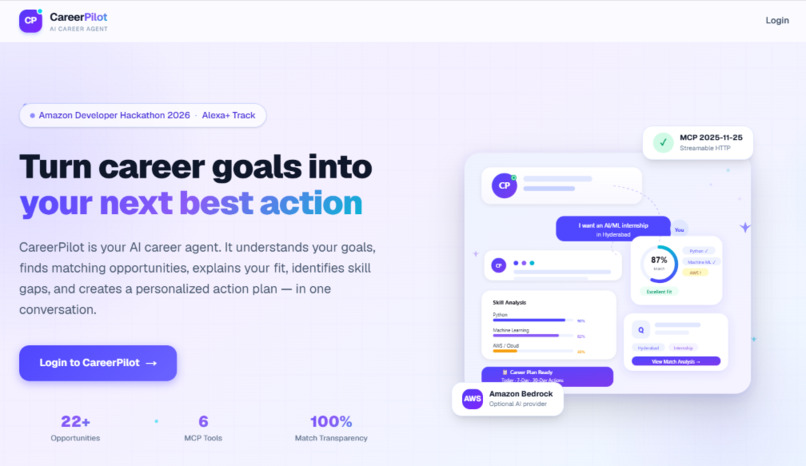
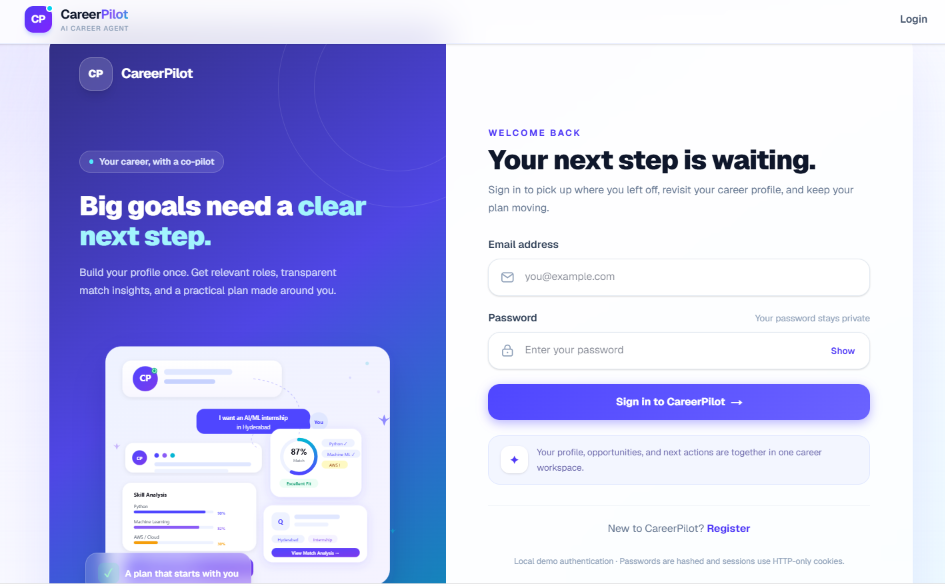
Home Page
-
-
-
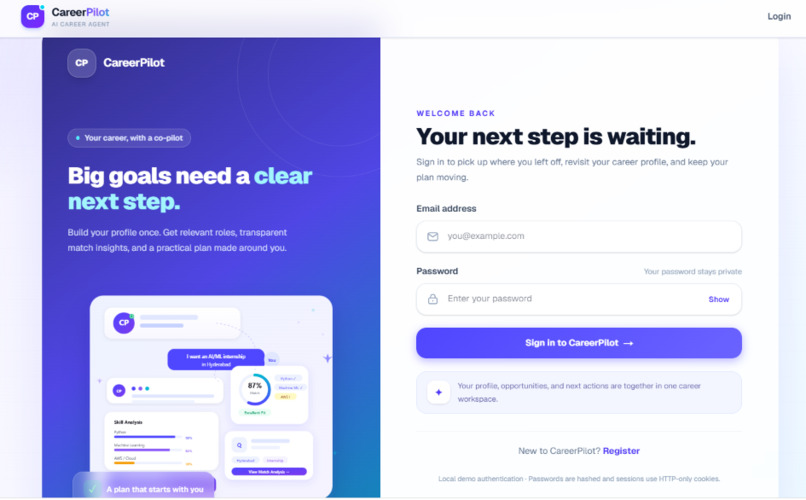
Signin Page
-
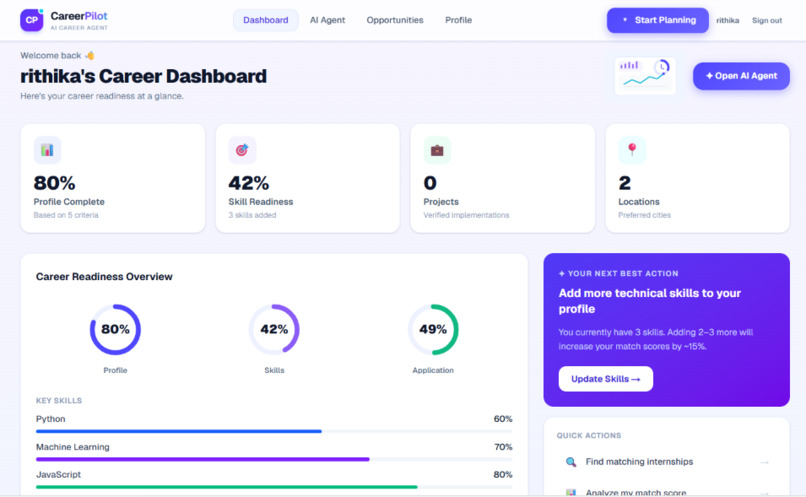
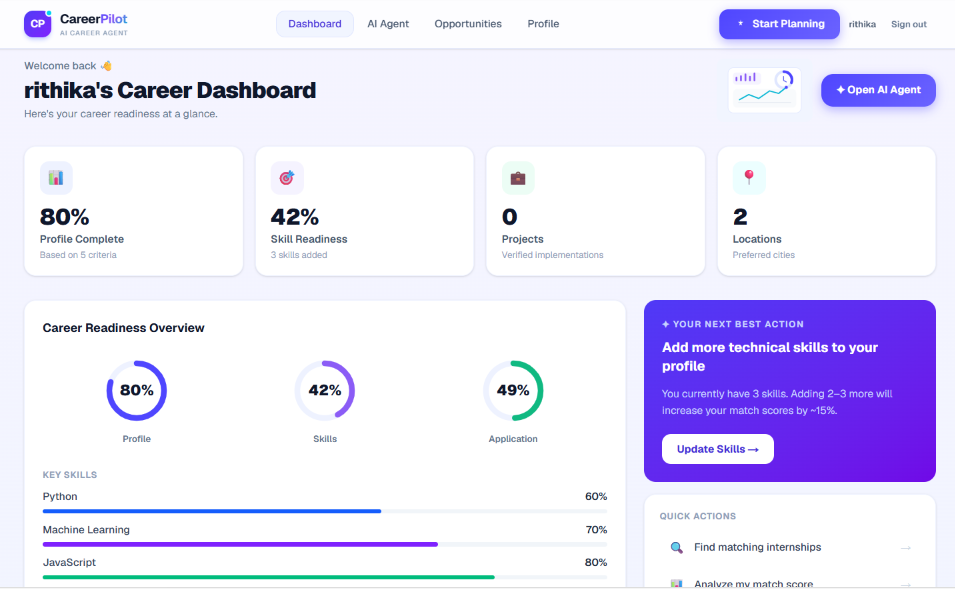
User Dashboard
-
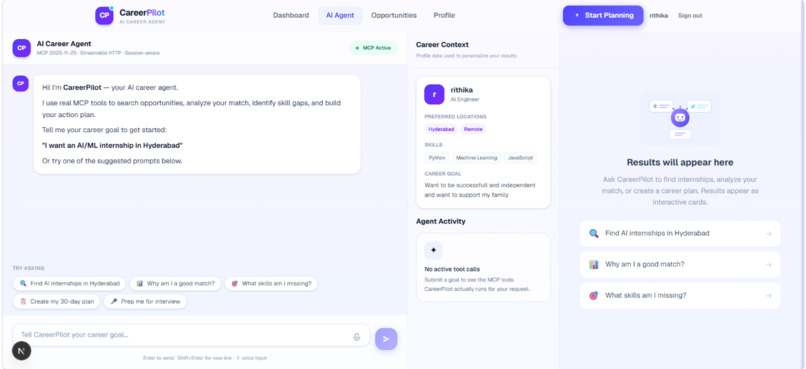
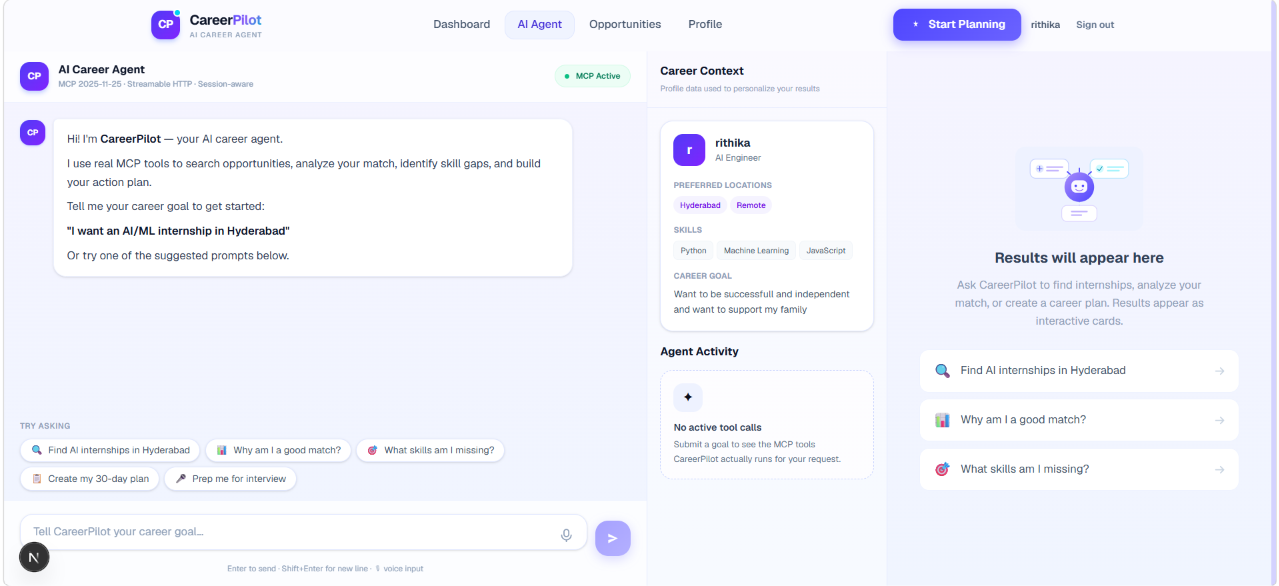
AI agent page
-
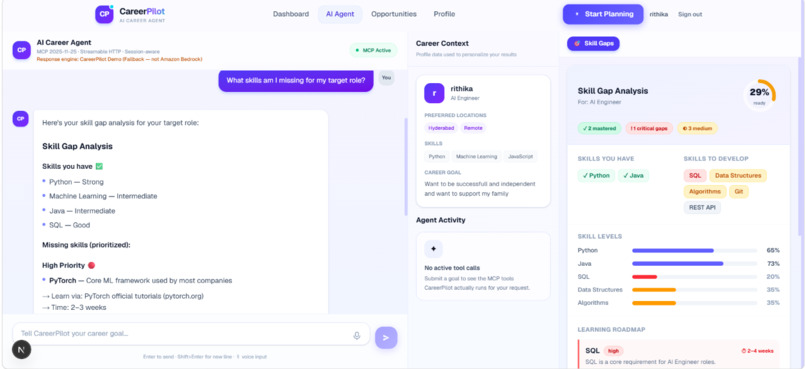
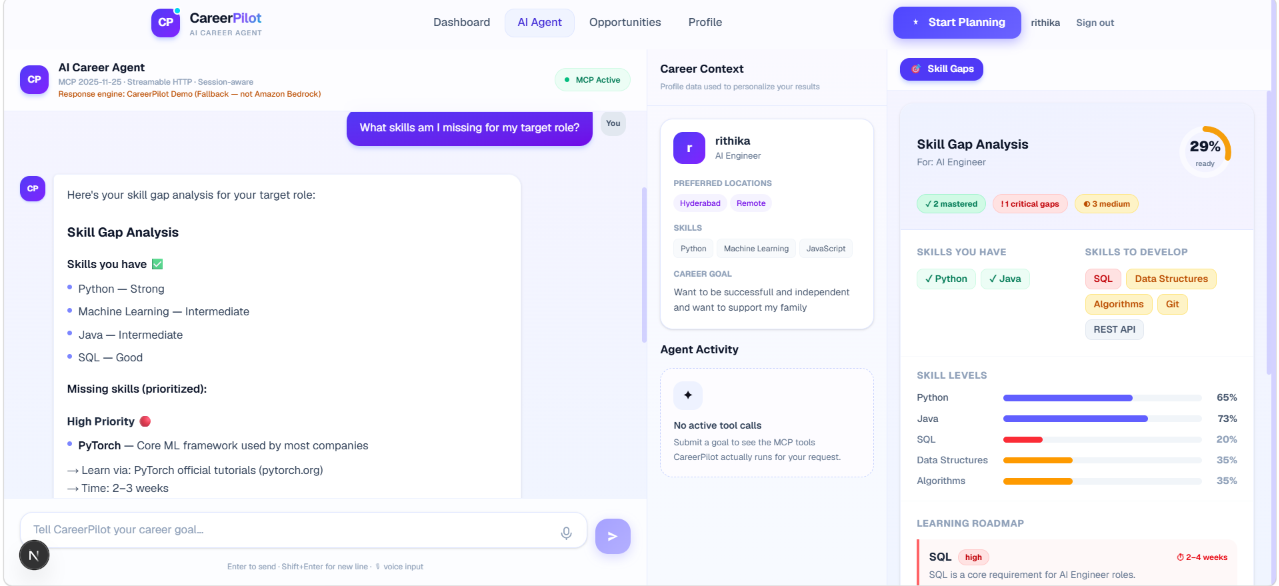
AI agent page after asking question and giving response
-
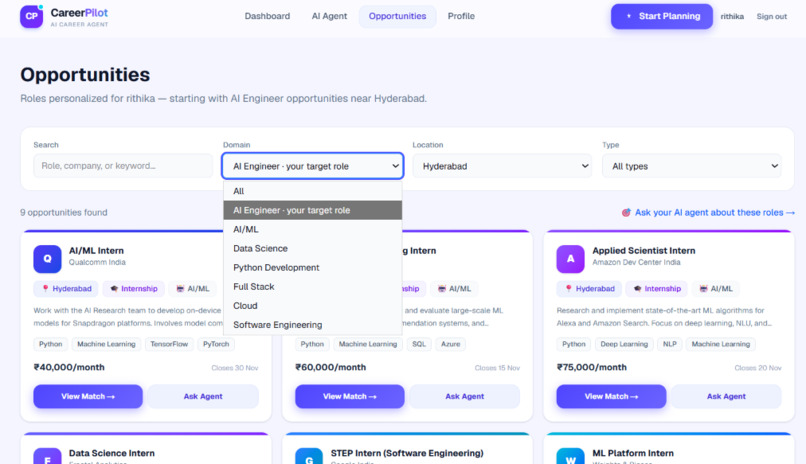
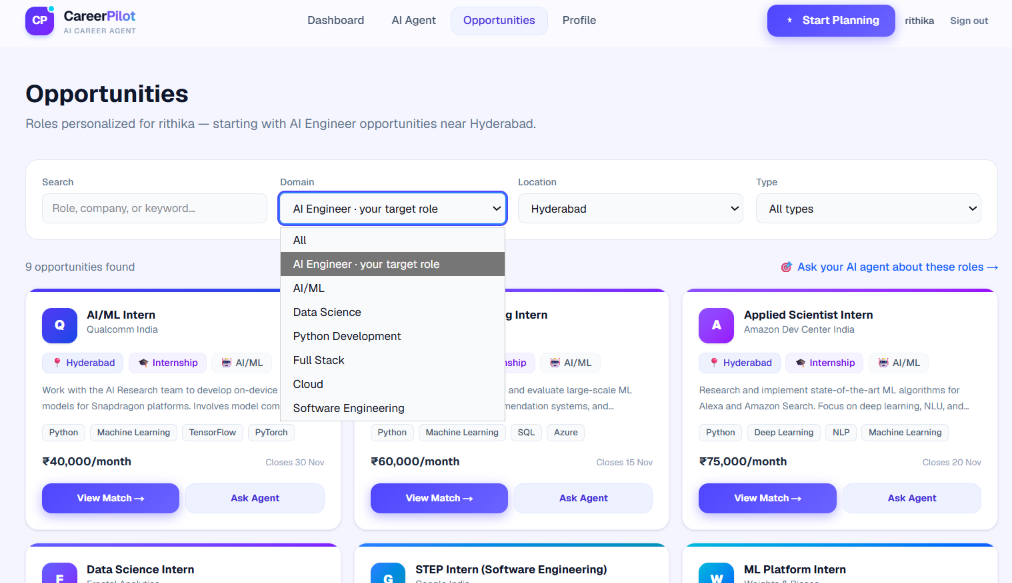
Opportunities for the target role
-
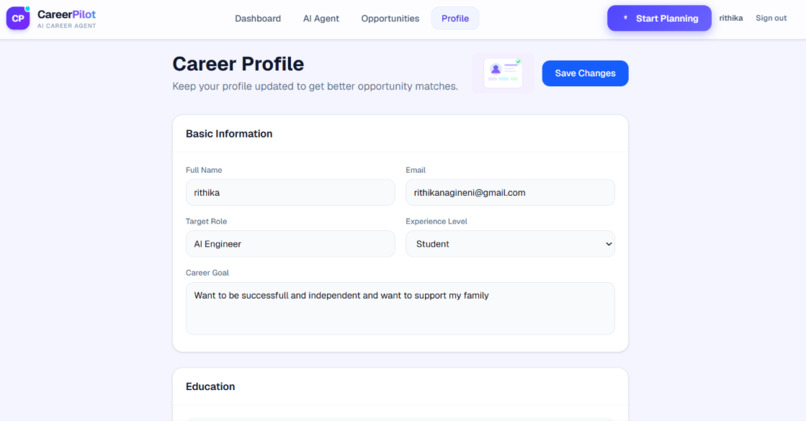
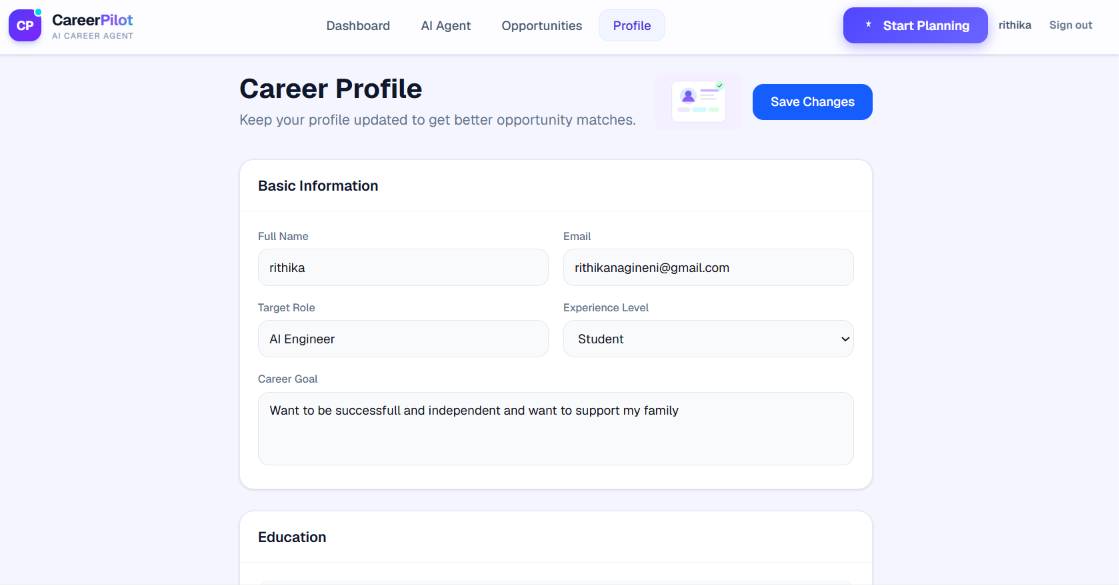
Profile Page
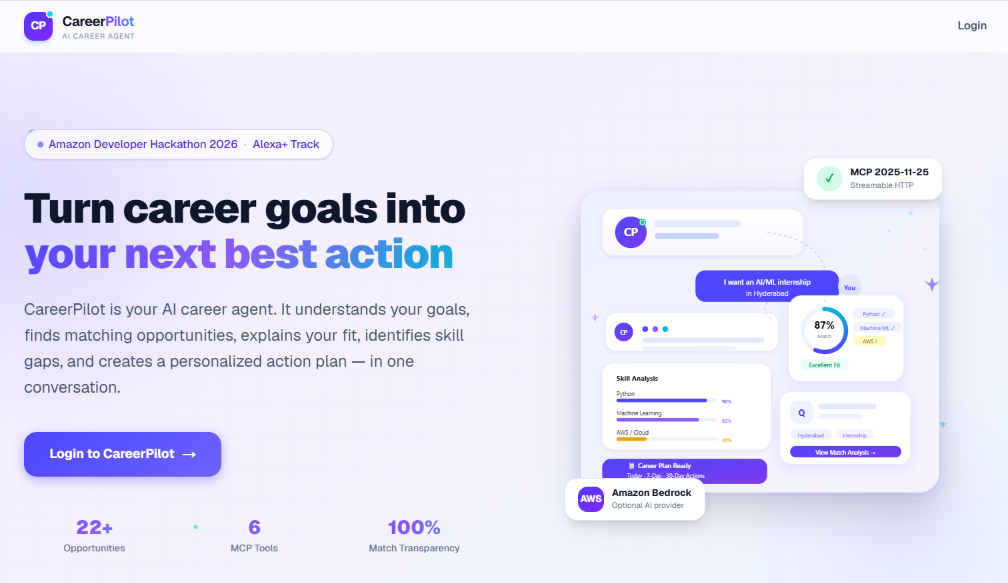
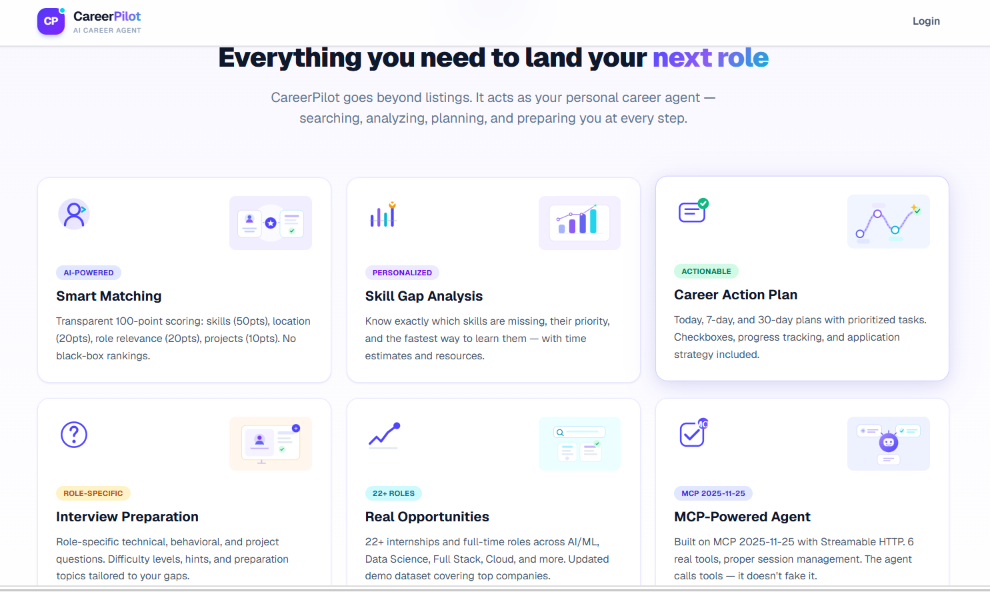
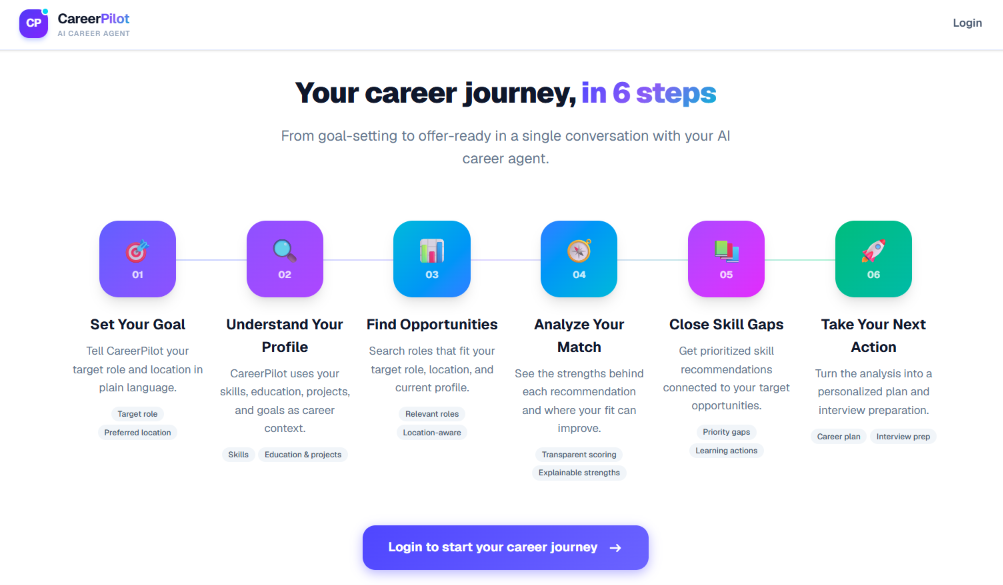
CareerPilot — Turn Career Goals Into Your Next Best Action
Inspiration
For students and early-career developers, finding the right internship or job is often not the hardest part. The harder part is understanding which opportunity is actually right for them, why they match it, what skills they are missing, and what they should do next.
Most career platforms stop at search and application. We wanted to build something more agentic: an AI career companion that can understand a career goal, reason about opportunities, explain its recommendations, identify skill gaps, and turn the result into an actionable career plan.
That idea became CareerPilot.
What CareerPilot Does
CareerPilot is an AI-powered career agent designed for students and early-career developers.
A user can provide a goal such as:
"I want an AI/ML internship in Hyderabad."
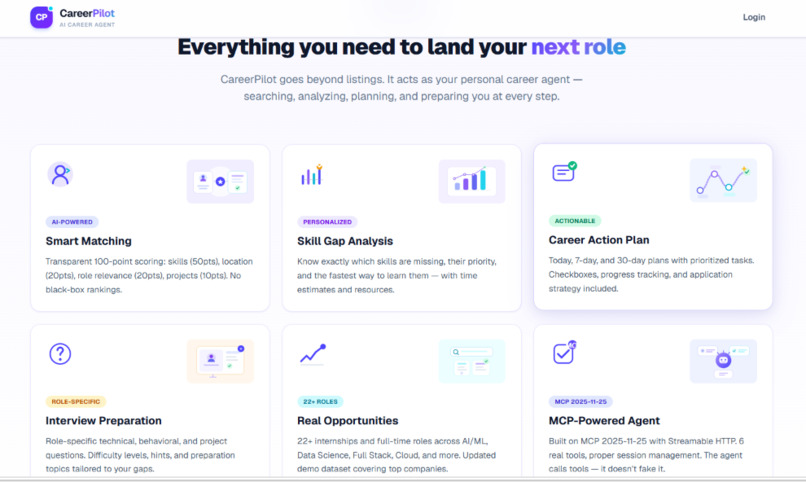
Instead of simply returning a list of opportunities, CareerPilot can:
- Understand the user's career goal and context.
- Retrieve relevant opportunities.
- Analyze how well each opportunity matches the candidate.
- Explain why an opportunity is a good match.
- Identify missing or weaker skills.
- Create a personalized career action plan.
- Generate interview preparation based on the target role.
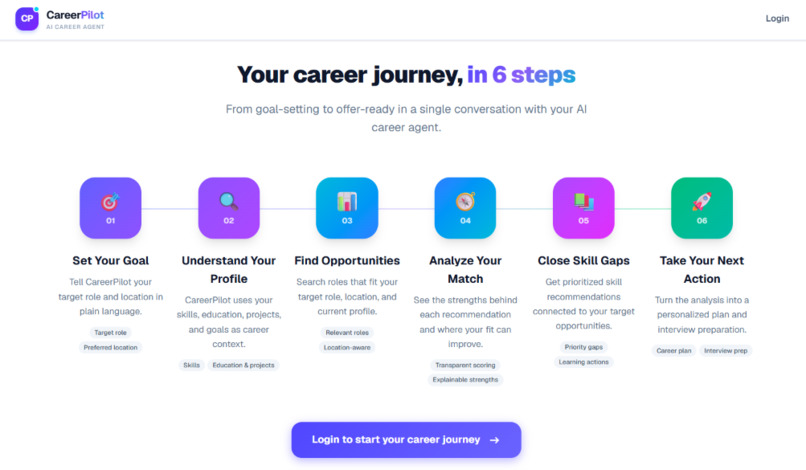
The goal is to move the user through:
Discover → Match → Understand → Improve → Prepare
rather than simply:
Search → Apply
How We Built It
CareerPilot was built as an agentic web application with a simulated Alexa+ experience.
The architecture consists of:
- CareerPilot Web UI — the user-facing career experience.
- Career Agent — understands the user's intent and decides which actions are needed.
- Self-hosted MCP Server — exposes career capabilities as tools.
- MCP Client — allows the agent to interact with those tools.
- Amazon Bedrock — provides the AI reasoning layer when configured.
- Fallback AI mode — keeps the application usable when Bedrock credentials are unavailable.
- Opportunity and candidate datasets — provide realistic data for demonstrating matching and career workflows.
The MCP server is implemented using the official Model Context Protocol SDK and supports MCP specification 2025-11-25 over Streamable HTTP.
CareerPilot exposes six core MCP tools:
get_candidate_profilesearch_opportunitiesanalyze_matchanalyze_skill_gapscreate_career_plangenerate_interview_prep
The important part is that MCP is not only documented in the project — the Career Agent actually interacts with the MCP server at runtime.
Alexa+ Track
For the Alexa+ primary track, we created a simulated Alexa+ web experience because the hackathon provides an alternative simulated experience path.
The interface is designed around an agentic interaction rather than a traditional form-based career portal. A user can express a career goal, while the agent performs the required sequence of actions and presents the resulting opportunities, explanations, skill gaps, and recommendations.
The project includes a real self-hosted MCP server using Streamable HTTP, making the MCP implementation an actual runtime component of the application.
Amazon Bedrock and AWS Builder
CareerPilot integrates Amazon Bedrock as its AI reasoning provider.
When Bedrock is configured, the Career Agent can use the selected Amazon Bedrock model to interpret requests and support the career workflow. We also implemented a transparent fallback mode so the application can still demonstrate its core functionality when cloud credentials or model access are unavailable.
This allowed us to separate the application architecture from a single model provider while still demonstrating a real AWS integration.
Match Explainability
One of the key design goals was to avoid presenting an unexplained AI score.
CareerPilot considers factors such as:
- Skills
- Interests
- Experience
- Projects
- Location
- Career goals
- Opportunity requirements
The resulting match is accompanied by an explanation of the candidate's strengths, missing skills, and improvement areas.
This makes the recommendation more useful than simply saying:
"Match score: 82%"
Instead, the user can understand why the opportunity matches and what they can improve.
What We Learned
Building CareerPilot taught us that an agentic application is more than connecting an LLM to a chat interface.
We learned how to:
- Design an application around tool-based agent workflows.
- Implement and test a self-hosted MCP server.
- Work with Streamable HTTP transport.
- Build an MCP client that communicates with the agent's tools.
- Integrate Amazon Bedrock into an application architecture.
- Design fallback behavior for cloud-dependent AI features.
- Make AI recommendations more explainable.
- Structure a career workflow as multiple actions rather than a single chatbot response.
- Test the MCP protocol implementation independently from the user interface.
One of our biggest lessons was that the tools and workflow matter as much as the model. A useful career agent needs access to structured capabilities and context so that it can take meaningful actions instead of only generating text.
Challenges We Faced
1. Implementing MCP Correctly
We wanted to make sure MCP was a real runtime capability rather than something mentioned only in the README.
We therefore implemented the MCP server using the official SDK, Streamable HTTP transport, session handling, initialization, tool discovery, and the required career tools.
We also created protocol-level tests covering the MCP handshake, session behavior, tool discovery, and tool invocation.
2. Cloud AI Availability
Amazon Bedrock access can depend on AWS credentials, model availability, and account or region configuration.
To make the project easier to demonstrate and test, we separated the AI provider from the rest of the application and implemented a fallback mode.
This also taught us the importance of designing cloud integrations so that the application can fail gracefully.
3. Building an Agentic Workflow Instead of a Generic Chatbot
We deliberately did not want CareerPilot to become another chatbot with career-related prompts.
The agent instead connects user intent to specific capabilities such as opportunity search, match analysis, skill-gap analysis, career planning, and interview preparation.
This made the architecture more complex, but it also made the product more useful and aligned with the hackathon's focus on agentic experiences.
Testing and Reliability
Before submission, we verified the project locally through:
- ESLint
- Application tests
- MCP protocol tests
- Production build
- Manual end-to-end application testing
The MCP protocol test suite successfully verified the core MCP implementation, including initialization, session handling, tool discovery, and the available career tools.
What Makes CareerPilot Different
CareerPilot is not designed to replace existing job boards.
It focuses on the reasoning layer between a student's goal and their next career action.
Instead of only asking:
"What jobs are available?"
CareerPilot helps answer:
"Which opportunities fit me, why do they fit me, what am I missing, and what should I do next?"
That makes the experience more transparent, actionable, and personalized.
What's Next
Future versions of CareerPilot could connect to live opportunity sources, persistent user profiles, richer resume analysis, real interview evaluation, additional career data providers, and more voice-first interactions.
We would also like to evolve the simulated Alexa+ experience into a more natural multimodal career assistant where users can move between voice, text, documents, and structured career actions.
Final Thought
Career decisions are rarely solved by a single search result.
They require context, reasoning, preparation, and a clear next step.
CareerPilot is our attempt to turn an AI career assistant from a question-answering tool into an agent that helps users move forward.
Built With
- ai
- aiagents
- amazon-web-services
- amazonbedrock
- careertech
- genai
- mcp
- ml
- next.js
- node.js
- react
- typescript
