-
-
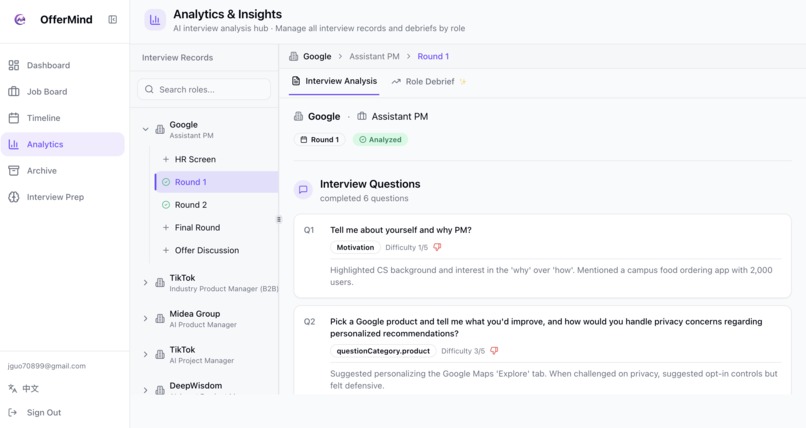
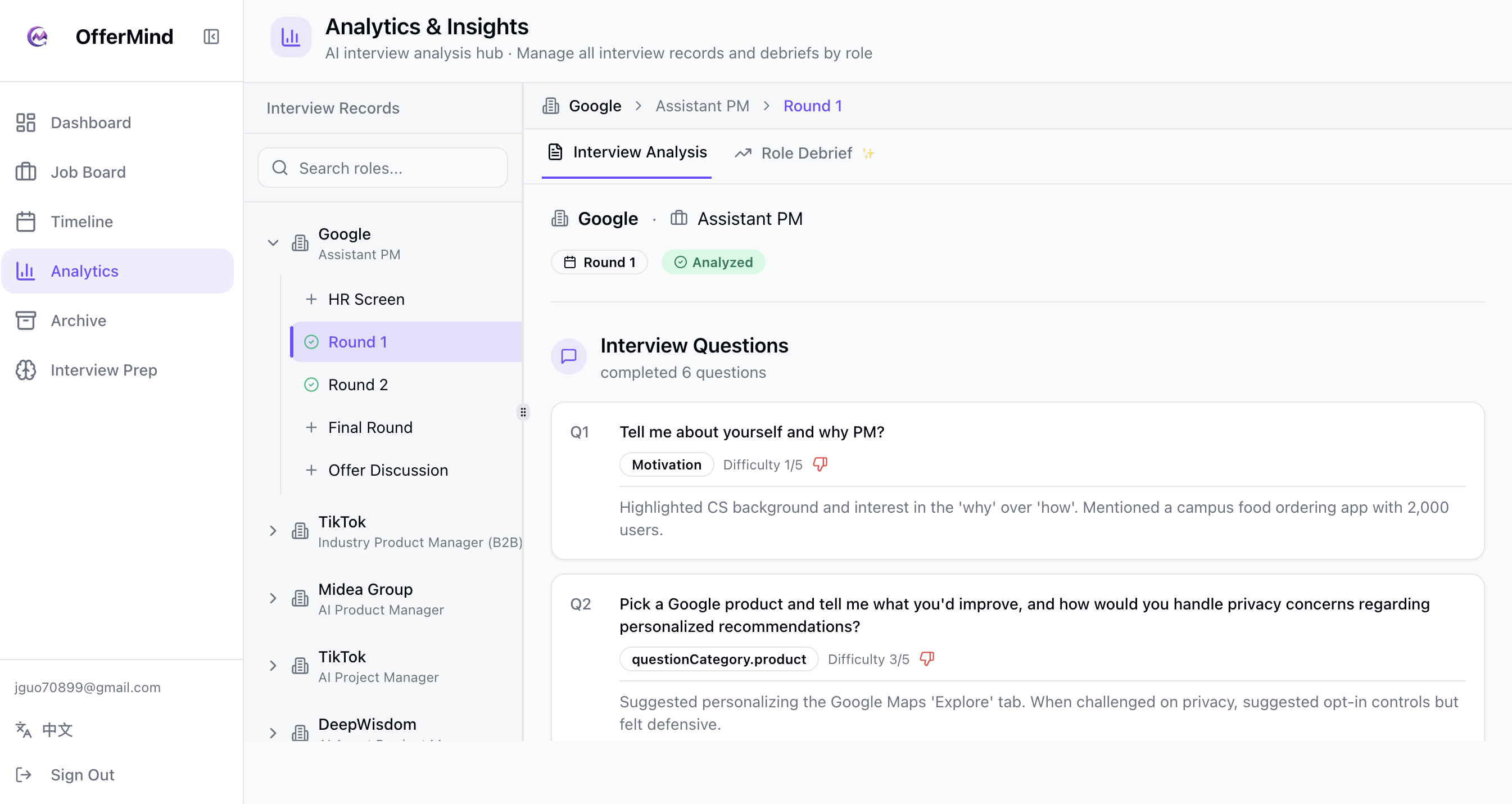
Interview Analysis
-
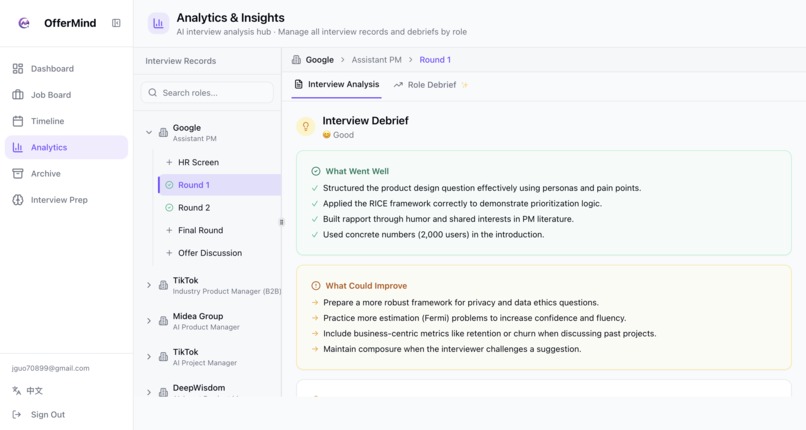
Interview Analysis
-
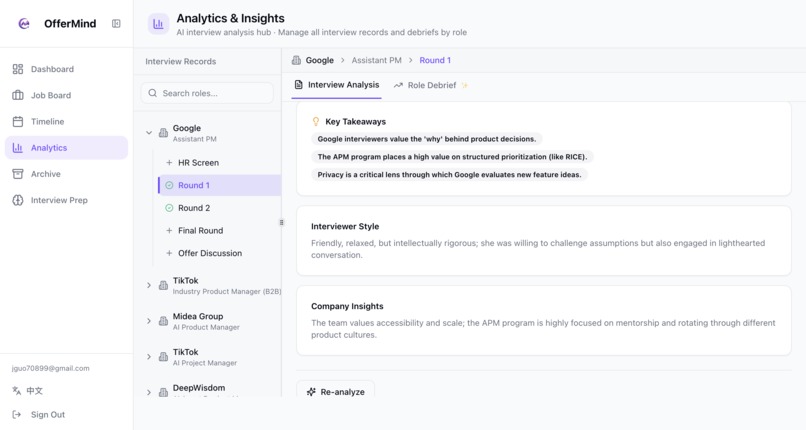
Interview Analysis
-
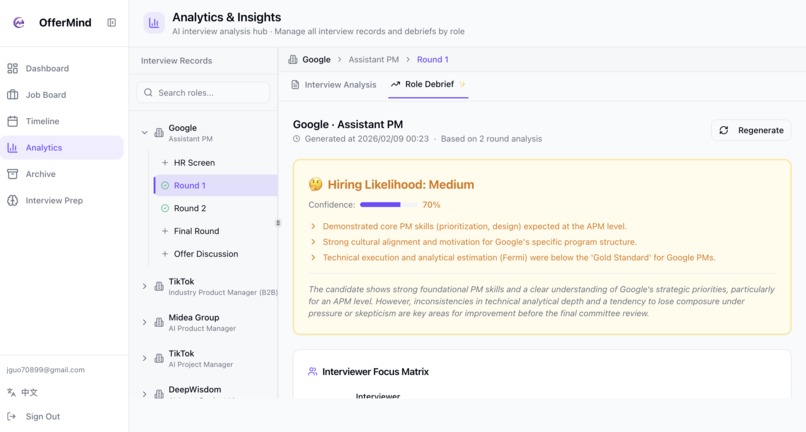
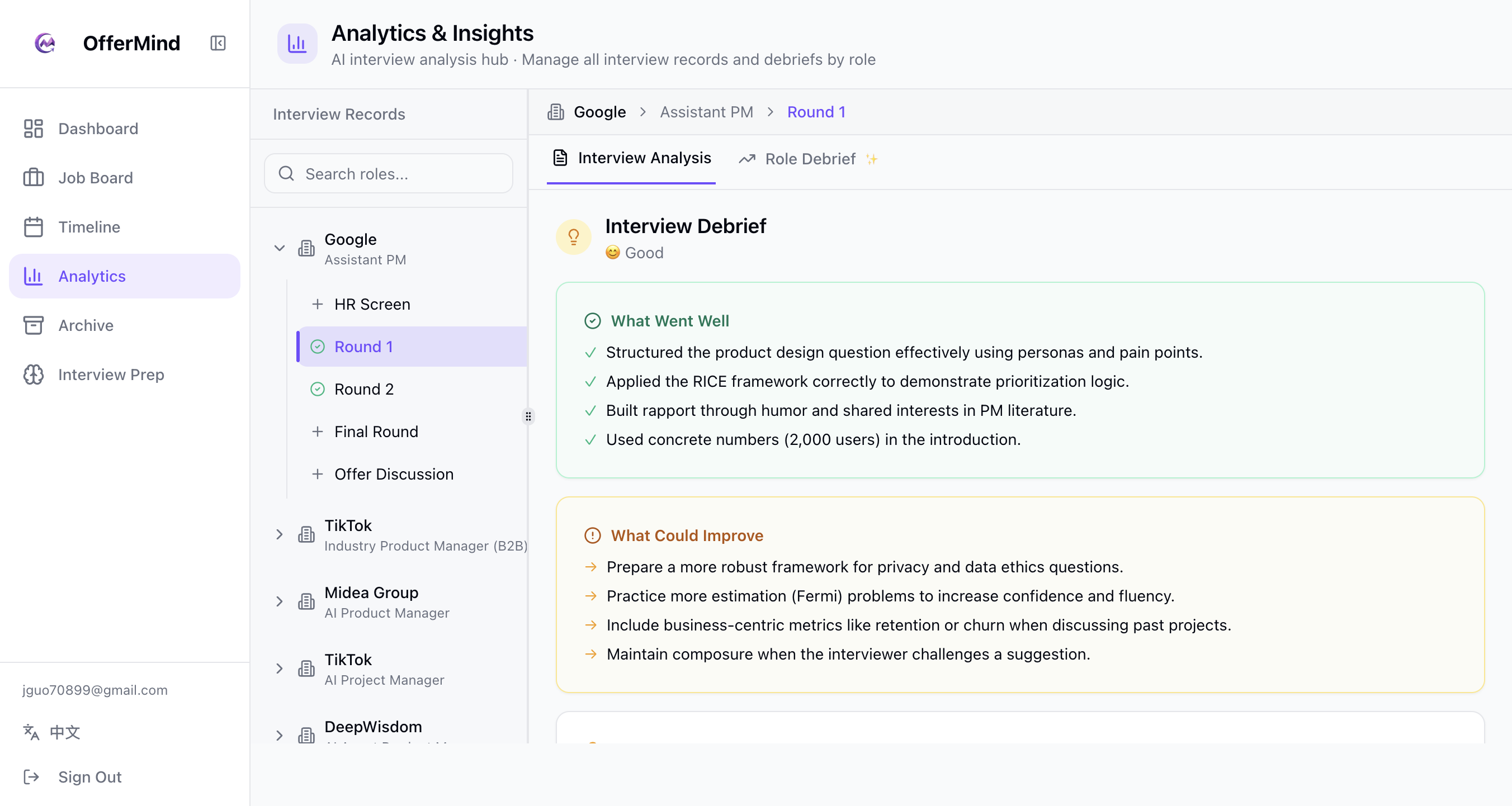
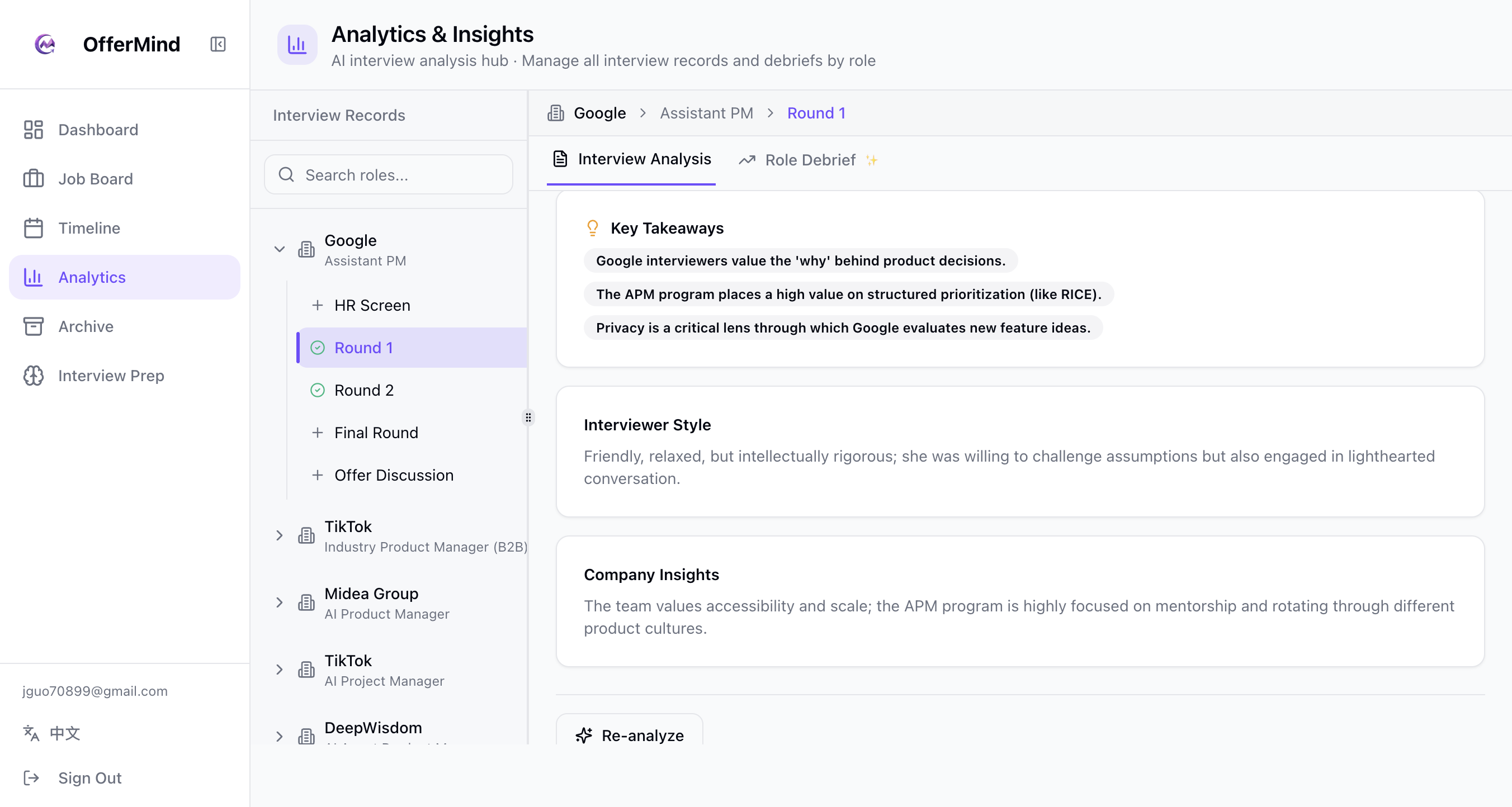
Role Debrief
-
Role Debrief
-
Role Debrief
-
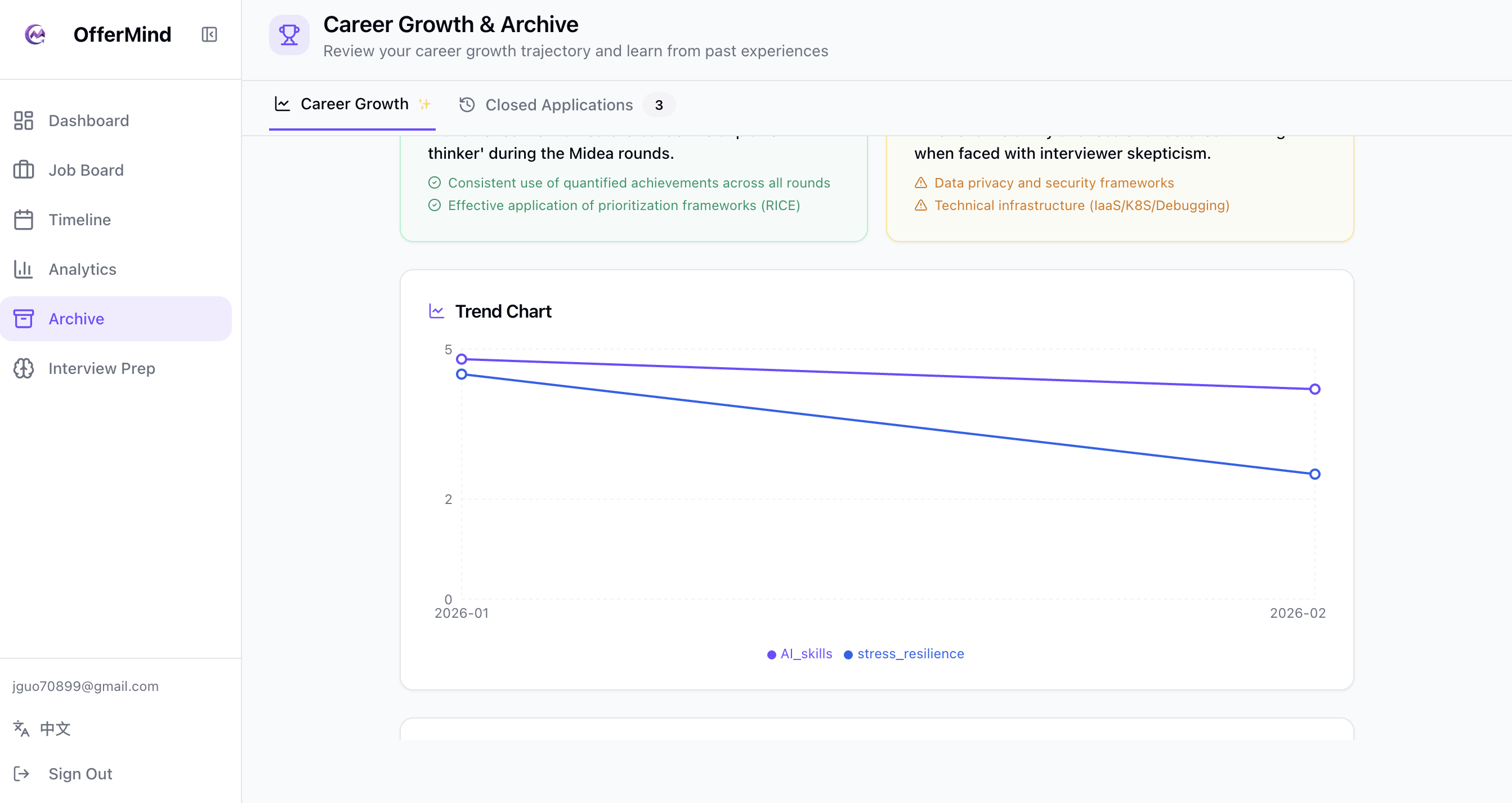
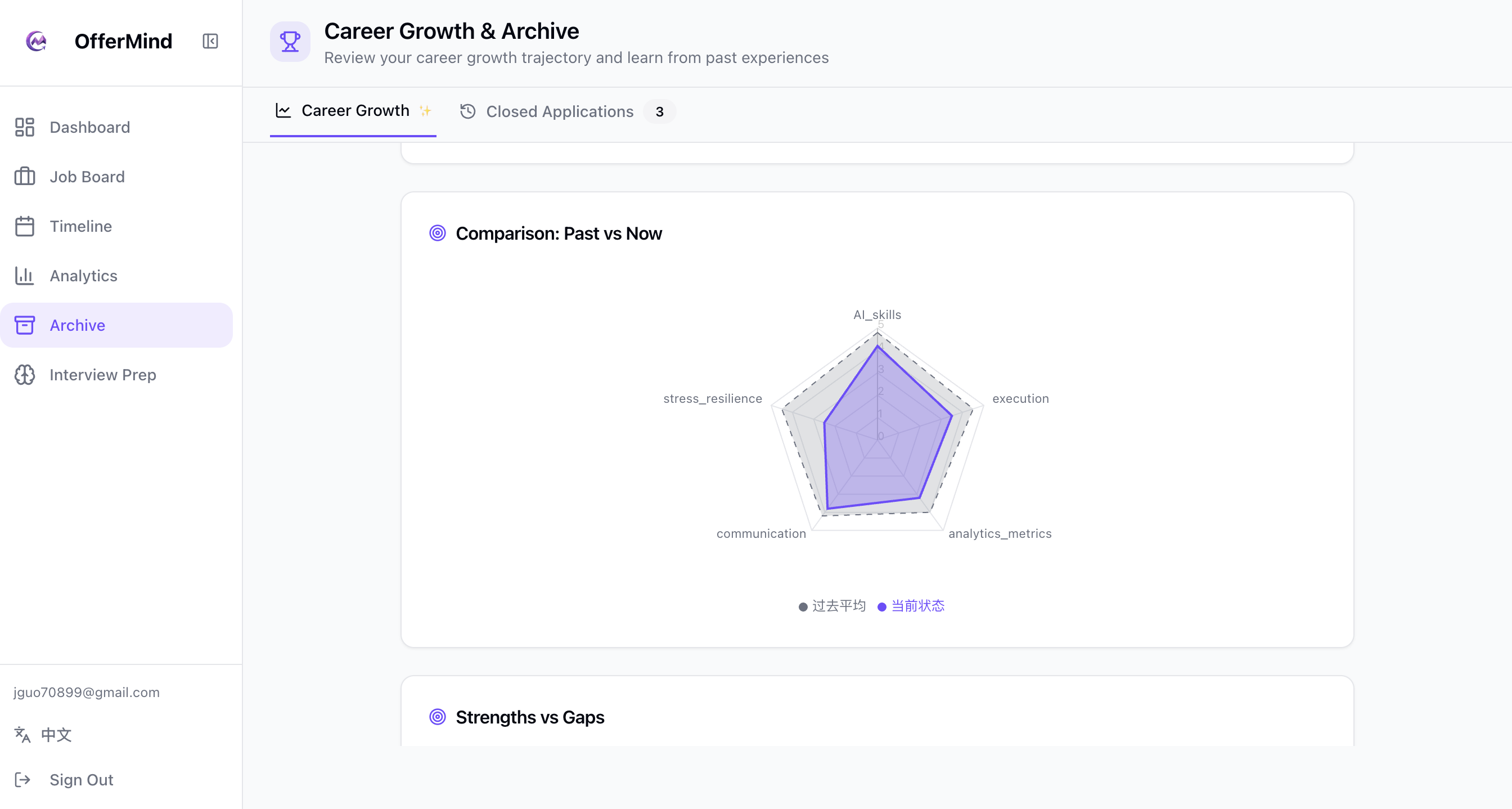
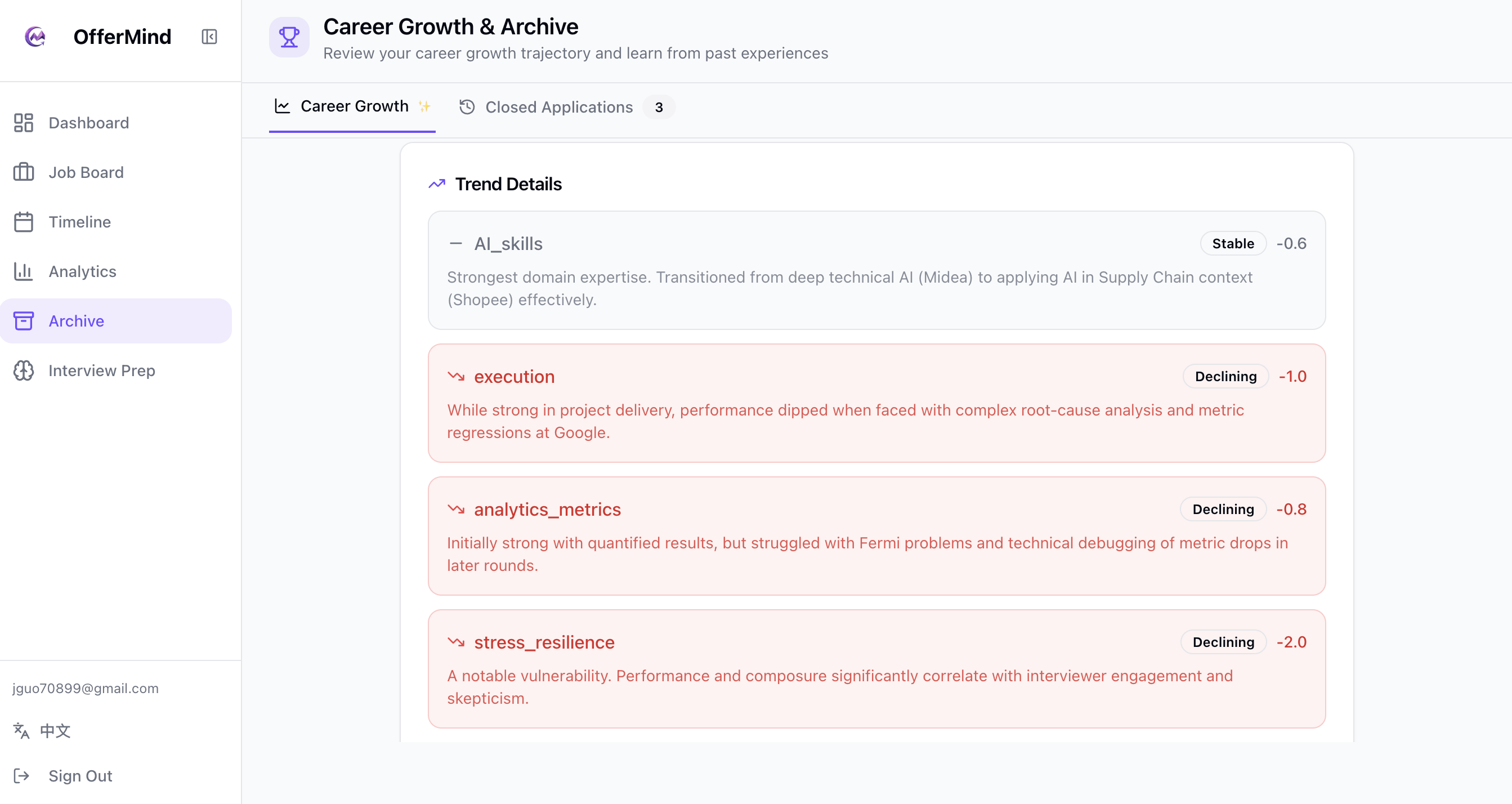
Career Growth Intelligence
-
Career Growth Intelligence
-
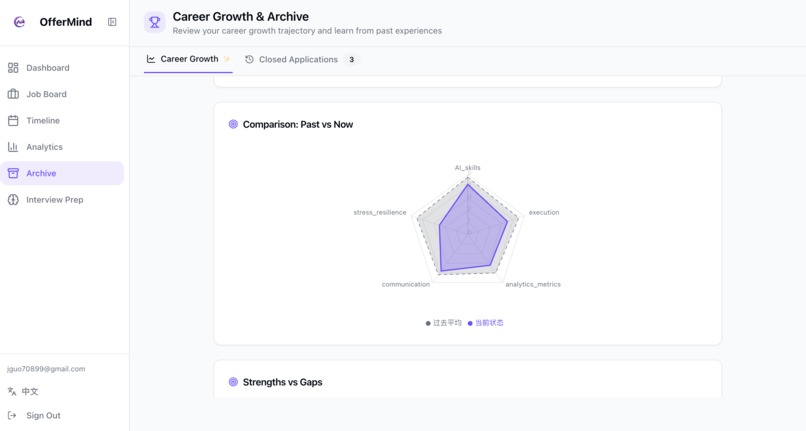
Career Growth Intelligence
-
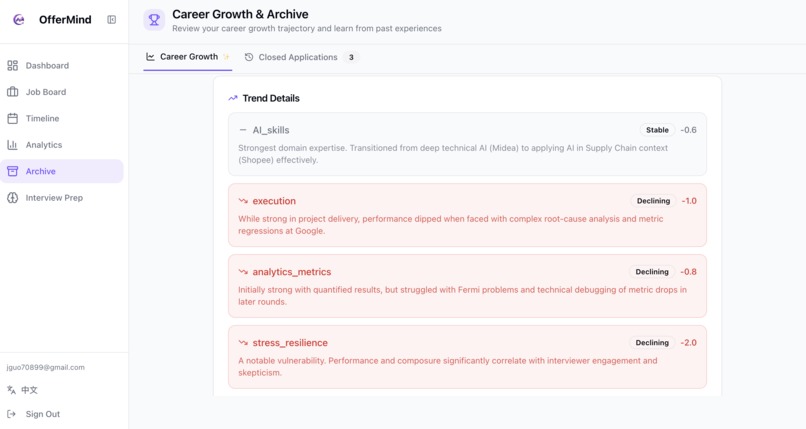
Career Growth Intelligence
-
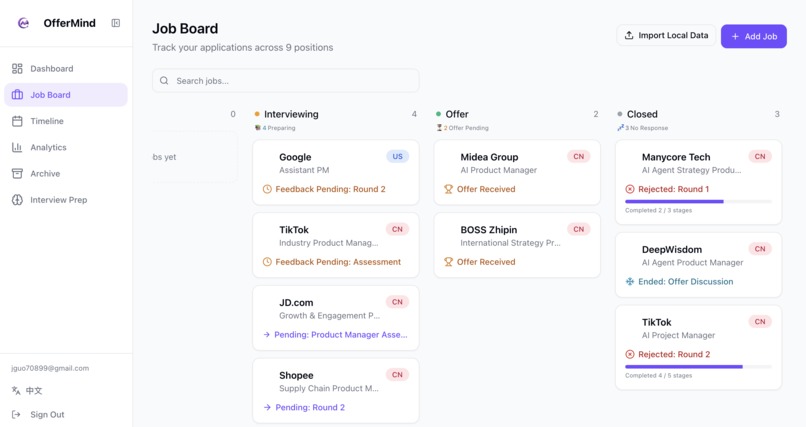
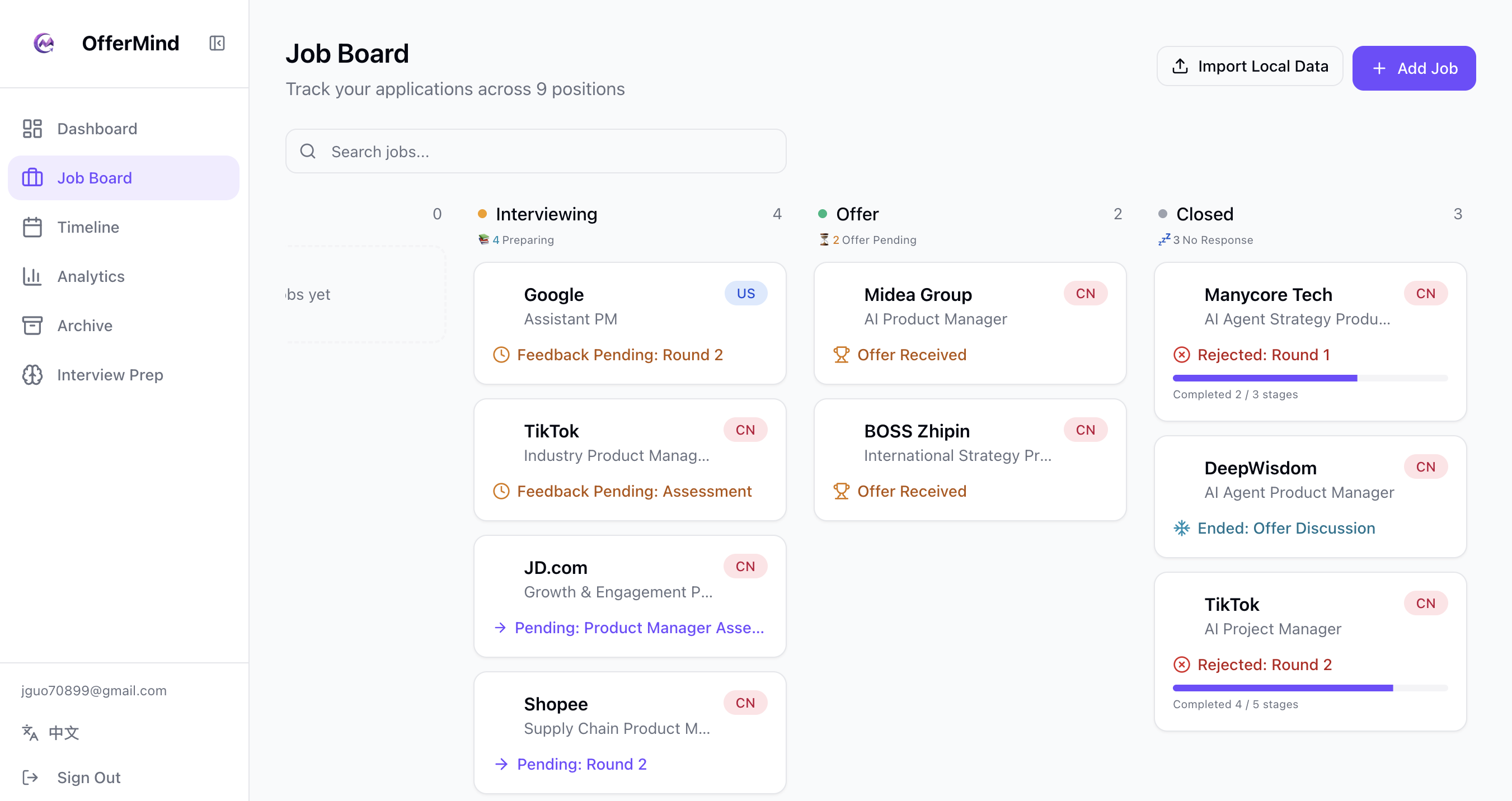
Job Tracking Board
-
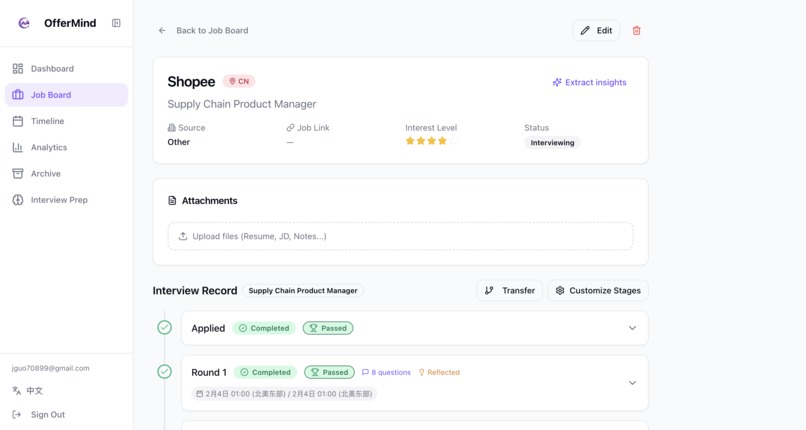
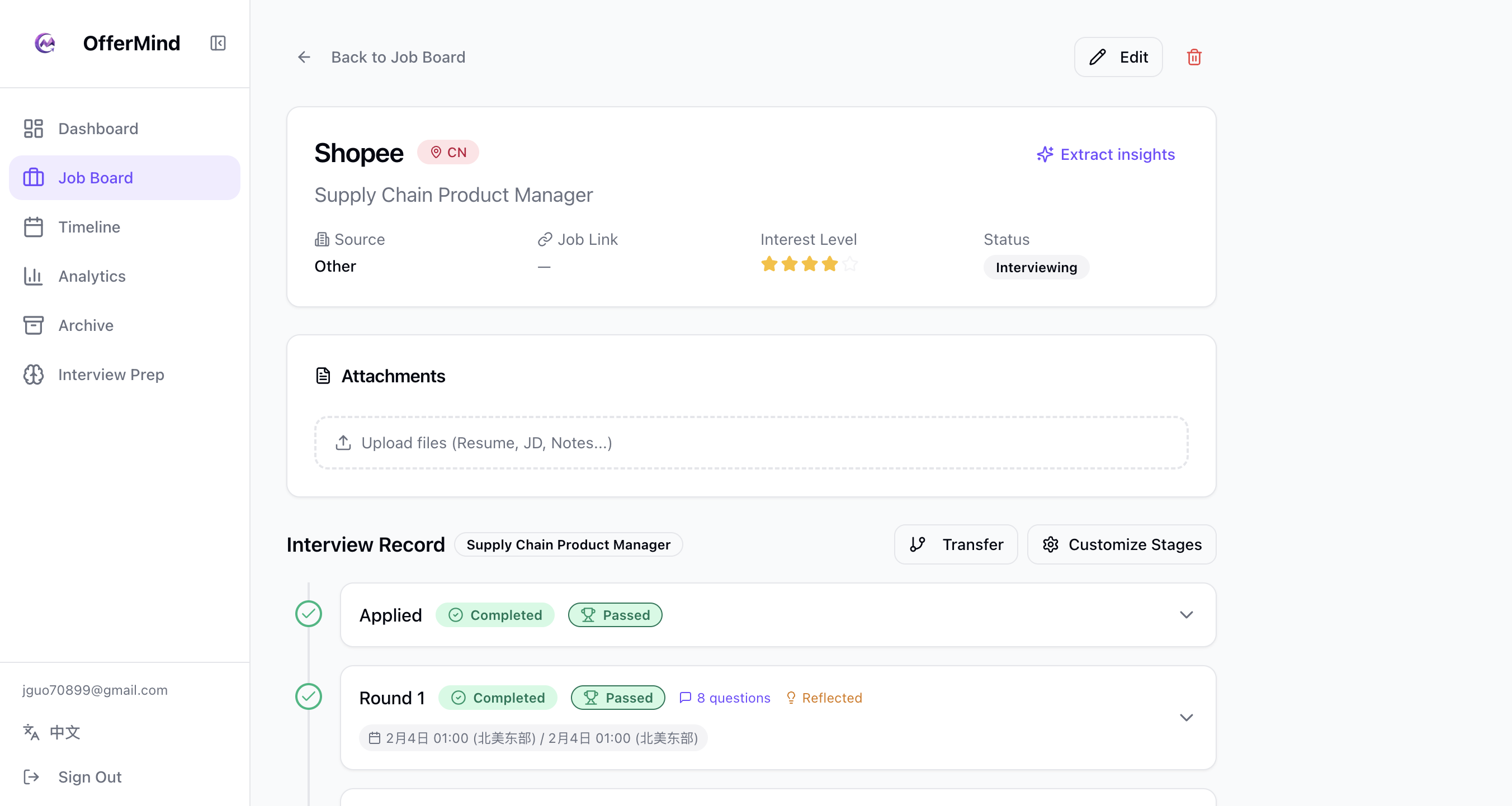
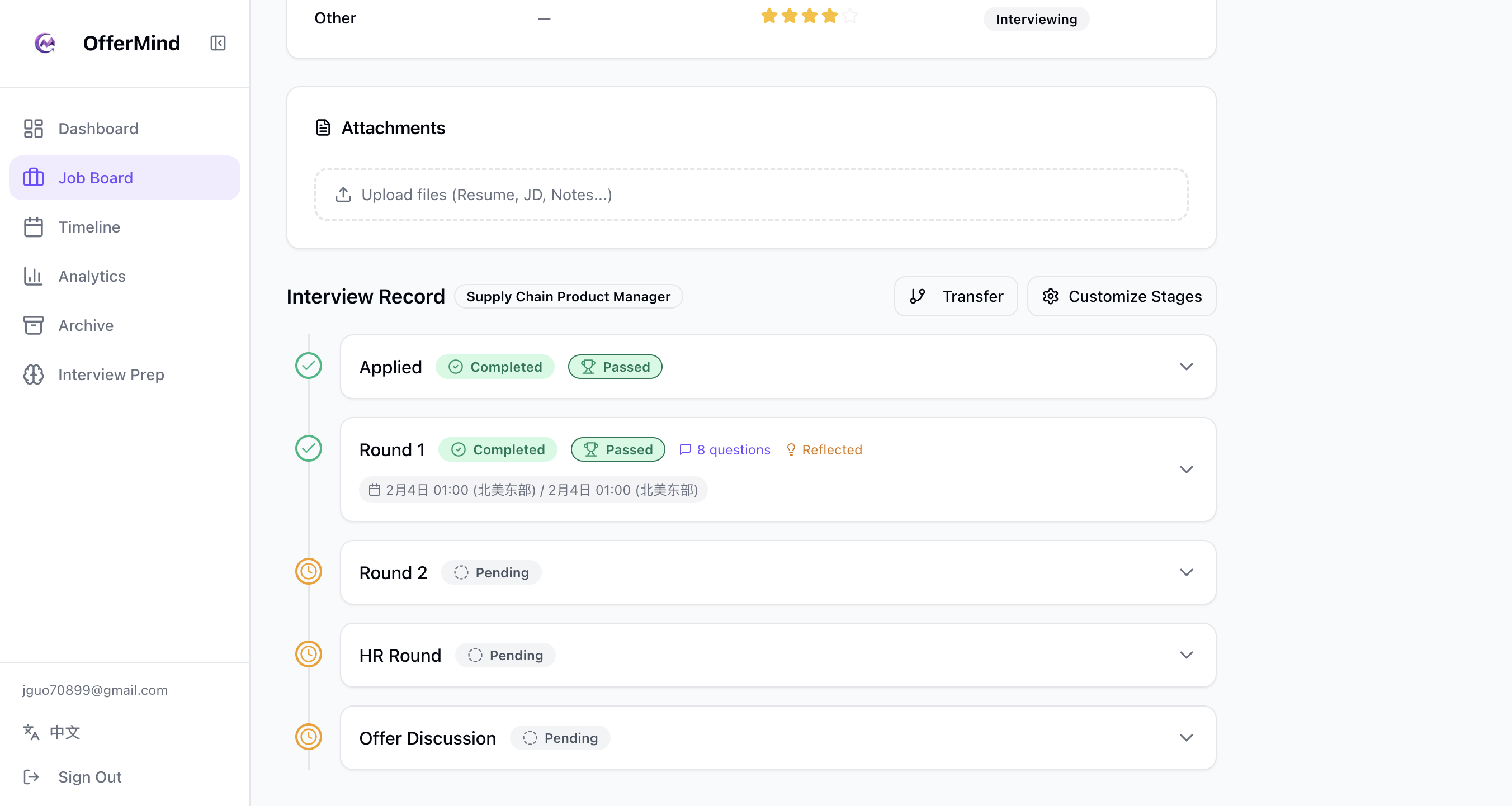
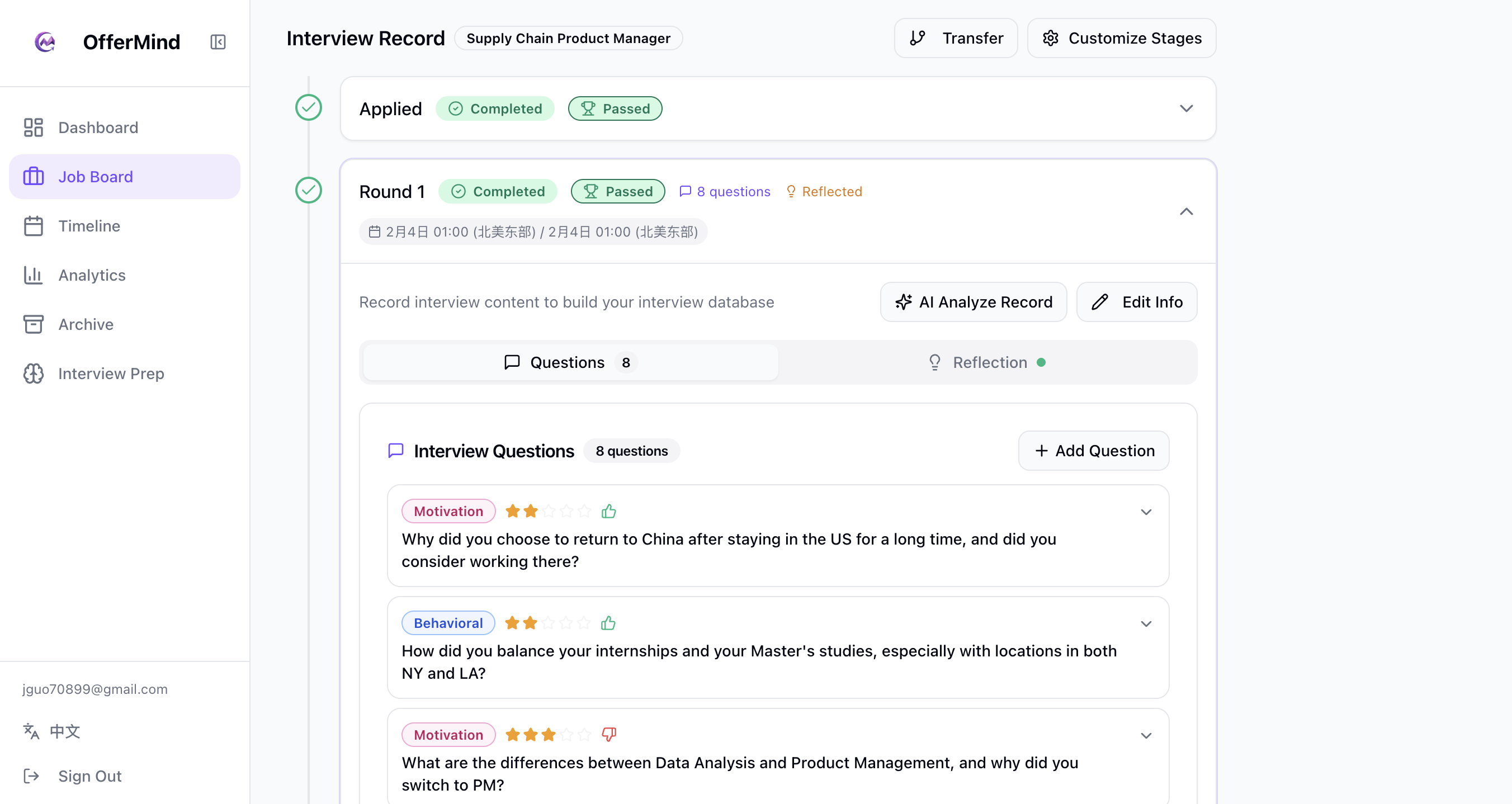
Job Detailed Page
-
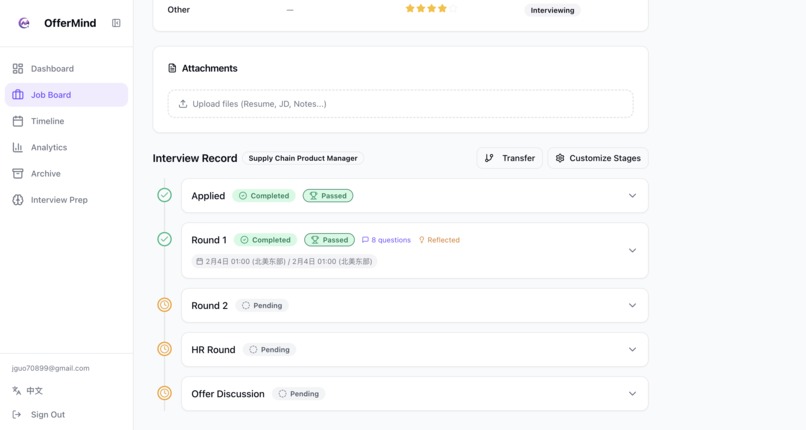
Job Detailed Page
-
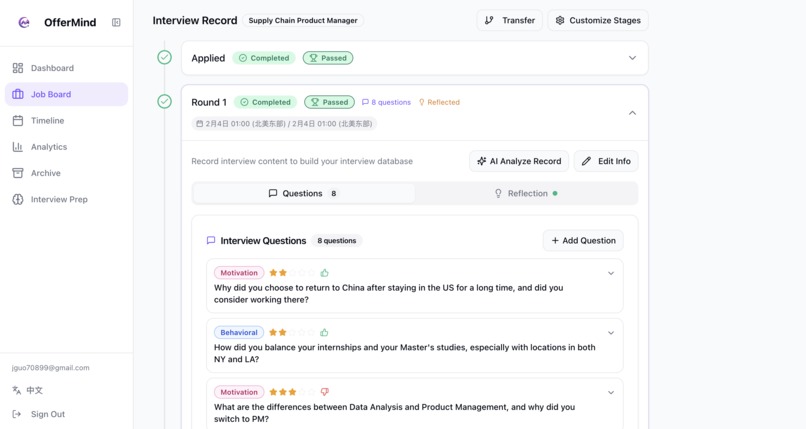
Job Detailed Page
-
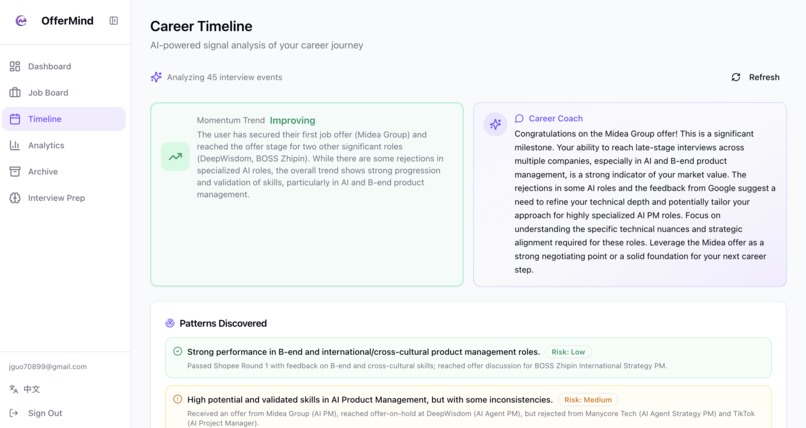
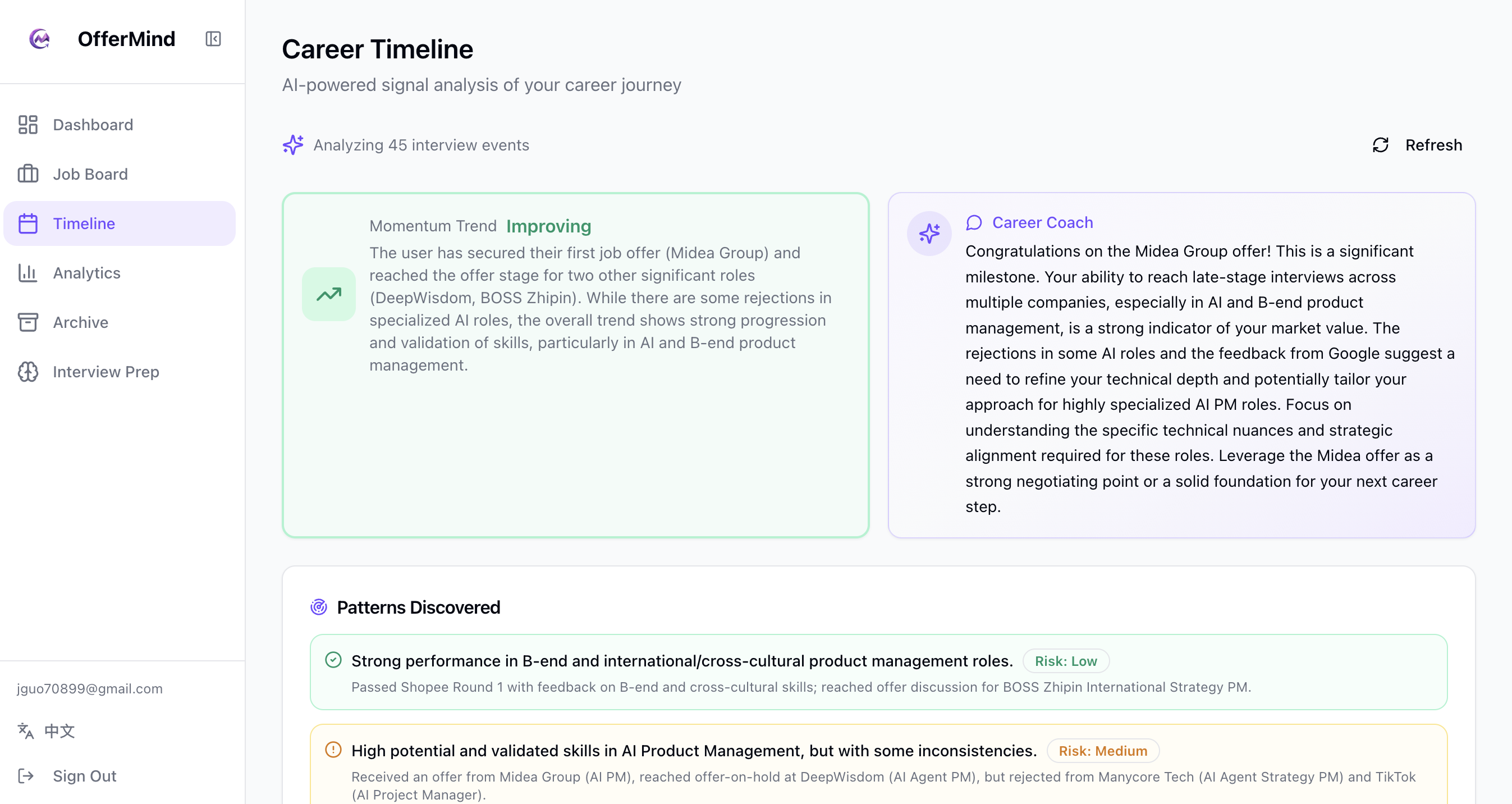
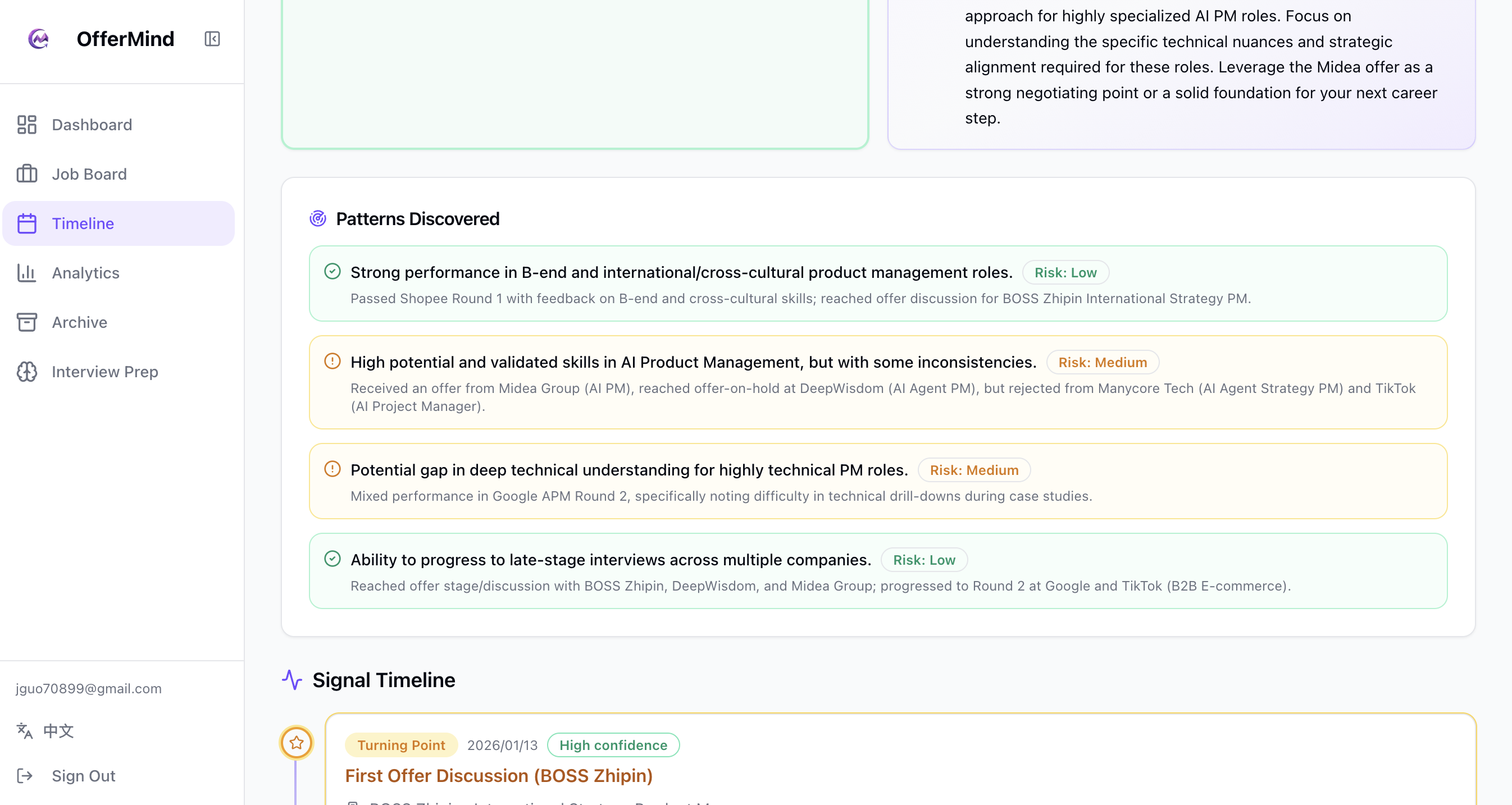
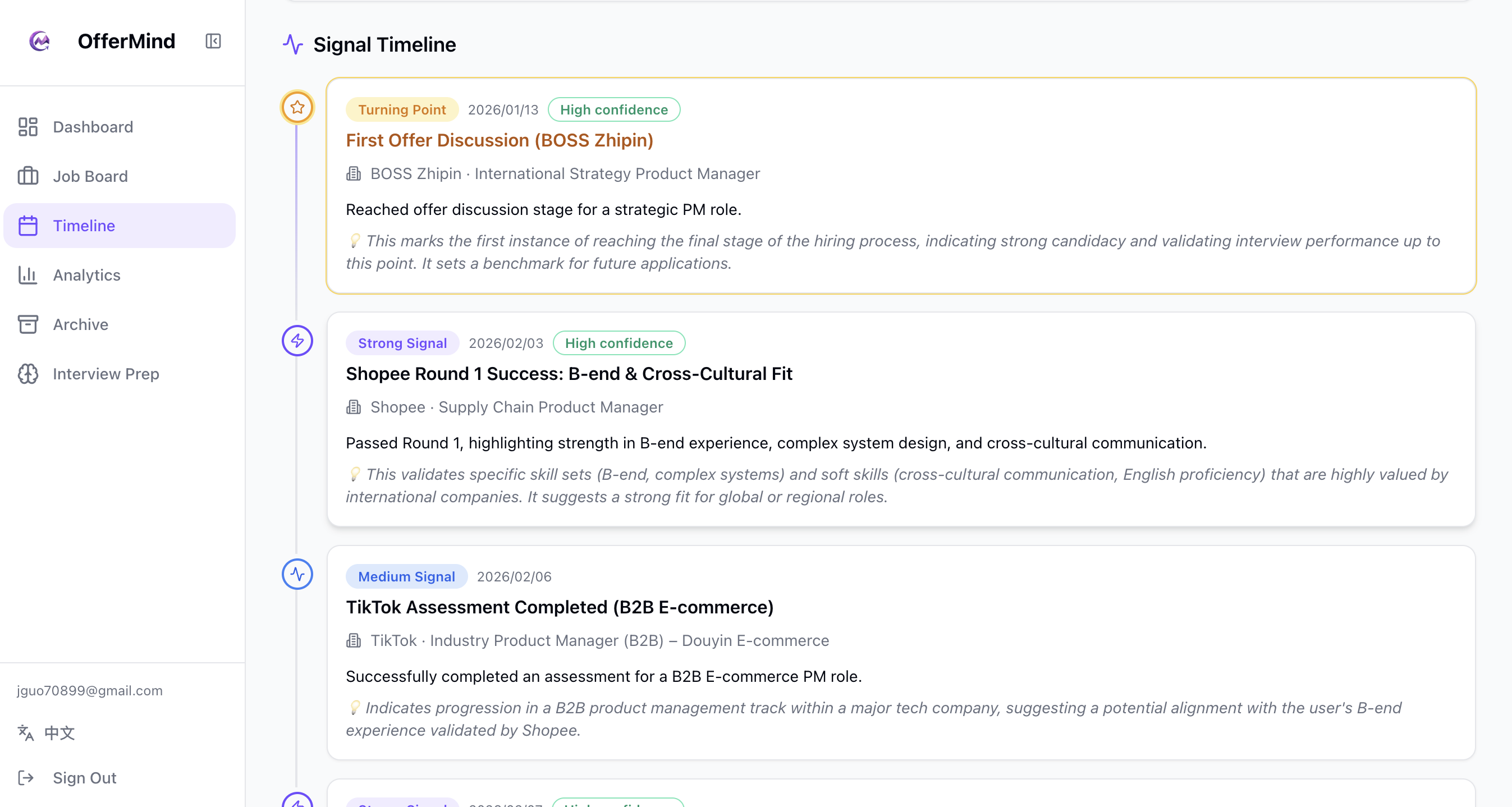
Career Timeline
-
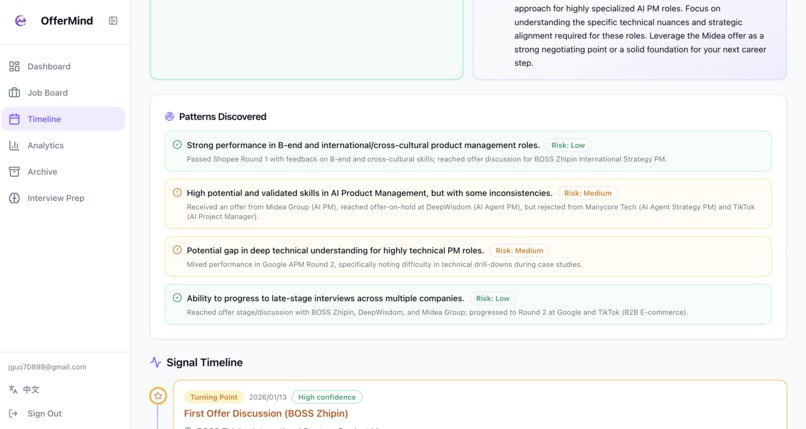
Career Timeline
-
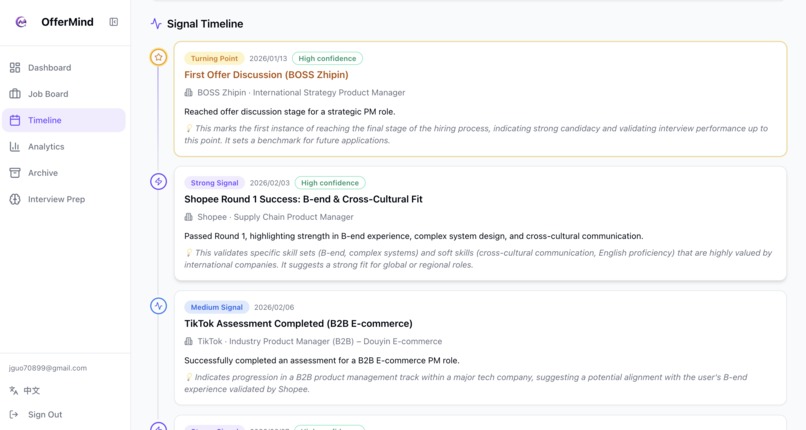
Career Timeline
OfferMind — Think Like Candidates Who Get Offers
Project Inspiration
I built OfferMind after noticing a pattern many candidates experience but rarely articulate.
I was doing everything "right" — tracking applications, preparing carefully, taking detailed notes, and reflecting after each interview.
Yet more interviews didn't bring more clarity.
I couldn't confidently answer questions like:
- Am I actually improving?
- Which skills are consistently holding me back?
- Why do strong interviews still end in rejection?
- And when offers finally arrive — why is choosing between them so difficult?
Most job search tools optimize for status tracking. Very few help candidates truly understand themselves.
That gap — between activity and insight — is what inspired me to build OfferMind.
What OfferMind Does
OfferMind is built on a simple belief:
Interviews should not be disposable events. They should become reusable career data.
Every interview contains valuable signals about skills, communication, decision-making, and role fit. Instead of letting those signals disappear after each round, OfferMind converts them into structured intelligence that compounds over time.
The goal is not just to prepare better for the next interview.
It is to help candidates think like people who consistently get offers.
How I Built It
OfferMind is designed as an AI-first system, not a traditional application with AI added later.
The platform operates across three layers of intelligence.
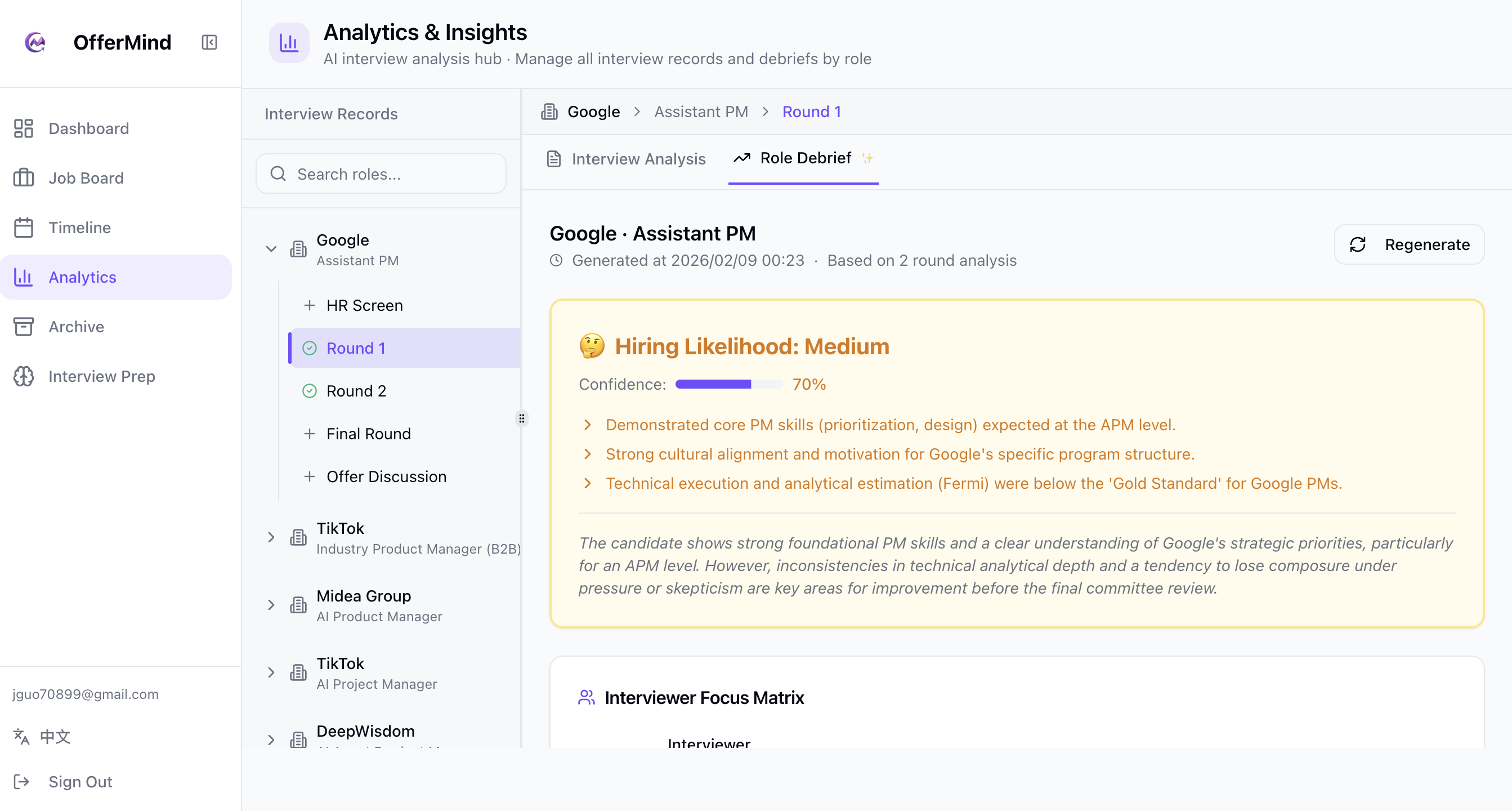
Interview Round Level — Structured Truth
Each transcript or interview note is analyzed to:
- Extract questions
- Classify question types and difficulty
- Evaluate response quality
- Generate concrete reflections
This transforms messy interview experiences into a reliable, structured record.
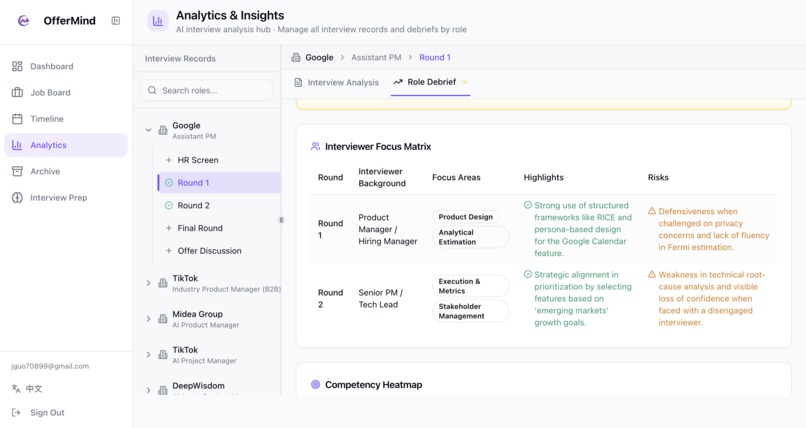
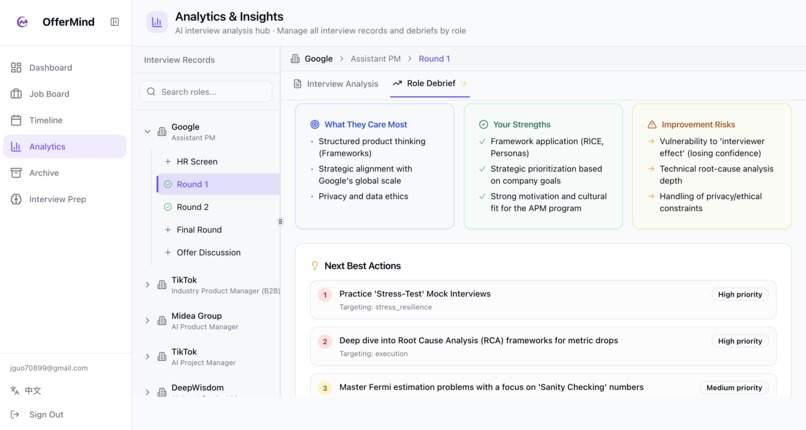
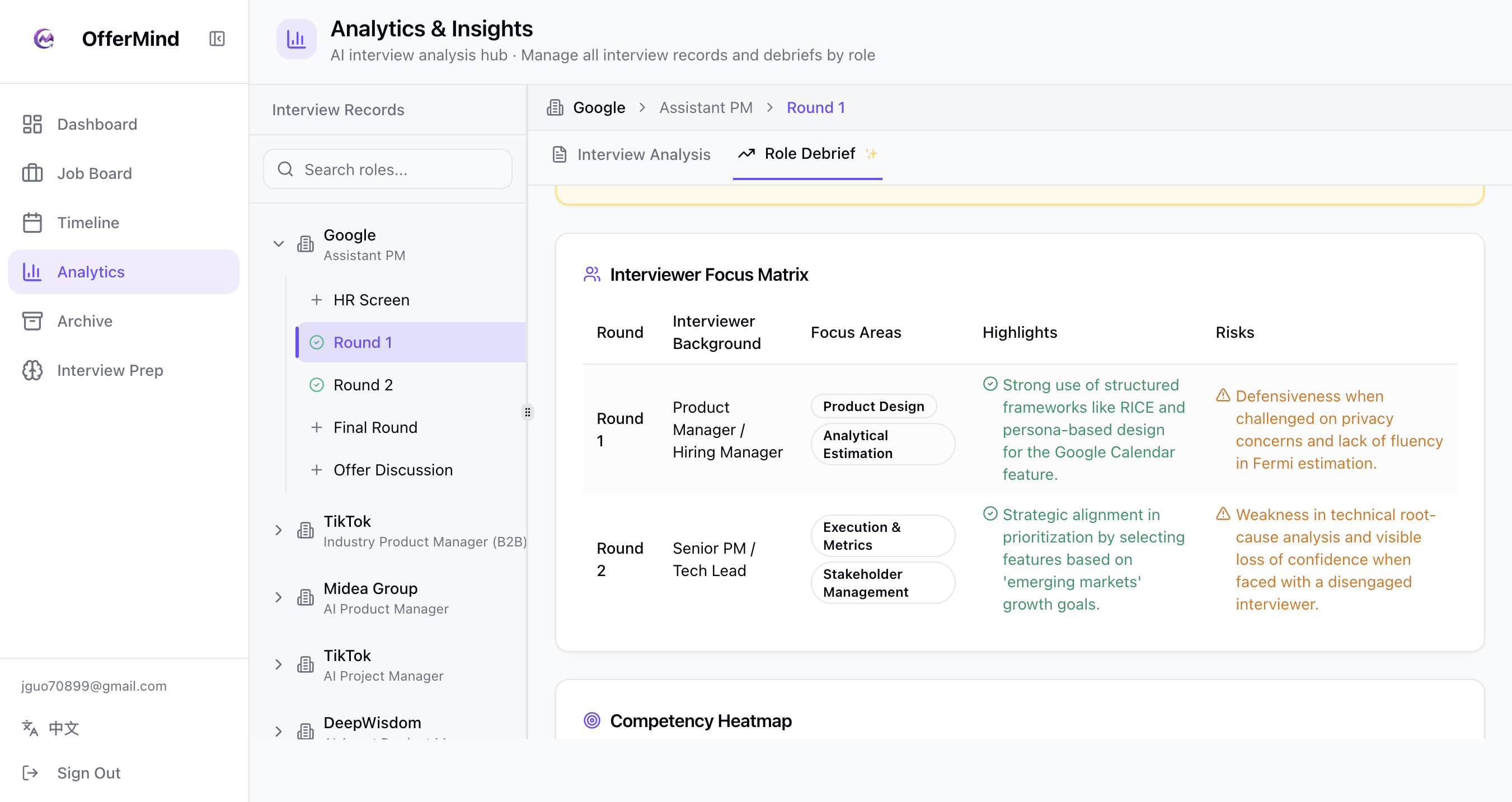
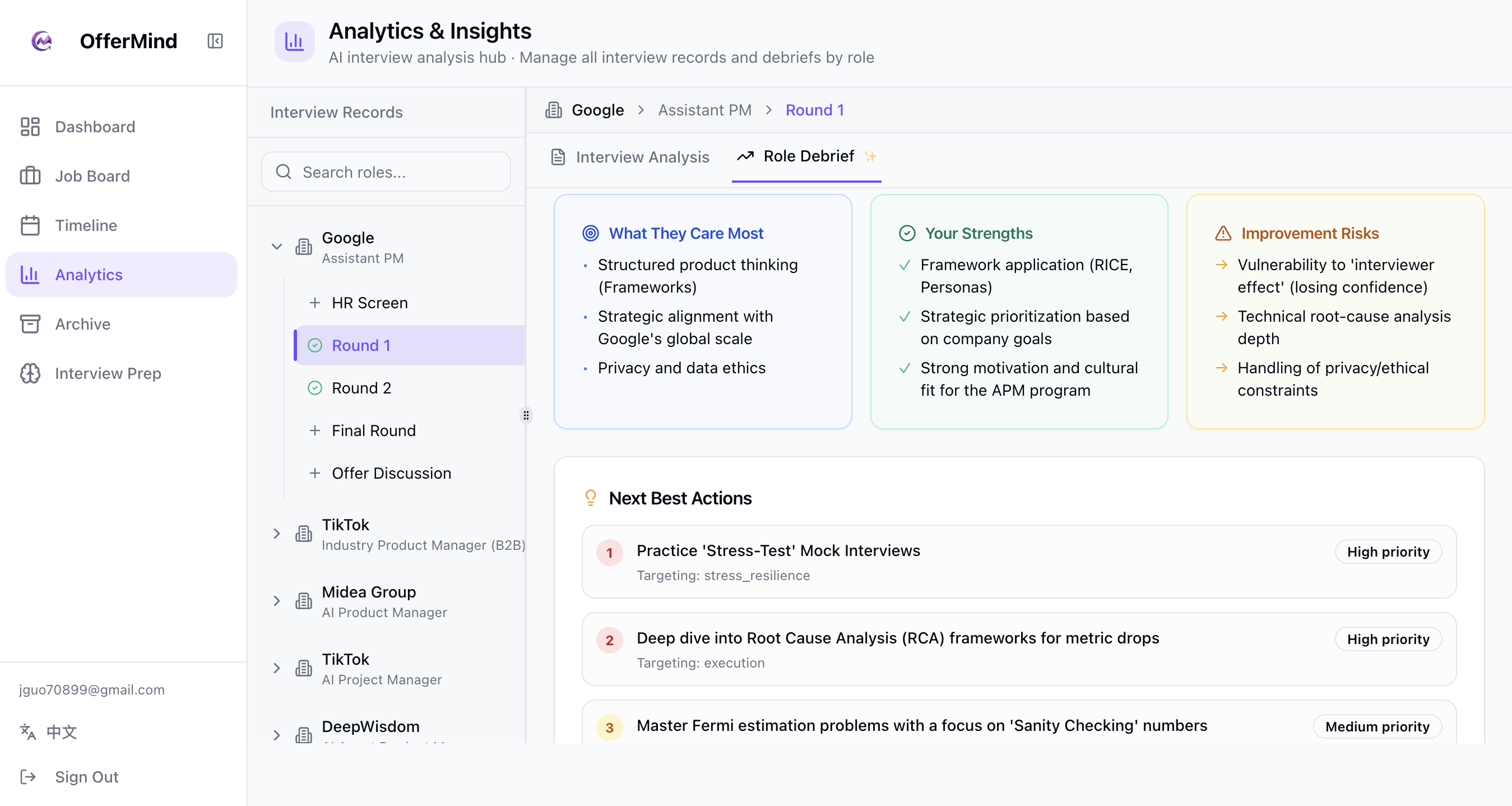
Role Level — Signal Aggregation
Signals from multiple rounds are synthesized to identify:
- Strengths and vulnerabilities
- Interviewer focus patterns
- Hiring signals
- Role-specific risks
Candidates stop guessing what interviewers wanted — and start seeing it clearly.
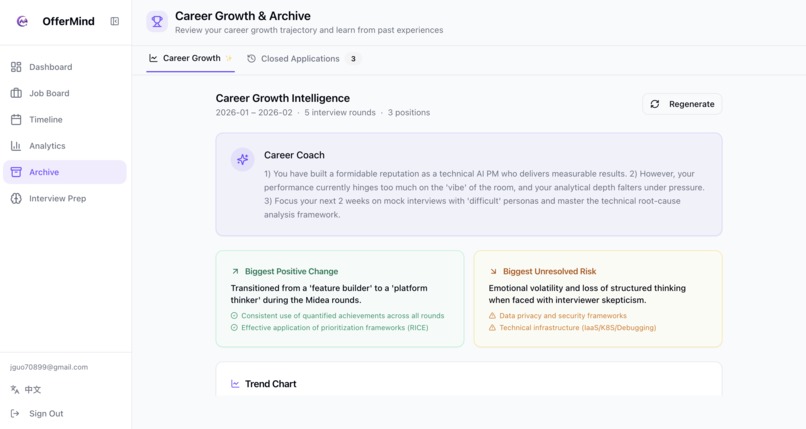
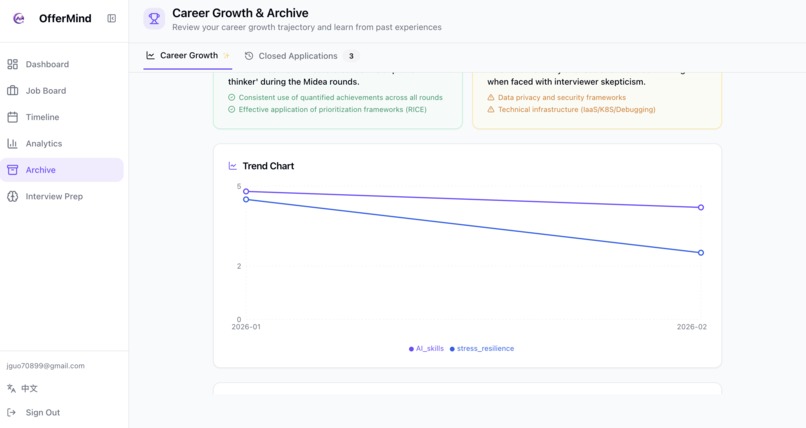
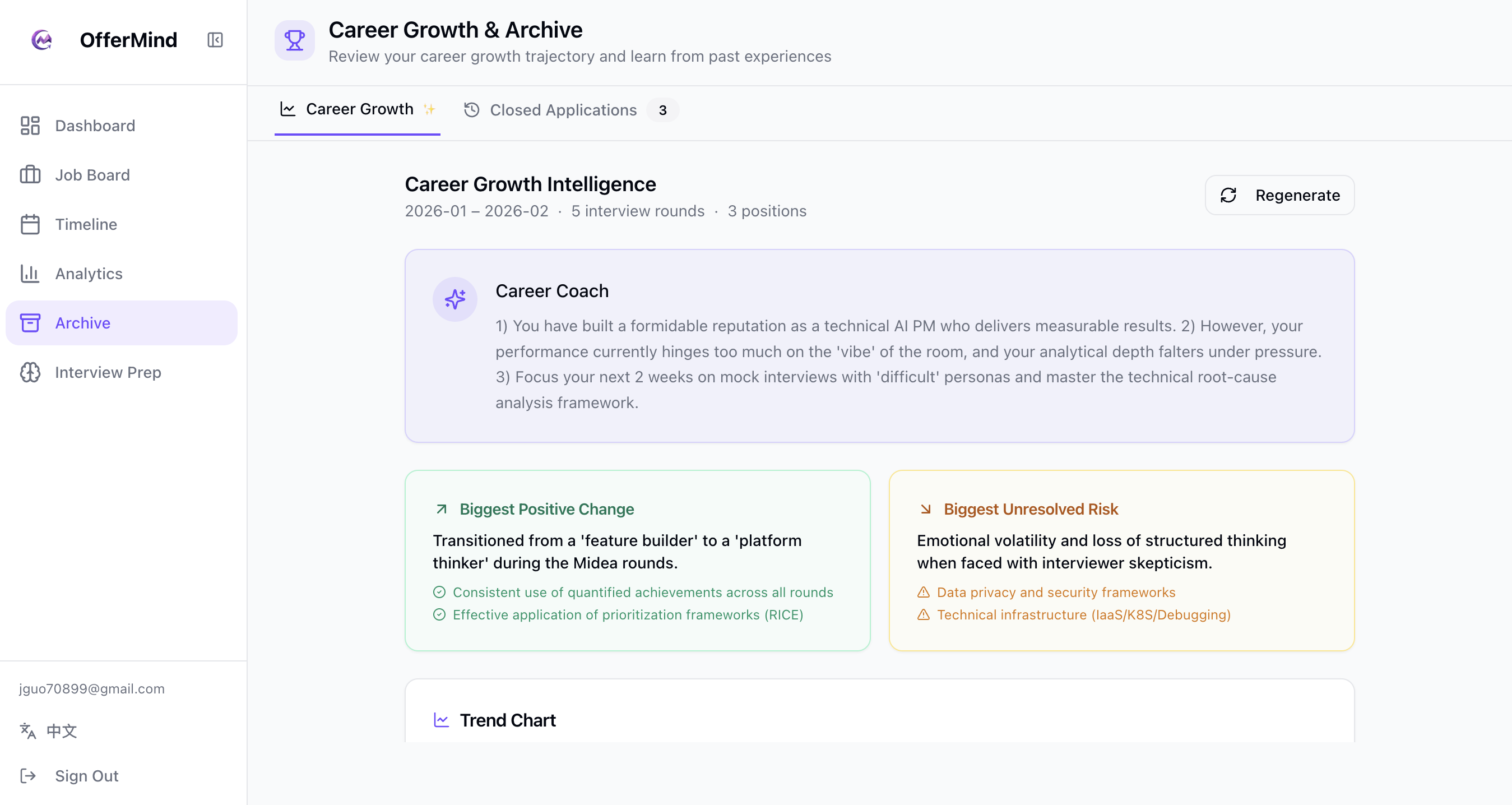
Career Level — Longitudinal Intelligence
Across companies and roles, OfferMind tracks:
- Competency evolution
- Turning points
- Stable improvements vs. temporary spikes
- Persistent, high-impact gaps
The result is not just feedback — it is trajectory awareness.
How OfferMind Uses Google Gemini
OfferMind's intelligence is powered by Google Gemini models across its entire AI stack. Gemini was chosen for three key reasons:
Long-context reasoning — Interview transcripts are messy, lengthy, and often bilingual (Chinese/English). Gemini's large context window allows the system to process entire multi-round interview histories in a single pass, enabling cross-round pattern detection that shorter-context models would miss.
Structured output reliability — OfferMind requires strict JSON schema compliance for its 10-dimensional competency framework, evidence-based scoring, and visualization-ready data. Gemini consistently produces well-structured outputs that conform to complex schemas, reducing post-processing failures.
Unified on Gemini 3 Flash Preview — OfferMind standardizes on
gemini-3-flash-previewacross all AI agents. This next-generation model delivers the ideal balance of reasoning depth, structured output reliability, and speed for every layer of the system:
AI Agent Architecture × Gemini 3 API
| Layer | Agent | Function | What It Does |
|---|---|---|---|
| Layer 1 | Transcript Analyzer | analyze-transcript |
Processes individual rounds — extracts questions, classifies types/difficulty, evaluates response quality, generates structured reflections. |
| Layer 2 | Role Debrief Agent | generate-role-debrief |
Aggregates signals across 2–6 rounds per role — synthesizes patterns, detects hiring signals, generates competency heatmaps and role-level risk assessments. |
| Layer 3 | Career Growth Intelligence | analyze-career-growth |
Performs chronological cross-job analysis — turning point detection, stability assessment, frequency-impact prioritization, and counterfactual insights. |
| Utility | Career Signal Timeline | analyze-career-signals |
Filters raw activity events into high-impact career signals with pattern detection. |
| Utility | Transcript Parser | parse-document |
Extracts text from uploaded documents (PDF, images, DOCX) using Gemini's multimodal capabilities. |
Why Gemini 3 Flash Preview?
Gemini 3 Flash Preview was chosen as the unified model because it excels at all three demands of OfferMind's architecture: long-context reasoning (processing entire multi-round interview histories), strict structured output (complex JSON schemas with 10-dimensional scoring), and multimodal input (parsing PDFs and images). Its next-generation reasoning capabilities handle both lightweight classification tasks and complex cross-job synthesis without the latency trade-offs of larger models.
Evidence-Based Scoring
All Gemini-powered agents follow a strict evidence-based scoring protocol: every competency score (1–10) must be accompanied by specific textual evidence from the source transcript. This design principle reduces hallucination and ensures that AI-generated insights are traceable and explainable — critical for a system where users make career decisions based on the output.
Technical Philosophy
To support messy real-world interview data — often subjective and inconsistent — I leveraged long-context language models capable of synthesizing signals across time.
Key design principles include:
- Strict structured outputs to ensure explainability
- Evidence-based scoring to reduce hallucination
- Schema-driven analysis for visualization readiness
- Pattern-over-event logic to prevent overreacting to single interviews
The system prioritizes reasoning over impression.
Tech Stack
- Frontend: React 18, TypeScript, Vite, Tailwind CSS, shadcn/ui, Recharts, dnd-kit, react-i18next
- Backend: Supabase (PostgreSQL, Auth, Edge Functions)
- AI: Google Gemini (2.5 Flash, 3 Flash Preview) via API gateway
- Deployment: Lovable Cloud
Challenges I Faced
Turning Subjective Experiences into Reliable Data
Interview performance is inherently inconsistent. I designed prompts and schemas that focus on patterns rather than emotional recency.
Eliminating Generic AI Advice
Early versions sounded polished — but vague.
I addressed this by introducing:
- Time-based comparisons
- Frequency–impact prioritization
- Explicit unresolved risk detection
Advice became sharper, more actionable, and harder to ignore.
Balancing Guidance with Honesty
OfferMind is not designed to guarantee offers.
Instead, it improves decision quality while openly acknowledging uncertainty — because credibility matters more than artificial confidence.
What I Learned
Building OfferMind reshaped how I see job searching.
It is not a tracking problem. It is a decision-making problem.
I also learned:
- Users trust AI more when it explains its reasoning
- Long-term value comes from recognizing patterns
- The best AI systems strengthen human judgment rather than replace it
The goal is not automation.
The goal is clarity.
Future Directions
OfferMind is built to evolve.
Future work includes:
- Offer comparison grounded in personal growth trajectories
- Role-fit and career-path forecasting
- Personalized learning loops based on persistent gaps
- Privacy-safe benchmarking across similar candidates
The Long-Term Vision
Help people make career decisions they will not regret — not just pass their next interview.
OfferMind
Think like candidates who get offers.
Built With
- gemini
- openai
- postgresql
- react
- recharts
- supabase
- tailwind
- typescript

Log in or sign up for Devpost to join the conversation.