-
-
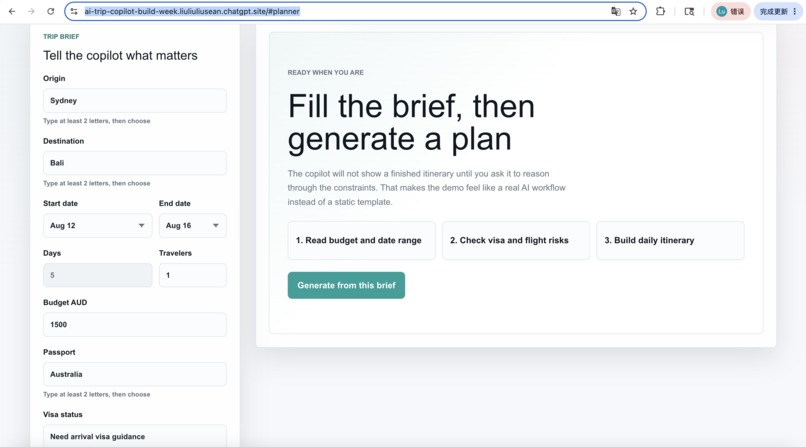
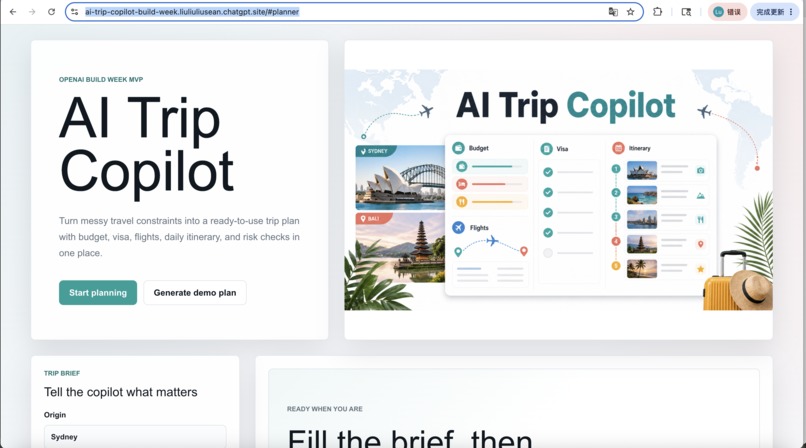
Standardized trip brief with keyword-matched origin, destination, passport, and visa inputs.
-
Generated AI Trip Copilot plan with visa checklist, flight strategy, budget, itinerary, and reasoning.
Inspiration
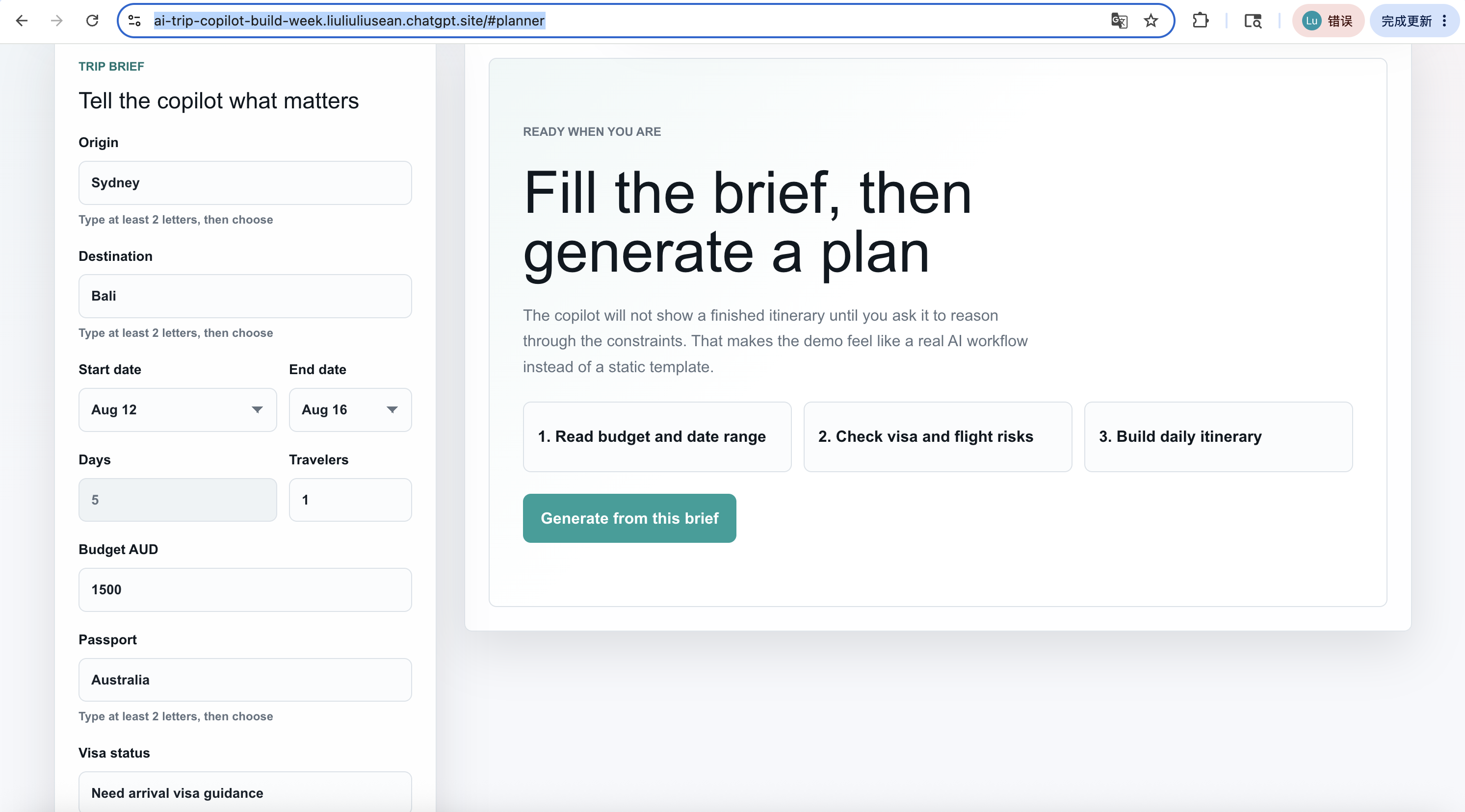
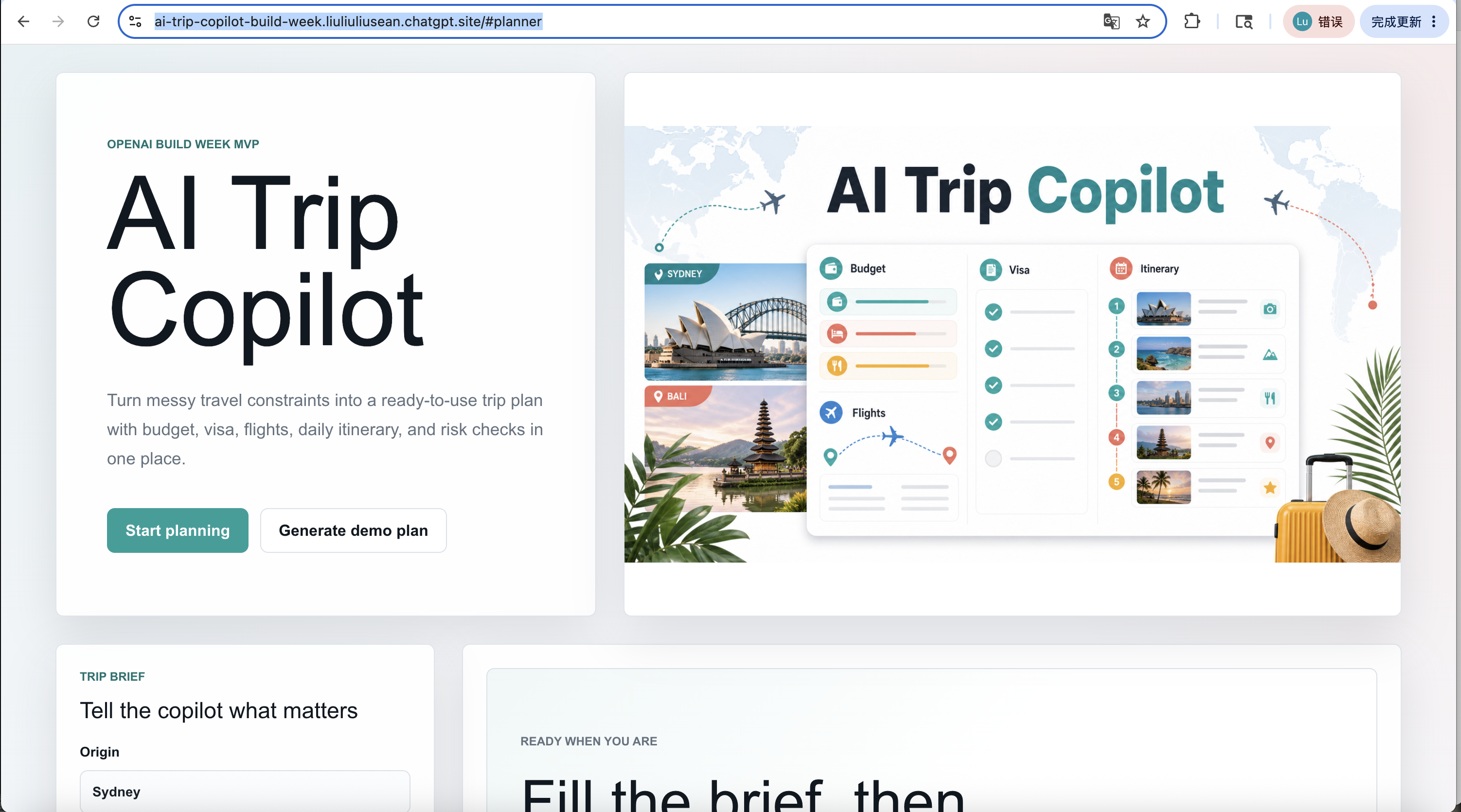
Travel planning usually starts with excitement and quickly becomes a mess of tabs: flights, entry rules, hotel budgets, maps, weather, local activities, and personal preferences. We wanted AI Trip Copilot to feel like a planning partner that can turn those scattered constraints into one practical plan.
What it does
AI Trip Copilot is an OpenAI Build Week MVP that turns a standardized travel brief into a budget-aware, visa-aware itinerary. The traveler enters origin, destination, start date, end date, passport, visa status, budget, travel style, and must-have activities.
Instead of leaving key fields as free-form text, the demo uses keyword matching and fixed selectors so the copilot receives cleaner inputs. After the user clicks Generate, the app shows a structured plan with:
- Visa checklist
- Flight strategy
- Budget breakdown
- Day-by-day itinerary
- Risk and timing checks
- A "Why this plan?" explanation
- A copy-ready final itinerary
The demo scenario focuses on a 5-day Sydney to Bali trip with a 1,500 AUD budget, but the product pattern can expand to more routes, visa rules, live prices, and collaborative planning.
How we built it
We used OpenAI Codex with GPT-5.6 to quickly design, implement, test, and deploy the MVP. Codex helped turn the product idea into a working Next.js and React app, including the page structure, responsive layout, trip input model, generation flow, planning logic, README, tests, and submission materials.
The frontend is built with Next.js, React, TypeScript, and Tailwind CSS. The demo is deployed with Sites to a public production URL. The current MVP uses a deterministic planning model in the app so judges can reliably see the full flow without needing a private API key during review.
How Codex and GPT-5.6 were used
OpenAI Codex and GPT-5.6 were used throughout development to:
- Scope the project into a realistic Build Week MVP
- Design the "brief to generated plan" product flow
- Implement and refine the React interface
- Generate the planning logic and judge-facing explanation copy
- Create the README, demo script, and submission materials
Future runtime integration would connect the standardized trip brief to an OpenAI model call so the itinerary can be generated dynamically from live user constraints and external travel data.
Challenges
The main challenge was making the demo feel like a real AI workflow in a short time. A static itinerary would not be convincing, so we added a clear sequence: standardize the brief, generate, show reasoning, then display the final plan.
Another challenge was avoiding messy free-form inputs for fields like origin, destination, passport, and visa status. We changed those into suggestion-driven controls so the generated plan starts from cleaner data.
Accomplishments that we're proud of
We are proud that the MVP is demoable end to end: a judge can open the live site, fill or adjust the brief, generate the plan, inspect the reasoning, and copy the result. The app also has a focused product angle instead of trying to become a full travel platform in one week.
What we learned
We learned that for AI product demos, the input structure matters as much as the model output. If the user gives the AI cleaner constraints, the generated result is easier to trust, explain, and improve.
What's next
- Add live OpenAI model generation from the standardized brief
- Connect flight price and visa-rule APIs
- Add saved trips and shareable itinerary links
- Add collaborative planning for two or more travelers
- Expand autocomplete coverage to more cities, passports, and destinations
- Add confidence scores and source links for visa and budget assumptions
Built With
- github
- gpt-5-6
- nextjs
- openai-codex
- react
- sites
- tailwindcss
- typescript

Log in or sign up for Devpost to join the conversation.