-
-
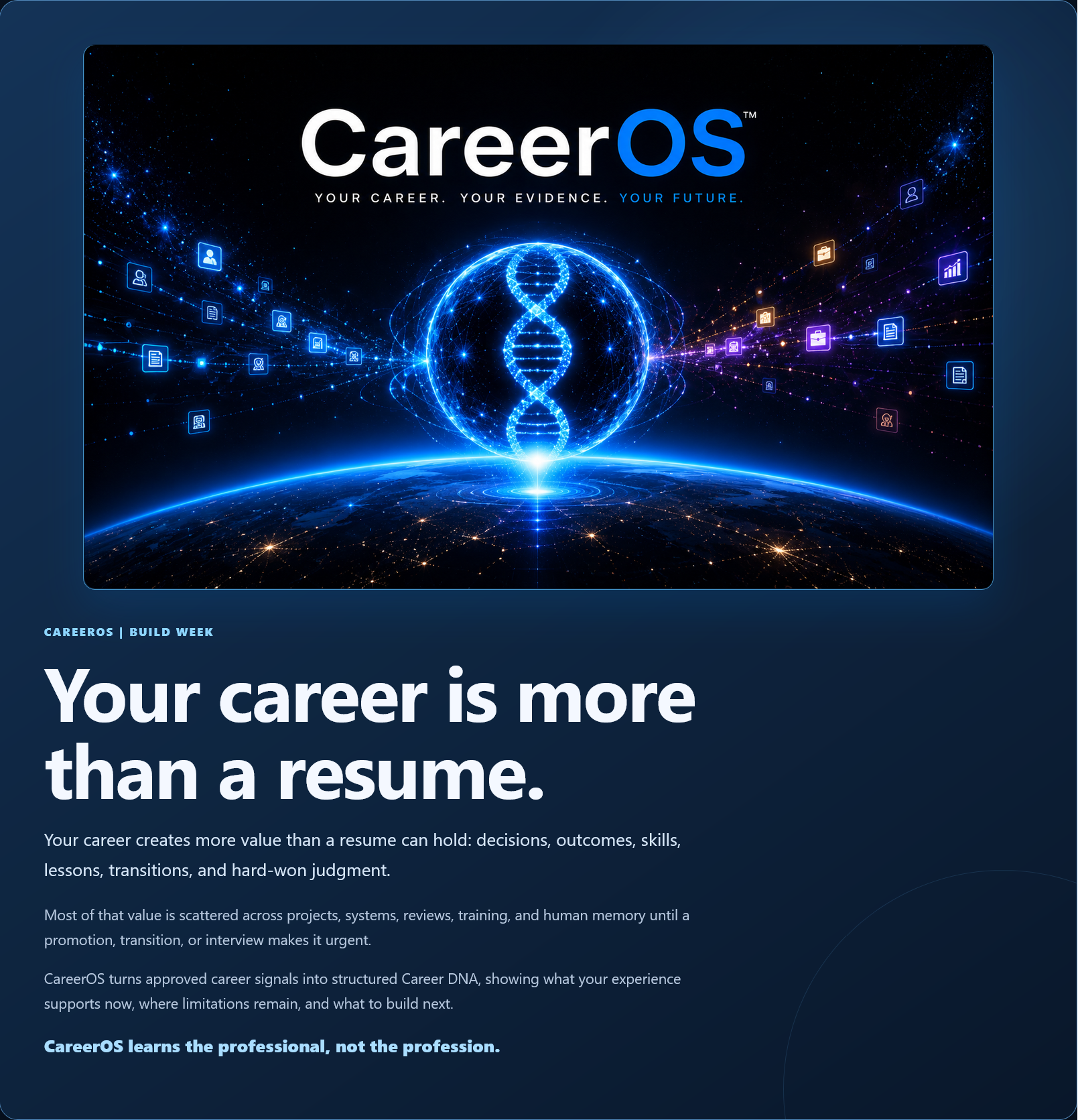
CareerOS turns approved evidence into user-owned Career DNA, showing strengths, limitations, readiness, direction, and what to build next.
-
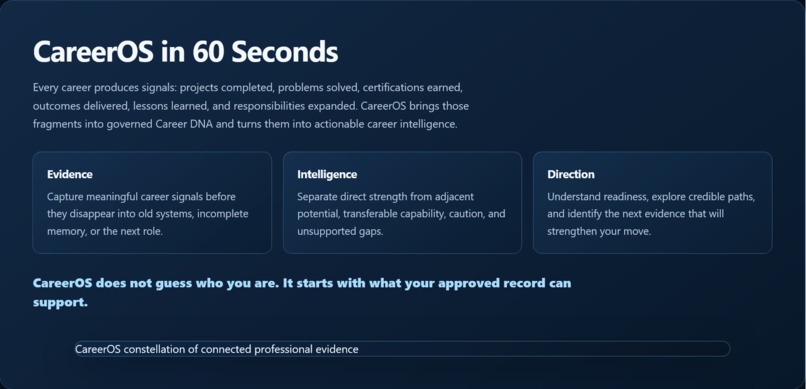
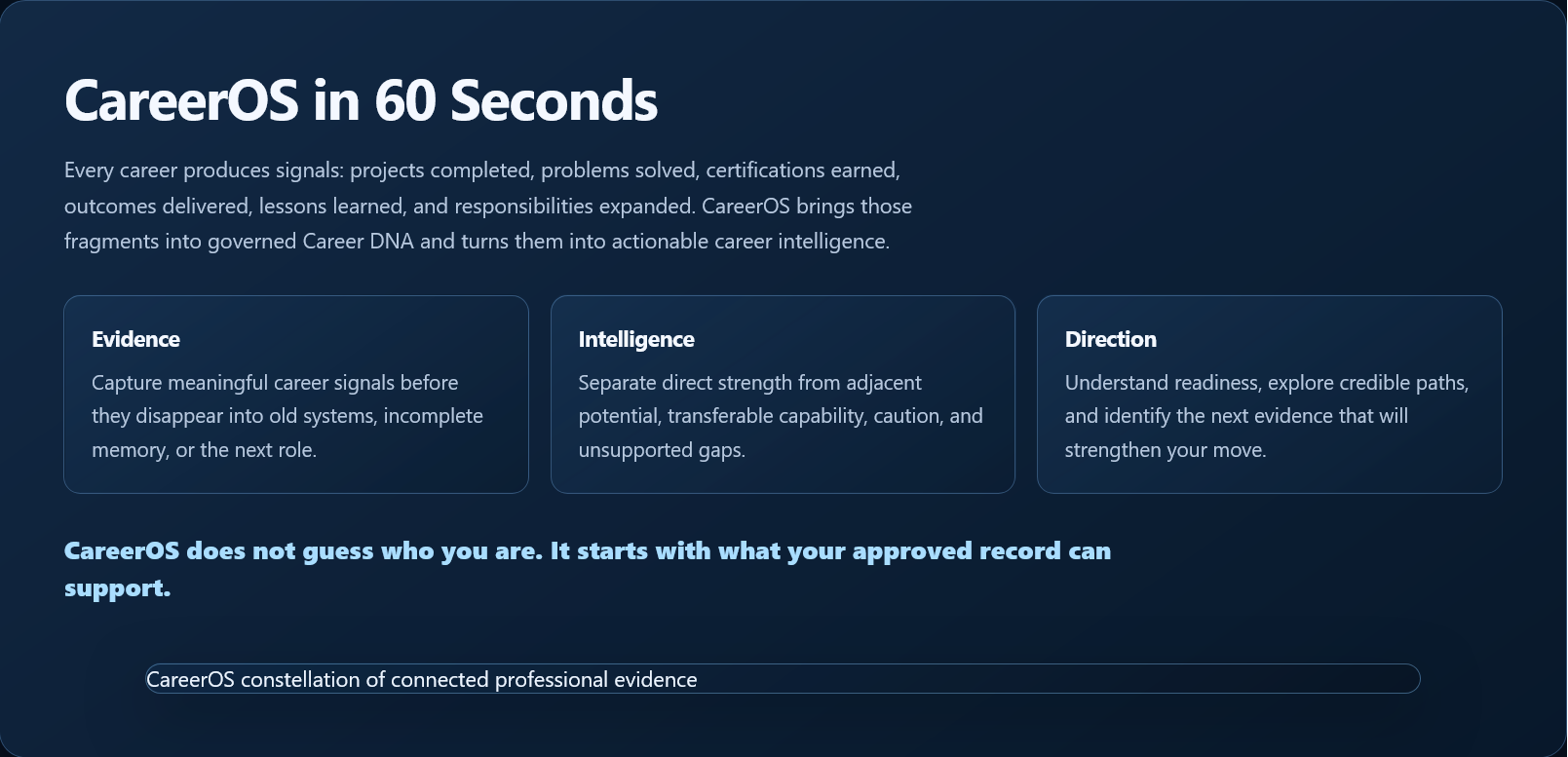
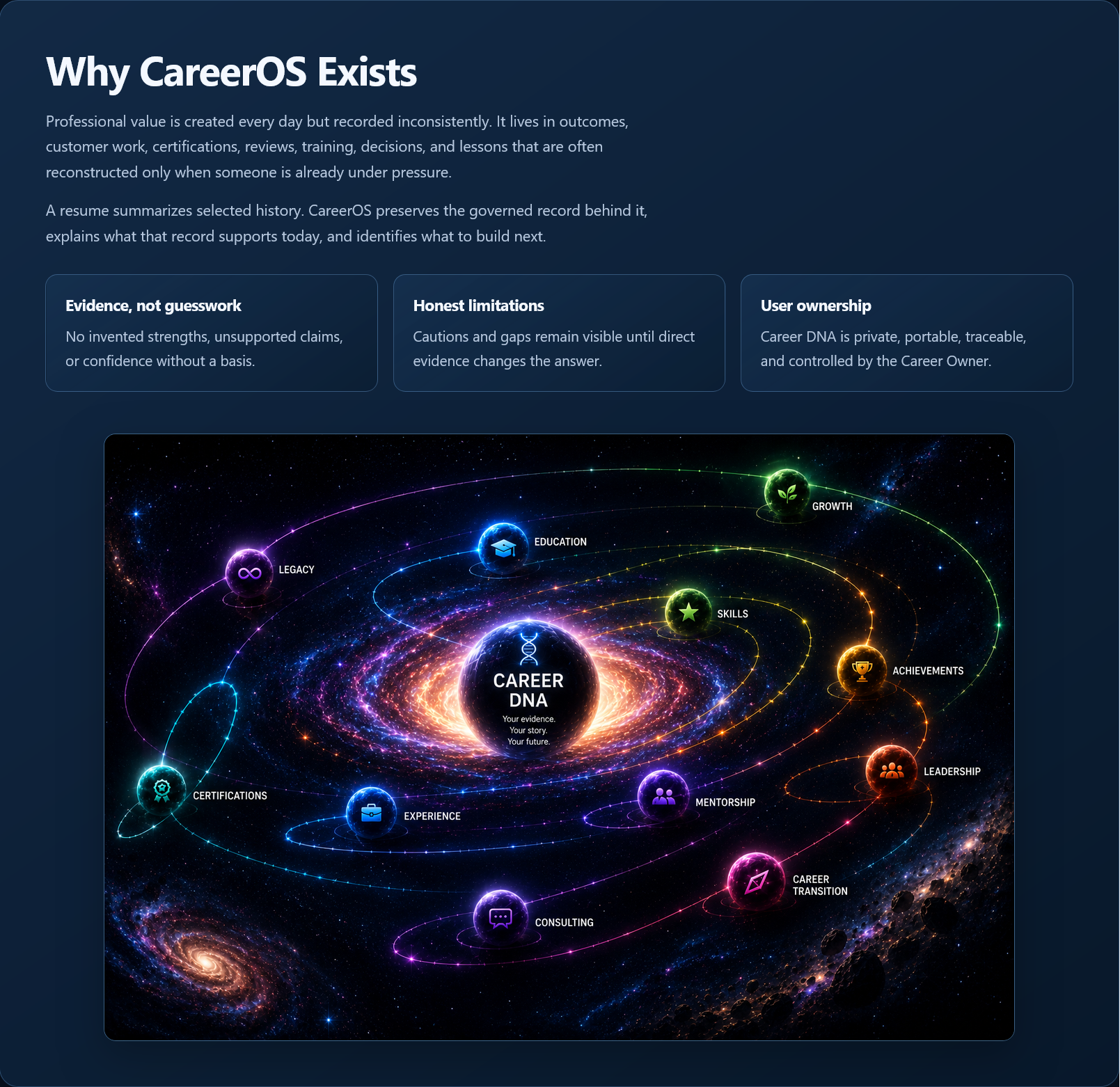
CareerOS captures career evidence, separates direct strength from adjacent potential and gaps, and turns analysis into practical direction.
-
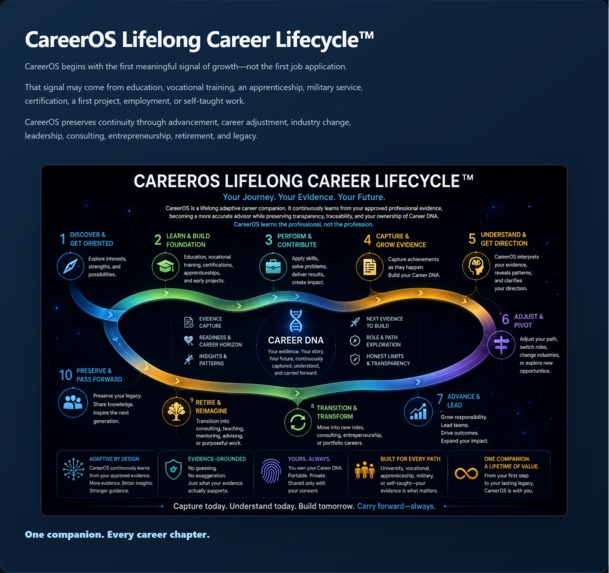
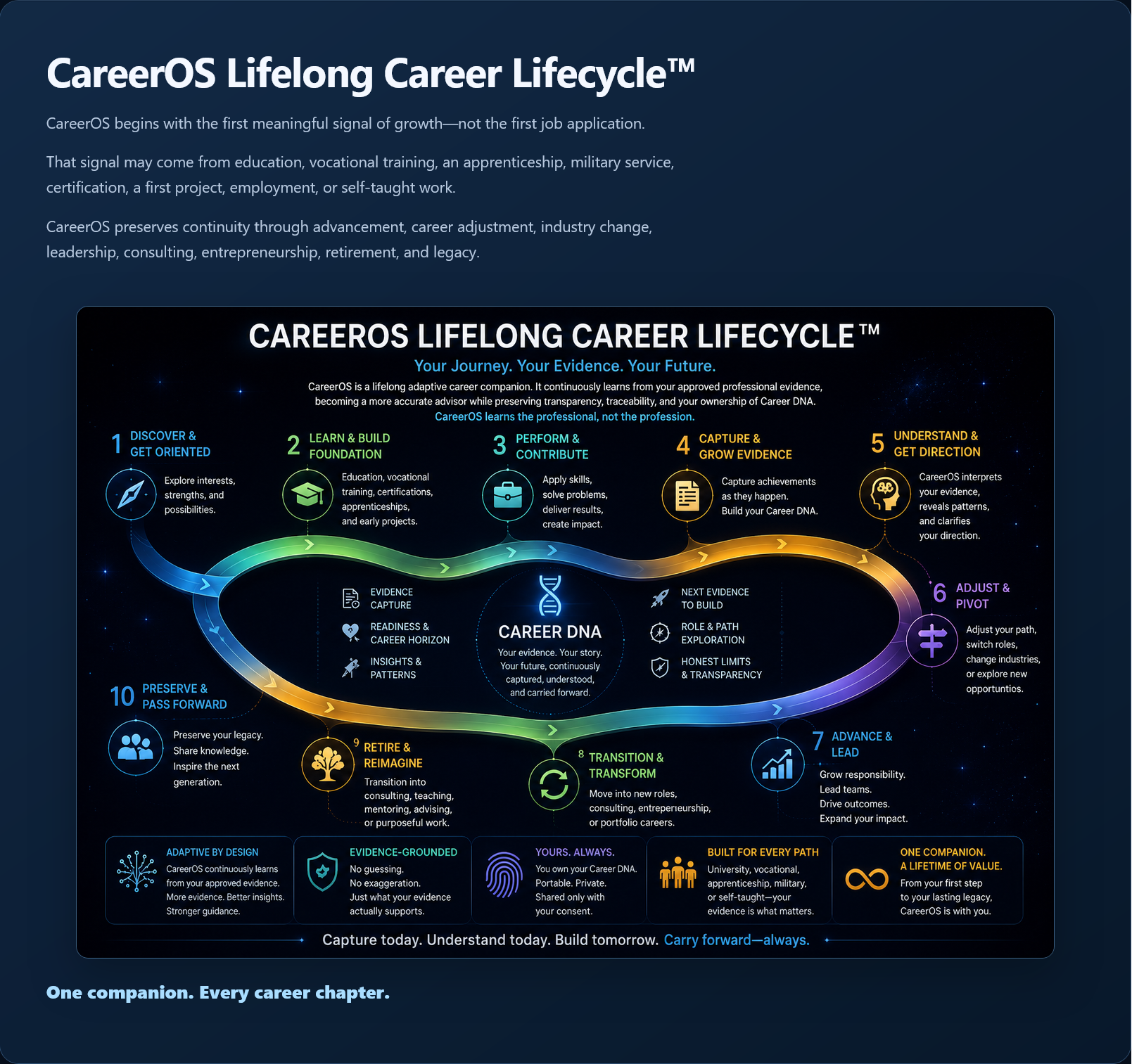
CareerOS preserves evidence from education and early work through leadership, transition, retirement, and legacy.
-
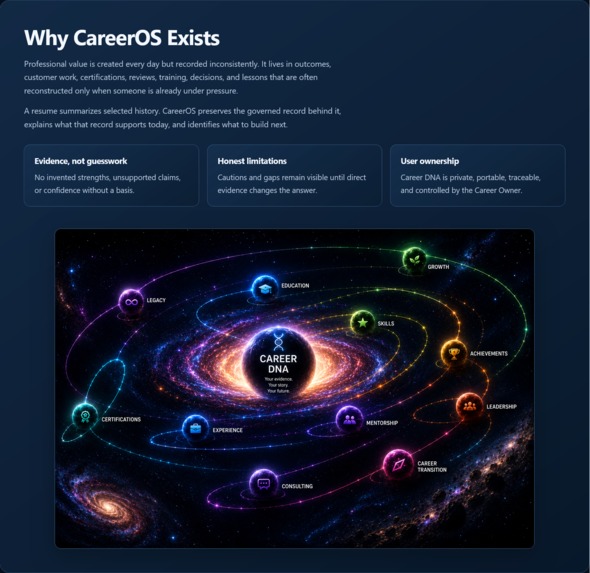
CareerOS preserves scattered professional evidence, explains what it supports today, and identifies what should be built next.
-
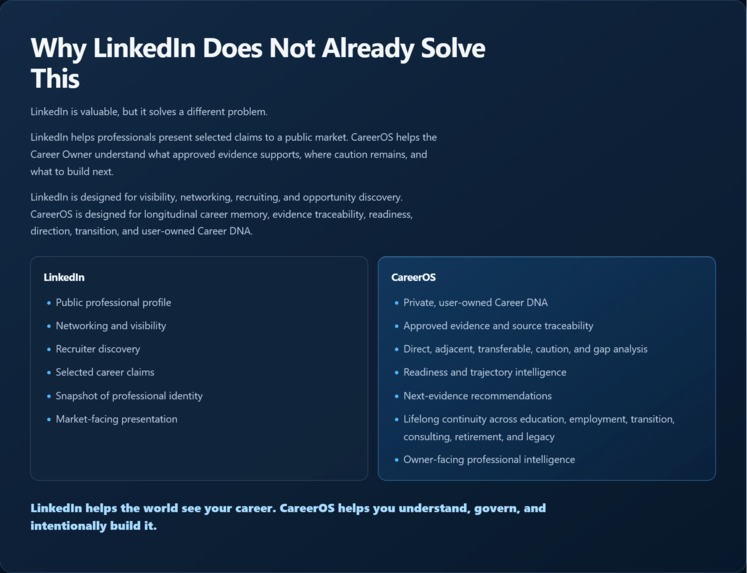
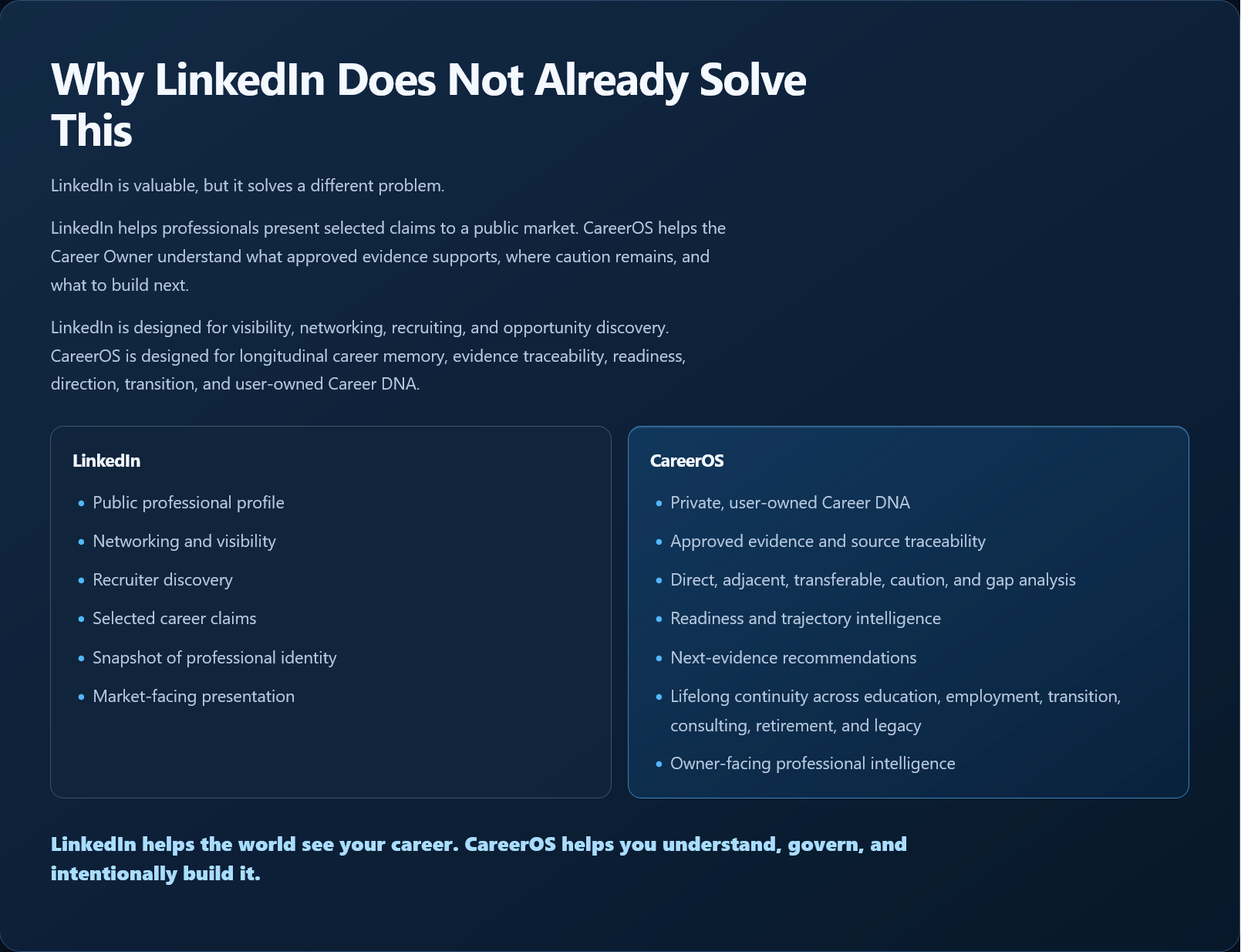
LinkedIn presents careers to the market. CareerOS helps people understand, govern, and build their private, evidence-based Career DNA.
-
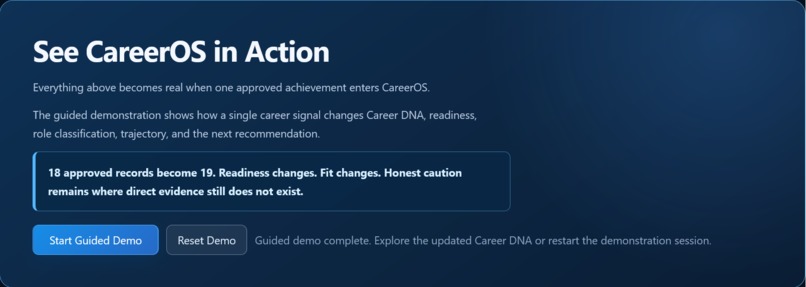
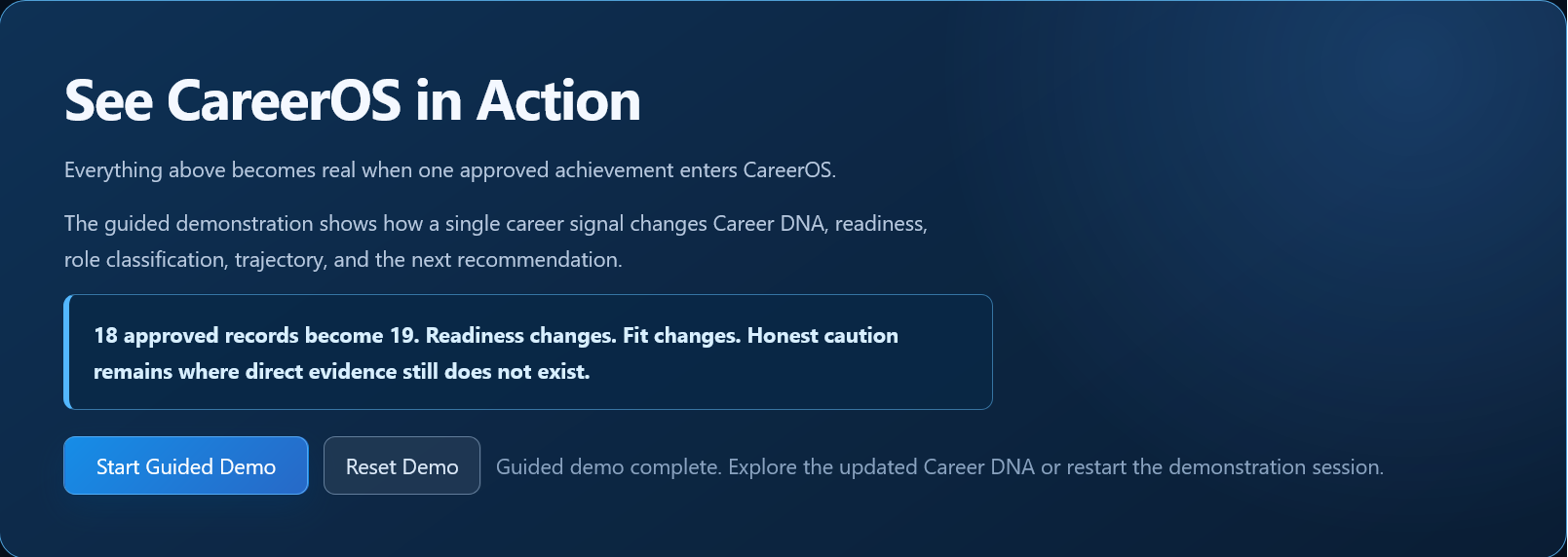
The guided demo shows how one approved achievement changes Career DNA, readiness, role fit, trajectory, and next recommendations.
-
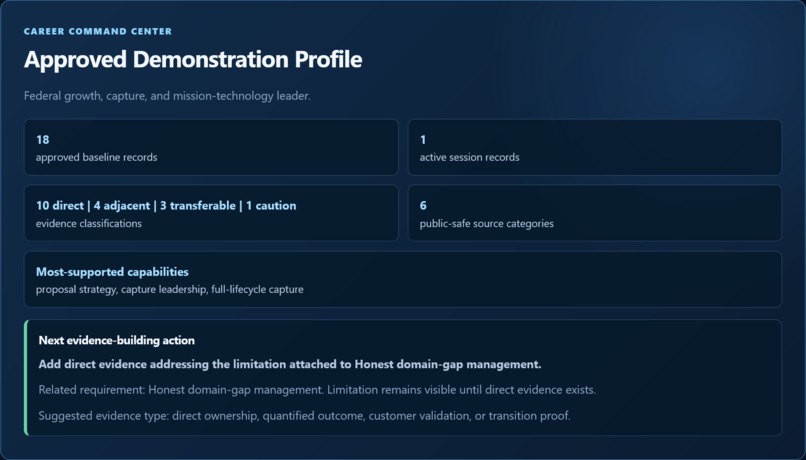
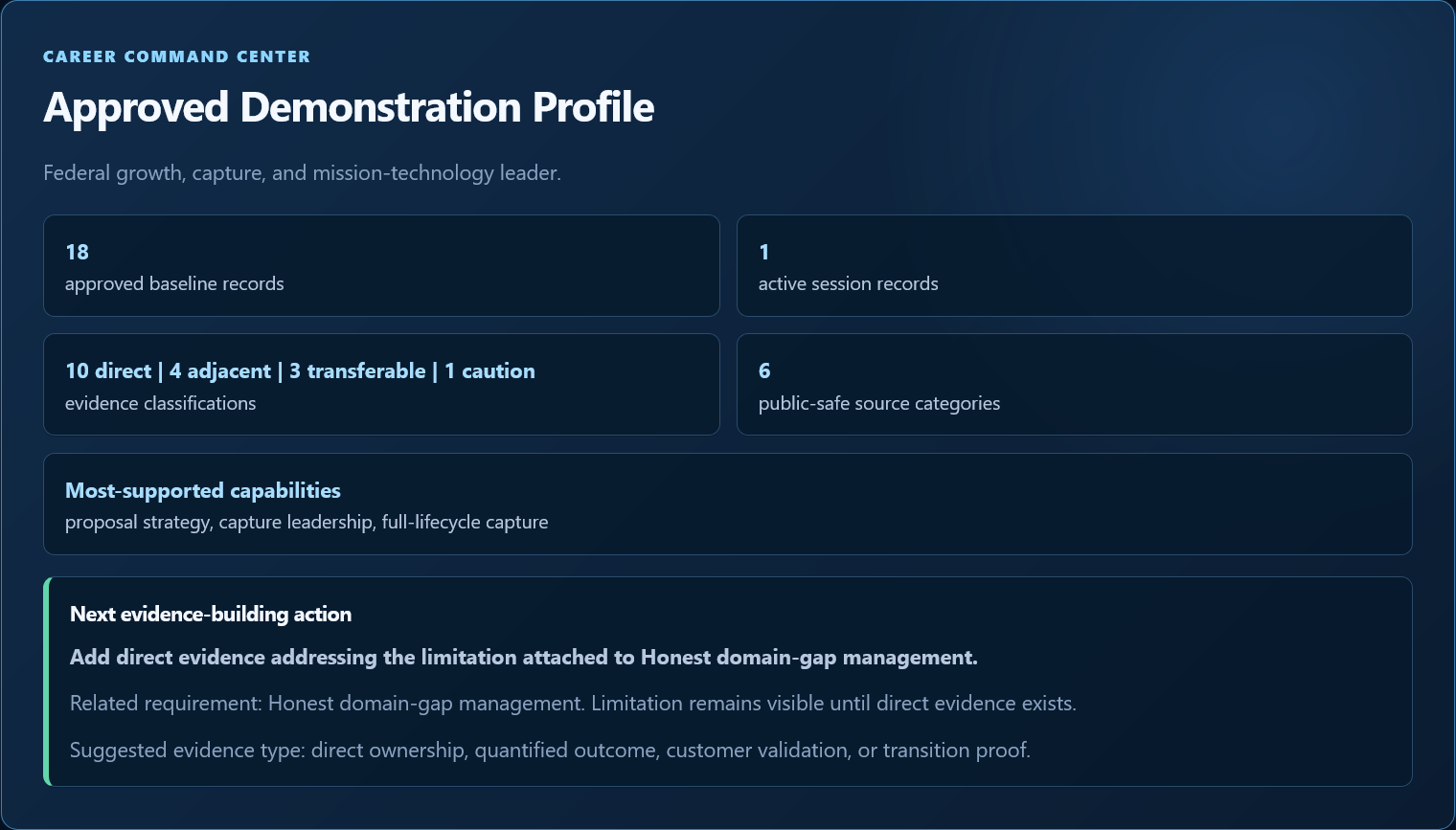
The Career Command Center summarizes approved evidence, capability classifications, source categories, and the next evidence worth building.
-
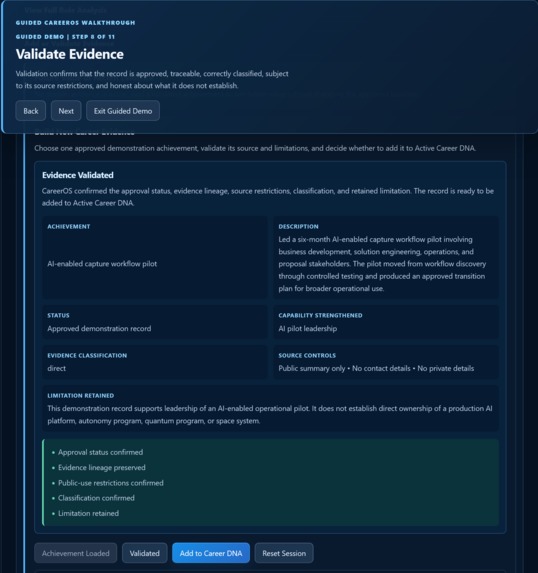
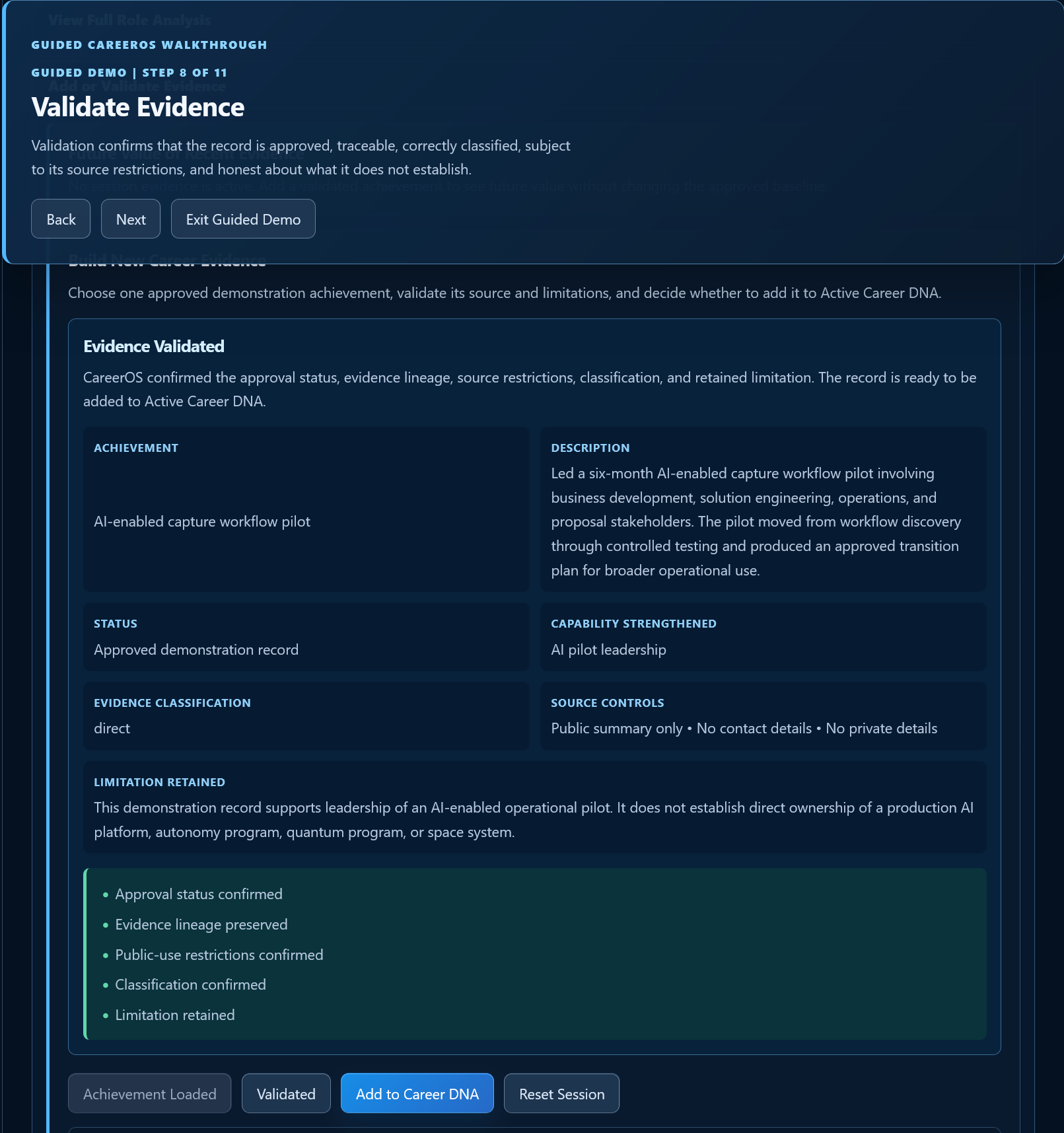
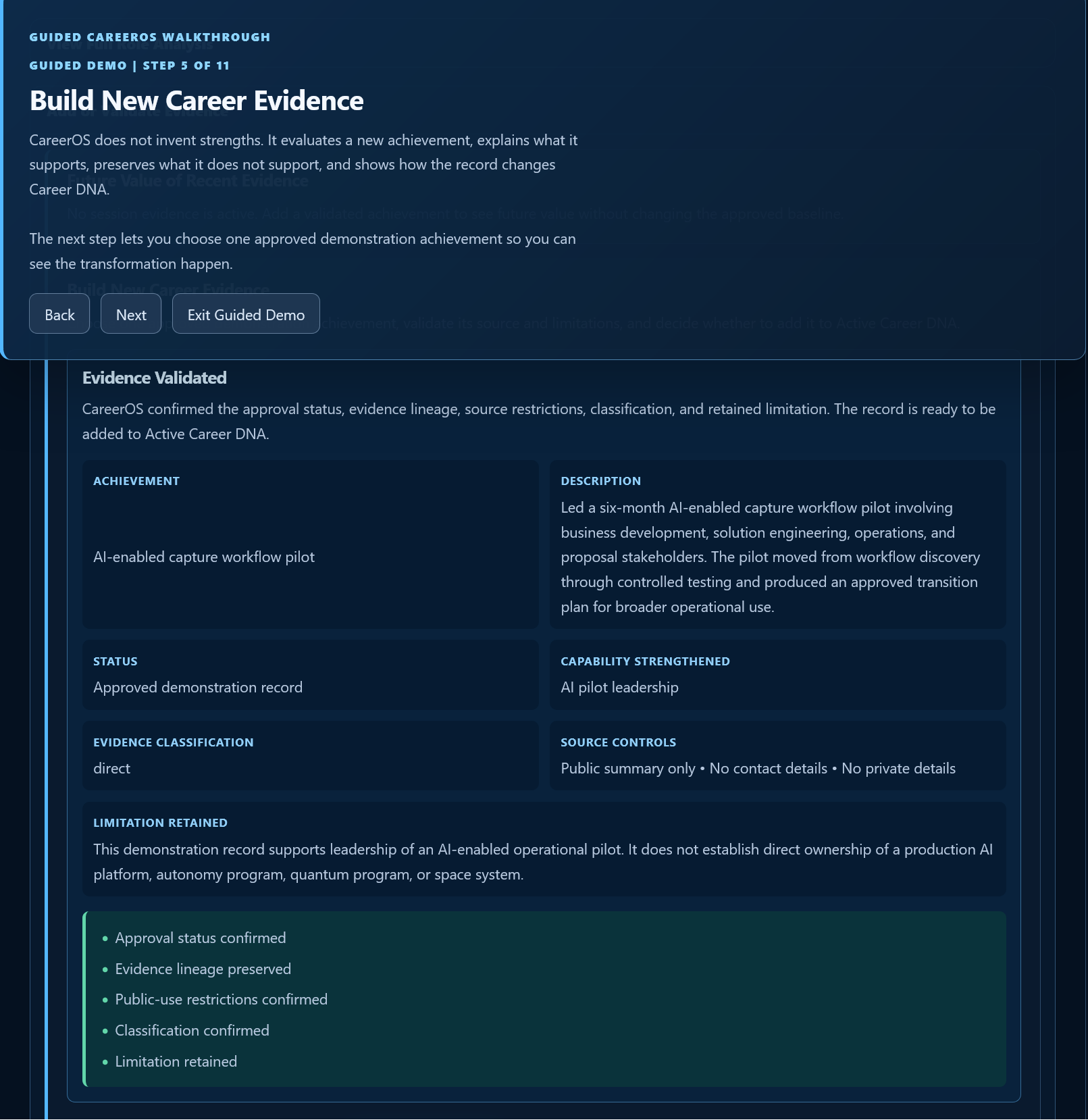
CareerOS validates evidence lineage, source controls, classification, and limitations before adding an achievement to Career DNA.
-
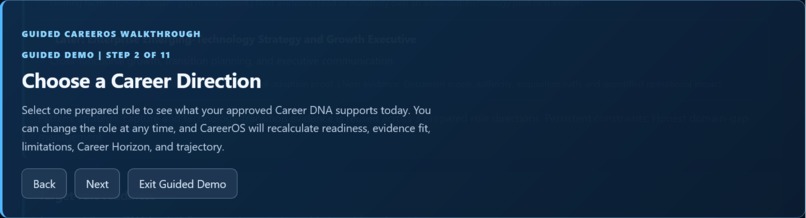
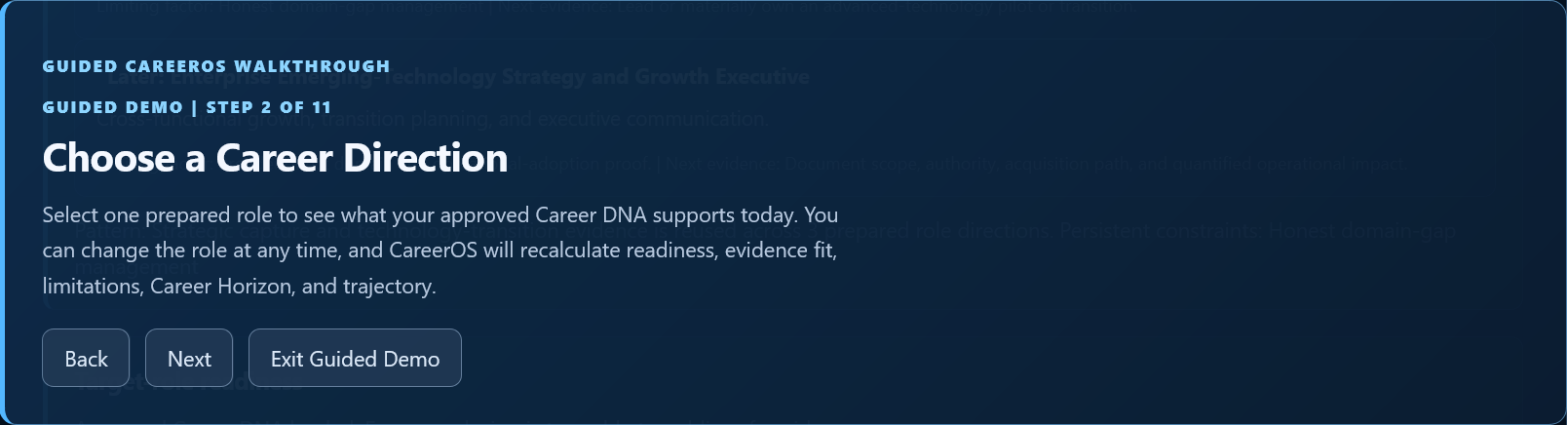
Choose a career direction and CareerOS recalculates readiness, evidence fit, limitations, Career Horizon, and trajectory.
-

CareerOS compares approved Career DNA with a selected role and separates direct fit, adjacent potential, caution, and gaps.
-
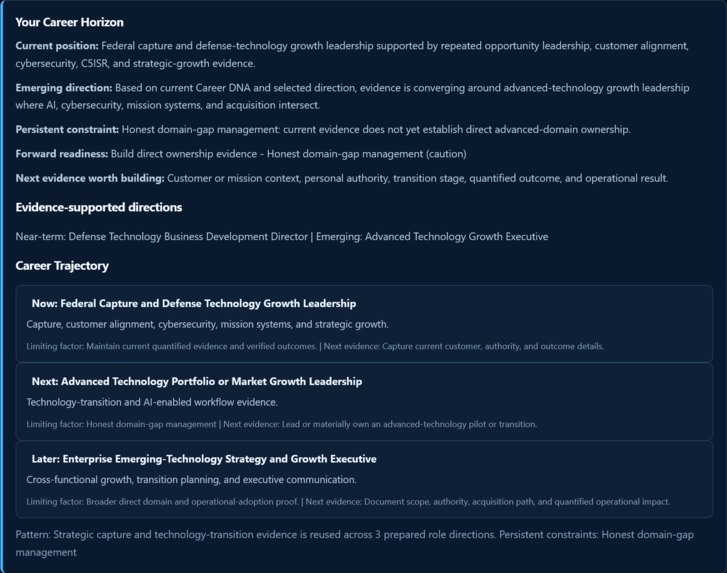
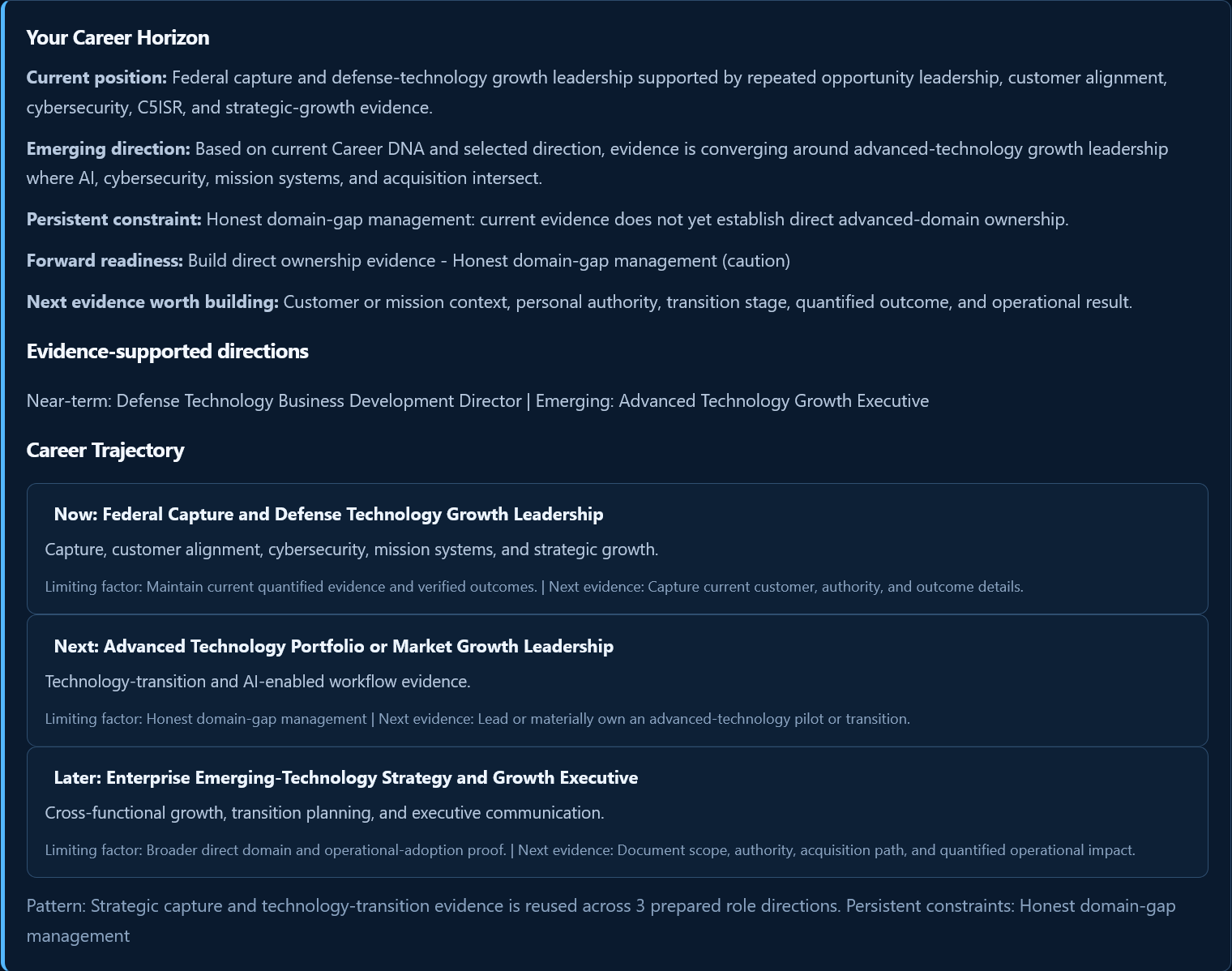
Career Horizon explains current position, emerging direction, persistent constraints, trajectory, and the next evidence worth building.
-
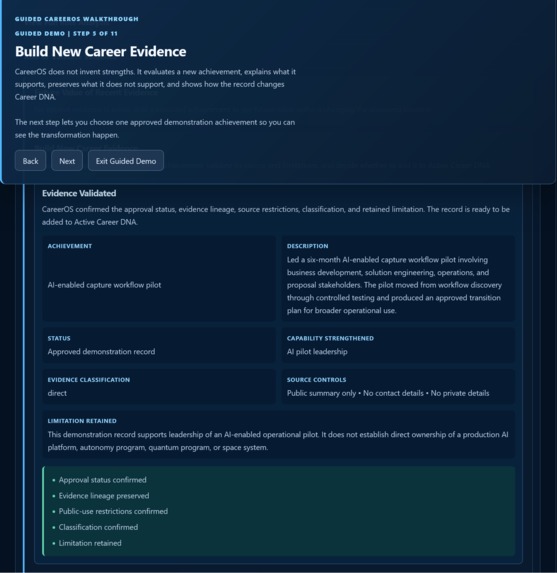
CareerOS validates approval, evidence lineage, source controls, classification, and retained limitations before updating Career DNA.
-
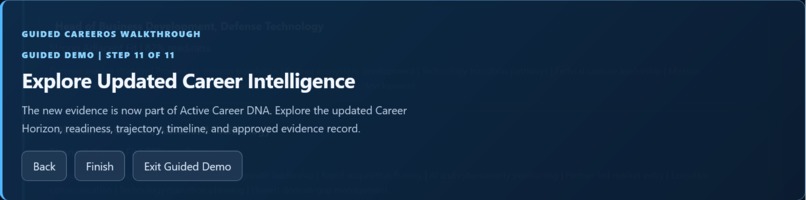
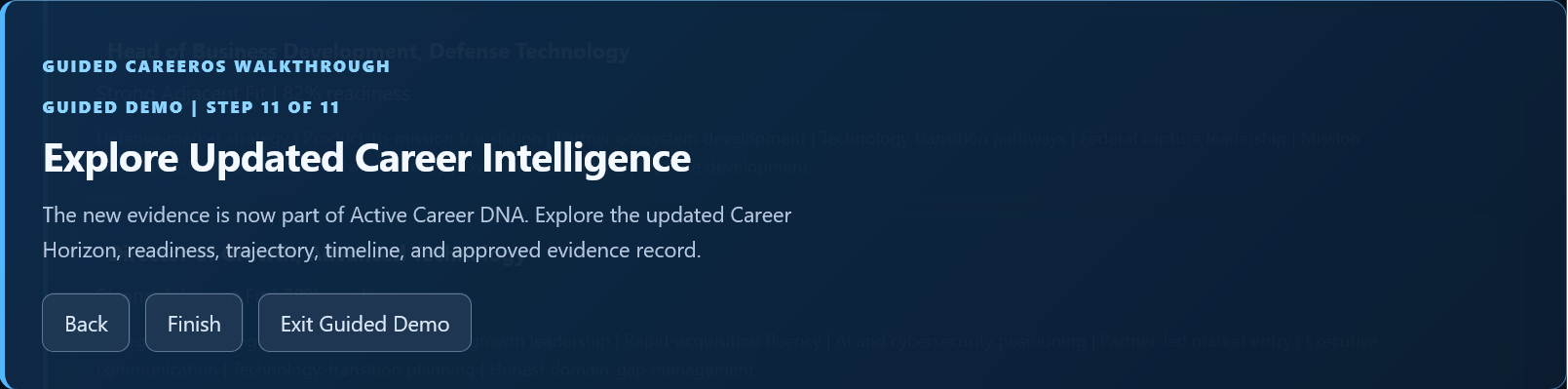
Approved evidence updates active Career DNA, readiness, capability strength, timeline, trajectory, and next-evidence recommendations.
-
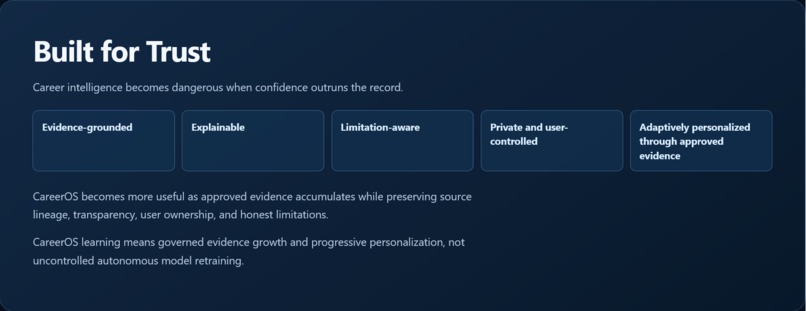
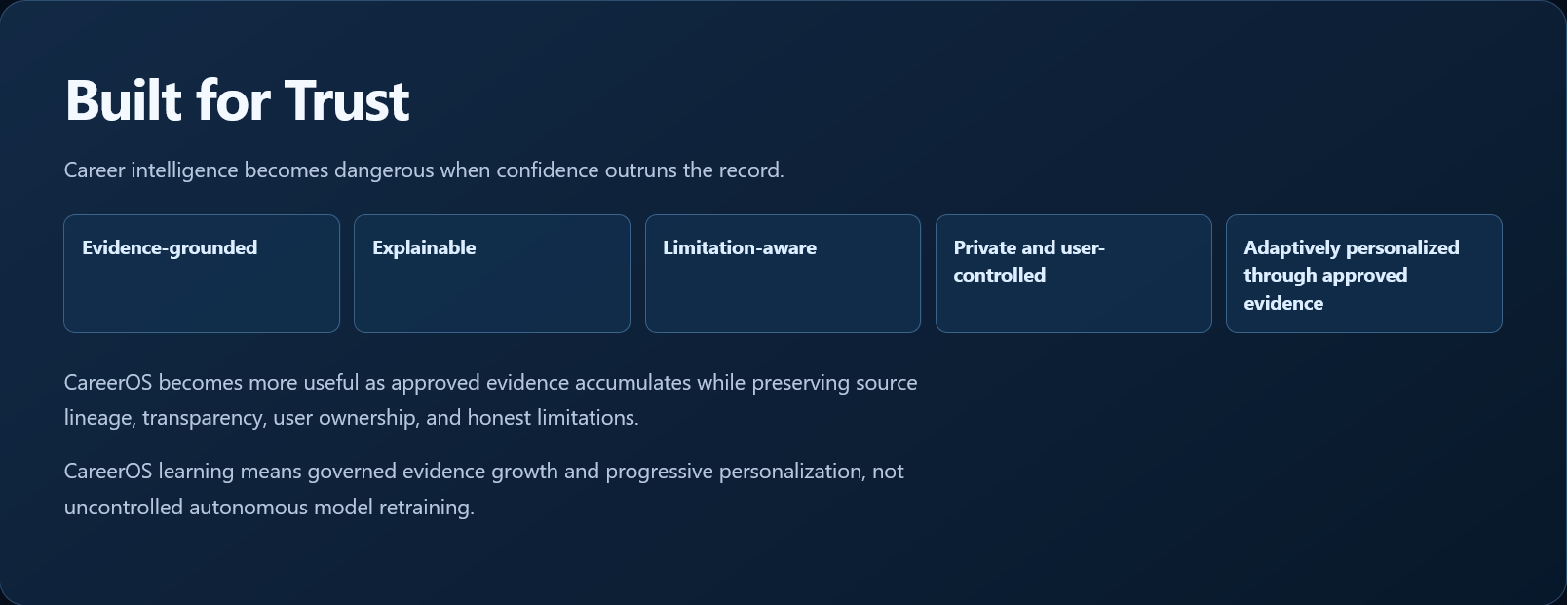
CareerOS is evidence-grounded, explainable, limitation-aware, private, user-controlled, and personalized through approved evidence.
-
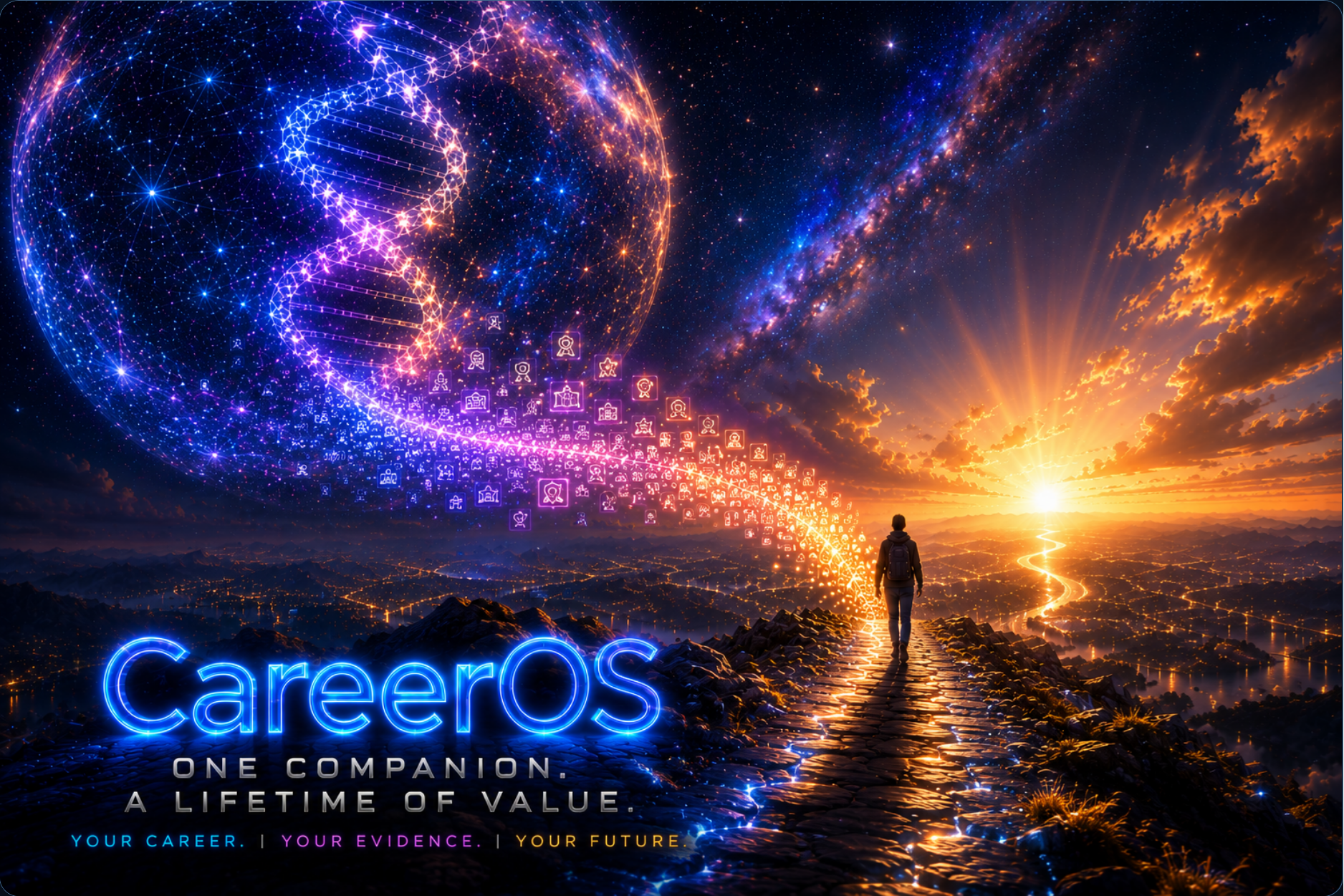
One companion. A lifetime of value.

Inspiration
About a year and a half ago, I read a LinkedIn post from a professional who had been unemployed for eighteen months before finally finding a new role.
As I read his story, I remember thinking, God, please, I hope this never happens to me.
A little more than a year later, I found myself living a version of that same uncertainty.
I have been applying, interviewing, advancing through multiple rounds, completing panel interviews, and sometimes being ghosted after investing weeks of time and energy. In one case, after three interviews, two panels, and nearly two months, I was still receiving the message: “You are in the mix.”
That experience changed how I thought about career management.
The problem was not simply finding another job. The deeper problem was that years of professional experience were scattered across résumés, applications, interview notes, projects, contracts, accomplishments, and memory. Every opportunity required rebuilding the professional story again, usually under pressure.
During this period, I also launched Signal Decoded, a biweekly LinkedIn newsletter focused on defense technology, cybersecurity, AI, national security, and federal acquisition. It has grown to nearly 500 subscribers and more than 5,000 readers every two weeks.
Writing Signal Decoded taught me how to organize complex information, identify patterns, develop a clear point of view, and turn years of experience into useful intelligence.
That is when the idea for CareerOS emerged.
I began asking:
- What if a person’s entire professional history could become a continuously growing intelligence system?
- What if every accomplishment, interview, project, lesson, and transition strengthened the next opportunity?
- What if AI could identify transferable experience that people often overlook?
- What if career strategy did not begin only after someone lost a job?
- What if one system could support a professional from the first role through retirement?
CareerOS was born from those questions.
What it does
CareerOS is a lifelong AI career intelligence companion that continuously transforms experience into performance, advancement, and opportunity across every stage of a person’s career path.
It is not limited to generating résumés. A résumé is only one possible output.
CareerOS is designed to:
- preserve a complete professional history;
- transform work experience into verified career evidence;
- identify direct, adjacent, and transferable capabilities;
- tailor application packages to specific opportunities;
- generate evidence-based interview preparation;
- maintain a reusable library of professional stories;
- track applications, interviews, feedback, and outcomes;
- support onboarding and 30-60-90-day planning;
- capture ongoing performance and measurable accomplishments;
- prepare users for promotions, compensation discussions, and leadership roles;
- support transitions between employers, industries, agencies, functions, and career stages.
The long-term vision is a system that remains useful before, during, and after a job search.
CareerOS follows the professional lifecycle:
$$ \text{Discover} \rightarrow \text{Apply} \rightarrow \text{Interview} \rightarrow \text{Transition} \rightarrow \text{Perform} \rightarrow \text{Advance} \rightarrow \text{Lead} \rightarrow \text{Reinvent} $$
Instead of asking users to reconstruct years of experience every time their career changes direction, CareerOS continuously preserves and strengthens their professional intelligence.
How we built it
We began by creating a CareerOS Constitution, a structured set of rules governing how the system retrieves, classifies, maps, validates, generates, records, and learns from professional information.
The core workflow is:
$$ \text{Retrieve} \rightarrow \text{Classify} \rightarrow \text{Map} \rightarrow \text{Adapt} \rightarrow \text{Validate} \rightarrow \text{Generate} \rightarrow \text{Record} \rightarrow \text{Learn} $$
CareerOS is being developed as a set of connected engines.
Career Evidence Engine
The system ingests information from résumés, interview transcripts, job applications, project notes, accomplishment records, professional documents, and user-provided sources.
Every major claim should remain traceable to evidence. The system is designed to avoid fabrication, unsupported assumptions, and silent exaggeration.
Experience Classification Engine
CareerOS separates experience into three categories:
- Direct experience: the user has worked with the specific customer, market, technology, or function.
- Adjacent experience: the user has worked in a closely related environment.
- Transferable experience: the underlying skills and results apply even when the exact sector or organization is different.
This allows CareerOS to broaden opportunity without pretending that transferable experience is direct experience.
Career Story Engine
The platform converts accomplishments into reusable professional stories for:
- résumés;
- application packages;
- strategic value statements;
- interviews;
- performance reviews;
- promotion cases;
- executive biographies;
- leadership positioning;
- future transitions.
Opportunity Mapping Engine
CareerOS compares the user’s evidence with a target role and identifies:
- strongest qualifications;
- transferable capabilities;
- potential experience gaps;
- likely interview themes;
- recommended positioning;
- evidence that should be emphasized;
- claims that require validation.
Continuous Performance Engine
After a user accepts a job, CareerOS transitions from application support to professional performance support.
It can help create:
- onboarding plans;
- 30-60-90-day strategies;
- stakeholder maps;
- accomplishment logs;
- progress reviews;
- professional development plans;
- promotion-readiness packages;
- long-term transition strategies.
The continuous performance loop is:
$$ \text{Plan} \rightarrow \text{Perform} \rightarrow \text{Capture Evidence} \rightarrow \text{Review} \rightarrow \text{Improve} \rightarrow \text{Advance} \rightarrow \text{Transition} $$
We are using Codex and OpenAI model 5.6 Sol to develop the architecture, schemas, evidence workflows, generation logic, validation rules, and user experience.
Challenges we ran into
The first major challenge was balancing personalization with evidence integrity.
CareerOS must tailor a user’s experience to a specific opportunity without changing facts or manufacturing credentials. That requires source traceability, confidence levels, claim validation, and a clear distinction between direct and transferable experience.
The second challenge was structuring messy professional history.
Career information is rarely organized like a clean database. It may contain:
- duplicated accomplishments;
- incomplete dates;
- inconsistent titles;
- overlapping responsibilities;
- confidential details;
- old versions of résumés;
- similar stories told differently in different interviews.
CareerOS must reconcile those inconsistencies without deleting valuable context.
The third challenge was defining the product boundary.
CareerOS can support applications, interviews, performance management, advancement, promotion planning, professional development, and long-term transitions. That vision is powerful, but it can also create feature sprawl.
To address this, the platform is being developed in phases:
- Evidence ingestion and structured career memory
- Experience classification and transferability mapping
- Application and résumé generation
- Interview intelligence
- Continuous performance tracking
- Advancement and transition strategy
- Long-term learning from outcomes
Another challenge was avoiding the limitations of traditional AI career tools. A system that only generates polished language can still produce shallow or inaccurate results. CareerOS must retrieve evidence first, validate it, and only then generate an output.
Accomplishments that we're proud of
One of the most important accomplishments was defining CareerOS as a lifelong professional intelligence system, rather than limiting it to a résumé builder or job-search assistant.
We created a governance structure that requires professional claims to remain grounded in evidence.
We also developed the direct, adjacent, and transferable experience model. This is critical because many professionals overlook opportunities simply because their previous job title, agency, or industry does not exactly match the next role.
Another accomplishment was designing CareerOS to continue after employment is secured.
Most career tools stop at the offer. CareerOS is designed to support onboarding, professional performance, advancement, promotion, leadership development, and the next transition.
We are also proud of the continuous career-memory concept.
Every project, result, interview, accomplishment, lesson, and professional transition can strengthen the user’s future career intelligence. The system learns from the career while the career is happening.
Finally, CareerOS emerged from a real and personal problem. It was not created as an abstract product idea. It grew from the emotional and professional reality of prolonged applications, interviews, uncertainty, and the exhausting need to repeatedly reconstruct years of professional value.
What we learned
We learned that career information is not the same as career intelligence.
Most professionals already possess years of valuable experience, but that experience is fragmented across old résumés, performance reviews, projects, interview notes, application files, email threads, and memory.
AI becomes more useful when it does more than generate text. It must organize evidence, preserve context, identify relationships, expose transferable experience, and improve future decisions.
We also learned that job titles rarely capture the full value of a professional.
A person may lack direct experience with a particular company, agency, or industry while still possessing highly relevant capabilities in leadership, strategy, customer engagement, technology, acquisition, operations, delivery, and problem-solving.
Transferability can expand opportunity, but it must remain honest and evidence-based.
We learned that professional development should not begin only after a layoff, stalled promotion, or career disruption.
By the time many people update their résumé, important accomplishments have already been forgotten. Metrics are difficult to reconstruct. Professional stories have lost detail. Decisions are being made under pressure.
CareerOS should capture professional value while it is being created.
The most important lesson was this:
No professional should have to reconstruct an entire career every time life changes direction.
CareerOS is designed to remember the work, preserve the evidence, strengthen the strategy, and help prepare the person for whatever comes next.
Built With
- ai
- api
- codex
- database
- docx
- fastapi
- generation
- github
- gpt-5.6
- json
- language
- markdown
- natural
- next.js
- openai
- pgvector
- postgresql
- processing
- python
- react
- rest
- retrieval-augmented
- typescript
- vector


Log in or sign up for Devpost to join the conversation.