-
-
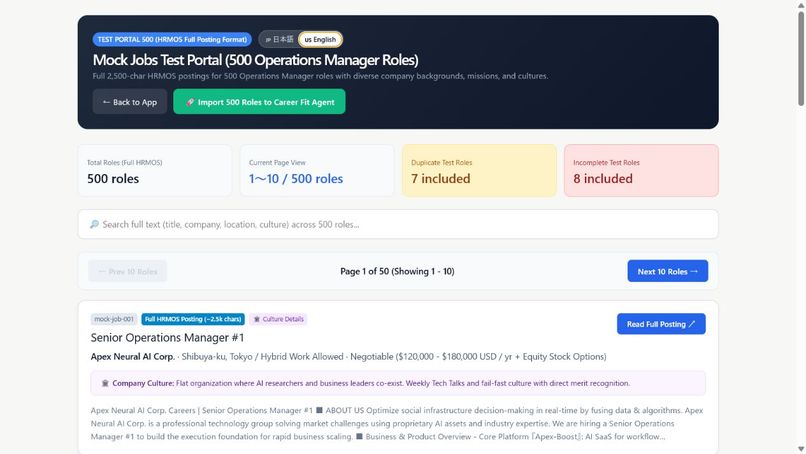
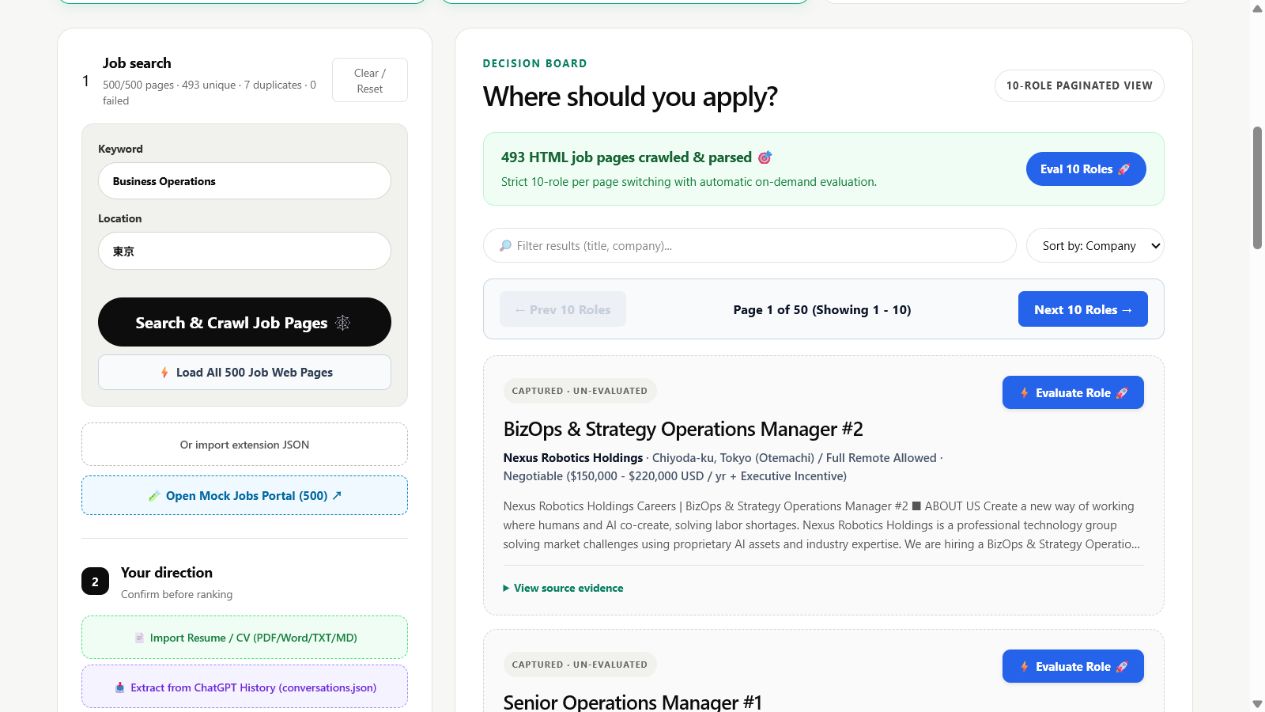
Controlled 500-job test portal with paginated full job descriptions.
-
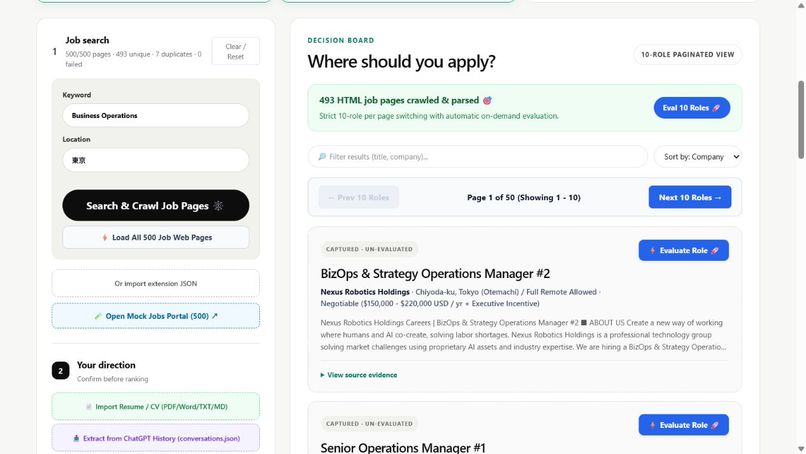
Auditable crawl: 500 pages processed, 493 unique roles, 7 duplicates, and 0 failures.
-
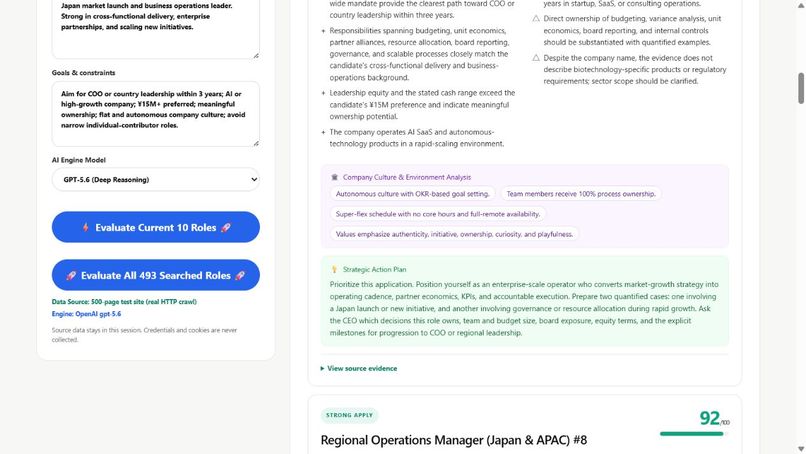
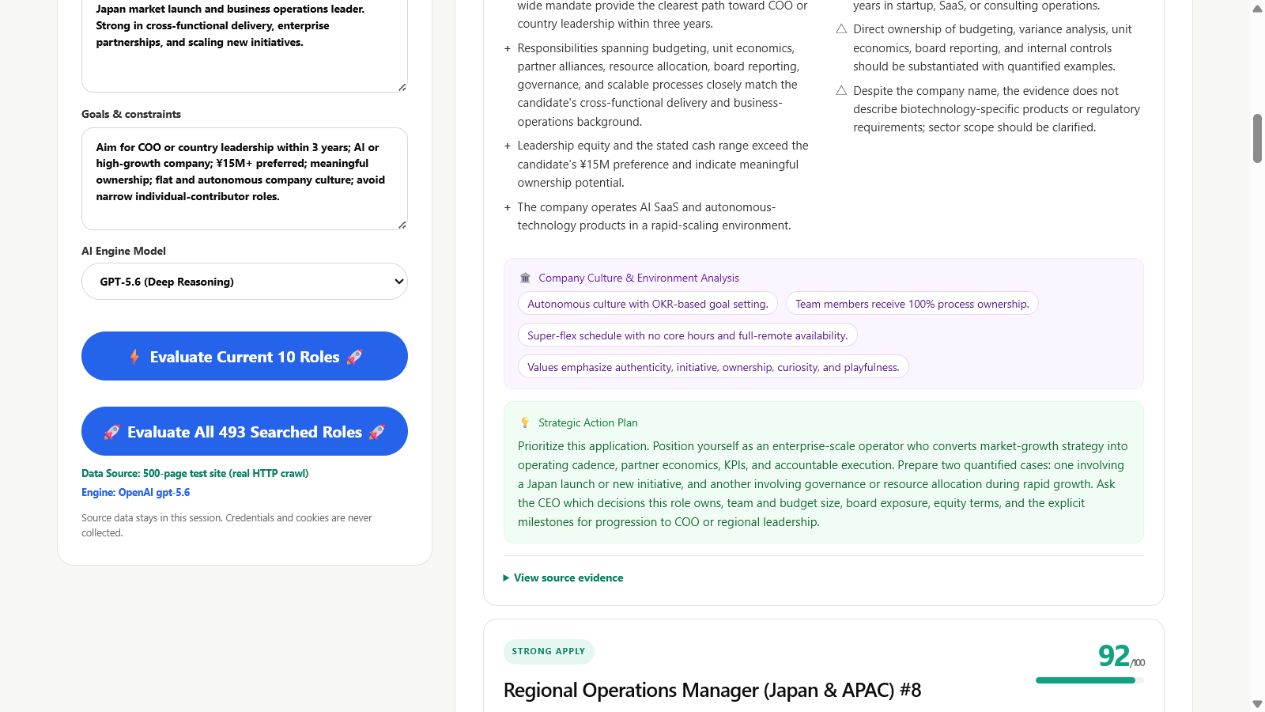
GPT-5.6 career-fit results with categories, reasons, concerns, and source evidence.
Inspiration
I was researching my own next career move on one of Japan's largest job platforms. Salary, title, and location filters helped, but they could not tell me which companies truly matched my experience, ambitions, and preferred way of working.
After spending a long time browsing, I found several interesting companies—then realized I had not reviewed even half of the available roles. That created a very personal kind of FOMO: what if the best opportunity for me was still hidden among the jobs I had not seen?
In our initial browser test, GPT-5.6 completed the long pagination task and reached the end where Claude had stopped earlier. That gave us the confidence to turn the idea into a product.
What it does
Career Fit Agent investigates every job in a defined set before recommending where a user should apply.
It:
- crawls paginated job listings and their detail pages;
- tracks processed, unique, duplicate, incomplete, and failed records;
- structures the job information and preserves source evidence;
- accepts a resume, career history, goals, and constraints; and
- uses GPT-5.6 to classify roles as Strong Apply, Strategic Bet, Safe Option, or Avoid, with reasons, concerns, and supporting evidence.
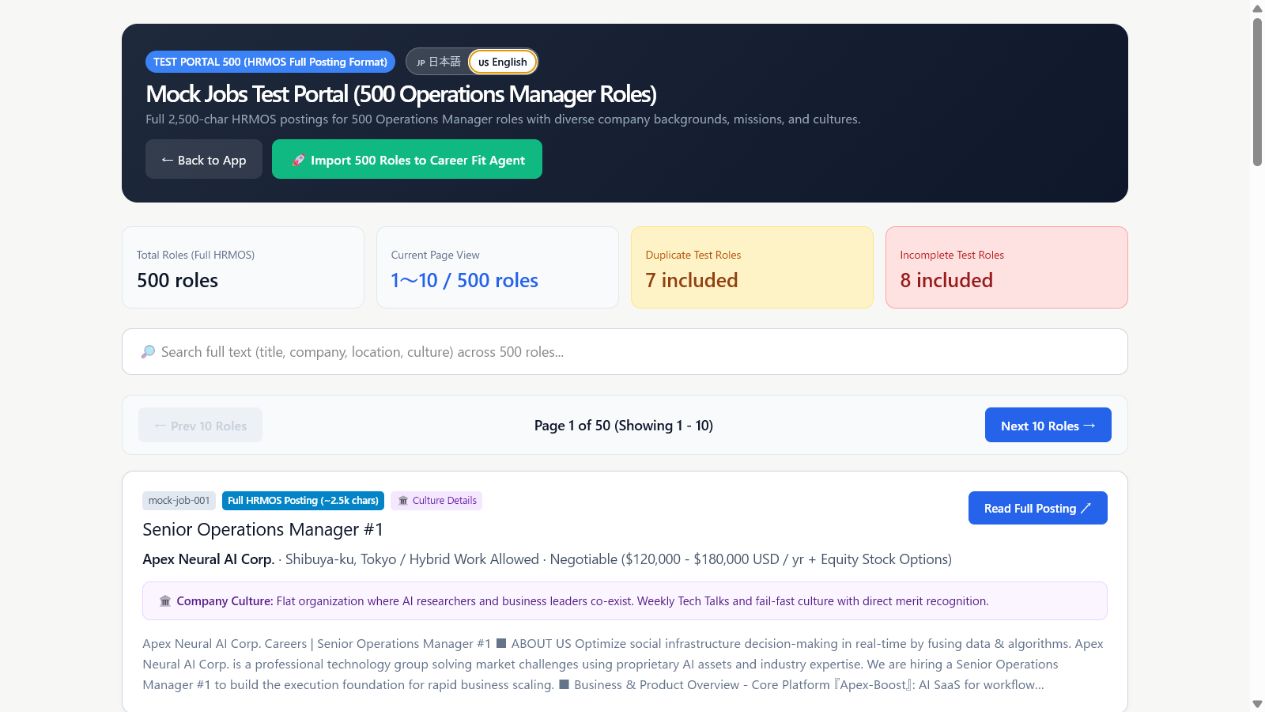
For the demo, we built a controlled 500-job test portal so judges can verify the complete workflow without scraping a third-party service or exposing private job-search data.
How we built it
The project began with the successful GPT-5.6 browser experiment. We then used Codex to turn that one-time result into a repeatable application.
The runtime crawler is deterministic code: phase one walks the paginated listing pages and discovers job URLs; phase two fetches and parses the job-detail pages with controlled concurrency. The dashboard makes coverage, duplicates, failures, and source evidence visible. GPT-5.6 is then used for the part that requires judgment—understanding the user's career direction and evaluating each role against it.
We built the web experience for Cloudflare Workers and created the 500-job test portal to demonstrate the full process safely and consistently.
Challenges we ran into
The biggest challenge was separating a successful AI browsing session from a reproducible product. Reaching the last page once was promising, but it did not prove which jobs had been processed, whether any were duplicated, or where failures occurred.
We also had to handle long pagination, detail-page extraction, duplicate detection, partial records, deployment limits, and a UI that stays understandable while hundreds of pages are processed. We deliberately avoided relying on a live third-party site in the public demo because of authentication, privacy, changing page structures, and site policies.
Accomplishments that we're proud of
We created an end-to-end demonstration that can process a 500-job test portal while openly reporting coverage, duplicates, and failures.
We are especially proud that the product does not simply claim, "I read everything." It shows what was discovered, what was processed, what failed, and the source behind each result. It then turns that auditable research into a practical career decision rather than stopping at data collection.
What we learned
We learned that model capability and deterministic software play different but complementary roles.
GPT-5.6 showed that the long research workflow was possible and provides the career-fit reasoning. Codex helped us convert that breakthrough into a working, testable product. Deterministic crawling, progress tracking, and failure reporting make the process reproducible and auditable.
We also refined our definition of "complete research": every item in the defined scope must be discovered, assigned a processing status, and traceable to its source.
What's next for Career Fit Agent
Next, we want to:
- add user-controlled connectors for more job sources;
- strengthen extraction and ranking evaluations against human-reviewed examples;
- support resumable research sessions and change tracking;
- improve privacy controls for resumes and conversation-history imports; and
- test whether the same auditable research pattern can help with other high-stakes, long-list decisions.
Our goal is simple: help people stop wondering what they missed and start making career decisions with evidence.
Built With
- api
- cloudflare
- codex
- gpt-5.6
- next.js
- node.js
- openai
- react
- tailwind
- typescript
- vite


Log in or sign up for Devpost to join the conversation.