-
-
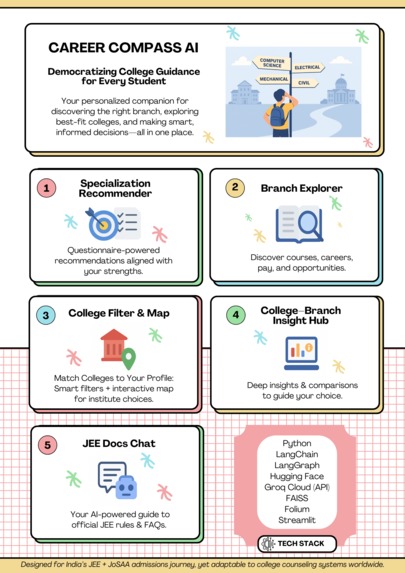
Poster: Career Compass AI
-
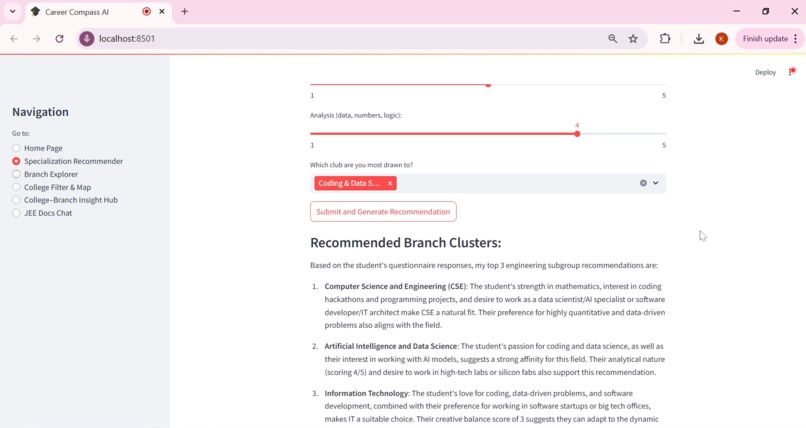
Specialization Recommender (Module 1) : Answer a short, focused questionnaire and get recommended the most relevant specialization
-
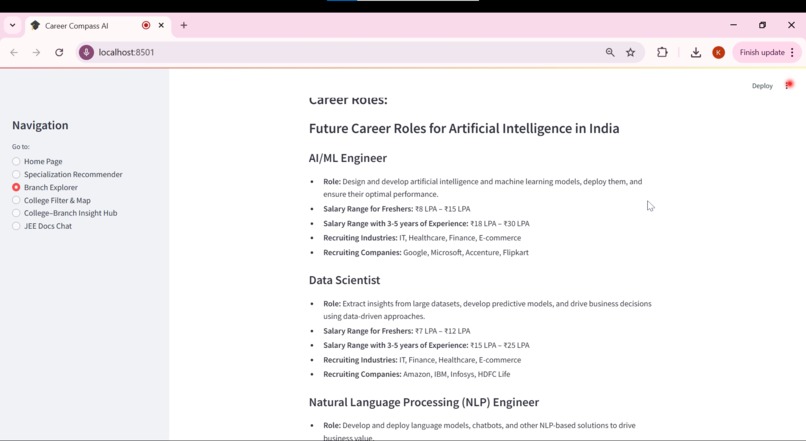
Output of Career Opportunities section of Branch Explorer (Module 2): LLM-generated response for "Artificial Intelligence"
-
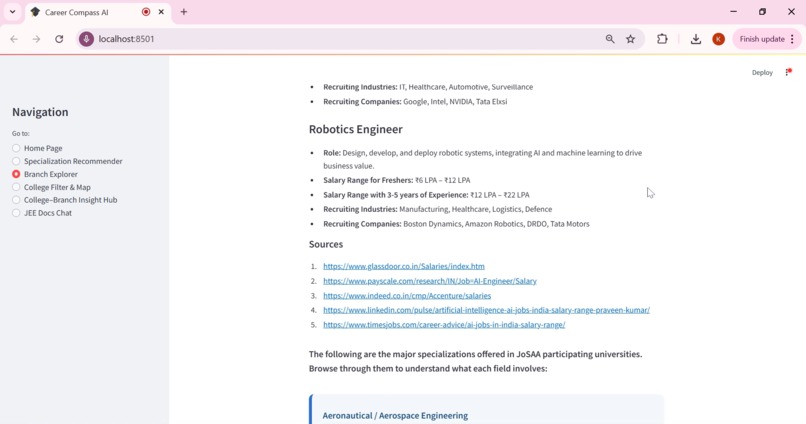
The sources referred are also presented for validation (if required)
-
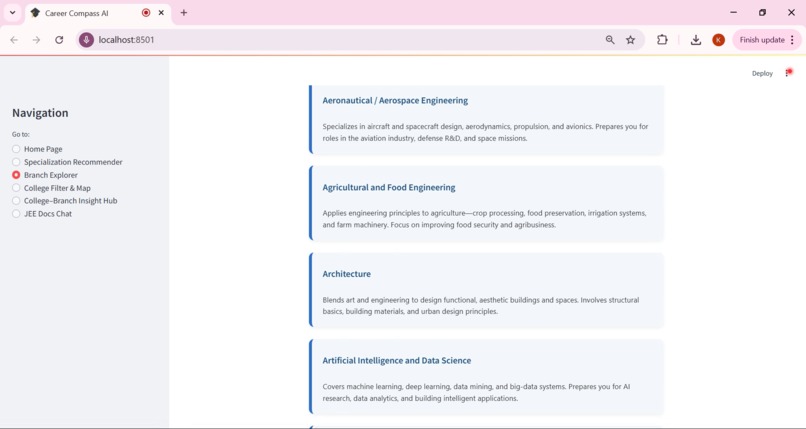
Major specializations offered by the JoSAA participating universities (IIT, NIT, IIIT, GFTI) for reference of student
-
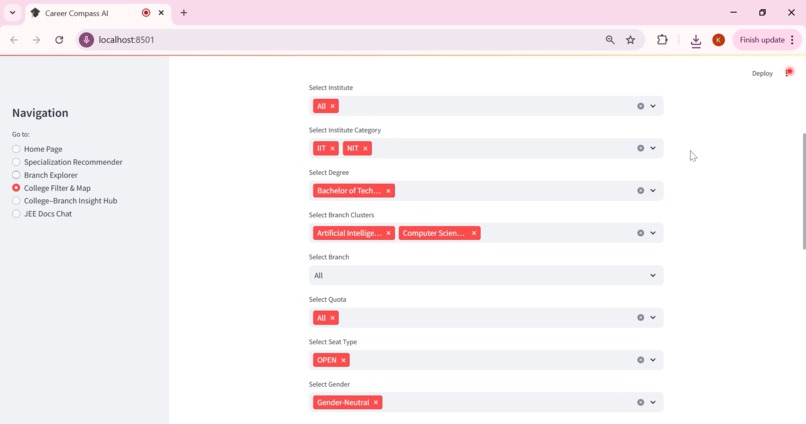
Plethora of filters provided in College Filter & Map (Module 3) for the user to choose branch and universities for their profile
-
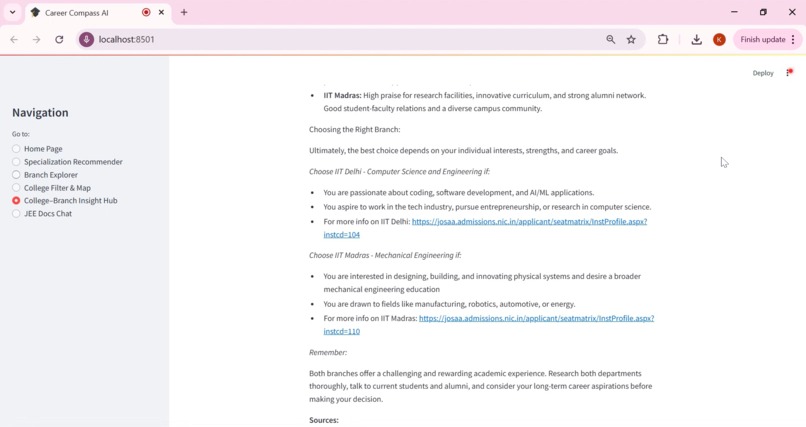
Compare college–branch and finalize the program. Concluding part of output of the Comparison bot of College–Branch Insight Hub (Module 4)
-
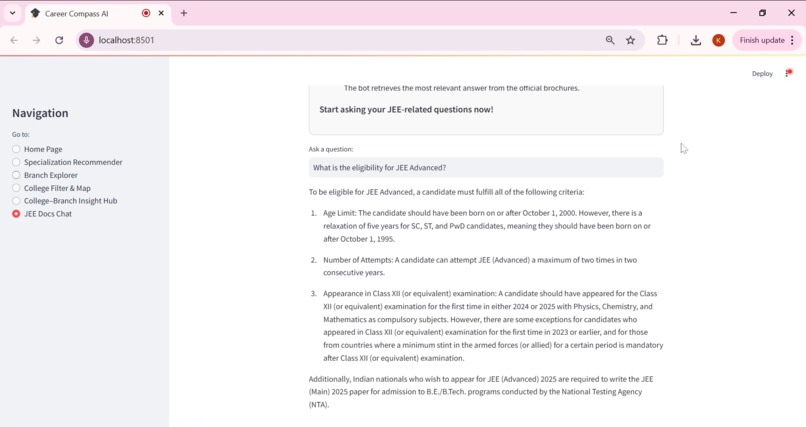
JEE Docs Chat (Module 5): A chatbot grounded via RAG (Retrieval-Augmented Generation) to answer queries reducing chances of hallucination


Inspiration
The inspiration for Career Compass AI came from my own experience as a student at NIT Trichy. When I went through the admissions process, I realized how confusing and stressful it can be to choose the right specialization and college. With 121 institutes participating in JoSAA, 200+ different academic programs, and about 60,000 total seats on offer, the decision-making process is overwhelming, especially for students who don’t have access to professional counseling or alumni networks. I have personally seen many students make suboptimal choices simply because they lacked structured guidance.
I wanted to change this. My motivation was to democratize college and career guidance, ensuring that every student—regardless of background, geography, or resources—has access to the same clarity and insights that only a privileged few enjoy. This belief became the driving force behind Career Compass AI, which I designed to be a personalized, AI-powered companion for every student exploring higher education opportunities.
Why Customization Matters
One of the biggest insights I had while working on this project was the importance of customizing guidance to specific education systems. If platforms try to be too general, they lose effectiveness, because they don’t reflect the actual exams, admission processes, and program structures students deal with.
In India, for example, the JEE and JoSAA system alone covers 121 institutes and 232 programs—an overwhelming landscape for any student. To make this manageable, I clustered these into 26 branch groups (such as “Artificial Intelligence and Data Science”), so exploration becomes clear, structured, and actionable. This customization makes the platform practical and impactful. While I built Career Compass AI for India’s JEE–JoSAA journey, the same idea of tailoring guidance to system-specific contexts can be adapted to education systems anywhere in the world.
What it does & How I built it
Career Compass AI is a five-module platform that guides a student from self-discovery to informed college choice — and each module is backed by specific technical components to ensure accuracy, consistency, and usability. For the LLM-driven responses, I used the LangChain and LangGraph frameworks for orchestration, with inference powered through by the Groq Cloud API:
Module 1 - Specialization Recommender
A short, focused questionnaire identifies a student’s interests, strengths, and career intent. The recommender returns ranked branch-cluster matches and an explanation for each match—so students understand why a suggestion was made. Technical approach: responses are parsed into structured features (preferences, subject strengths, career intent). Those features are matched against the 26 curated clusters (clusters were produced using re-based pattern matching on JoSAA program names followed by manual validation). The match + features are passed to an LLM using instruction-based prompts that enforce a consistent schema: ranked matches + short rationales. This reduces variance and makes results explainable.
Module 2 - Branch Explorer
Once a student has identified potential areas, this module provides structured insights into each specialization. Using schema-driven prompts, it outputs an introduction, relevant high school concepts, program coursework, and career opportunities. To keep exploration easy, I’ve also created concise branch cards, short summaries across the 26 branch clusters, so students can discover options they might not have known earlier.
Module 3 - College Filter & Map
The obvious next question: Where can I study this? Students can enter a JEE rank/score and filter institutes by branch, quota, degree, or type. Results render in a sortable table and on an interactive map. Technical approach: I scraped JoSAA 2024 cutoff and seat datasets from official sources, cleaned and normalized them. The branch-cluster to program mapping allows the UI to match a student’s rank to realistic institute–branch pairs. The interactive frontend exposes filters and sorts; the backend applies the mapping and cutoff logic.
Module 4 - College–Branch Insight Hub
This module helps students evaluate concrete options. The Info Bot presents structured details about a specific college–branch pair. The Comparison Bot produces side-by-side comparisons (e.g., IIT Delhi CSE vs IIT Madras ECE). Technical approach: both bots use the same structured output schema—college overview, curricular highlights, fee structure, placement statistics, and alumni insights, concluding with guidance on who might be best suited for each program A combination of schema-driven prompts and few-shot examples yields consistent, comparable outputs. To support deeper exploration, I have also linked official university and program websites.
Module 5 - JEE Docs Chat
Many students struggle with doubts about rules, quotas, and admission processes. To address this, I built a chatbot that answers queries with accuracy and minimal hallucination by leveraging Retrieval-Augmented Generation (RAG). I ingested the official JEE Mains and Advanced brochures, converted them to text, chunked and embedded the content, and indexed the embeddings in FAISS. A multi-step RAG pipeline, orchestrated in LangGraph, retrieves the most relevant passages, validates their confidence, and generates answers—ensuring reliability and grounding in official documents.
Challenges I ran into
No project comes without challenges. For Career Compass AI, the biggest hurdles included:
Program Clustering: Mapping 232 diverse academic programs into 26 meaningful clusters required careful pattern-matching rules and manual verification. Small errors could misguide students, so I had to iterate extensively.
LLM hallucinations: Reducing confident but incorrect model outputs demanded strict prompt schemas, retrieval grounding, and explicit citation of data sources.
UX vs. depth: Presenting technically detailed information in a simple, actionable form (branch cards, comparisons) took many UI iterations.
What I learned
Building Career Compass AI was not only about solving a social problem but also a deep technical learning experience. Some of the biggest lessons included:
Advanced prompt engineering: I discovered how critical schema-driven prompting, instruction-based templates, and few-shot examples are in ensuring LLM responses remain structured, trustworthy, and actionable.
Data integration and reliability: By scraping and processing JoSAA cutoff data and embedding JEE brochures into FAISS, I learned how to ground AI systems in authoritative sources to minimize hallucinations.
UX determines adoption: Even the most accurate model will be ignored unless the output is presented in an accessible way.
In building Career Compass AI, I not only addressed a pressing social need but also grew as an engineer. I learned how to make AI systems both powerful and practical, technical yet human-friendly, and above all, trustworthy. Currently, Career Compass AI is built specifically for the JEE–JoSAA admissions journey—its data pipelines, branch clusters, and cutoff logic are tailored to that ecosystem. To expand beyond India, the platform will need deliberate adaptation: rebuilding program clusters for local naming conventions, integrating country-specific admission datasets and cutoffs, and encoding regional rules, quotas, and timelines. With those targeted adaptations, the same customization-first approach can be applied to other national systems, helping students around the world make smarter, more confident choices. My hope is that this platform will empower thousands of students to make informed decisions about their future, turning confusion into clarity and anxiety into confidence.
