

Of course. Here is a detailed story about your project, formatted in Markdown as requested.
Inspiration In India, students are often faced with a bewildering array of career choices, coupled with immense societal pressure and a lack of personalized guidance. The one-size-fits-all advice commonly available fails to consider an individual’s unique passions, skills, and aptitudes. We were inspired by this gap. We wanted to build a tool that could serve as a personal mentor—something that could replace confusion with a clear, data-driven, and actionable plan. Our inspiration was to leverage the power of Generative AI to democratize career counseling, making personalized and insightful guidance accessible to every student, right from their screen.
What it does Career-Compasss is an AI-powered web application that functions as a personal career advisor. A user begins by building a comprehensive profile that includes not just their academic performance, but also their technical skills, hobbies, and long-term ambitions.
Using this rich profile, the application’s AI engine, powered by Google's Gemini API, performs a deep analysis and generates:
Tailored Career Recommendations: It suggests three distinct career paths that are a strong match for the user's profile.
Actionable Roadmaps: For each recommendation, it provides a concrete, step-by-step plan, including the specific skills to acquire, courses and certifications to pursue, and even project ideas to build a strong portfolio.
A Personalized Dashboard: All this information is presented in an intuitive dashboard, which also includes financial planning insights to give the user a holistic view of their potential future.
How we built it We built Career-Compasss on a modern, scalable, and cloud-native technology stack, treating it like a production-ready application from the start.
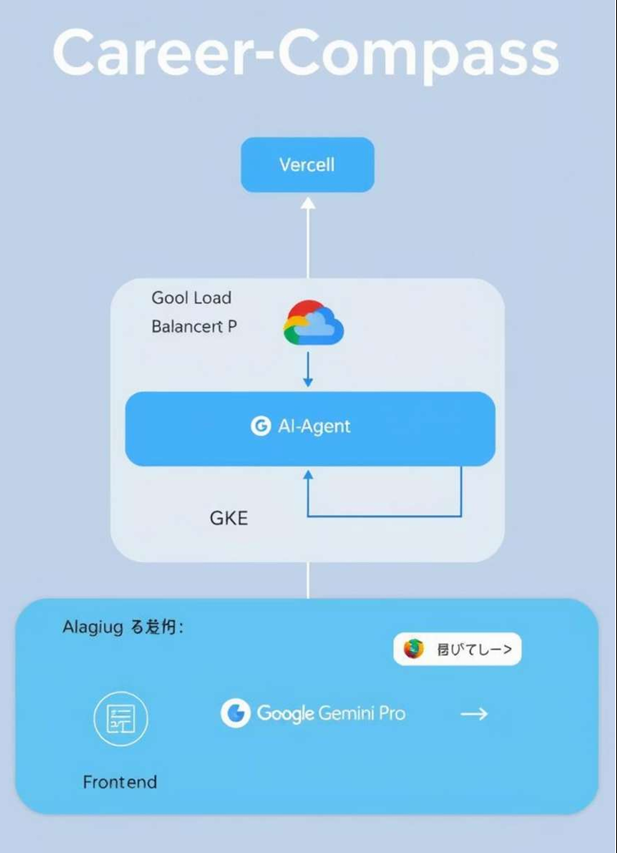
Architecture: We chose a microservices architecture to separate the frontend from the backend AI logic.
Frontend: The user interface is a dynamic and responsive application built with React and the Vite toolchain. It is deployed on Vercel for seamless continuous integration and global content delivery.
Backend: The core AI logic resides in a backend service written in Python using the FastAPI framework. This service is responsible for communicating with the Gemini API.
Containerization & Orchestration: The Python backend was containerized using Docker. To ensure scalability and reliability, we deployed this container on Google Kubernetes Engine (GKE). This allows the application to handle fluctuating user loads and manage itself with features like automated healing and rolling updates.
The Flow: The Vercel frontend communicates with the GKE backend via a secure API endpoint exposed by a Google Cloud Load Balancer. This architecture ensures the entire system is decoupled, robust, and scalable.
Challenges we ran into Our journey was a masterclass in real-world cloud deployment, and it came with significant challenges:
The Cost Barrier: Our initial excitement was quickly met with the reality of cloud costs. A standard GKE cluster configuration was prohibitively expensive for a prototype. This forced us to pivot from just deploying the application to deploying it in the most cost-effective way possible.
The Over-Optimization Trap: Our first attempt at cost-saving was aggressive. We configured a node pool with e2-micro instances, the smallest available. However, this backfired. The nodes had insufficient memory and CPU resources, causing our application pods to get stuck in a "Pending" state, unable to be scheduled. The application was deployed but completely non-functional.
Finding the Sweet Spot: The main challenge became a balancing act. We had to debug the resource issue within Kubernetes and experiment with different machine types, eventually landing on e2-small instances. This provided just enough resources for the application to run stably while still being incredibly cost-effective when combined with our other optimization strategies.
Accomplishments that we're proud of Successfully Deploying on Kubernetes: As first-time cloud users, designing, containerizing, and deploying a microservices application on a sophisticated platform like GKE was a major technical achievement.
Aggressive and Successful Cost Optimization: We are incredibly proud of the infrastructure strategy we implemented. By combining preemptible nodes, node autoscaling (down to zero), and Horizontal Pod Autoscaling (down to zero), we reduced the potential monthly cost by over 90% to an estimated ~$20-25/month, making the project sustainable.
Building a True End-to-End AI Application: We successfully integrated a modern frontend, a scalable backend, and a powerful third-party generative AI API to create a seamless and intelligent user experience.
Resilience and Problem-Solving: We didn't give up when our application failed to run. We systematically diagnosed the resource constraint issue and engineered a solution, which was a critical learning experience.
What we learned This project was an immense learning experience, extending far beyond just writing code.
Cloud Is More Than Just Servers: We learned that modern cloud engineering is about architecture, cost management, and automation. Theoretical knowledge is one thing, but implementing it under real-world constraints is another.
The Importance of Financial Planning in Tech: We learned to think like financial managers for our own project, understanding that the most powerful technical solution is useless if it's not financially sustainable.
Hands-On Kubernetes: We moved from understanding Kubernetes conceptually to using kubectl and YAML manifests to manage a live application, giving us practical DevOps skills.
Performance vs. Cost: The challenge with the e2-micro nodes taught us the critical lesson of balancing performance requirements and budget. The cheapest option is not always the most viable one.
What's next for Career-Compasss We see the current prototype as a strong foundation for a much larger platform. Our next steps include:
User Accounts and Persistence: Implementing a database (like PostgreSQL) to allow users to create accounts, save their profiles, and track their progress over time.
Fine-Tuning the AI Model: Integrating a feedback loop where users can rate their recommendations, allowing us to collect data to fine-tune the Gemini model for even more accurate and context-aware suggestions specific to the Indian job market.
Direct Integrations: Connecting our recommended skills and courses directly to learning platforms (like Coursera, Udemy, NPTEL) via their APIs.
Expanding the Dashboard: Adding more detailed modules for long-term financial planning, investment suggestions, and progress tracking against the user's career roadmap.
Built With
- and-scale-our-containerized-backend-ai-agent
- axios
- cloud
- docker
- engine
- ensuring-high-availability-and-reliability.-vercel:-the-platform-for-continuous-deployment-and-hosting-of-our-frontend-react-application.-docker:-for-containerizing-our-python-backend-application
- fastapi
- gemini
- google-cloud
- google-kubernets
- javascript
- kubernetes
- manage
- python
- react
- vercel
- vite


Log in or sign up for Devpost to join the conversation.