Inspiration
The inspiration for Career Co-Pilot came from a shared frustration: the job application process feels broken.
Applying to jobs today is repetitive, time-consuming, and emotionally draining. Candidates manually search across multiple platforms, tweak resumes for every role, re-enter the same information into countless forms, and often never hear back. There is little feedback, limited visibility into what’s working, and no structured way to improve over time.
We asked ourselves:
- Why is applying to jobs still so manual in 2026?
- Why can’t there be a system that learns from your profile and outcomes?
- Why can’t AI handle the repetitive parts while the human focuses on strategy?
Career Co-Pilot was built to be more than a resume builder. It’s a career operating system - a centralized platform that helps candidates discover roles, tailor applications, prepare for interviews, and learn from outcomes in a continuous feedback loop.
Instead of being just another tool, we wanted to build a co-pilot, something that works alongside you, not just for you.
What it does
Career Co-Pilot is an AI-assisted job search and application platform that helps users manage the entire application lifecycle.
At a high level, it:
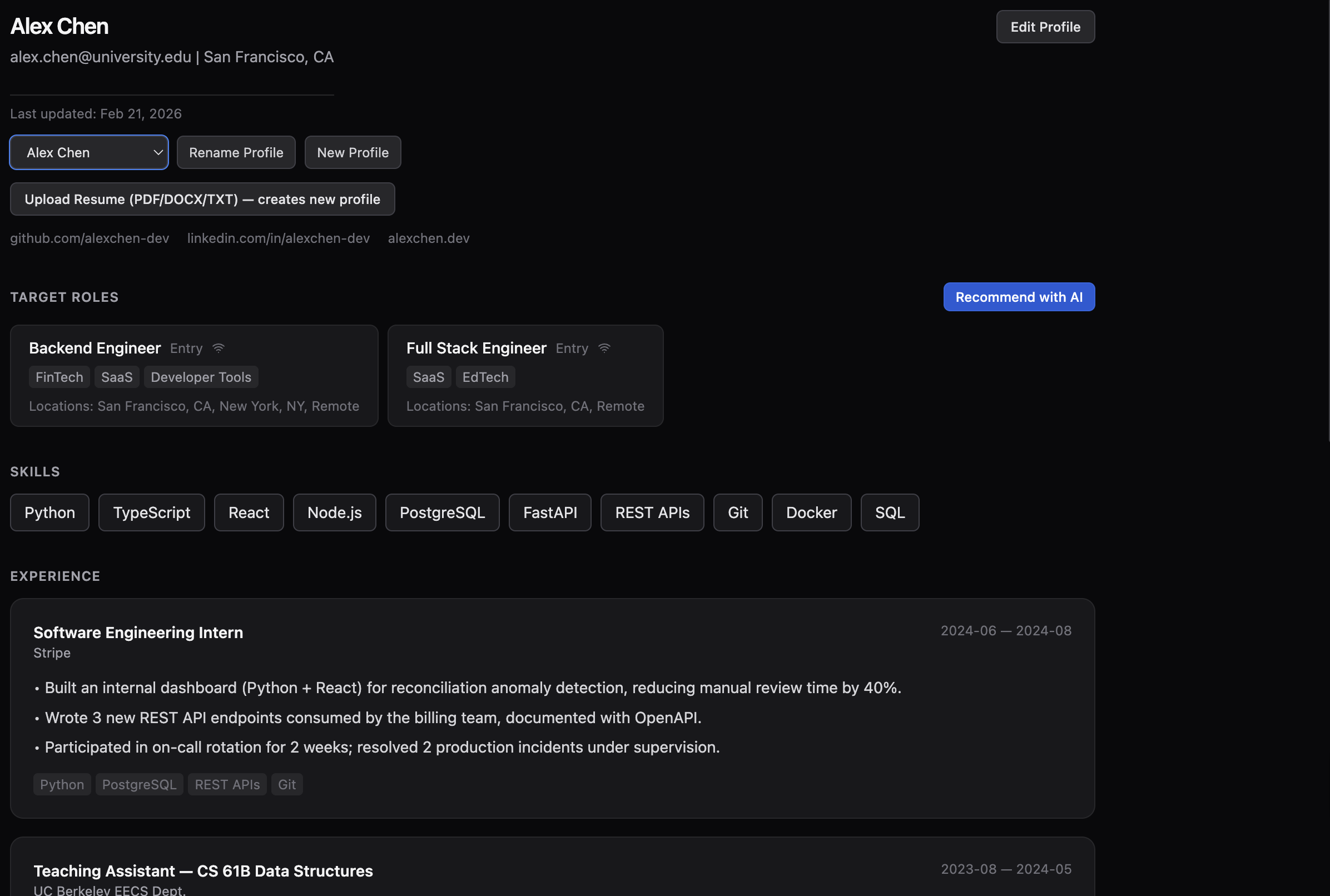
- Stores and structures your professional profile
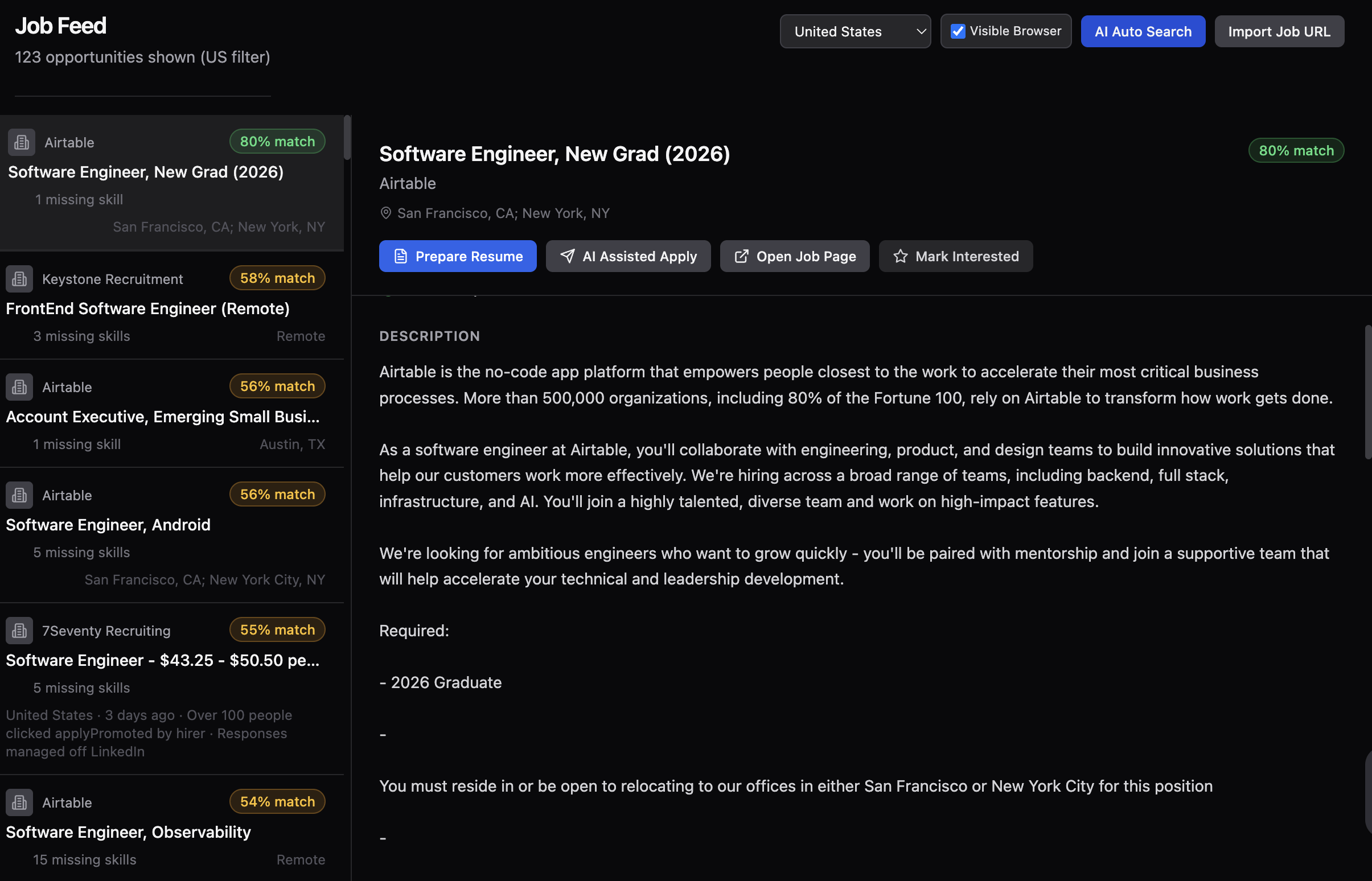
- Discovers relevant jobs
- Matches roles using skill and experience alignment
- Generates tailored resume versions
- Drafts application form responses
- Assists with controlled form submissions
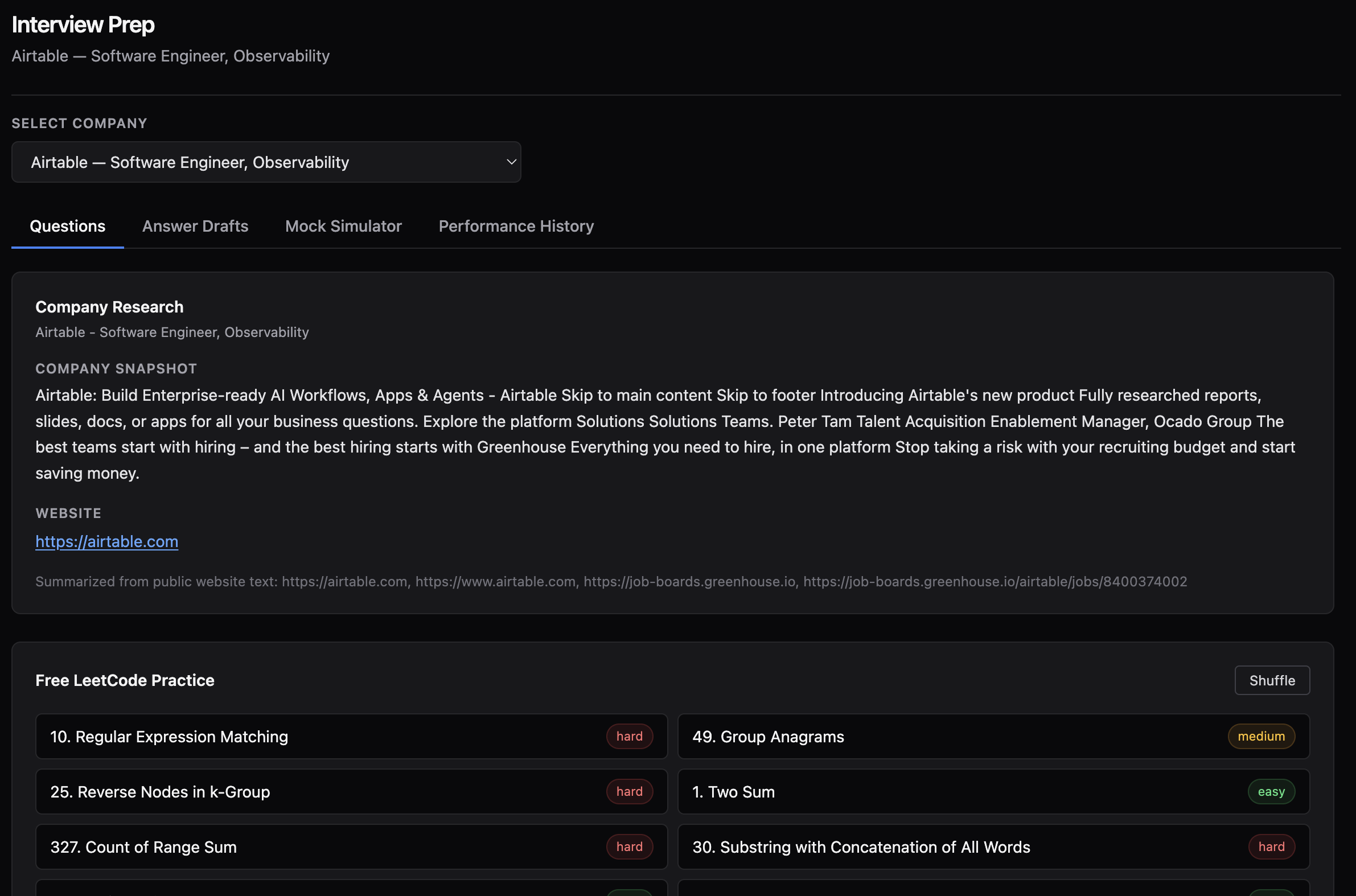
- Creates interview preparation kits
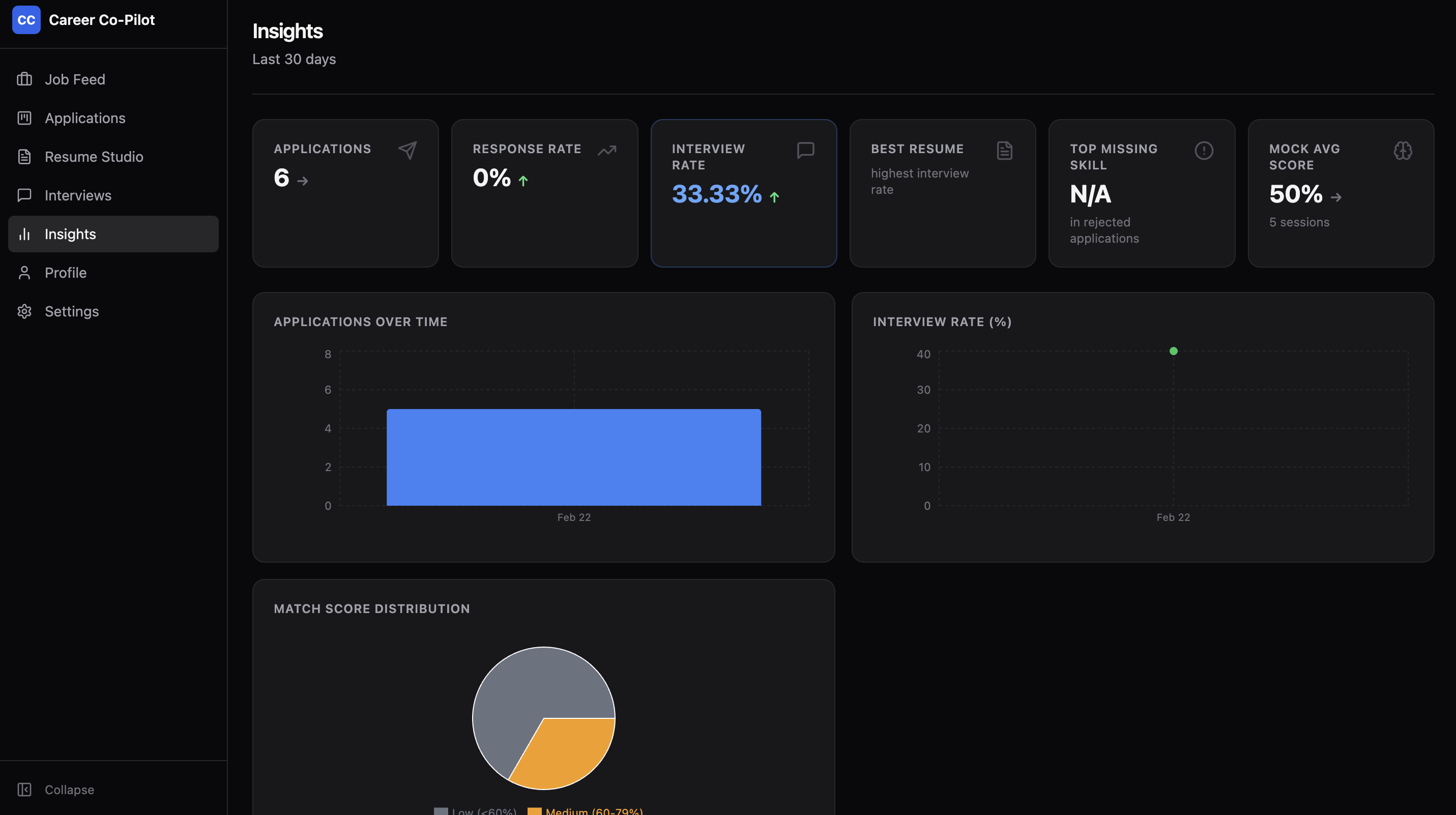
- Tracks outcomes and generates insights
1. Structured User Profile
Users input:
- Skills
- Experience
- Projects
- Certifications
- Role interests
- Resume uploads
All data is normalized and stored in a structured format. This enables downstream engines to reason about alignment, generate tailored content, and avoid hallucinating details.
2. Intelligent Job Discovery
Career Co-Pilot includes a discovery engine with:
- Source adapters
- Query generation
- Job normalization
- Deduplication
- Ranking
Jobs are scored based on:
- Skill match
- Role alignment
- Experience match
This helps users focus on high-quality opportunities instead of mass-applying blindly.
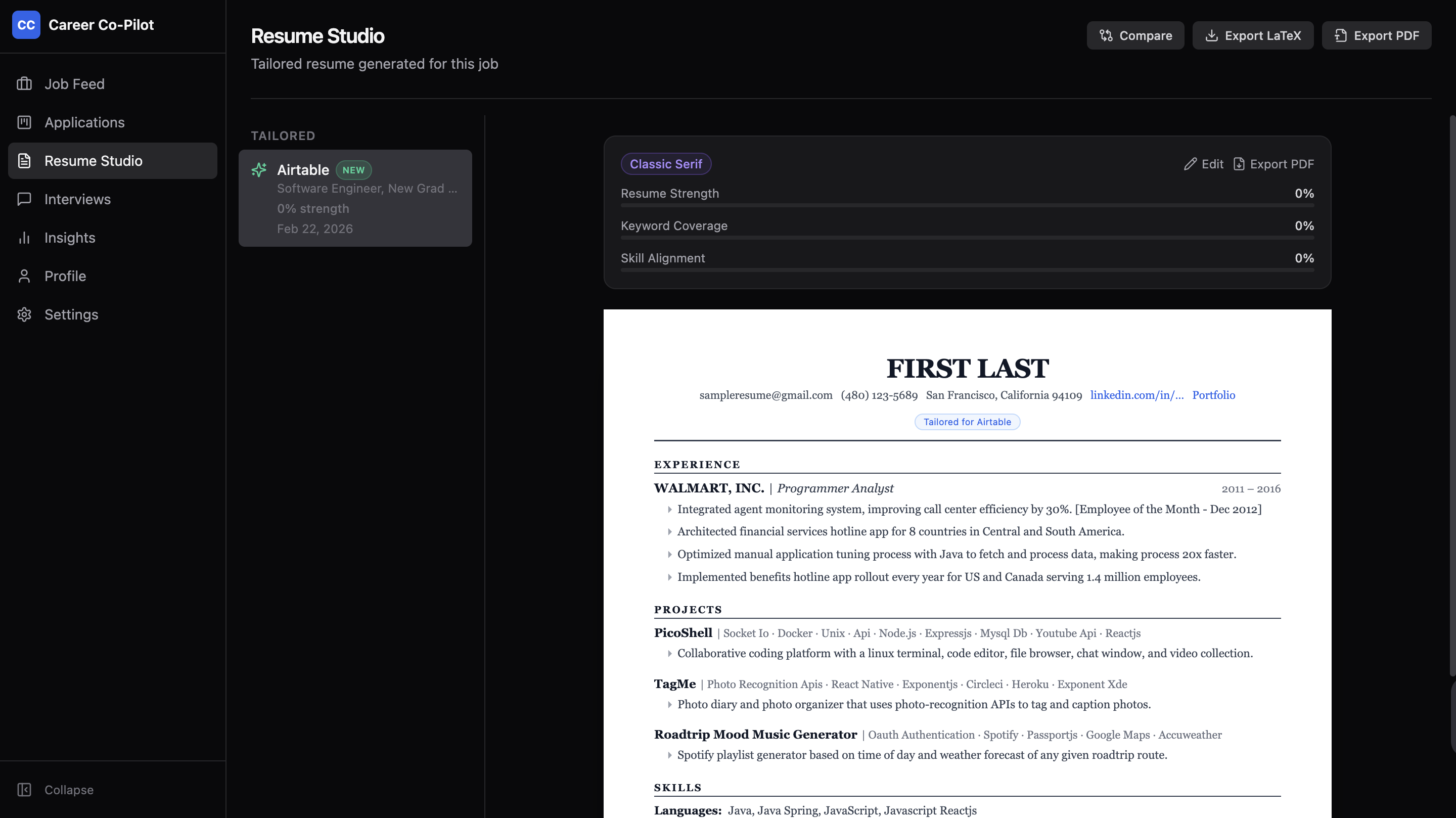
3. Resume Studio
The Resume Studio allows users to:
- Generate multiple resume versions
- Optimize keyword coverage
- Improve skill alignment
- Compare versions via diff view
- Export tailored PDFs
Each version is tied to a specific job for targeted applications.
4. Application Drafting Engine
The draft generator:
- Analyzes job descriptions
- Parses application forms
- Auto-fills deterministic fields (name, email, links)
- Infers years of experience
- Generates concise, context-grounded essay responses
- Avoids inventing facts
Unknown or risky fields are marked explicitly for review.
5. Controlled AI Submission Engine
The submission engine:
- Scans live forms using Playwright
- Plans limited AI actions
- Applies operator guidance
- Enforces daily submission caps
- Captures screenshots
- Maintains structured progress logs
- Supports real-time user intervention via chat
This ensures safety, transparency, and human-in-the-loop control.
6. Interview Kit Generator
For each application, Career Co-Pilot can generate:
- Company profile summaries
- Question banks
- Draft answers
- Mock evaluation scores
- Practice simulation modes
This bridges the gap between applying and preparing.
7. Insights & Feedback Loop
The system aggregates:
- Application outcomes
- Rejection types
- Response times
- Resume strength metrics
- Keyword coverage
- Skill alignment scores
This allows users to continuously refine their strategy.
Career Co-Pilot turns the job search from chaos into a measurable system.
How we built it
Career Co-Pilot is built as a modular full-stack system.
Backend
The backend is structured around:
- A central SQLite database
- Modular engines for each stage of the pipeline
- A thin LLM client abstraction
- Strict separation of deterministic logic and AI-assisted logic
Core components include:
- Profile ingestion and resume parsing
- Job discovery orchestrator
- Resume compiler and bullet rewriter
- Application draft generator
- Form analyzer
- AI submission engine
- Interview kit generator
- Insights aggregator
We built guardrails into every AI interaction:
- Constrained prompts
- Context-limited generation
- Explicit fallback logic
- Required review markers
- Daily submission caps
- Timeout boundaries
The system can operate partially without an LLM, falling back to rule-based logic when needed.
Frontend
The frontend is modular and feature-driven.
Each feature has its own package:
- Jobs
- Applications
- Resume Studio
- Profile
- Interviews
- Insights
- Settings
State is isolated per feature to prevent cross-contamination.
The UI includes:
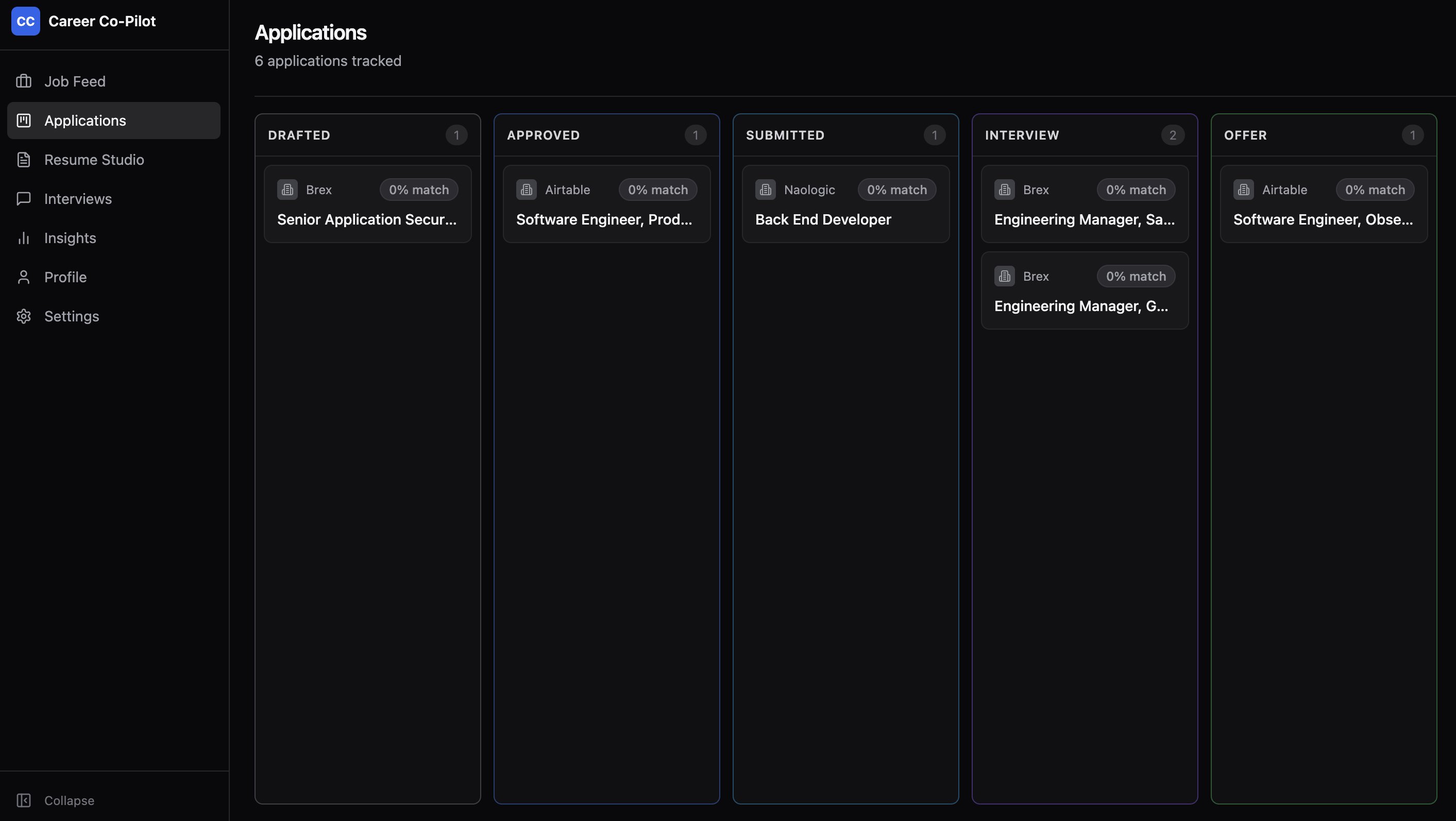
- Kanban-style application tracking
- Resume version comparison
- Job match scoring indicators
- Interview practice tabs
- Metrics dashboards
The design prioritizes clarity and workflow continuity.
DevOps & Architecture
We used:
- Docker for containerization
- Modular monorepo structure
- Feature-based architecture
- Clear separation between API, core types, and UI
- Environment-based LLM configuration
Every major subsystem is independently testable.
Challenges we ran into
1. Balancing Automation with Safety
Fully automated submissions are risky.
We had to design:
- Rate limiting
- Operator guidance
- Real-time progress logs
- Action caps per turn
- Screenshot verification
The goal was not just automation but controlled automation.
2. Avoiding AI Hallucinations
In job applications, hallucinating even one fact is unacceptable.
We implemented:
- Strict prompt constraints
- Context-bound generation
- Explicit “REQUIRES_REVIEW” placeholders
- Fallback logic when AI output is empty or unsafe
Trust was more important than creativity.
3. Normalizing Messy Job Data
Different job sources structure data inconsistently.
We built:
- Adapters
- Normalizers
- Skill taxonomy mapping
- Role synonym mapping
- Deduplication pipelines
This ensured consistent scoring and ranking.
4. Real-Time Browser Automation
Handling live forms required:
- DOM scanning
- Field type normalization
- Timeout management
- Safe element targeting
- Action throttling
Many edge cases appeared with dynamic forms and inconsistent labels.
5. Designing for Extensibility
We wanted Career Co-Pilot to evolve.
So we avoided:
- Hard-coded workflows
- Monolithic services
- Tightly coupled state logic
Every feature is modular by design.
Accomplishments that we're proud of
We are proud that Career Co-Pilot is not just a prototype it is a coherent system.
Key accomplishments:
- A fully structured career database schema
- AI-assisted but controlled application submission
- Resume versioning tied to job context
- Skill-aligned job ranking
- Interview kit generation pipeline
- Feedback loop architecture
- Modular feature-based frontend
- LLM fallback safety logic
- Human-in-the-loop chat intervention during submission
Most importantly:
We didn’t just build features.
We built an end-to-end workflow.
Career Co-Pilot transforms the job search from reactive and emotional to structured and data-driven.
What we learned
1. AI is Most Powerful When Constrained
Unbounded AI is unpredictable.
Constrained AI is transformative.
By limiting context and actions, we made the system safer and more reliable.
2. Systems Thinking Beats Feature Thinking
Building isolated features is easy.
Designing a cohesive lifecycle is hard.
We learned to think in terms of pipelines and feedback loops.
3. Transparency Builds Trust
Users need:
- Logs
- Screenshots
- Clear review markers
- Operator override capability
Automation without visibility feels unsafe.
4. Data Modeling Matters More Than UI Polish
The strength of Career Co-Pilot comes from:
- Structured schemas
- Consistent normalization
- Clear separation of concerns
The database design enabled everything else.
5. The Job Search Is an Optimization Problem
Applications are experiments.
Resumes are hypotheses.
Rejections are signals.
Career Co-Pilot treats the process as iterative optimization.
What's next for Career Co-Pilot
We see Career Co-Pilot evolving into a true autonomous career system.
Next steps include:
- Smarter ranking models based on outcome history
- Adaptive resume tuning based on rejection patterns
- Company-level response analytics
- Cold outreach automation with guardrails
- Recruiter response tracking
- Longitudinal career growth analytics
- Multi-profile support for career pivots
- Smarter interview simulations with performance scoring
- Cloud deployment for multi-device continuity
- Secure credential vault for safer submissions
Long-term, we envision:
Career Co-Pilot as a lifelong career intelligence layer.
Not just helping users land a job but helping them navigate their entire professional journey strategically.
Career Co-Pilot is our attempt to bring structure, intelligence, and feedback to one of the most stressful processes in modern life.
And this is just the beginning.
Built With
- asyncio
- css
- fastapi
- gemini
- html5
- javascript
- playwright
- pnpm
- python
- react
- sqlite
- tailwind
- typescript
- vite


Log in or sign up for Devpost to join the conversation.