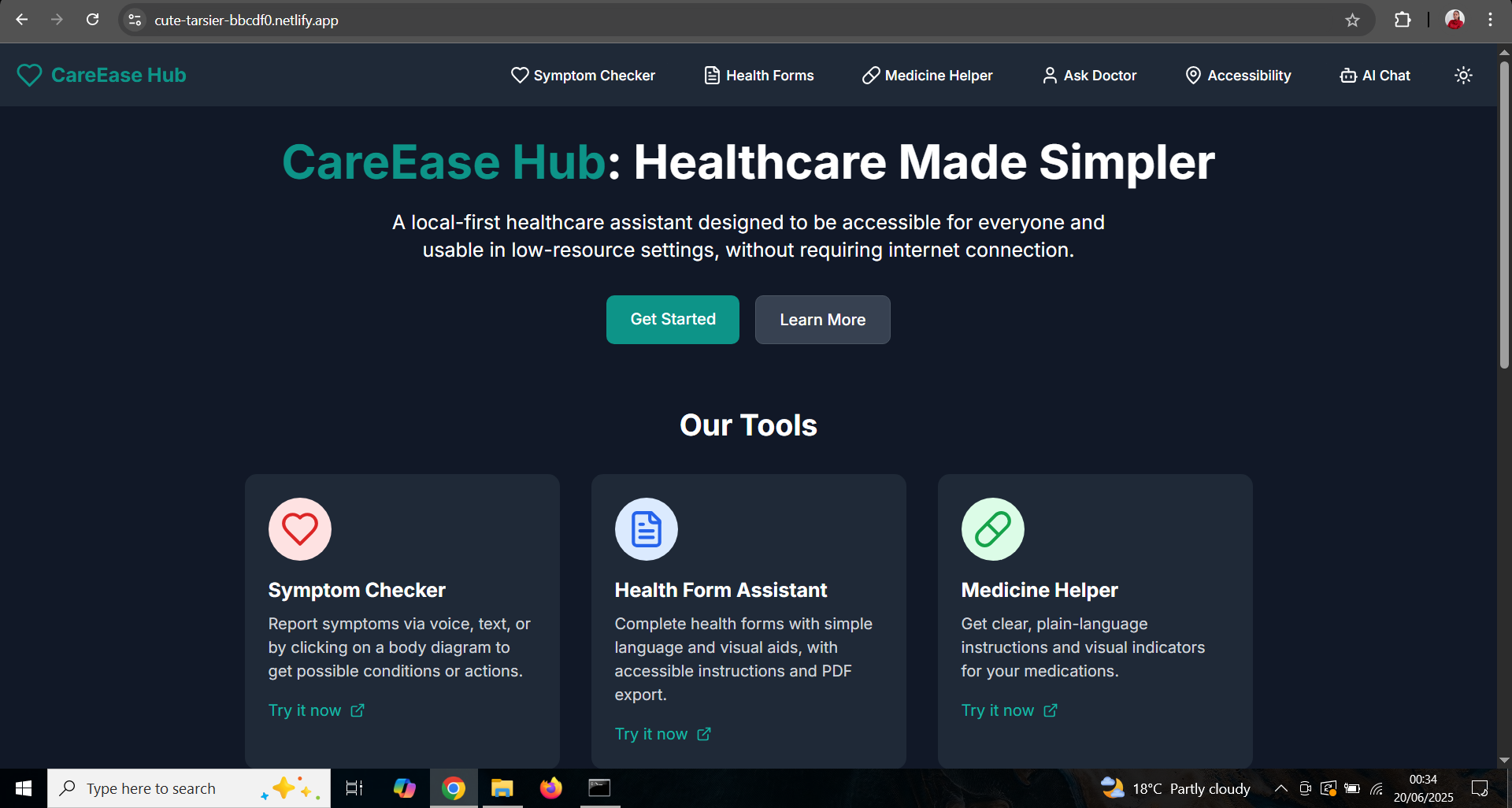
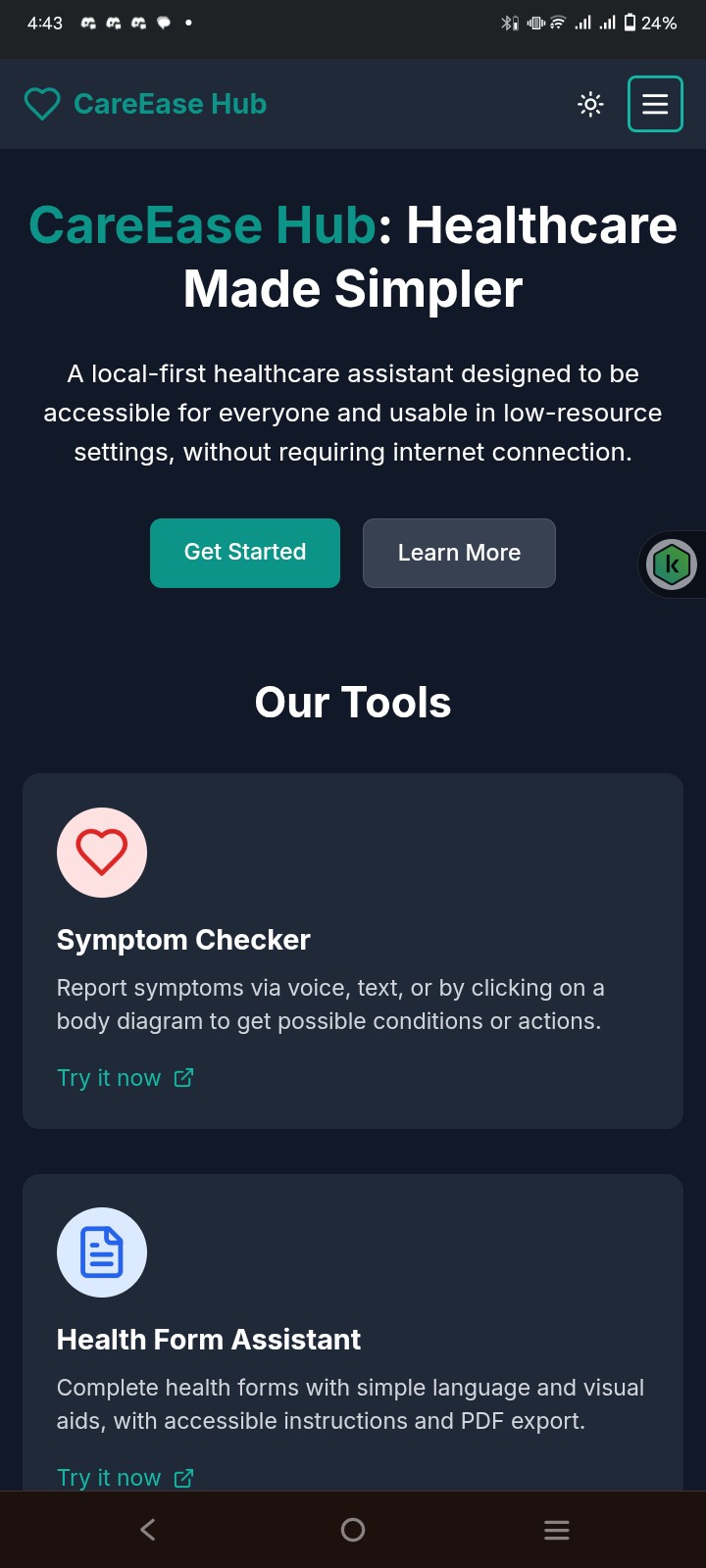
💡 CareEase Hub – Accessible Healthcare Assistant Platform Inspiration In many underserved communities, especially rural areas, accessing basic healthcare services remains a significant challenge. For individuals with disabilities, these challenges are amplified by inaccessible digital tools, complex interfaces, and a lack of localized support.
We built CareEase Hub to bridge this gap, creating a tool that is now online-first, prioritizes accessibility, and empowers both patients and healthcare providers.
💡 What It Does CareEase Hub is an online-first, accessibility-focused healthcare assistant designed for inclusive and remote healthcare support. It empowers both patients and health practitioners through a set of intuitive, visual, and voice-enabled tools.
🔍 Key Features: 🩺 Symptom Checker: Users can report symptoms using voice, text, or a visual body diagram, and receive instant suggestions for possible conditions and recommended next steps.
📄 Health Form Assistant: Assists users in completing medical forms through plain language, visual prompts, and voice guidance, then generates downloadable PDFs.
🤖 AI Chatbot: A one-to-one assistant that answers common health-related questions in real-time, using voice or text input, powered by the Groq AI model.
📍 Accessibility & Location Services: Detects the user’s geographic location to customize healthcare content and localize responses. Optimized for screen readers, voice interaction, and WCAG 2.1 compliance.
🧑⚕️ Ask a Doctor: A virtual page where users can send messages, questions, or reports to a professional (or a placeholder assistant), simulating doctor consultations.
🔊 Accessibility Modes:
Light, dim, and dark themes
Voice interaction and screen reader compatibility
Full keyboard navigation
WCAG 2.1–compliant layout and components
💊 Medicine Helper: Translates complex medication instructions into easy visuals and reminders.
🛠️ How We Built It Frontend: Built with React, Vite, TypeScript, and Tailwind CSS.
Backend: A Python backend using the Flask framework.
AI Models: We integrated the Groq API for fast language model processing and the ElevenLabs API for high-quality text-to-speech.
Accessibility: Implemented ARIA roles, theme toggles, and responsive design for assistive devices.
Deployment: The frontend is deployed as a Static Site on Render, and the backend is deployed as a Web Service on Render.
🧱 Challenges We Faced Designing reliable health workflows with external APIs.
Maintaining full accessibility (WCAG compliance) while keeping the UI intuitive.
Integrating third-party APIs for voice and AI into the application.
Ensuring smooth communication between the frontend and backend, particularly with CORS policies.
🏆 Achievements We're Proud Of A fully functioning prototype that uses modern, industry-standard tools.
Custom accessibility modes for low vision, motor disabilities, and cognitive limitations.
A visual-first interface for users with low digital literacy.
Successfully integrating powerful AI tools to enhance the user experience.
📚 What We Learned Modern web frameworks like React and Vite are highly effective for building complex applications.
Integrating external APIs like Groq and ElevenLabs can significantly improve user interaction and performance.
Accessibility benefits everyone, not just people with disabilities.
Thoughtful design is key to a successful user experience.
🚀 What's Next for CareEase Hub 🌍 Multilingual Support: Add local language options for rural and non-English speakers.
🧠 Smarter Symptom Matching: Integrate public medical datasets to improve suggestions.
🏥 Clinic Integration: Allow syncing with offline health centers or clinics.
💻 Open Source: Launch publicly for NGOs, developers, and health orgs to extend.
🎤 Voice Expansion: Improve voice input for blind and low-vision users.

Log in or sign up for Devpost to join the conversation.