-
-
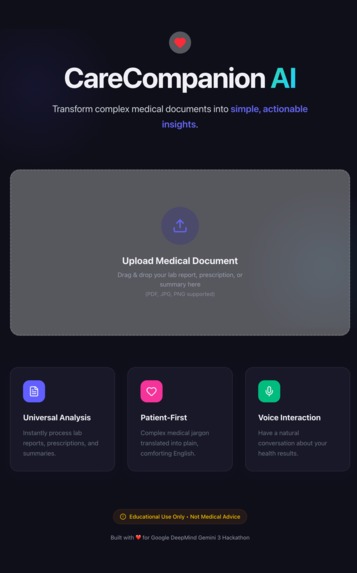
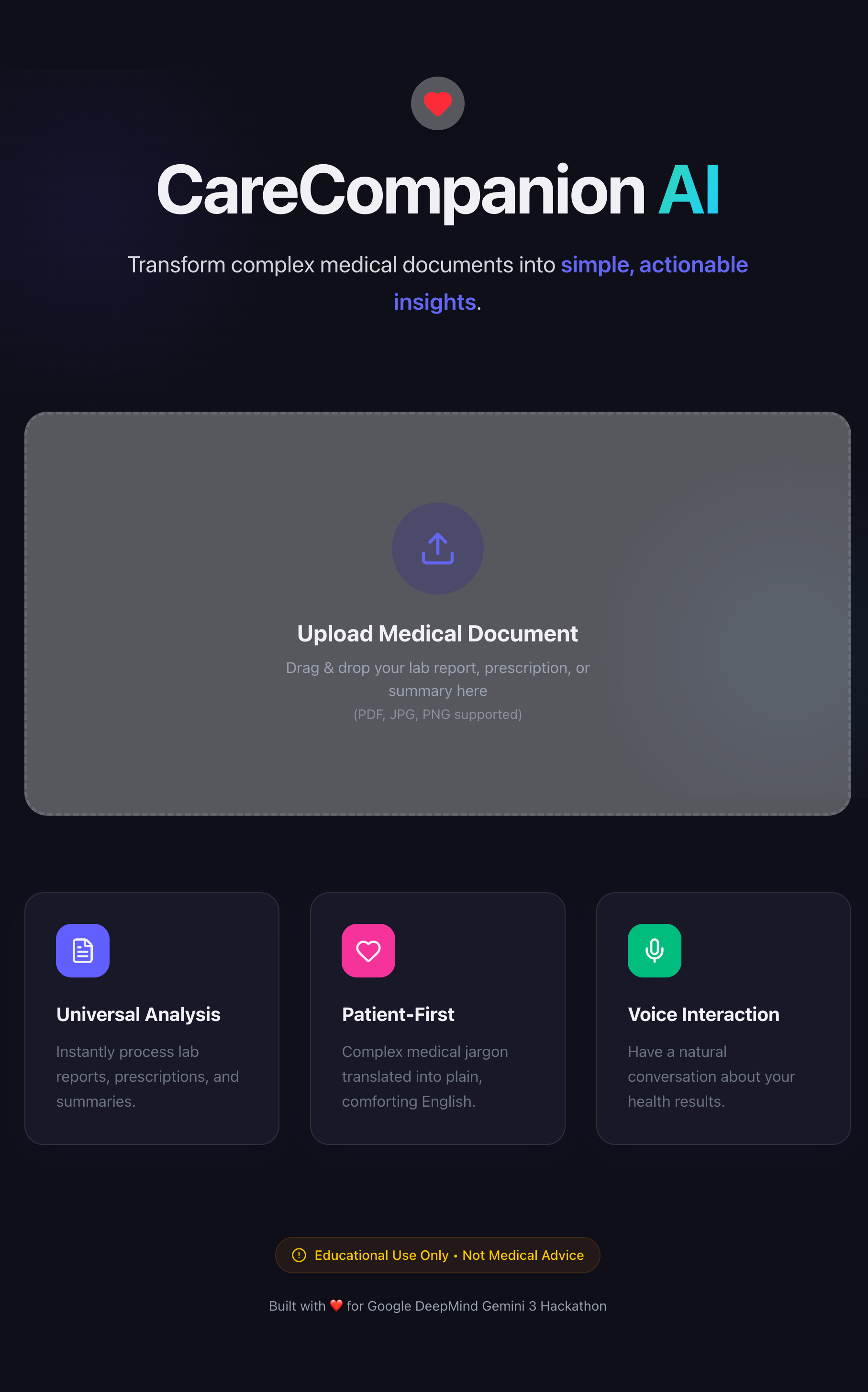
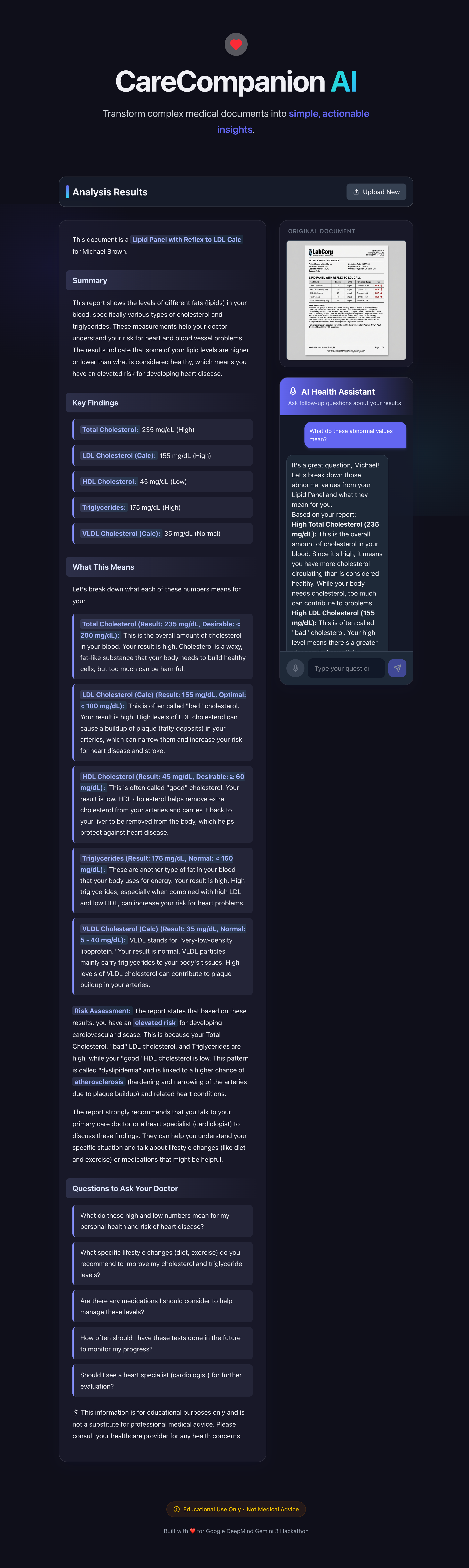
Modern, Patient-First Interface: Clean design with drag-and-drop analysis and real-time voice interaction.
-
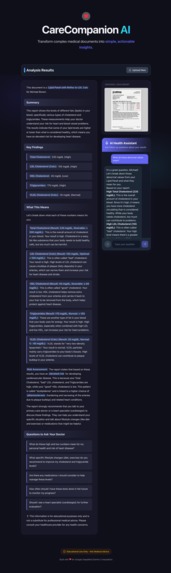
Gemini 3 breaks down complex lab reports into plain English with key findings and actionable insights.
-
Appealing Website Logo
Inspiration
Reading medical documents feels like learning a new language. Lab reports with "Hematocrit," "Basophils," and "Creatinine" are confusing and scary for patients. We wanted to build a bridge between complex medical data and patient understanding—a companion that not only reads data but also explains it with empathy and clarity.
What it does
CareCompanion AI is a multimodal health assistant that:
- Analyzes Medical Documents: Upload images or PDFs of lab reports (blood tests, metabolic panels, etc.).
- Explains in Plain English: Uses Gemini 3's deep reasoning to break down complex medical terms into simple analogies (e.g., "White blood cells are your body's defense team").
- Voice Interaction: Patients can ask follow-up questions naturally using their voice ("Is my cholesterol strictly bad?").
- Fact-Checked Answers: Leverages Google Search Grounding to verify facts and check drug interactions against the latest medical guidelines.
How we built it
- Frontend: Next.js 14 (App Router) with Tailwind CSS and shadcn/ui for a modern, accessible interface.
- AI Engine: Gemini 3 Flash Preview via the Google AI Node.js SDK.
- Multimodal Capabilities: Used Gemini's vision capabilities to process document images directly (no OCR needed!).
- Grounding: Integrated Google Search tool to ensure answers are factually grounded.
- Voice: Web Speech API for real-time voice input.
Challenges we ran into
- Prompt Engineering: Tuning the model to be "empathetic but precise" was tricky—we didn't want it to sound like a robot or give false hope.
- Rate Limits: Working with the preview model meant hitting quota limits often, forcing us to optimize our context usage!
Accomplishments that we're proud of
- Seamless drag-and-drop document analysis that feels like magic.
- The "Deep Think" style explanations that use analogies (e.g., Hemoglobin = Oxygen Trucks).
- Integrating Voice + Vision + Search in a single seamless flow.
What's next for CareCompanion AI
- Multilingual Support: Explaining reports in parents' native languages.
- History Tracking: improved long-term memory of patient history.
- EHR Integration: Connecting directly to hospital systems.
Built With
- gemini-api
- google-cloud
- next.js
- react
- tailwind-css
- typescript
- vercel

Log in or sign up for Devpost to join the conversation.