-
-
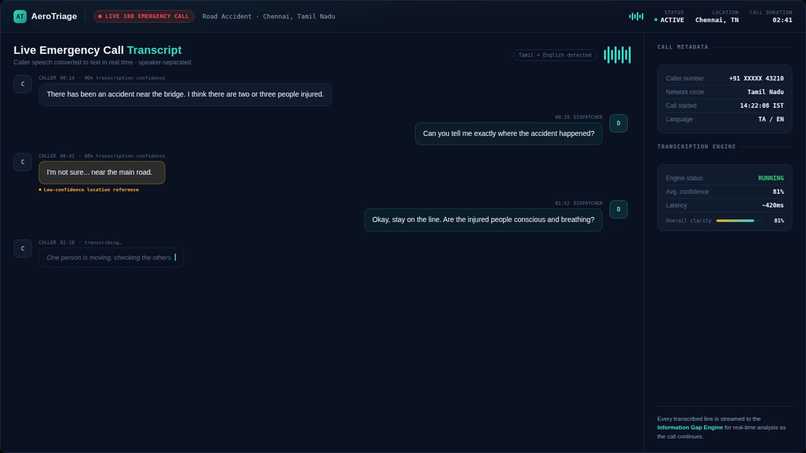
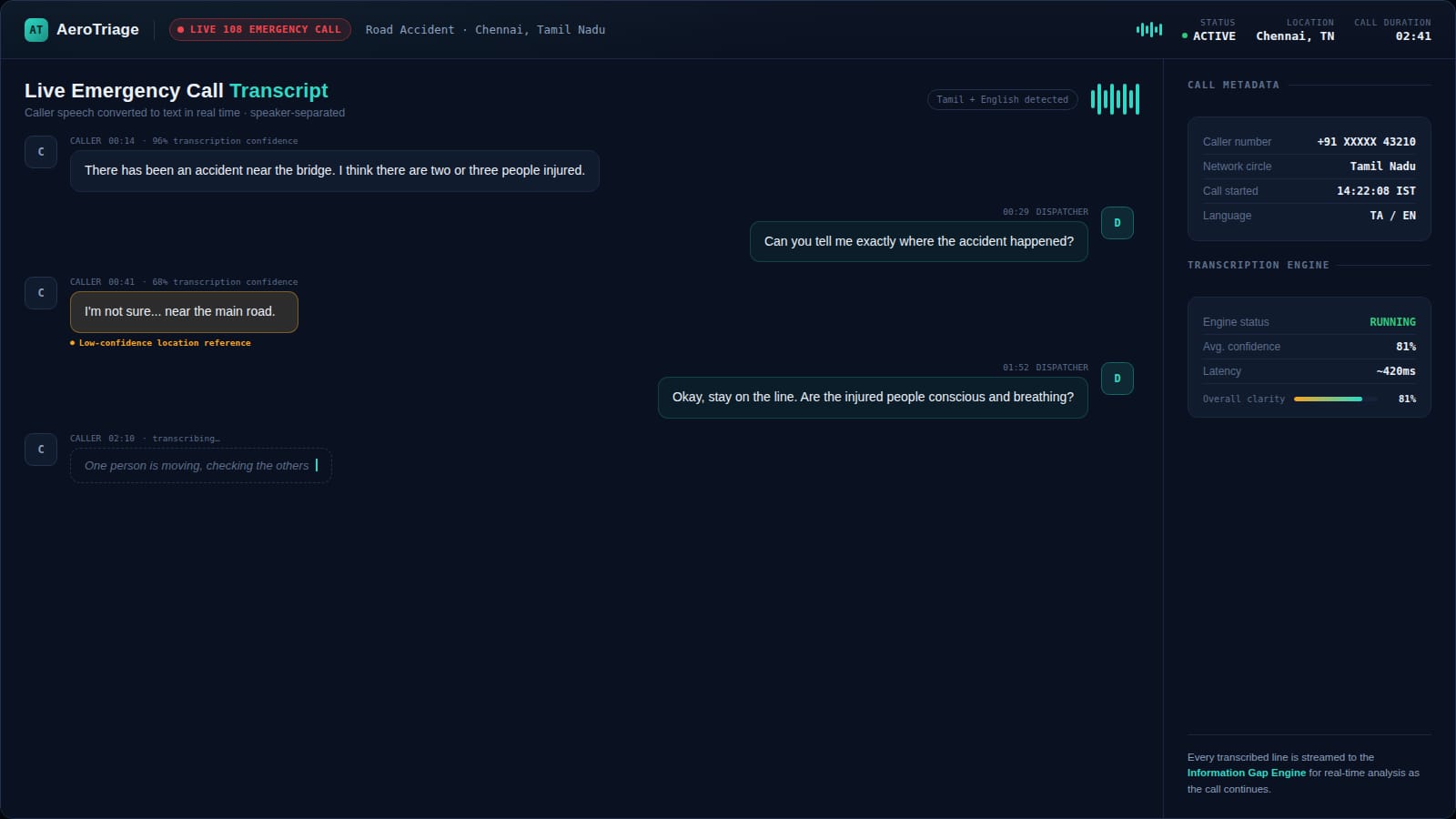
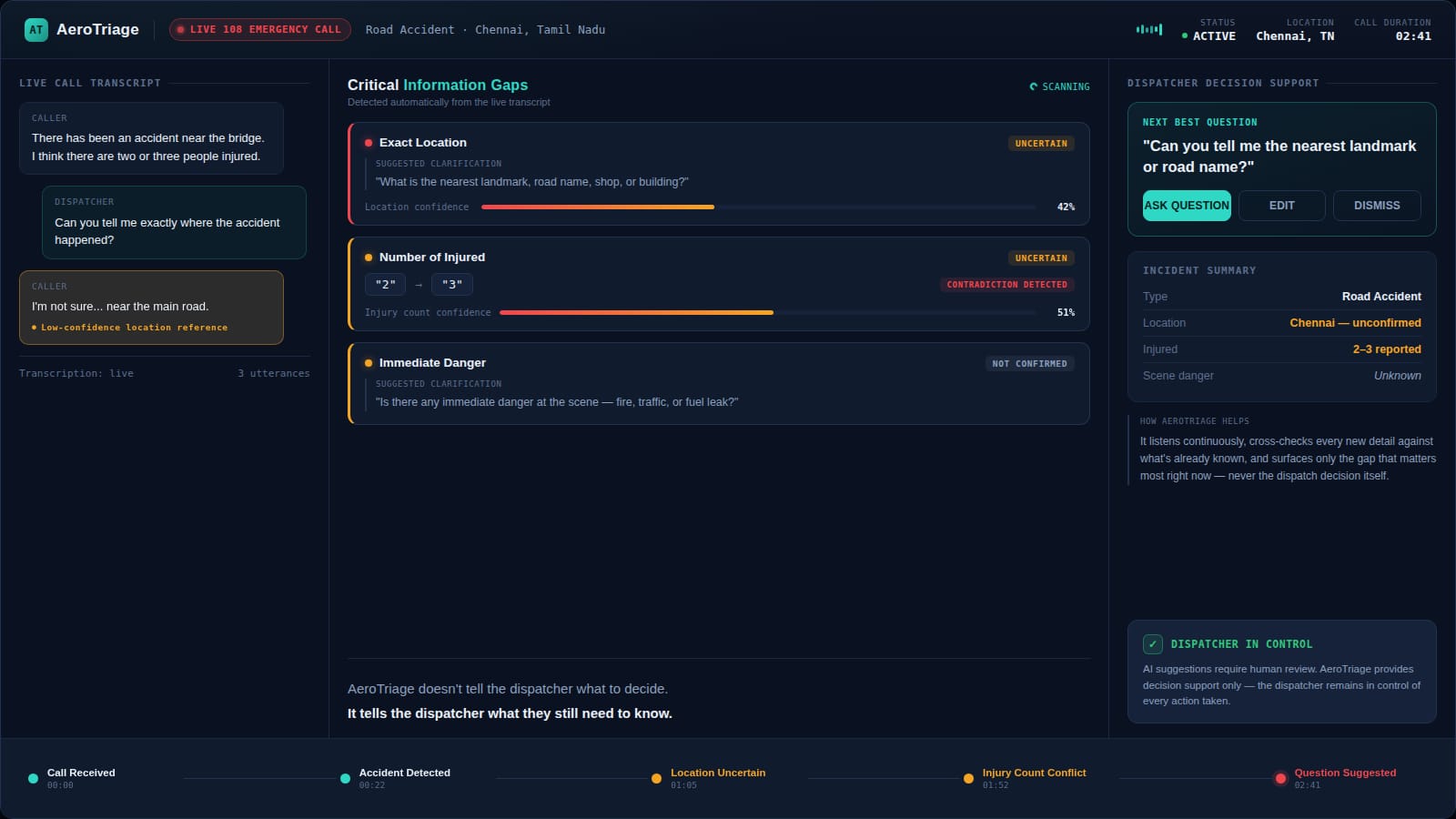
Live Emergency Call Console showing the real-time call transcript and critical information identified during the emergency.
-
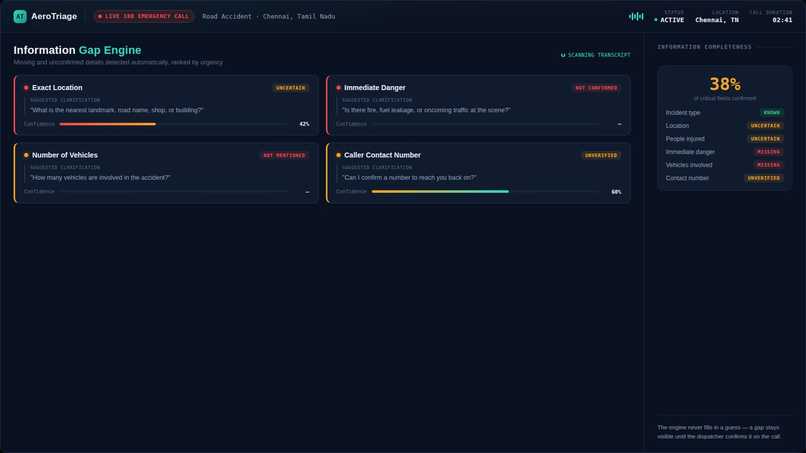
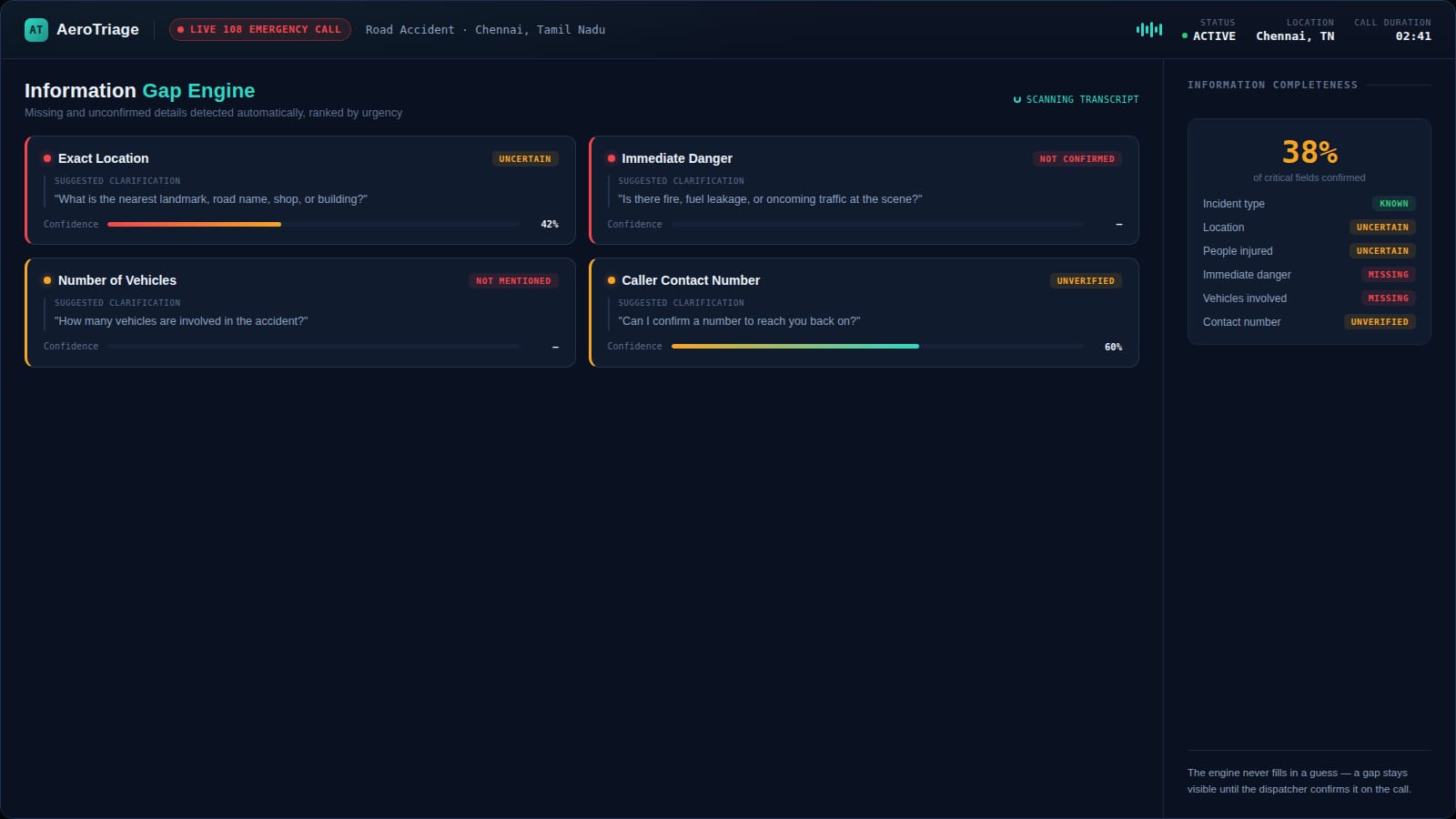
Information Gap Engine identifying missing and uncertain information required for effective emergency response.
-
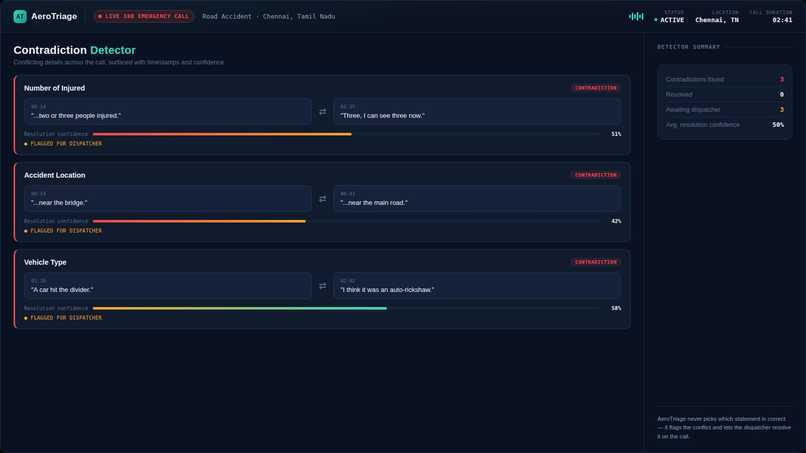
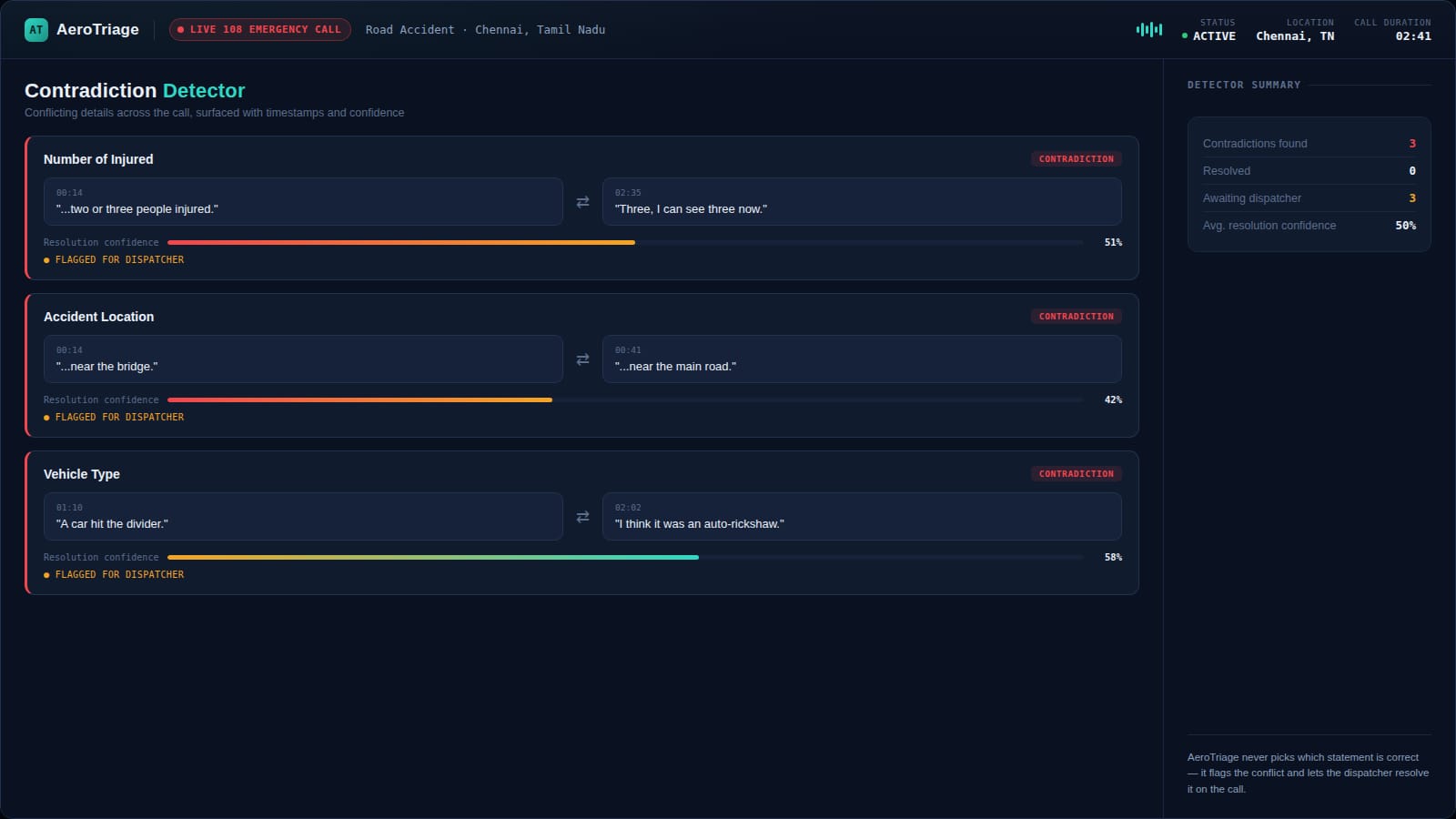
Contradiction Detection module highlighting conflicting information about the accident location, injured persons, and vehicle type.
-
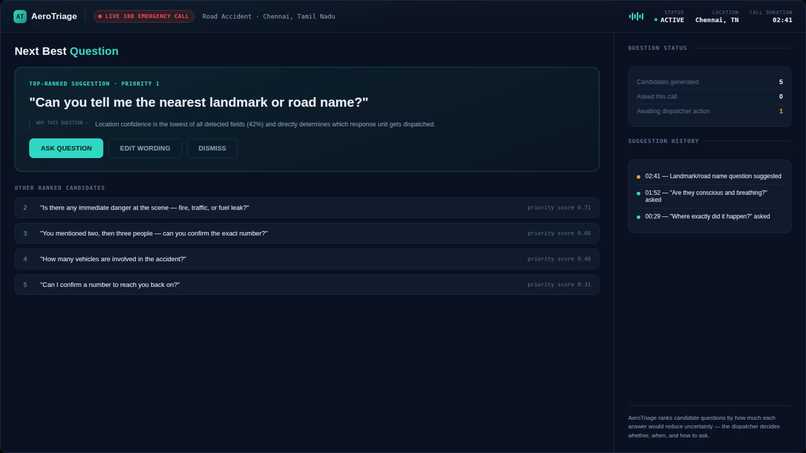
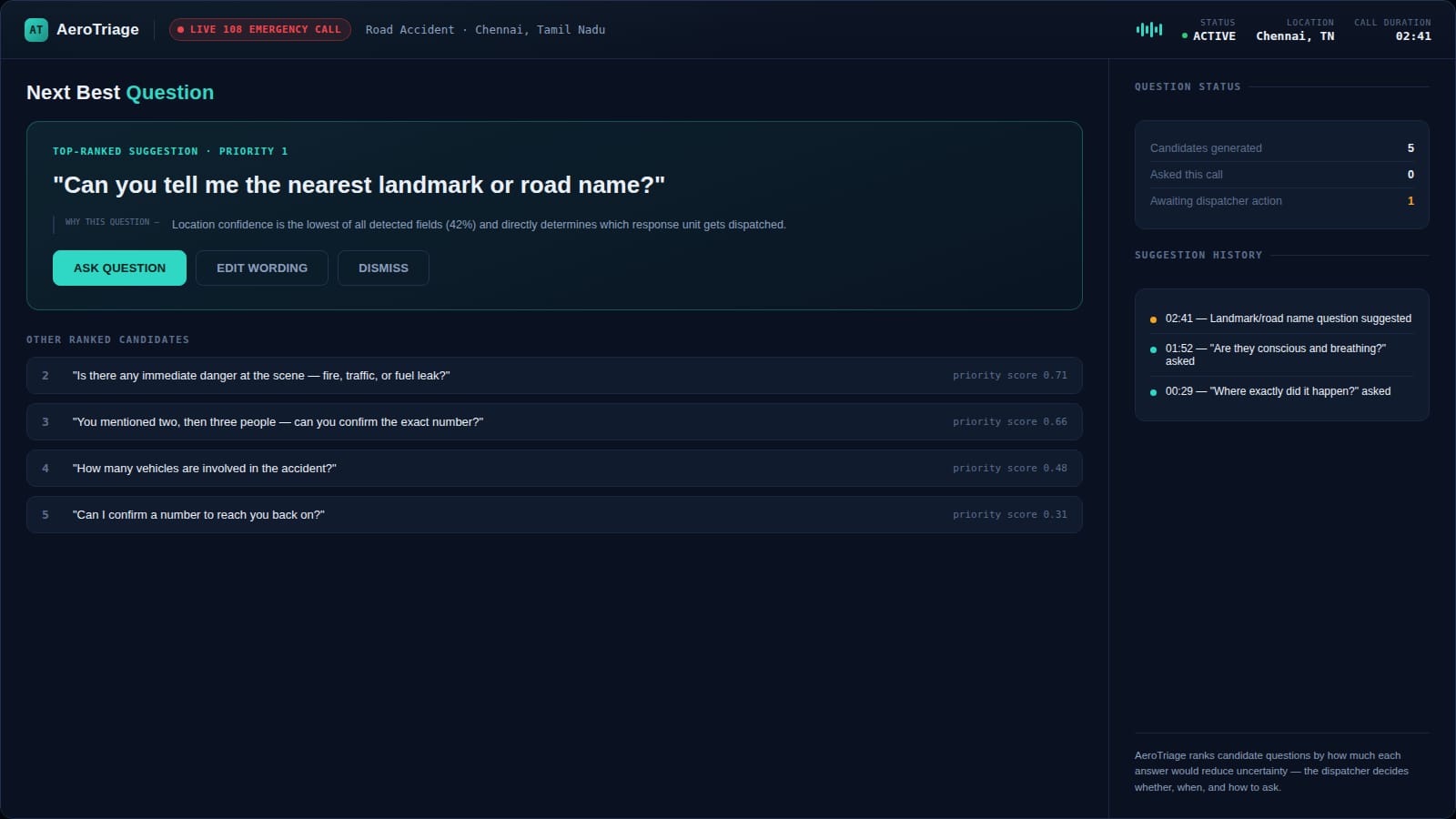
Suggested Next Question module recommending the most important clarification question for the dispatcher.
-
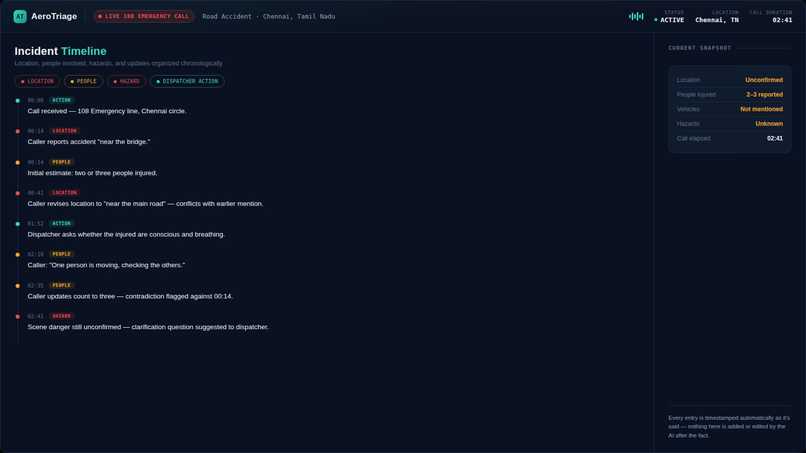
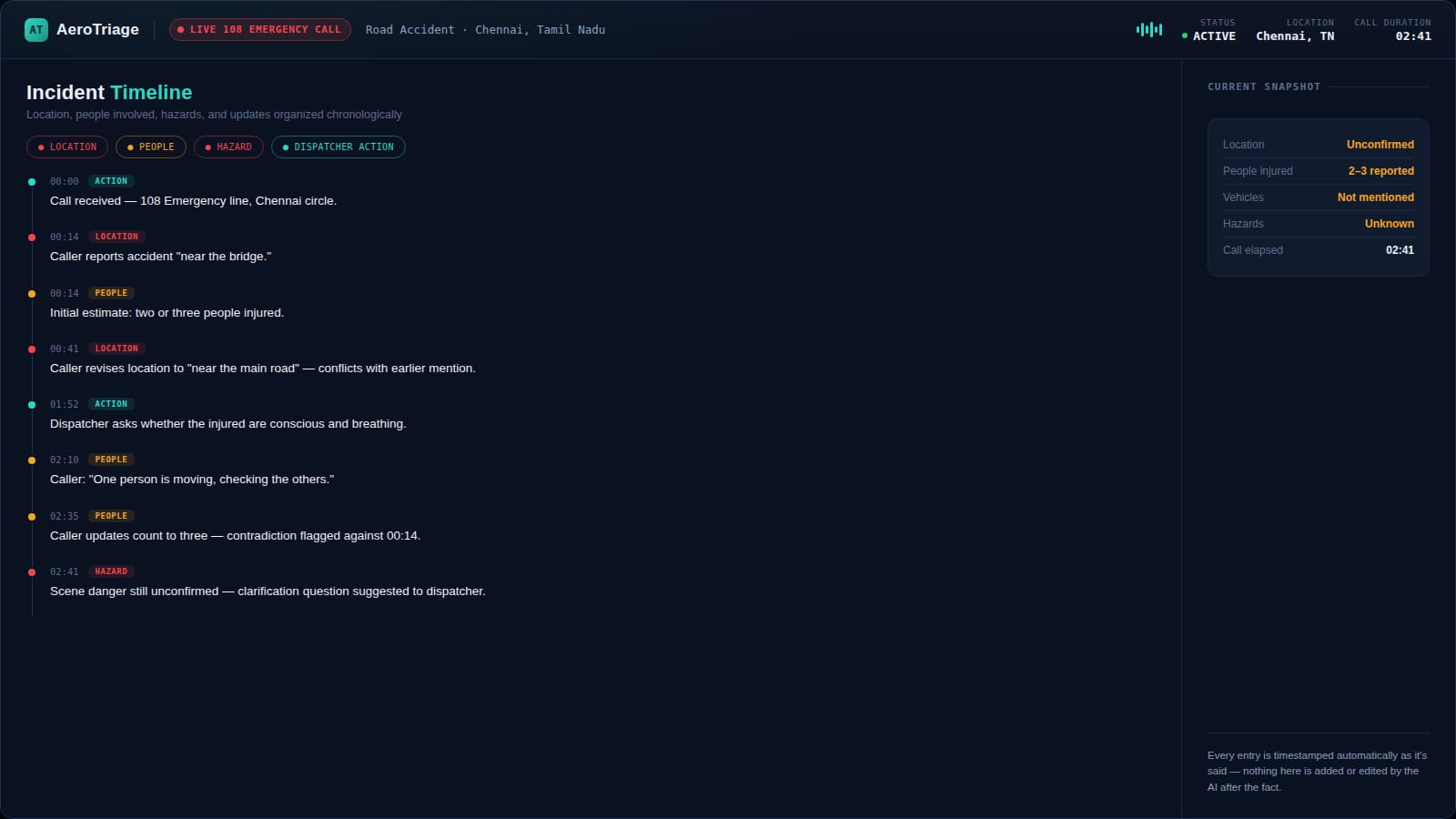
Incident Timeline presenting the accident details, updates, and dispatcher actions in chronological order.
-
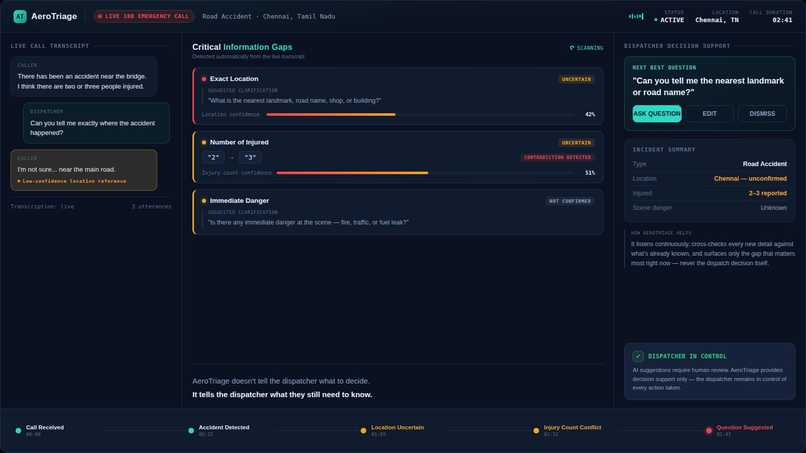
Dispatcher Overview providing a consolidated view of the emergency call and AI-assisted decision support.
Inspiration
Emergency dispatchers work under intense time pressure while trying to extract critical information from emergency calls. Important details such as exact location, number of people involved, and immediate hazards may be missing, uncertain, or contradictory.
This inspired us to ask:
What if AI could help a dispatcher identify what information is still missing, instead of simply summarizing what was already said?
That idea led us to create AeroTriage.
What it does
AeroTriage is an AI-powered emergency-dispatch copilot.
Its core innovation is the Information Gap Engine, which identifies:
- Known information
- Missing information
- Uncertain information
- Contradictions
- Priority gaps
- Suggested clarification questions
For example, in a simulated emergency call, a caller may report a fire near a market road but fail to provide the exact location or number of people involved.
AeroTriage identifies these gaps and suggests a prioritized clarification question such as:
“Is there a shop name or nearby landmark you can see from where you are?”
The dispatcher remains in control. AeroTriage does not replace the dispatcher, diagnose medical conditions, or automatically dispatch emergency services.
How we built it
For the Ideathon, we developed AeroTriage as a conceptual prototype using simulated emergency scenarios and product mockups.
Our proposed workflow is:
Emergency Call → Speech-to-Text → AI/NLP Extraction → Information Gap Engine → Priority Engine → Suggested Question → Dispatcher Dashboard
The proposed technology stack includes React/Next.js, Tailwind CSS, Python/FastAPI, speech-to-text, AI/NLP extraction, PostgreSQL, and real-time streaming technologies.
Our focus was on designing the user experience, Information Gap Engine, dispatcher workflow, safety boundaries, and technical architecture.
Challenges we ran into
One of our biggest challenges was designing AI that supports emergency dispatchers without attempting to replace their professional judgment.
We had to distinguish between information that is known, missing, uncertain, or contradictory, while avoiding overwhelming the dispatcher with too many suggestions.
Another challenge was designing a safe human-in-the-loop system where AI recommendations remain optional and transparent.
Accomplishments that we're proud of
We are proud of turning a broad emergency-AI idea into a focused concept with a clear core innovation: the Information Gap Engine.
We developed a complete conceptual workflow covering:
- Real-time information extraction
- Missing-information detection
- Uncertainty tracking
- Contradiction detection
- Priority ranking
- Suggested clarification questions
- Dispatcher dashboard design
- Human-in-the-loop safety
We also created simulated scenarios and mockups to demonstrate how AeroTriage could work in practice.
What we learned
We learned that AI in high-stakes environments does not always need to be autonomous.
A better approach can be to make AI supportive, transparent, and controllable.
Through AeroTriage, we learned to think about uncertainty, human oversight, privacy, failure cases, and the importance of clearly defining what an AI system should and should not do.
Most importantly, we learned that the real value is not simply transcribing an emergency call, but identifying what important information is still missing.
What's next for AeroTriage
Our next step would be to move from the conceptual prototype toward controlled testing using synthetic and consented emergency-call scenarios.
Future development could include:
- Multilingual and regional-language support
- GIS and map integration
- Configurable emergency protocols
- Computer-Aided Dispatch integration
- Offline/edge fallback
- Supervisor analytics
Any real-world deployment would require extensive validation, security review, and approval from the relevant emergency-service authorities.
AeroTriage
Find the missing information before it becomes the missing link.
AI recommends. Human decides.
Built With
- ai
- css
- fastapi
- human-in-the-loop
- llm
- natural-language-processing
- next.js
- postgresql
- python
- react
- real-time
- speech-to-text
- systems
- tailwind

Log in or sign up for Devpost to join the conversation.