-
-
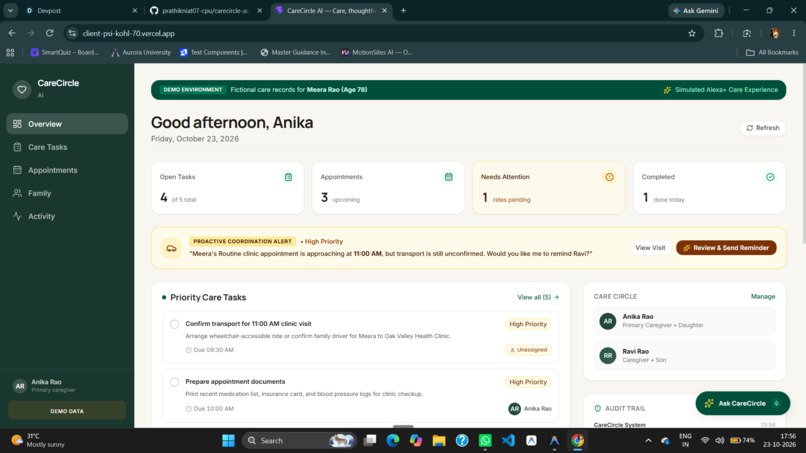
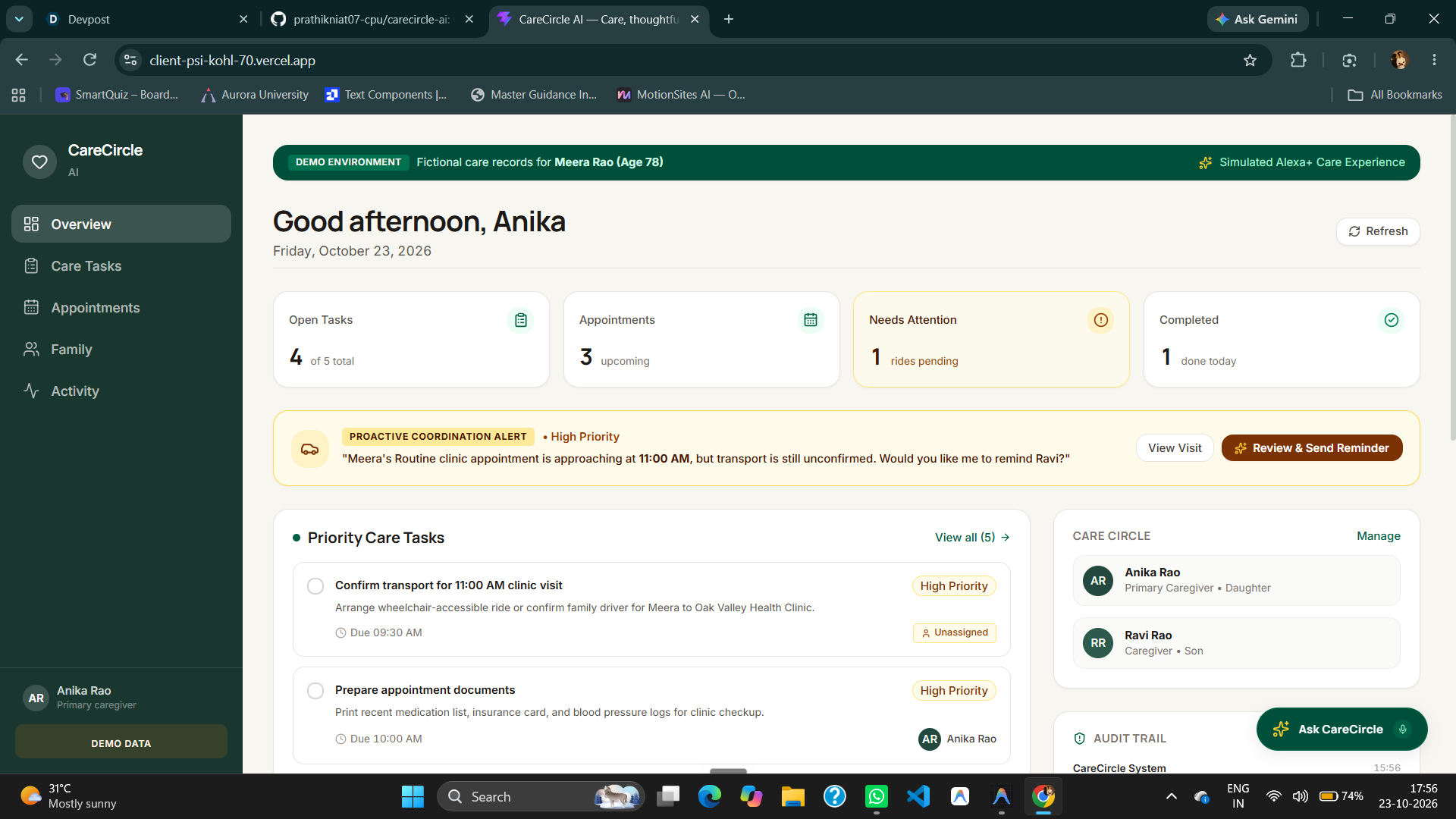
AI dashboard for family caregiving: tracks tasks, appointments, and pending rides, with proactive alerts and a real-time activity log.
-
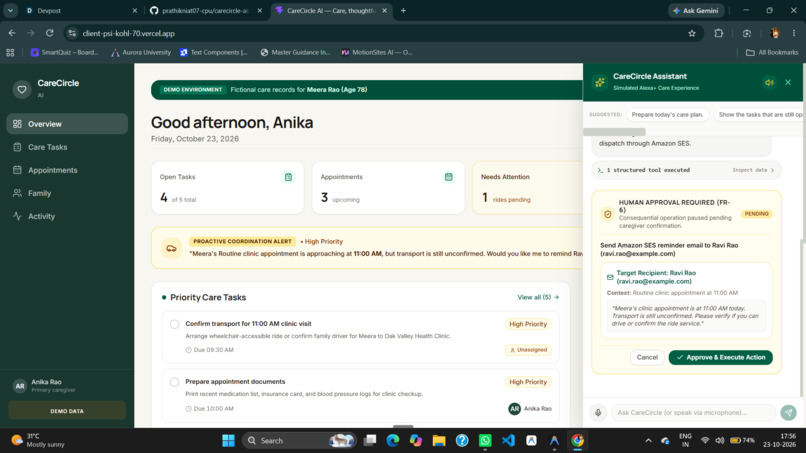
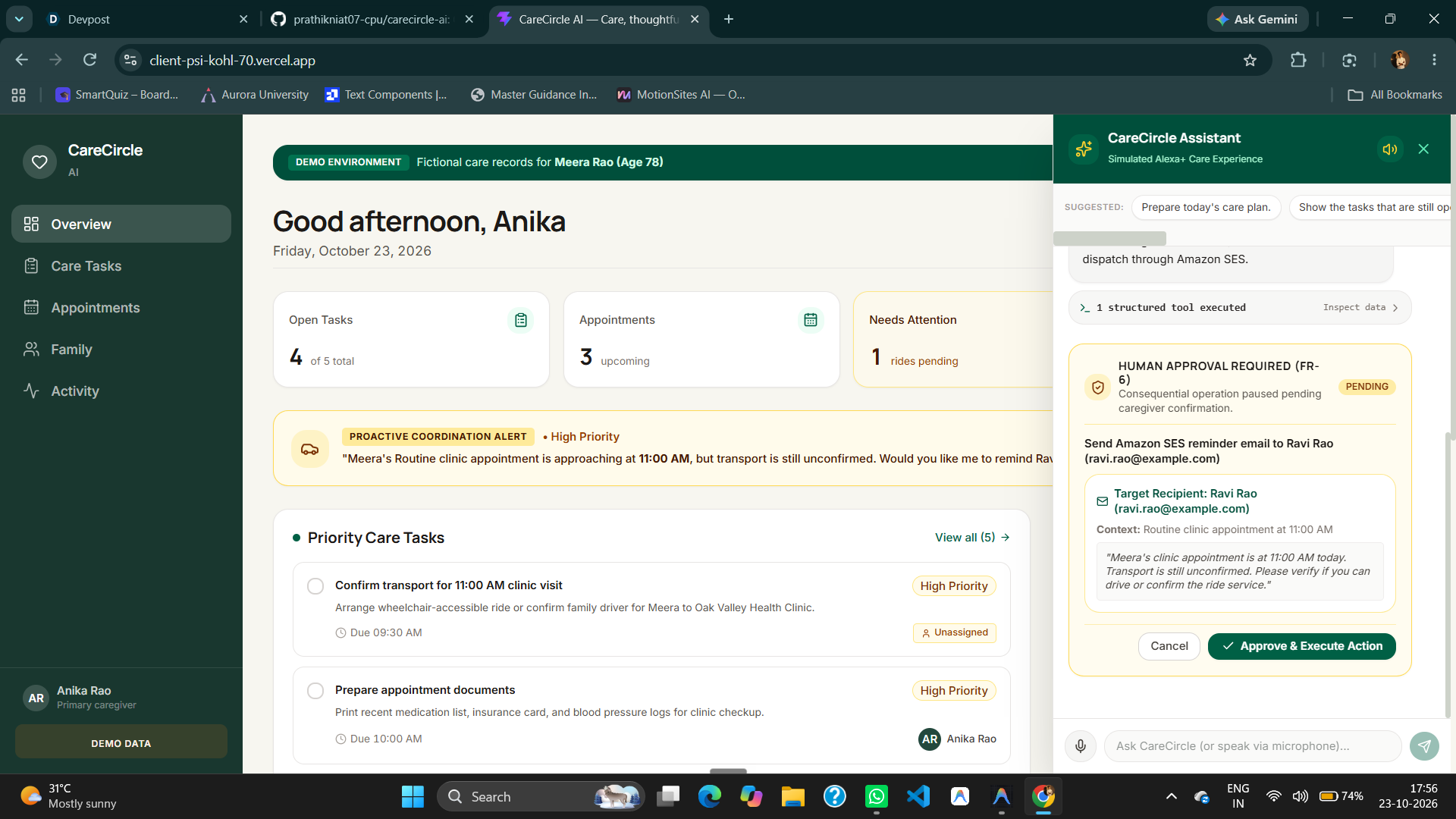
AI caregiving assistant for voice/text coordination that drafts actions and enforces human approval before sending external emails.
-
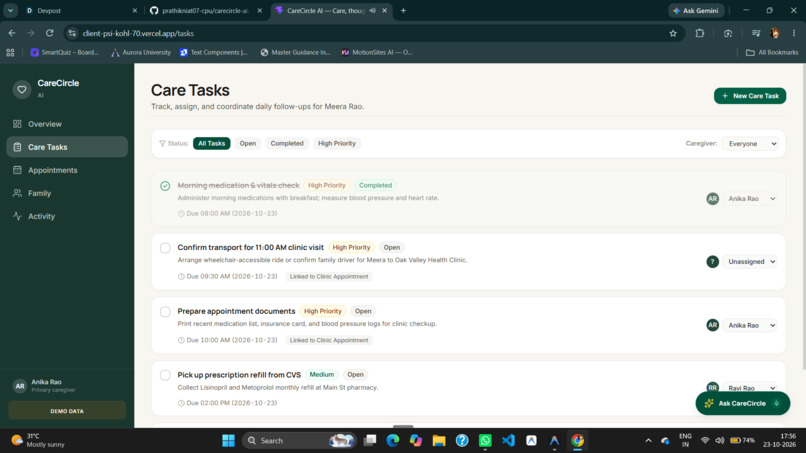
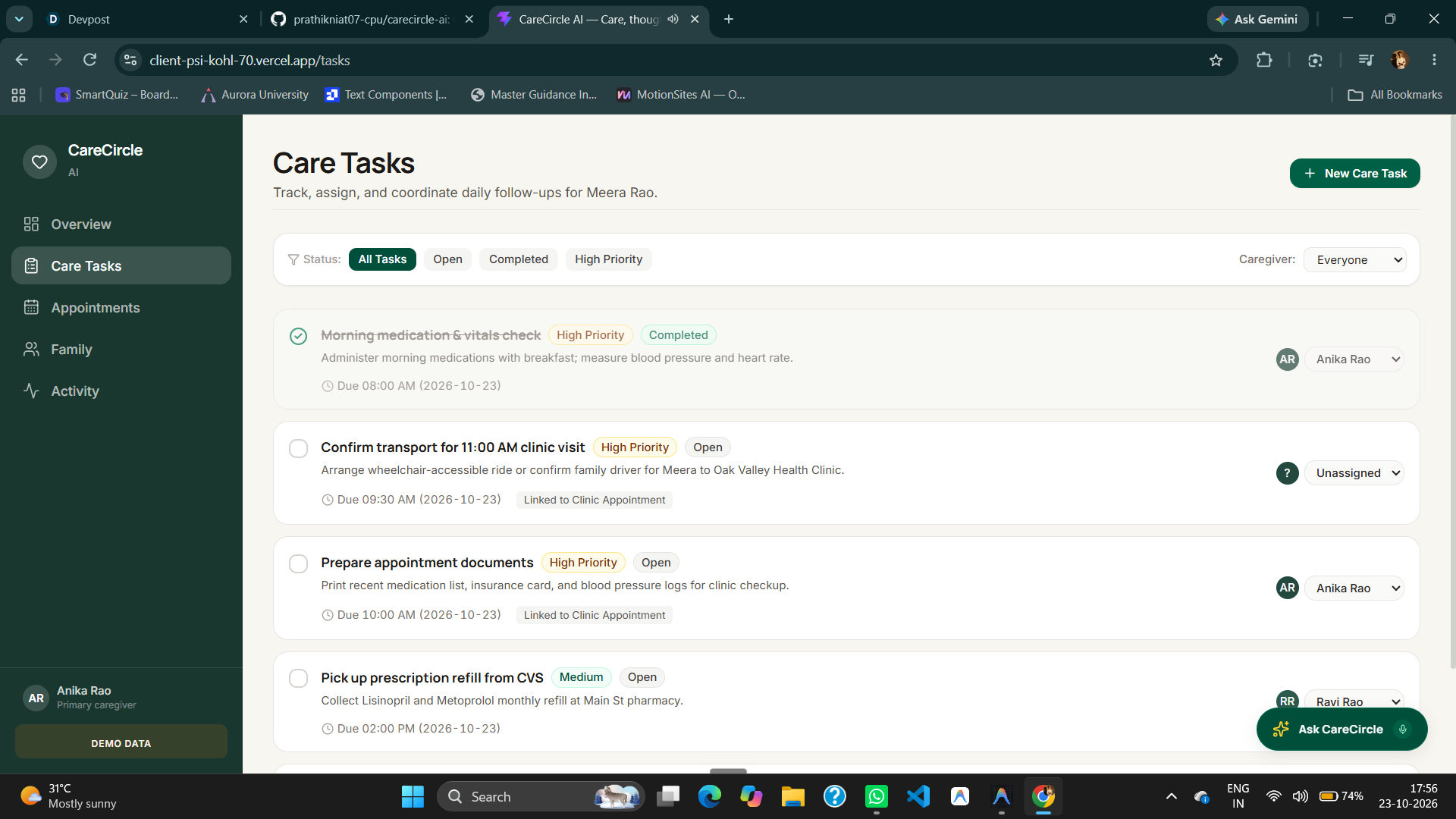
Care task manager for tracking, filtering, and assigning daily caregiving duties with due times, priority badges, and status updates.
-
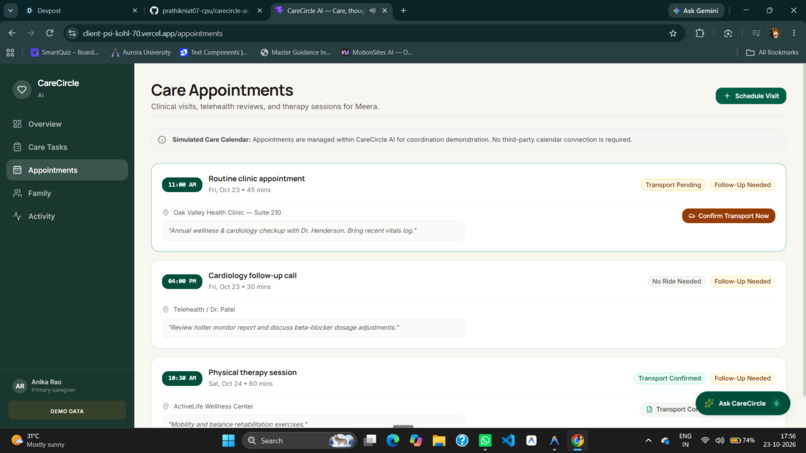
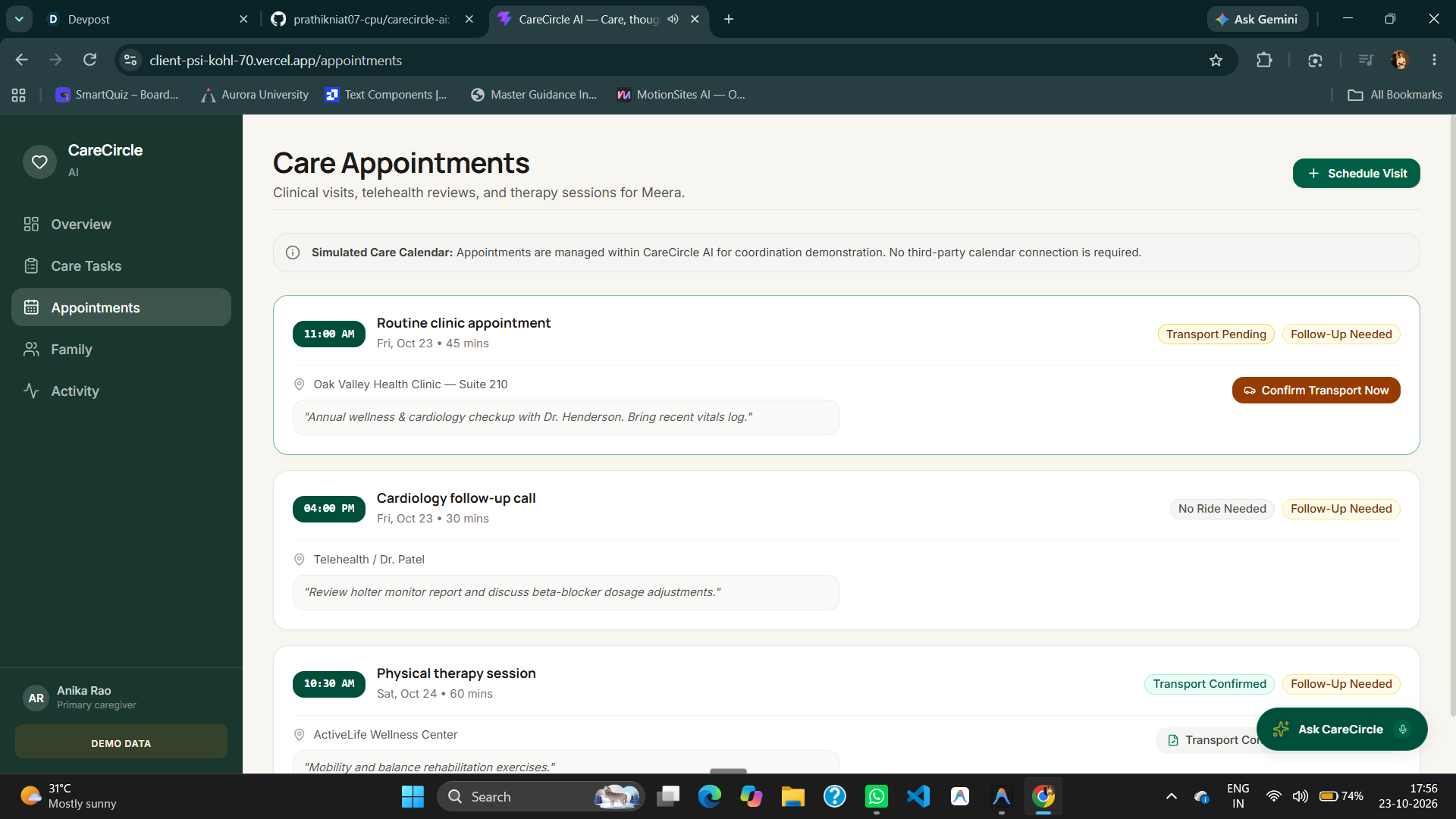
Centralized calendar to schedule, track, and manage clinical visits, therapy sessions, health calls with status tags and transport status.
-
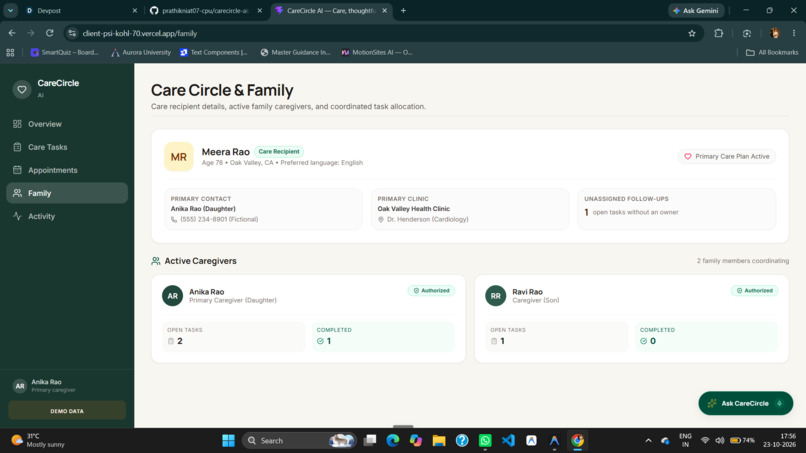
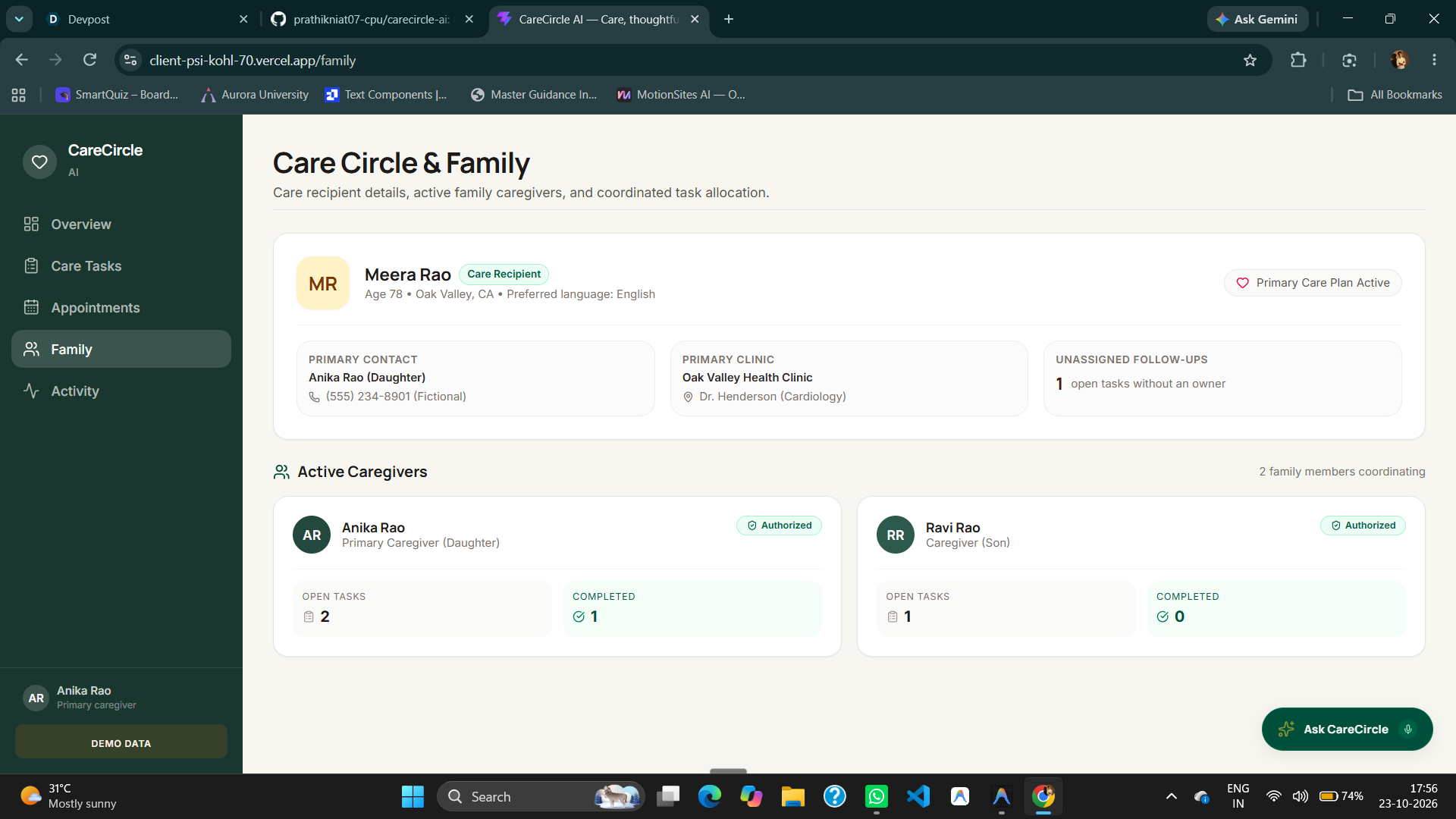
Family member directory displaying care recipient profile (Meera Rao), primary contacts, clinic details, and active caregivers' task loads.
-
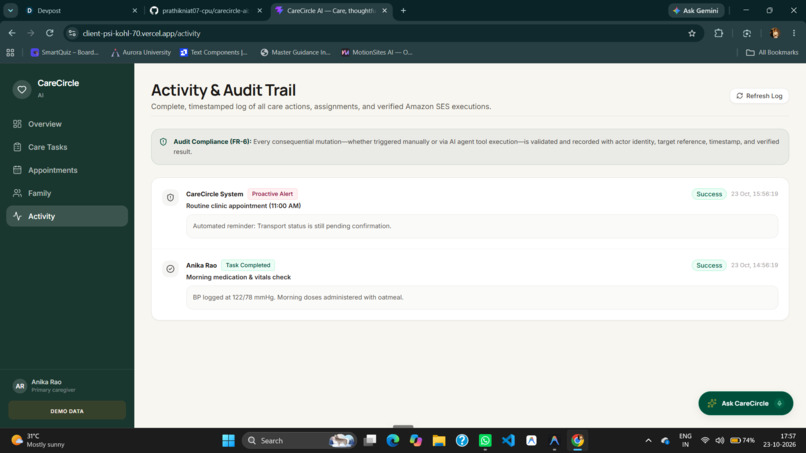
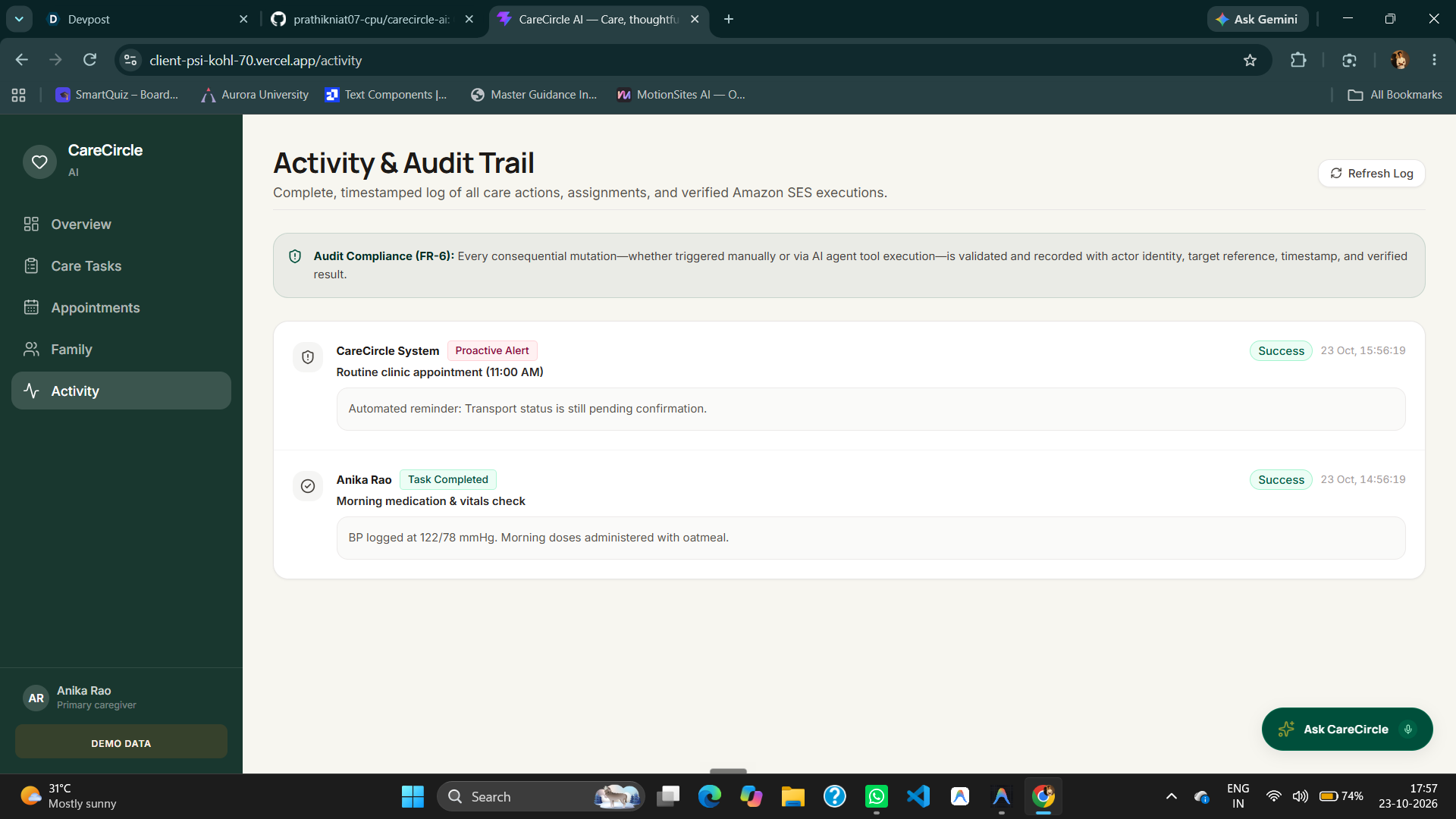
Timestamped audit log recording all care actions, system alerts, and AI executions with actor identity and verified outcomes.
Inspiration
Caring for an aging family member involves more than attending appointments. Families must coordinate transportation, daily care tasks, follow-ups, and responsibilities while balancing their own busy lives. Important tasks can easily be missed when communication is scattered across calls, messages, and reminders.
We wanted to build an AI assistant that helps families stay one step ahead—not by replacing caregivers, but by identifying potential gaps and helping them act before something important is forgotten.
This inspired CareCircle AI, built on the belief that care should be proactive, trustworthy, and human-centered.
What it does
CareCircle AI is an AI-powered family-care coordination assistant that brings appointments, daily tasks, caregiver assignments, and activity records into one place.
Its key capabilities include:
- Care coordination: Create, assign, prioritize, and track daily care tasks.
- Appointment management: Organize visits, transportation requirements, and follow-up activities.
- Proactive risk detection: Identify potential problems, such as an upcoming appointment with unconfirmed transportation.
- AI-assisted recommendations: Suggest practical next steps based on care tasks and appointment data.
- Human-approved actions: Request approval before executing consequential actions.
- Transparent audit trail: Record actions and outcomes so families can understand what happened.
CareCircle AI focuses on care logistics rather than medical diagnosis. Its goal is to reduce coordination stress while keeping families in control.
How we built it
We developed CareCircle AI as a full-stack application using React, TypeScript, Vite, Tailwind CSS, Node.js, Express, and SQLite.
The frontend provides a responsive experience for managing care tasks, appointments, family members, and activity records. The backend handles application logic, data validation, API requests, and persistence.
Our architecture is designed to support structured AI tools, Amazon Bedrock for AI reasoning, Amazon SES for approved email reminders, and Model Context Protocol (MCP) for exposing care-related tools to compatible AI clients.
We follow an approval-first workflow:
Detect → Explain → Propose → Ask for approval → Execute → Record the result.
The application is designed to distinguish real integrations from simulated functionality, ensuring that users are not misled about whether an action actually occurred.
Challenges we ran into
One of our biggest challenges was moving beyond a visually appealing prototype to a reliable application with working interactions and persistent data.
We also needed to consider how an AI assistant could take useful actions without compromising user trust. We addressed this through structured tools, input validation, explicit approval, and audit logging.
Another challenge was balancing advanced capabilities—such as proactive detection, external messaging, MCP, and voice interaction—with the need to preserve working features. We chose an incremental implementation strategy so each capability can be developed and validated independently.
Accomplishments that we're proud of
We are proud of building a unified experience that makes family-care responsibilities easier to understand and coordinate.
- A centralized dashboard showing priorities and upcoming appointments.
- Interactive care-task management and caregiver assignments.
- Appointment views highlighting transportation and follow-up needs.
- Family coordination screens that clarify responsibilities.
- An activity and audit interface for reviewing recorded actions.
- An architecture designed around trustworthy AI, structured tools, and human approval.
Our most important accomplishment is establishing a clear product direction: an assistant that does not merely respond to questions, but helps families identify what might be missed while keeping people in control.
What we learned
We learned that building useful AI requires more than generating convincing text. An assistant must work with reliable data, use well-defined tools, handle failures honestly, and respect user approval.
We also learned that proactive automation must be grounded in evidence, external integrations need careful validation, and transparent records are essential when actions affect other people.
Most importantly, we learned that technology should simplify caregiving rather than add complexity to an already demanding responsibility.
What's next for CareCircle AI
We plan to strengthen the AI assistant with structured tool execution, validate the MCP integration, and integrate Amazon Bedrock and Amazon SES where the required access is available.
We also aim to improve proactive risk detection, introduce hands-busy voice interaction, and evaluate the application with caregivers using real observations and measured task-completion times.
Our long-term goal is to help families coordinate care more confidently through an assistant that anticipates potential gaps, asks before taking consequential actions, and transparently records what it does.
CareCircle AI — Care that thinks ahead. Actions you can trust.
Built With
- amazonbedrock
- amazonses
- express.js
- frontend:-react
- mcp
- node.js
- sqlite
- sqlite-ai-&-cloud-services:-amazon-bedrock
- tailwind-css-backend:-node.js
- tailwindcss
- typescript
- vite


Log in or sign up for Devpost to join the conversation.