-
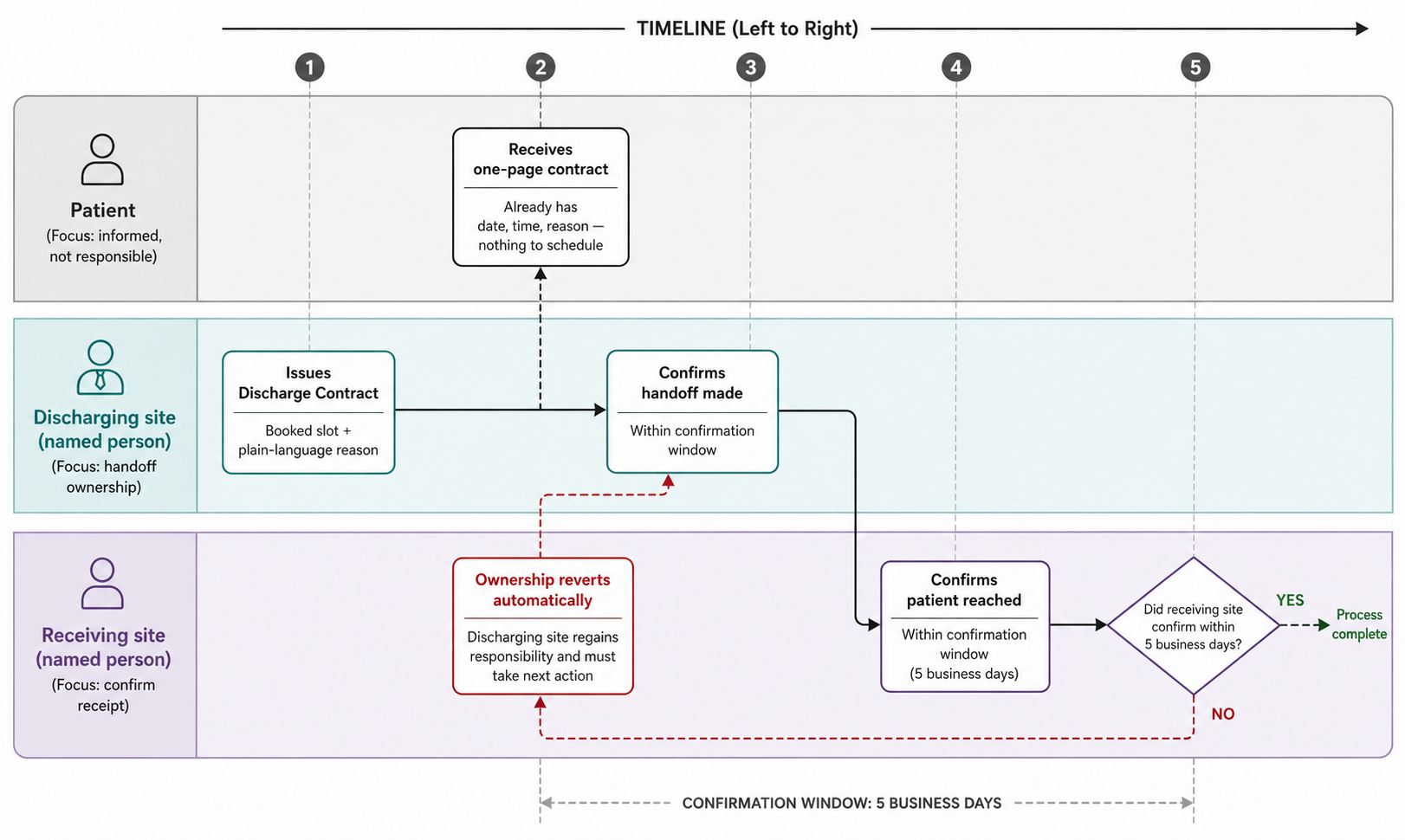
Swimlane-diagram
-
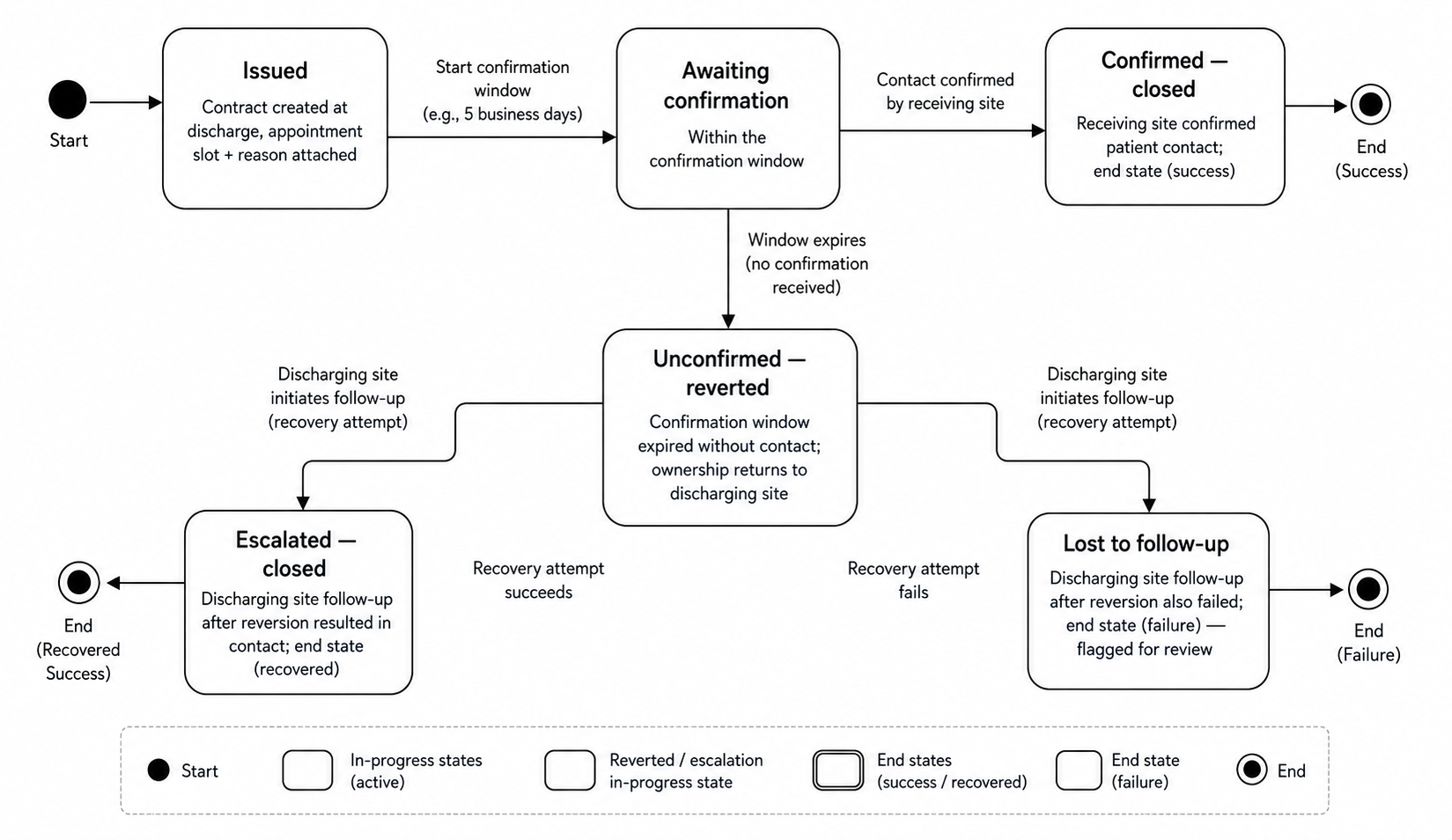
State-diagram
-
State-diagram
-
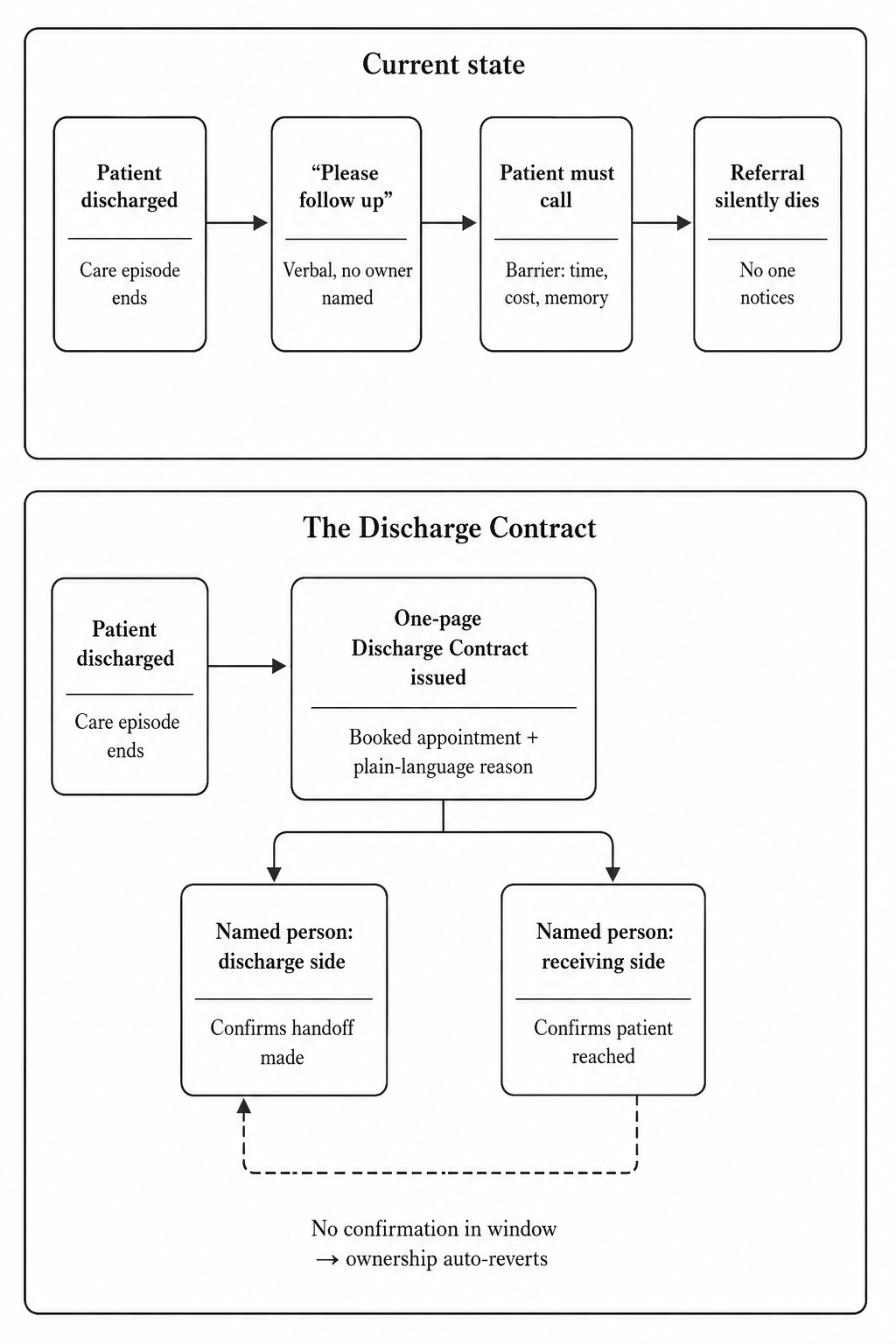
System-diagram
-
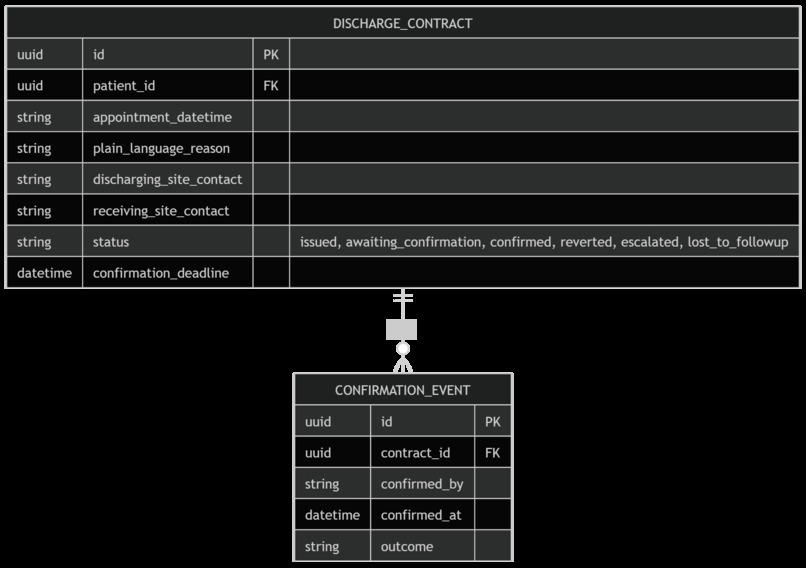
ER-diagram
Inspiration
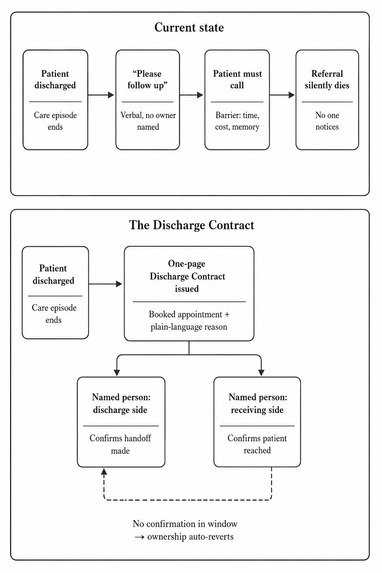
Healthcare has a blind spot hiding in plain sight, and it doesn't look like a technology gap — it looks like a sentence. "Follow up with your cardiologist." "See a specialist about that." Every discharge in America ends with some version of this instruction, spoken once, in a hallway, to a patient who is often in pain, overwhelmed, or simply trying to get home.
We started digging because that sentence has a body count. Referral-completion literature is unambiguous: nearly one in three ED patients never follow up with a PCP or specialist after discharge. Specialty referral completion hovers around 50% industry-wide, and some ED-referral studies show completion rates as low as 75%, meaning a quarter of referrals evaporate before they become a visit. For patients discharged after a heart failure episode specifically, completing cardiology follow-up is associated with meaningfully lower odds of death within both 30 days and one year. That is not an administrative inefficiency. That is a measurable, recurring, preventable loss of life, and it is happening at scale, silently, inside a step of care that everyone assumes is already working.
We asked the obvious question first: hasn't this already been solved? It has been addressed — heavily. Referral-management platforms, automated reminder systems, care-coordinator staffing models — an entire commercial category exists to reduce no-shows and referral leakage. But when we looked closely at how these tools actually work, we found a structural blind spot baked into their design, not their execution. They are built and sold to a single institution, integrated with that institution's own EHR, covering that institution's own patient panel. The instant a patient moves between an ED, an independent specialist, and a community clinic — three separate systems, three separate logins, three separate walls — no software has visibility across the full handoff. Worse, these platforms automate contact, not accountability. They send more reminders and flag no-shows after the failure has already happened. At the actual moment of discharge — the one moment where the outcome is still preventable — responsibility for making the follow-up happen remains diffuse. No single named person, on either side of the handoff, owns getting the patient from referral to seat.
That was the moment the direction of this project changed. We stopped asking "what software could fix this?" and started asking "what if the fix isn't software at all?" Every existing solution in this space assumes the answer must be sold, licensed, and integrated. We wanted to test whether the actual failure — diffuse accountability at the point of discharge — could be solved with something radically simpler: a redesigned piece of paper, and two names.
What it does
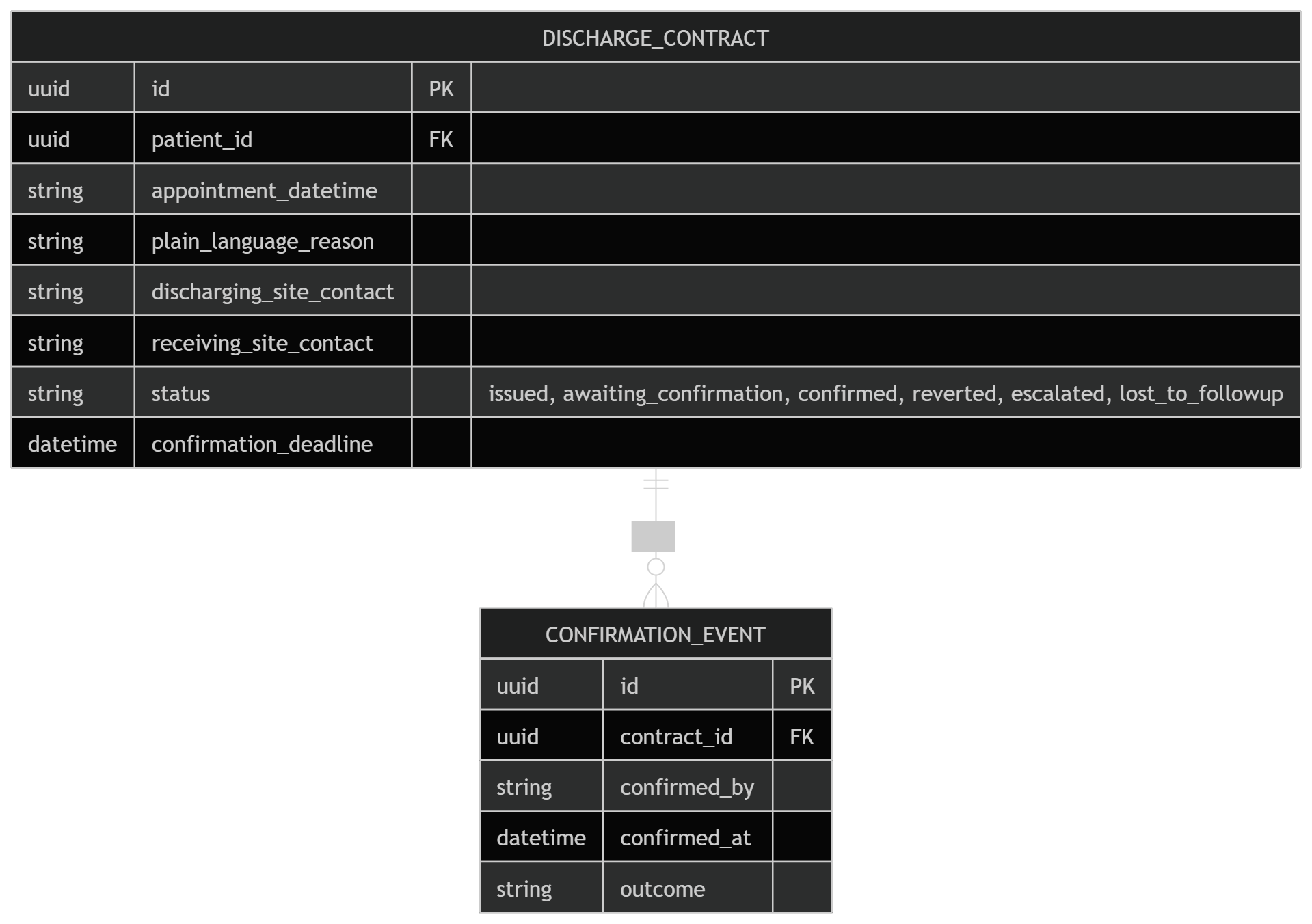
CareChain's core deliverable is the Discharge Contract — a one-page, plain-language commitment document that replaces the verbal, ambiguous discharge instruction with three concrete, non-negotiable fields, filled out before the patient leaves the building:
1. A real, already-booked appointment slot. Not "please call to schedule" — a specific date and time, reserved through a warm handoff initiated by the discharging site itself, not left to the patient to arrange. Even a 48–72 hour placeholder hold closes the single largest gap in the current process: the absence of a committed next step.
2. A plain-language reason, stated in one sentence. Referral-completion research repeatedly cites inadequate discharge information as a leading, documented cause of non-completion. CareChain requires one sentence, written for the patient, explaining why this matters and what happens if it's skipped — a low-cost intervention aimed directly at a proven failure cause, not a generic reminder.
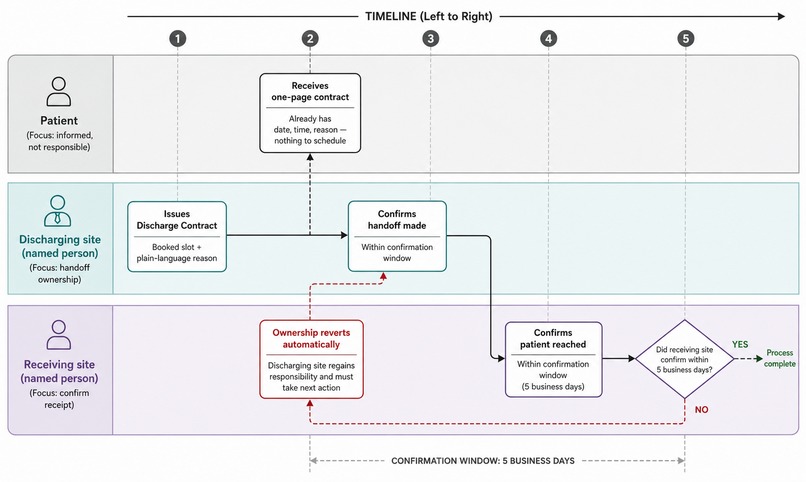
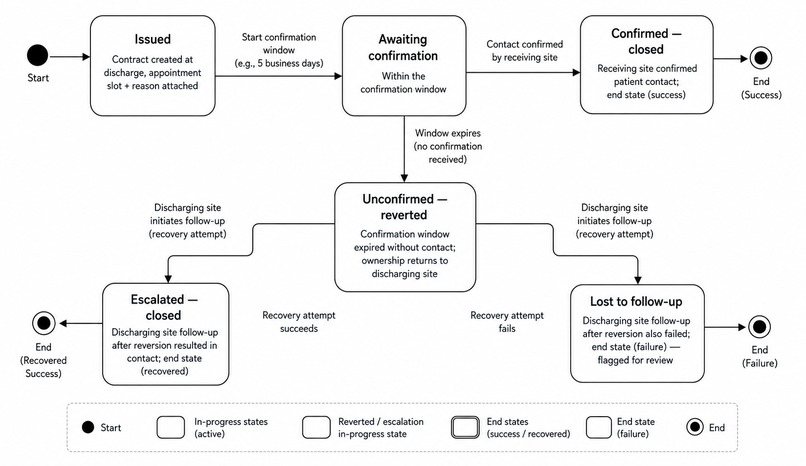
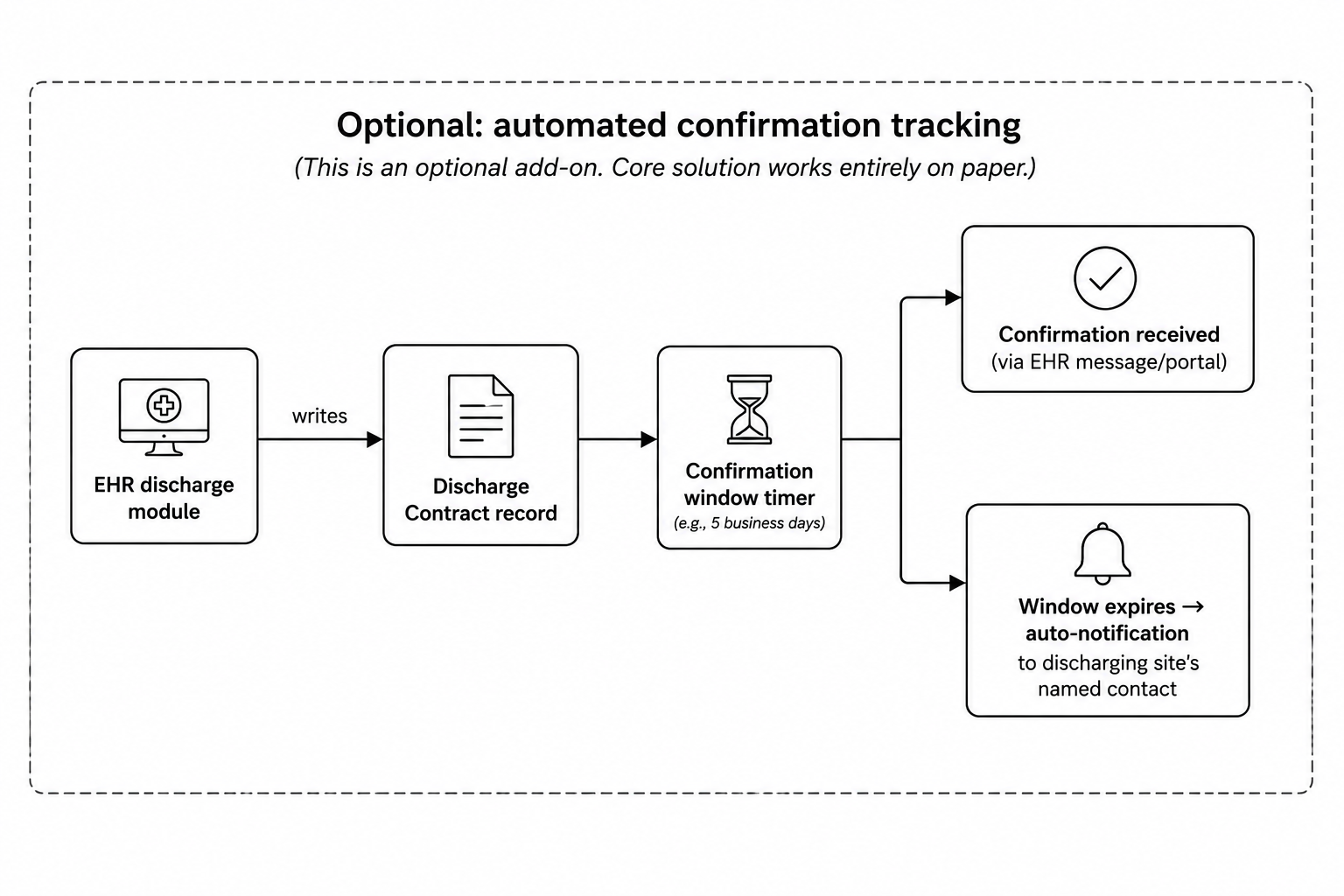
3. Two named, accountable people — not departments. One person at the discharging site confirms the handoff was made. One person at the receiving site confirms the patient was reached. If the receiving side has not confirmed contact within a defined window (five business days is our recommended default), accountability automatically reverts to the discharging site's named person. This single mechanic — failure is the default trigger for reassignment, not a special case someone has to notice — closes the "whose job was this?" loop that every existing system leaves open.
The mechanism works because it inverts the model every other tool in this space is built on. Existing platforms require someone to notice a missed follow-up and intervene after the fact. CareChain requires positive confirmation before responsibility is considered fulfilled — silence is treated as failure, not success.
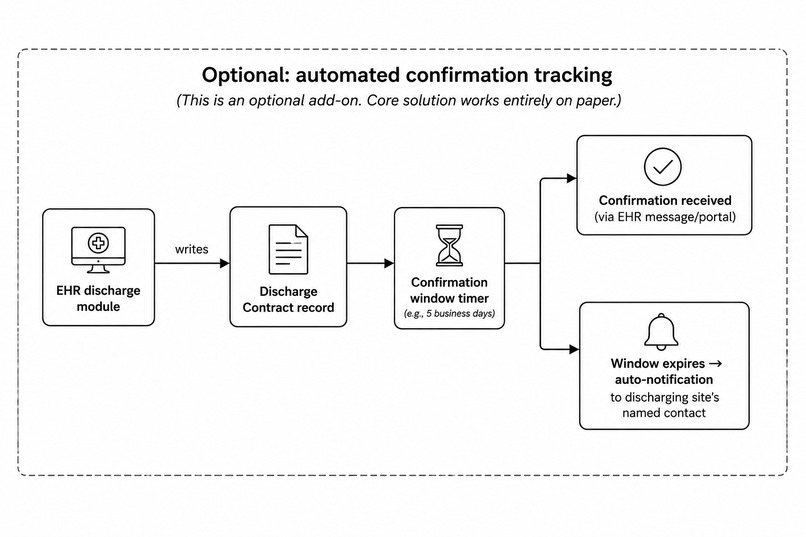
Critically, the Discharge Contract is technology-agnostic by design. It can be a paper form filled out by hand in a rural clinic with zero technology budget, or it can be added as a required structured field inside an existing EHR discharge summary for a large hospital system that wants automation. It works identically for a patient with a smartphone and a patient with neither a phone nor stable housing, because the commitment lives on paper and inside a named person's job description — not inside an app that assumes connectivity, literacy, and follow-through the highest-risk patients often don't have.
We didn't stop at the protocol itself. Because a free clinical process only creates impact if it actually gets adopted, we built out the complete case for adoption as part of this submission:
- The templates themselves — a patient-facing copy and a provider-to-provider copy (Appendices A and B), plus a zero-technology implementation checklist (Appendix C) any clinic can execute without procurement, budget approval, or IT involvement.
- An adoption model that treats distribution honestly as what it is — a dissemination path, not a sales funnel. There is no purchase decision here, so there is no sales team: publish the templates openly, partner with one professional or state hospital association to pilot and validate outcomes, publish before/after completion-rate results, and let clinical word-of-mouth and public evidence carry adoption forward.
- A market research summary that sizes the problem honestly using cited industry benchmarks, maps the existing competitive landscape (referral-management SaaS, patient-owned PHR tools), and identifies the specific white space no current player occupies: nothing today addresses the accountability gap before the failure occurs, and nothing today is free and technology-agnostic enough for FQHCs and rural clinics to adopt without new spend.
- A cost-avoidance ROI model, fully formula-driven and editable, that makes the adopter's case in their own financial language — without pretending this is a startup with revenue projections, because it isn't one.
How we built it
We deliberately built this backward from most product processes. Instead of starting with a solution and looking for a problem to fit it, we started with the failure literature and refused to move forward until we understood the actual mechanism of failure — not just its symptoms.
That research phase surfaced the insight that reframed the entire project: the dominant narrative in this space is "referrals fail because patients forget or don't follow through." The data tells a more precise story — referrals fail because of unclear discharge information, the absence of a pre-booked appointment, and the absence of a single accountable party on either end of the handoff. Once we saw that the failure was structural and about accountability design, not communication volume, the entire solution space narrowed. We weren't looking for a better reminder system. We were looking for a way to make responsibility undeniable and self-correcting.
From there, we worked in disciplined phases:
Problem definition and root-cause isolation. We separated "the problem people talk about" (patients skip appointments) from "the problem the data supports" (institutions never actually commit ownership of the handoff). This distinction is the foundation the entire protocol is built on.
Minimum viable intervention design. We asked what the smallest possible change to the existing discharge workflow could be that would still close the structural gap — not the most technically sophisticated intervention, the smallest sufficient one. That constraint produced the three-field, two-name design: enough to close the loop, deliberately not one field more, because every additional requirement is friction that reduces the odds of real-world adoption in an already overloaded discharge process.
Adoption strategy, treated as seriously as the protocol itself. A free intervention that nobody adopts has zero impact, so we spent as much effort on the dissemination model as on the clinical design — deliberately modeling it after how genuinely successful open clinical protocols have spread historically, rather than modeling it after how a startup goes to market.
Financial and market validation, built to be checked, not just claimed. The ROI model is not a static number we asserted — every cell is a live formula from adjustable inputs, so a skeptical adopter (or a skeptical judge) can change the assumptions and watch the case update in real time rather than trusting our arithmetic.
Throughout, we treated intellectual honesty as a design constraint, not an afterthought — which shaped several of the hardest decisions we made.
Challenges we ran into
Resisting the gravitational pull toward "just build an app." Every competitor in this space is sold as software, and that created constant, quiet pressure to scope this the same way — to add a dashboard, a notification system, a login. Each time we considered it, we asked the same question: does this exclude the FQHC or rural clinic with no IT budget? Every time, the answer was yes. Staying disciplined about zero technology cost as the actual differentiator — not a nice-to-have, but the entire reason this reaches the institutions existing solutions structurally cannot — meant repeatedly choosing the less impressive-looking, more genuinely useful path.
Making the accountability mechanism self-enforcing, not aspirational. Early versions of the design relied on someone remembering to check whether a handoff had been confirmed — which is exactly the diffuse-responsibility failure mode we were trying to eliminate, just relocated one step downstream. The breakthrough was inverting the default: instead of requiring a person to notice a failure, the system assumes failure until positive confirmation arrives, and automatically reassigns ownership when that confirmation doesn't come. Getting that inversion right — designing failure as the default state rather than the exception — took several iterations before it stopped being a suggestion and became a structural guarantee.
Being rigorous with numbers that would be easy to inflate. It would have been simple to claim large validated improvements for a project at this stage. Instead, we bounded our completion-rate improvement estimate conservatively (15–20 percentage points) rather than asserting anything beyond what a real pilot could support, used the documented $400–800 lost-episode-value range rather than cherry-picking its upper bound, and labeled every projected figure explicitly as an illustrative, pre-pilot estimate. That discipline made the financial model less dramatic — and considerably more credible.
Designing genuinely for the lowest-resource setting, not just claiming to. "Technology-agnostic" is an easy phrase to write and a hard constraint to actually honor. We stress-tested every design decision against the hardest case: a patient with no phone and no stable address, at a clinic with no fax budget and no EHR. If a decision didn't survive that test, it didn't make the final design.
Accomplishments that we're proud of
We're proud that CareChain is a complete, immediately adoptable intervention — not a concept, not a prototype that needs funding to become real. A discharge planner could implement the Discharge Contract tomorrow morning using the templates and checklist we've already built, at zero marginal technology cost, with no procurement cycle and no vendor negotiation standing between the protocol and a patient's next appointment.
We're proud of the accountability-reversal mechanism specifically — a small design decision with an outsized effect, because it closes a gap that has persisted across an entire commercial software category built to reduce reminders and no-shows but never redesigned to remove diffuse ownership.
We're equally proud of what we chose not to build. We didn't dress this up as a startup pitch to make it feel more fundable — no revenue projections, no funding ask, no equity structure, because none of that honestly applies to a free clinical process protocol, and pretending otherwise would have undermined the very thing that makes this adoptable by the institutions that need it most.
And we're proud that every number in this submission is defensible. The financial model runs on live formulas an adopter can interrogate and adjust. The market sizing cites benchmark ranges rather than manufactured precision. The improvement estimate is explicitly conservative, not aspirational. In a category where it would have been easy to overclaim, we chose to be checkable instead.
What we learned
The most durable lesson from this project is that the biggest gaps in care coordination aren't always technology gaps — sometimes they're accountability gaps wearing a technology costume. An entire commercial software category has grown up around automating reminders for a problem whose own research literature says the root cause is diffuse ownership and unclear information, not insufficient contact frequency. Recognizing that mismatch — and having the discipline to build the smaller, less flashy fix that actually targets the real mechanism — was the single most important design decision we made.
We also learned that rigor and impact aren't in tension; they compound. The more conservative and defensible we made our claims, the more credible — and ultimately more persuasive — the case became. A $780,000 annual recovered-value estimate built on a live, adjustable formula and a clearly labeled conservative assumption is a far stronger claim than a bigger, unverifiable number would have been.
Finally, we learned that designing for the lowest-resource user first doesn't just serve equity — it produces a fundamentally better design for everyone. Because we insisted the protocol had to work on paper, at zero cost, for a patient with no phone and no fixed address, we ended up with something simpler, faster to adopt, and more robust than a technology-first design would ever have produced — even for the best-resourced hospital system that eventually layers EHR integration on top of it.
What's next for CareChain
The next phase is deliberately narrow and evidence-driven, not expansive. Phase 2 is a single pilot on one high-mortality-impact referral pathway — post-heart-failure discharge or post-ED cardiology follow-up — chosen specifically because the clinical case for cross-institution cooperation is strongest there, and because the mortality data gives the clearest possible signal of impact. We will adapt the Discharge Contract template into the pilot site's existing discharge paperwork, identify the two named accountable roles per department, and track referral completion rate before and after adoption over a defined window.
That pilot exists to do one thing: replace our conservative, cited placeholder figures with real, measured outcomes. Once we have published before/after completion-rate data from a real clinical setting, the adoption strategy activates as designed — partnering with a professional association or state hospital association to validate and disseminate those results, publishing them openly, and letting clinical evidence and word-of-mouth carry adoption to the FQHCs, rural clinics, and safety-net providers that current commercial solutions have never been built to reach.
Longer term, we see a natural, optional path for sustainability that requires no company and no vendor lock-in: a nonprofit or academic partner offering paid implementation support and EHR-integration services for larger health systems that want it, while the core protocol itself remains exactly what it is today — free, open, and adoptable by anyone willing to name two people and keep a promise.
Built With
- care-coordination
- clinical-workflow
- docx
- google-docs
- health-equity
- healthcare-protocol
- markdown
- patient-safety
- process-design
- spreadsheet-modeling

Log in or sign up for Devpost to join the conversation.