-
-
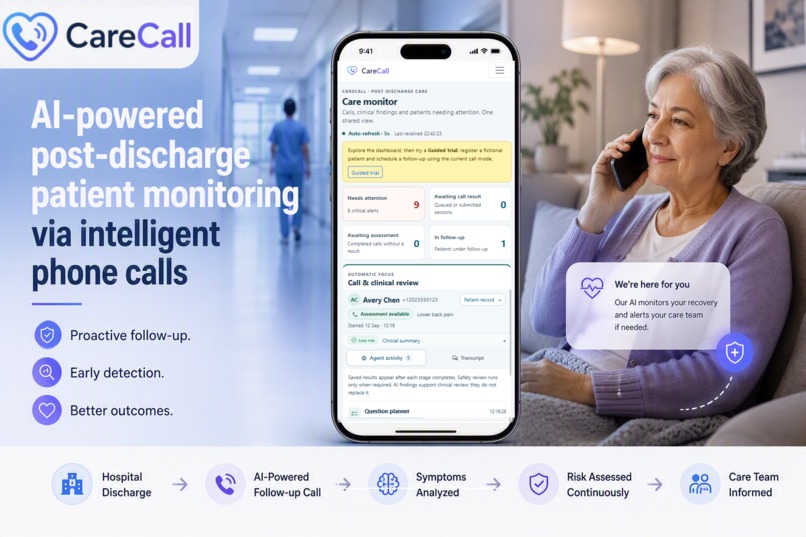
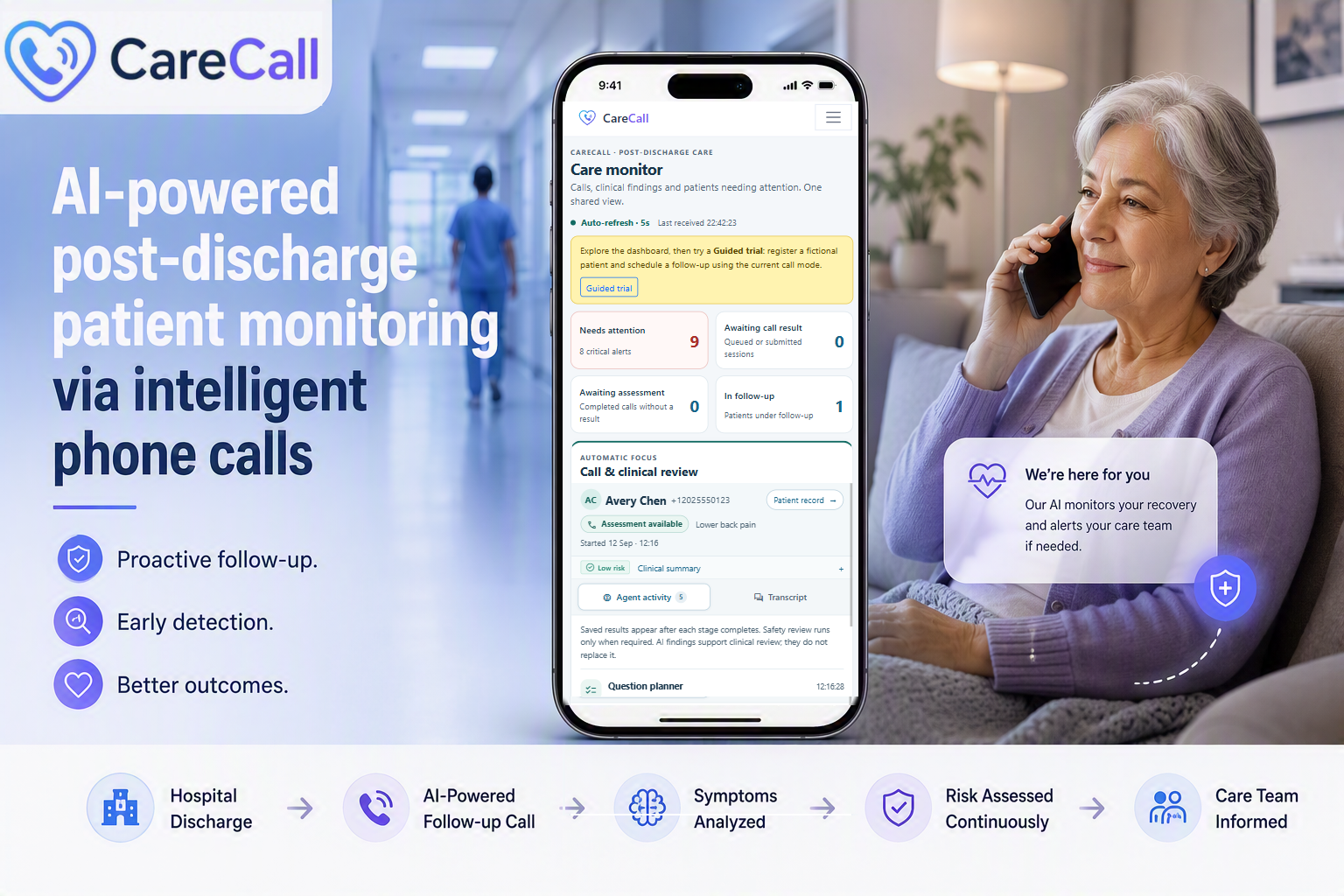
CareCall: Conceptual visualization
-
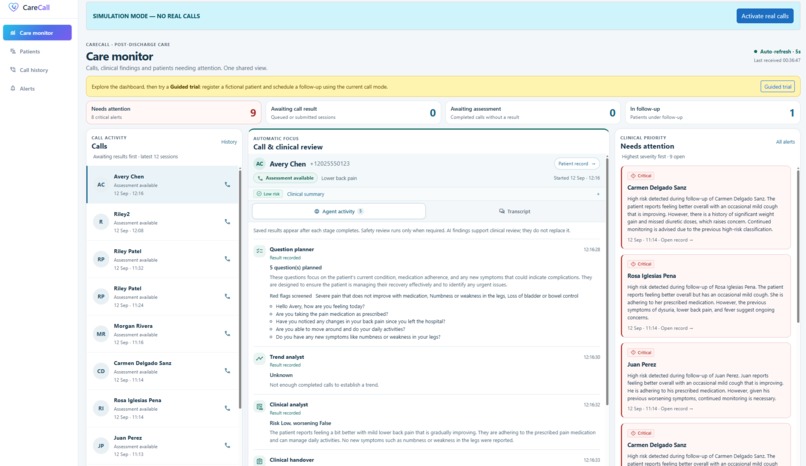
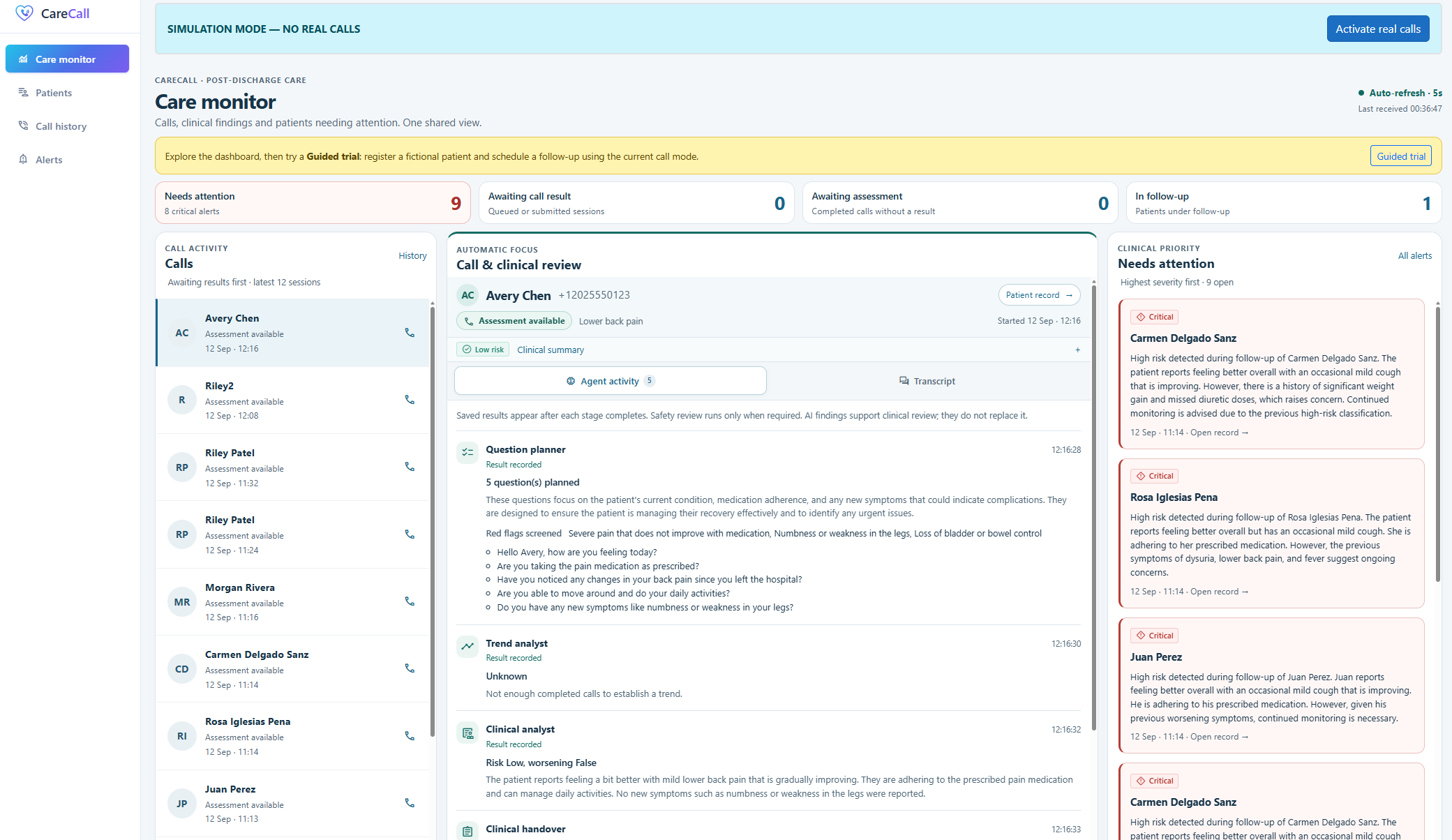
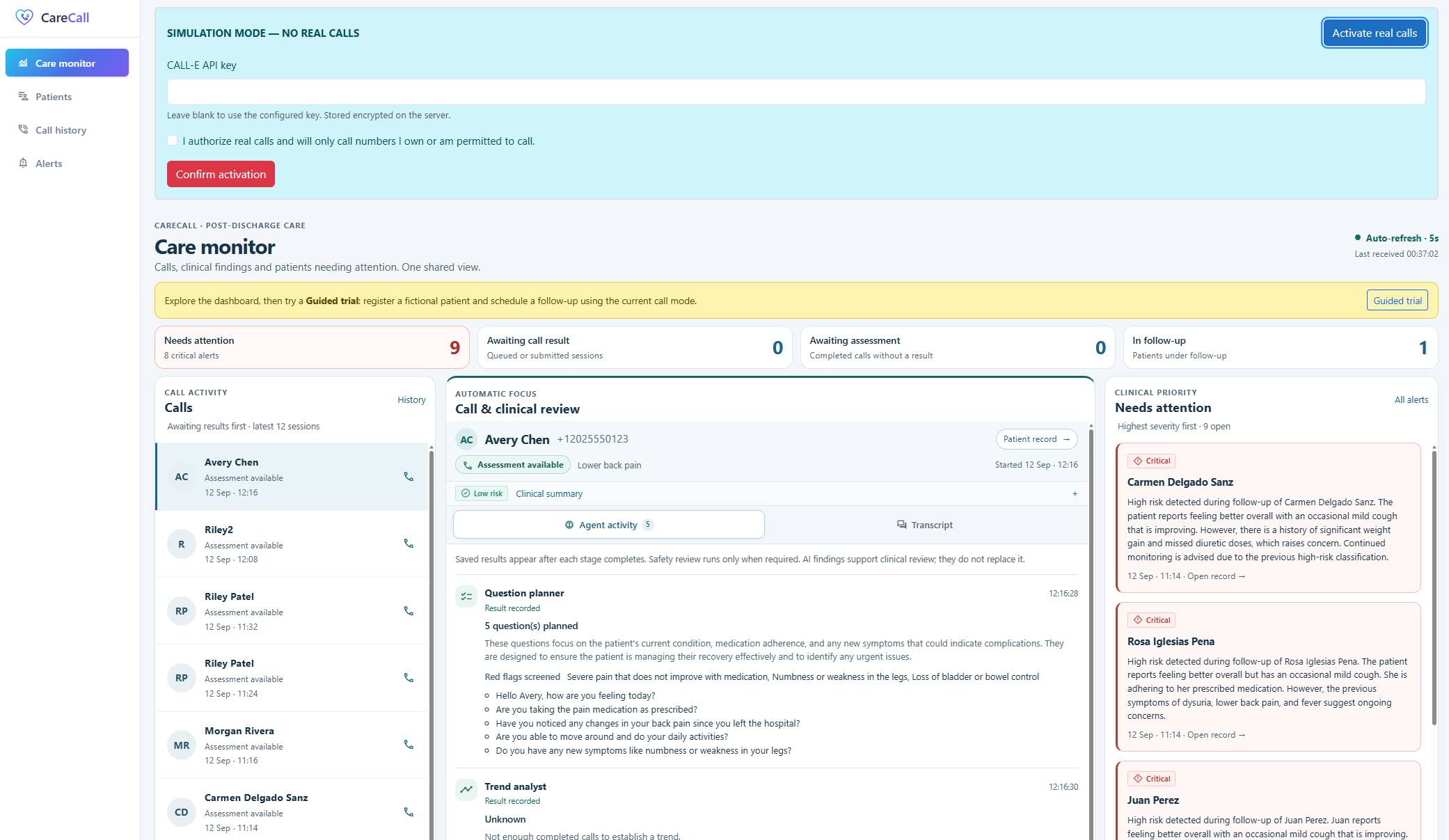
CareCall: Dashboard (desktop)
-
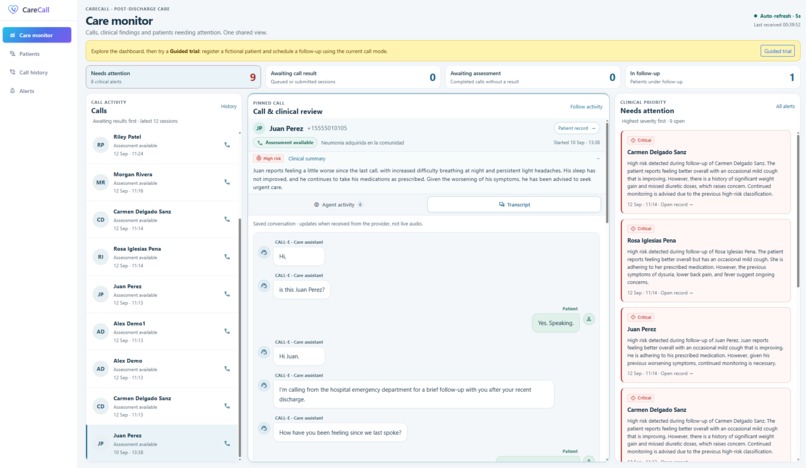
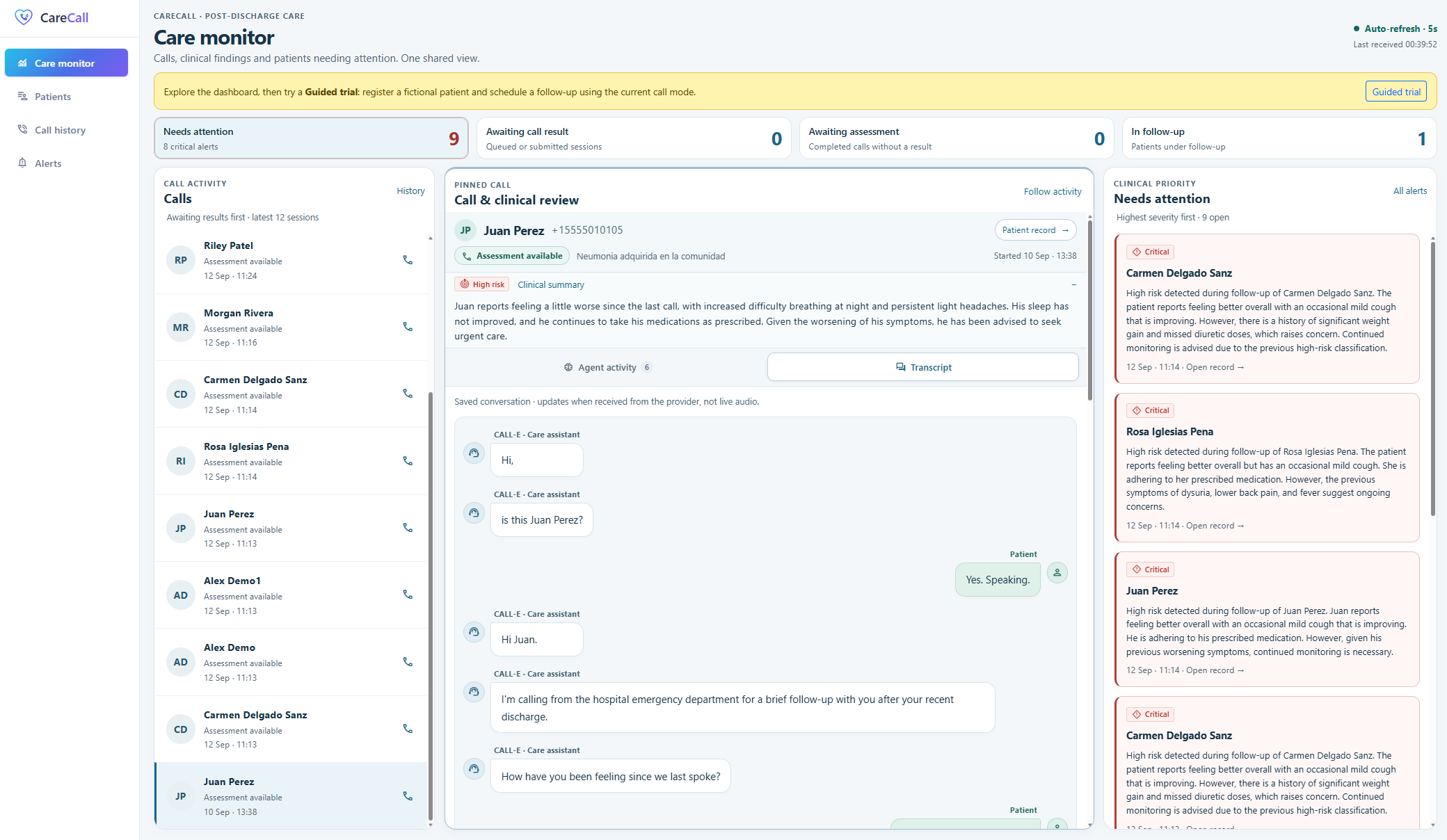
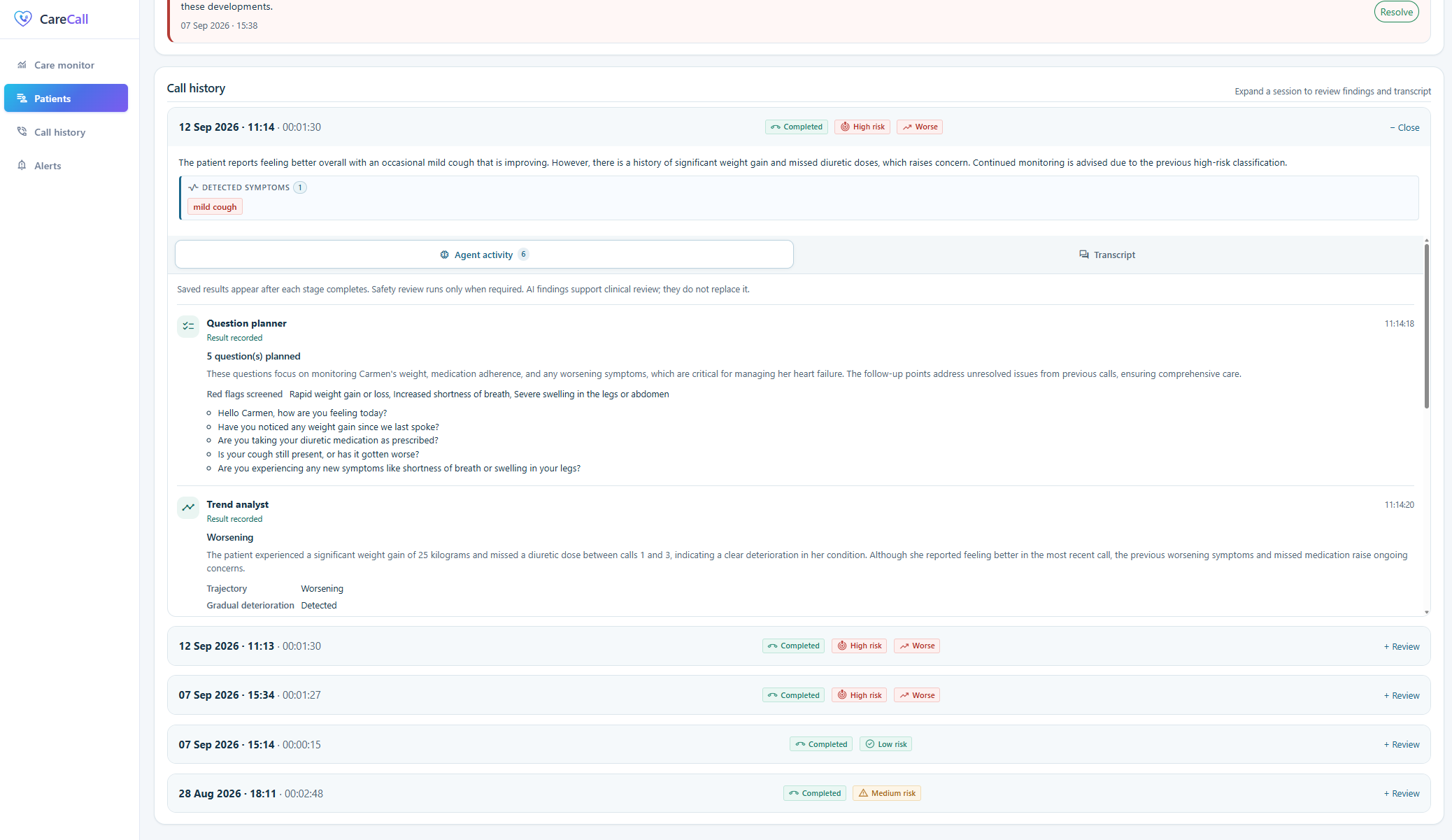
CareCall: Dashboard - Call Transcript (Desktop)
-
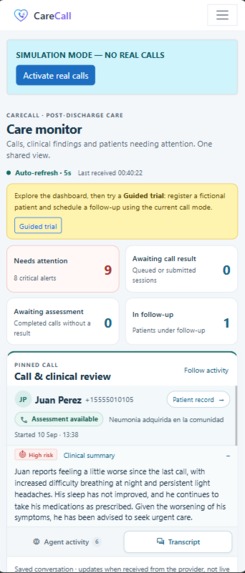
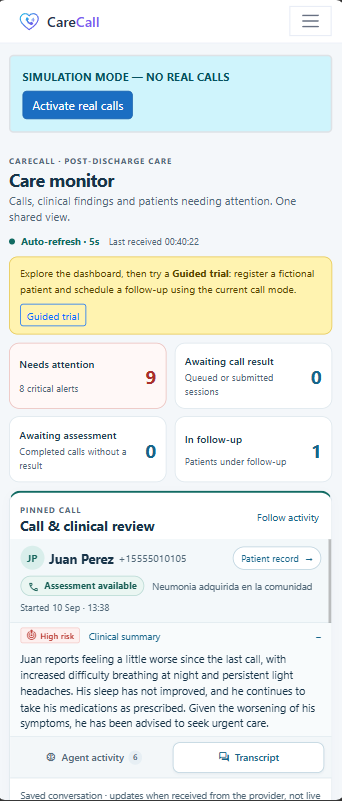
CareCall: Dashboard (mobile)
-
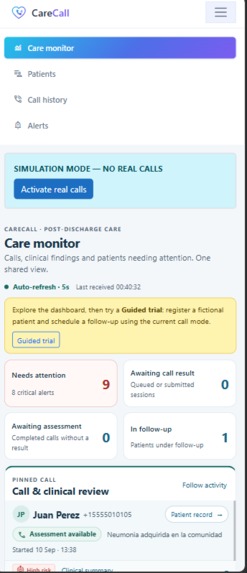
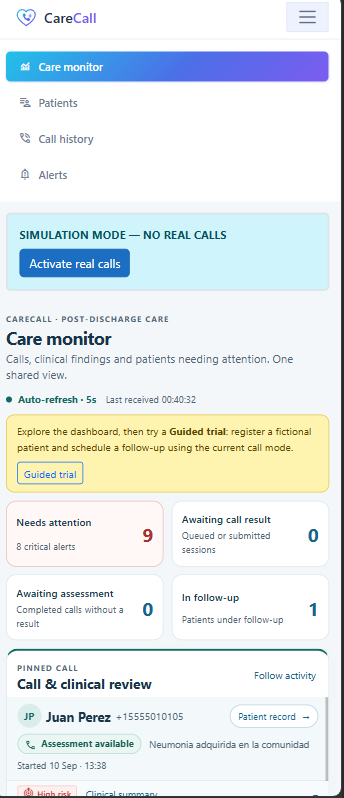
CareCall: Menu (Mobile)
-
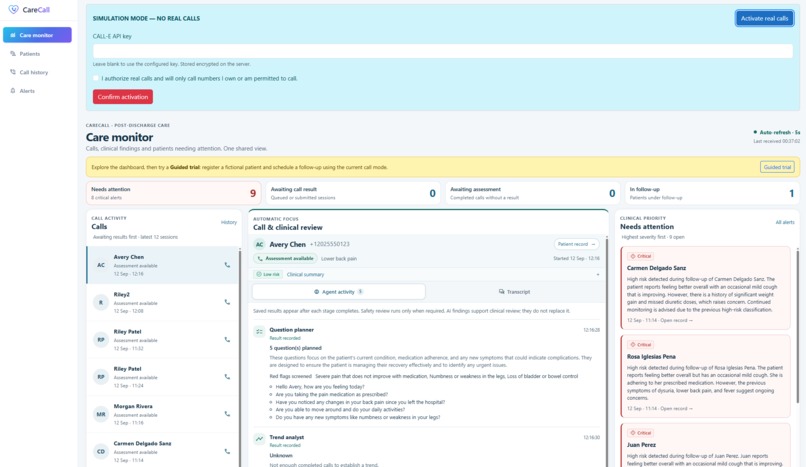
CareCall: Enable real CALL-E calls form
-
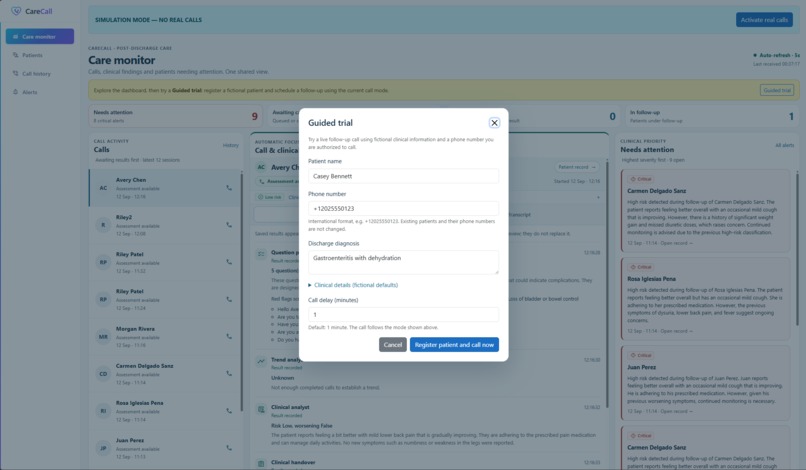
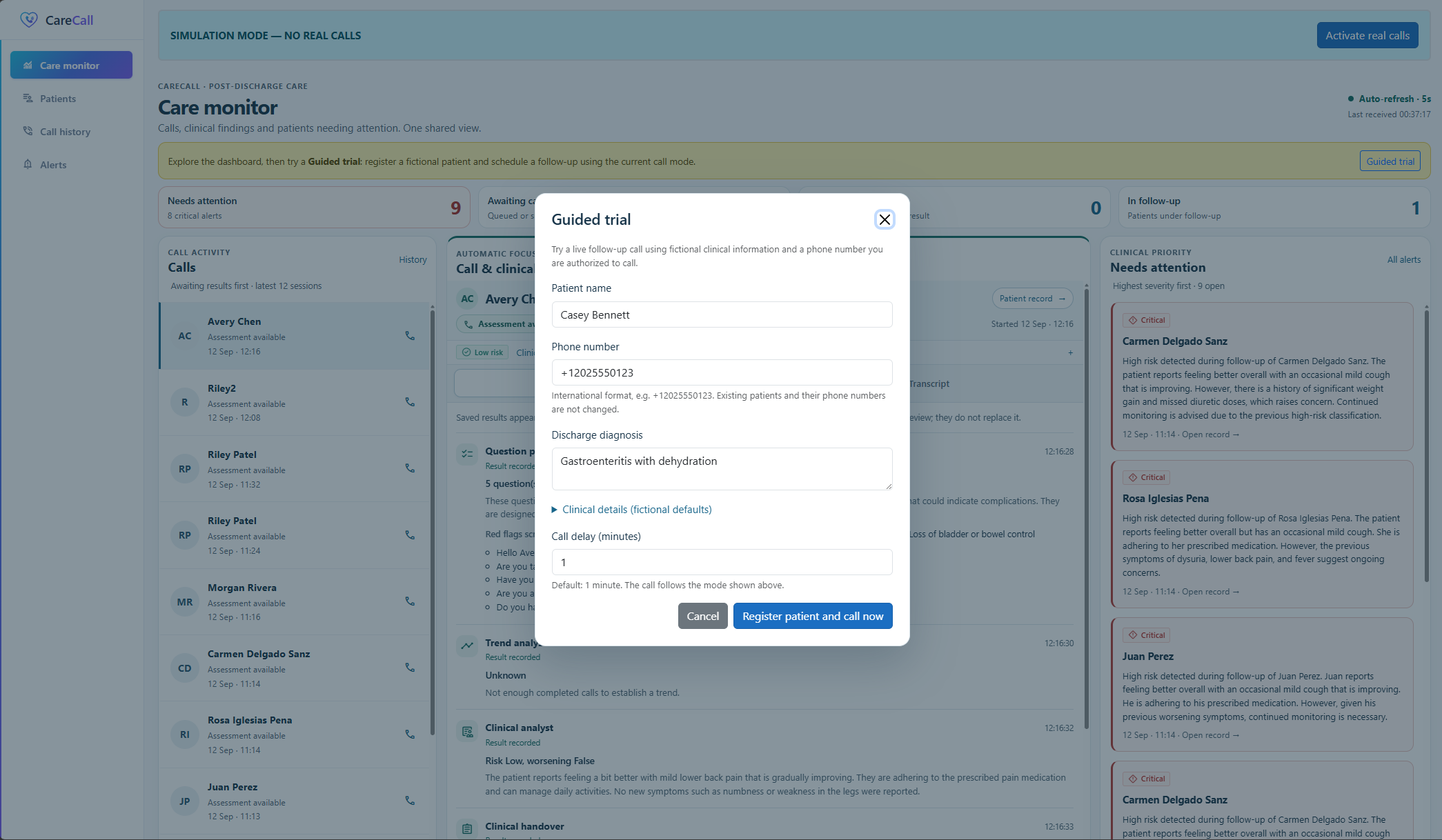
CareCall: Guided trial form
-
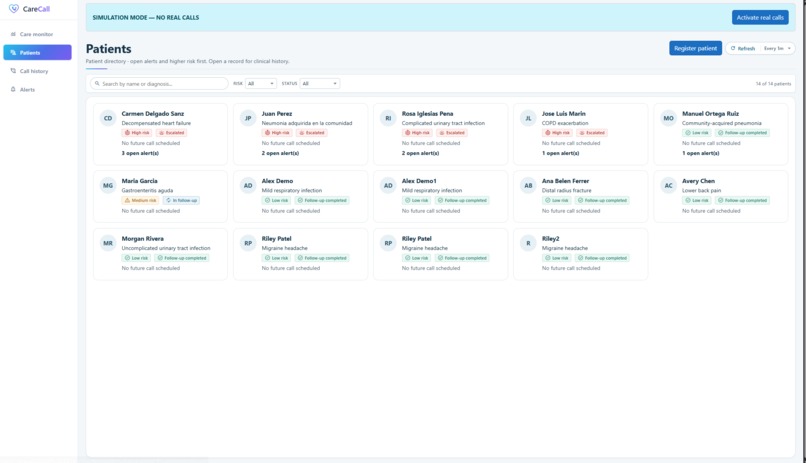
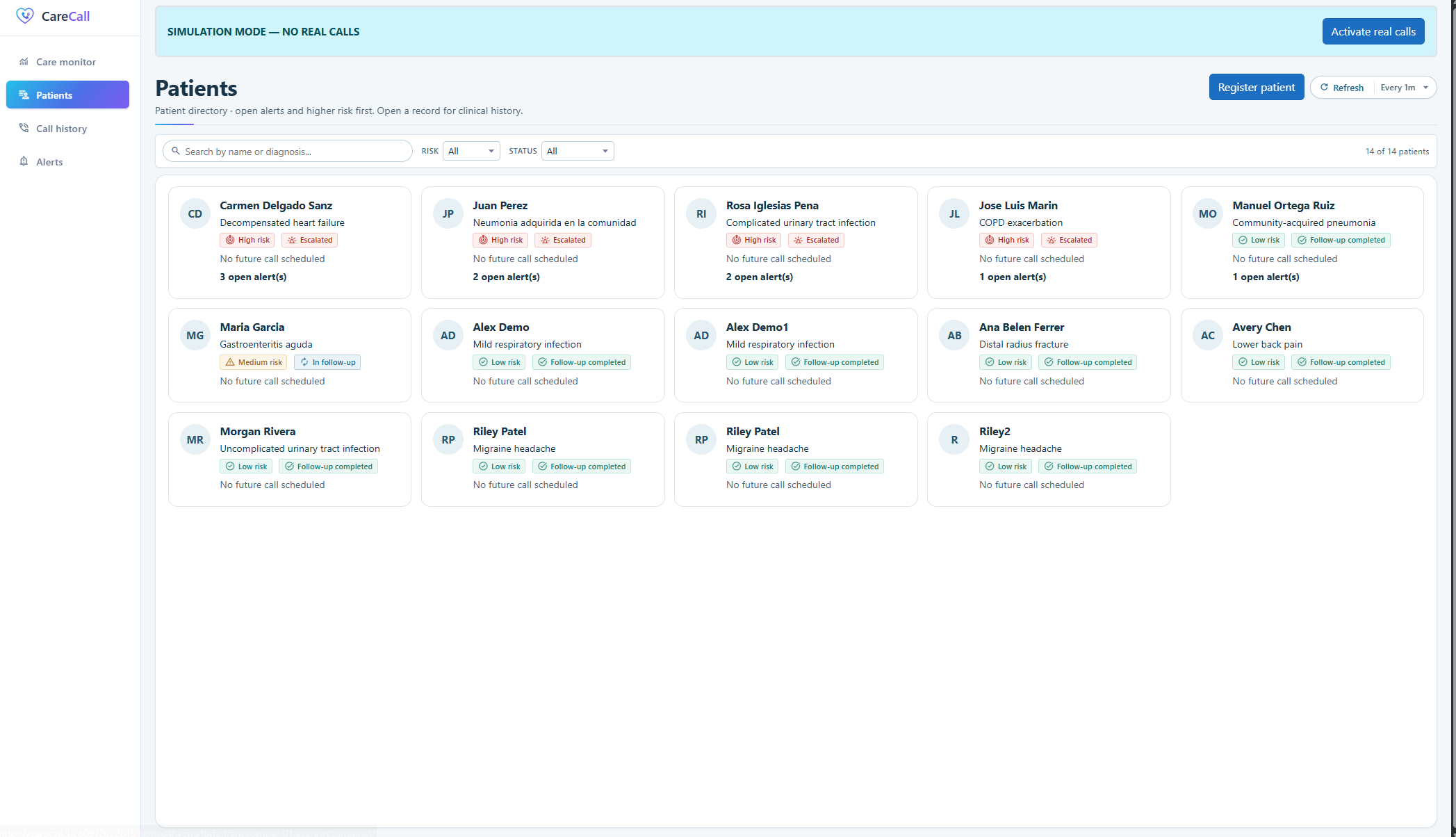
CareCall: Patients screen (desktop)
-
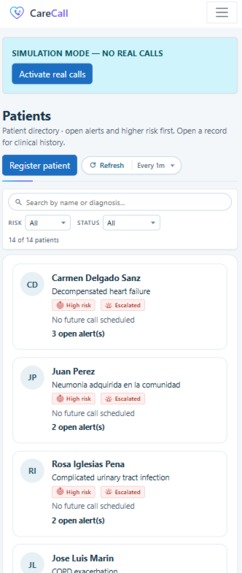
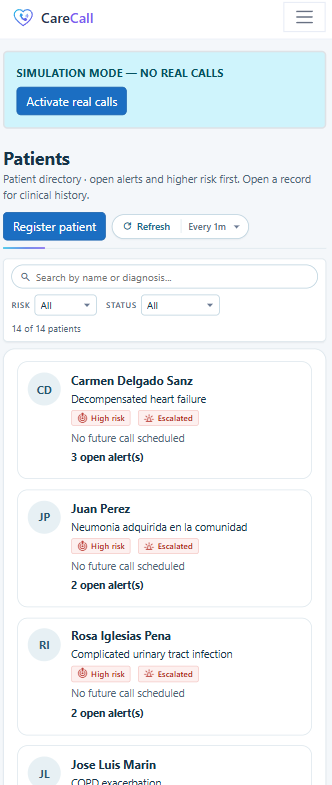
CareCall: Patients screen (mobile)
-
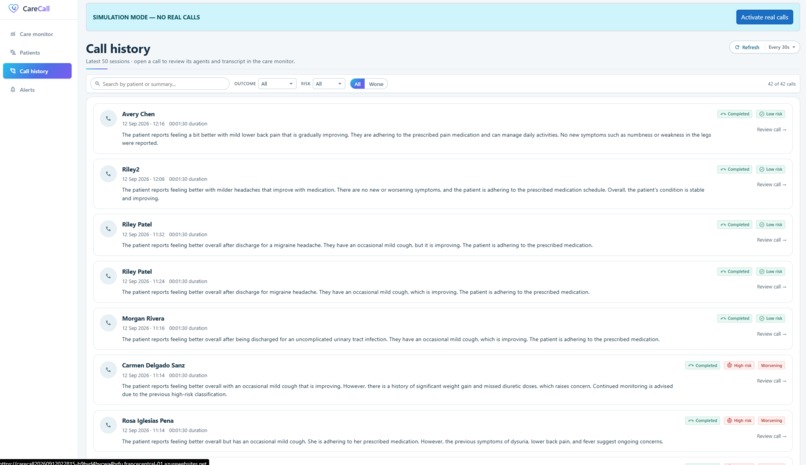
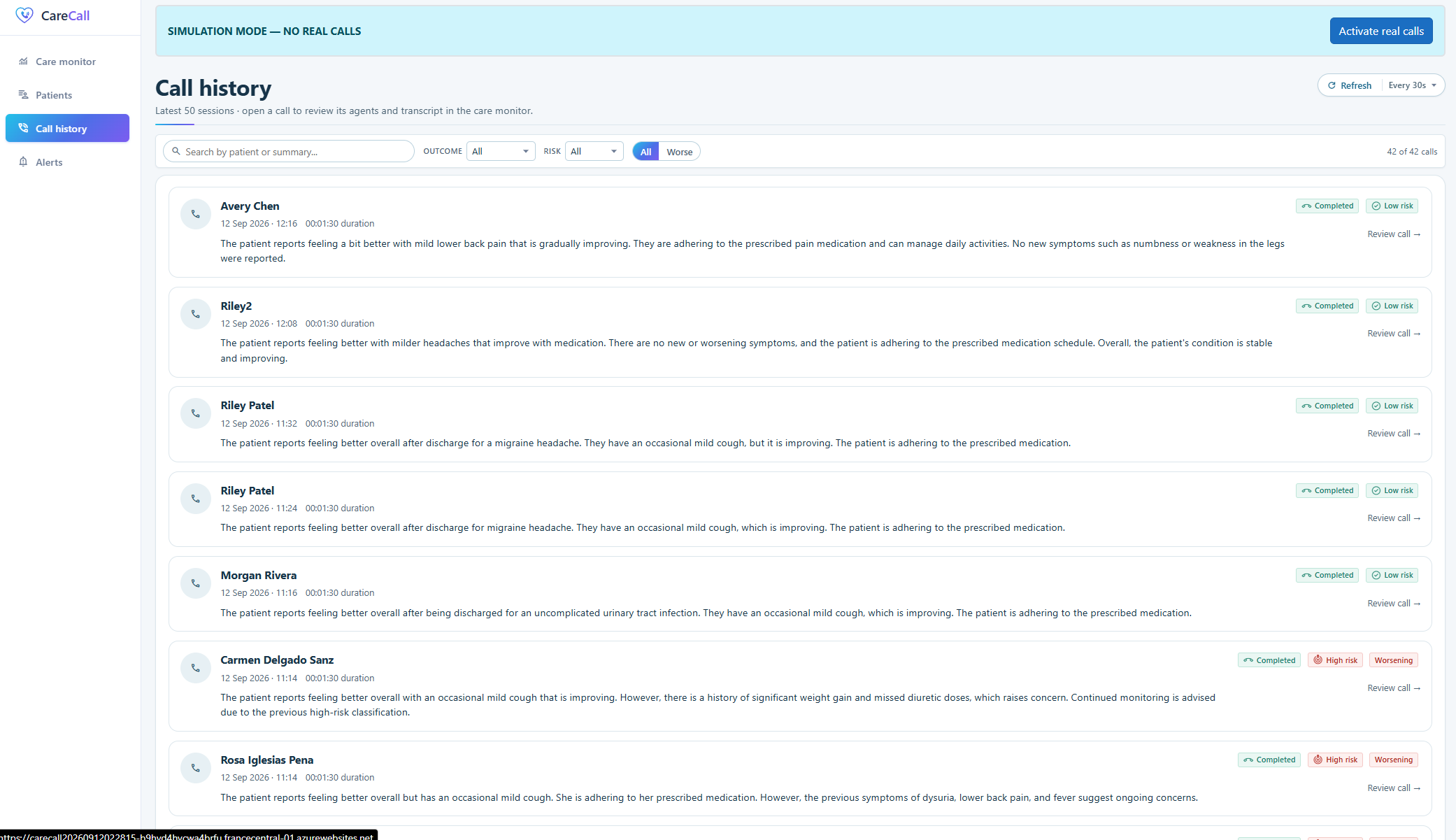
CareCall: Call History screen (desktop)
-
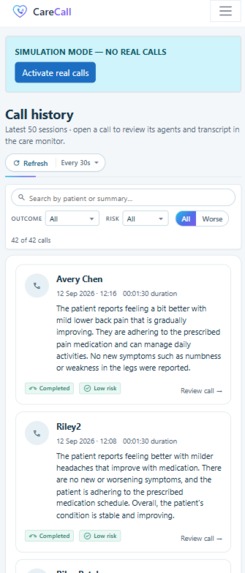
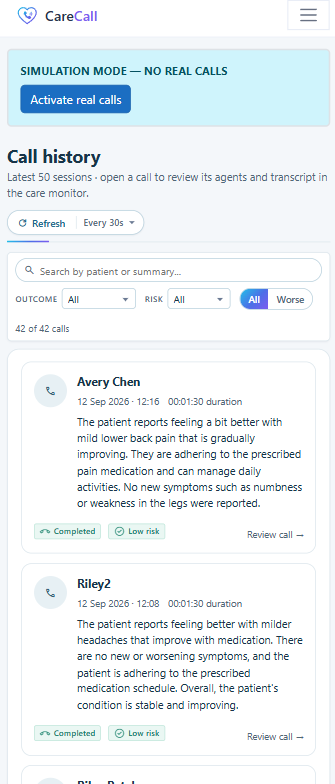
CareCall: Call history screen (Mobile)
-
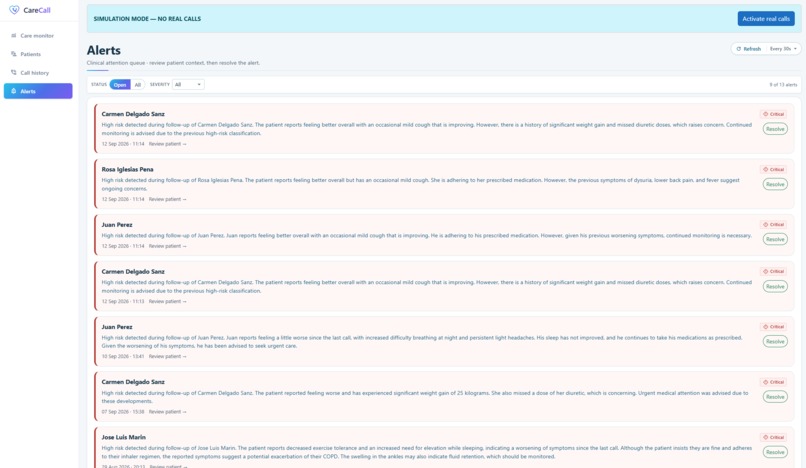
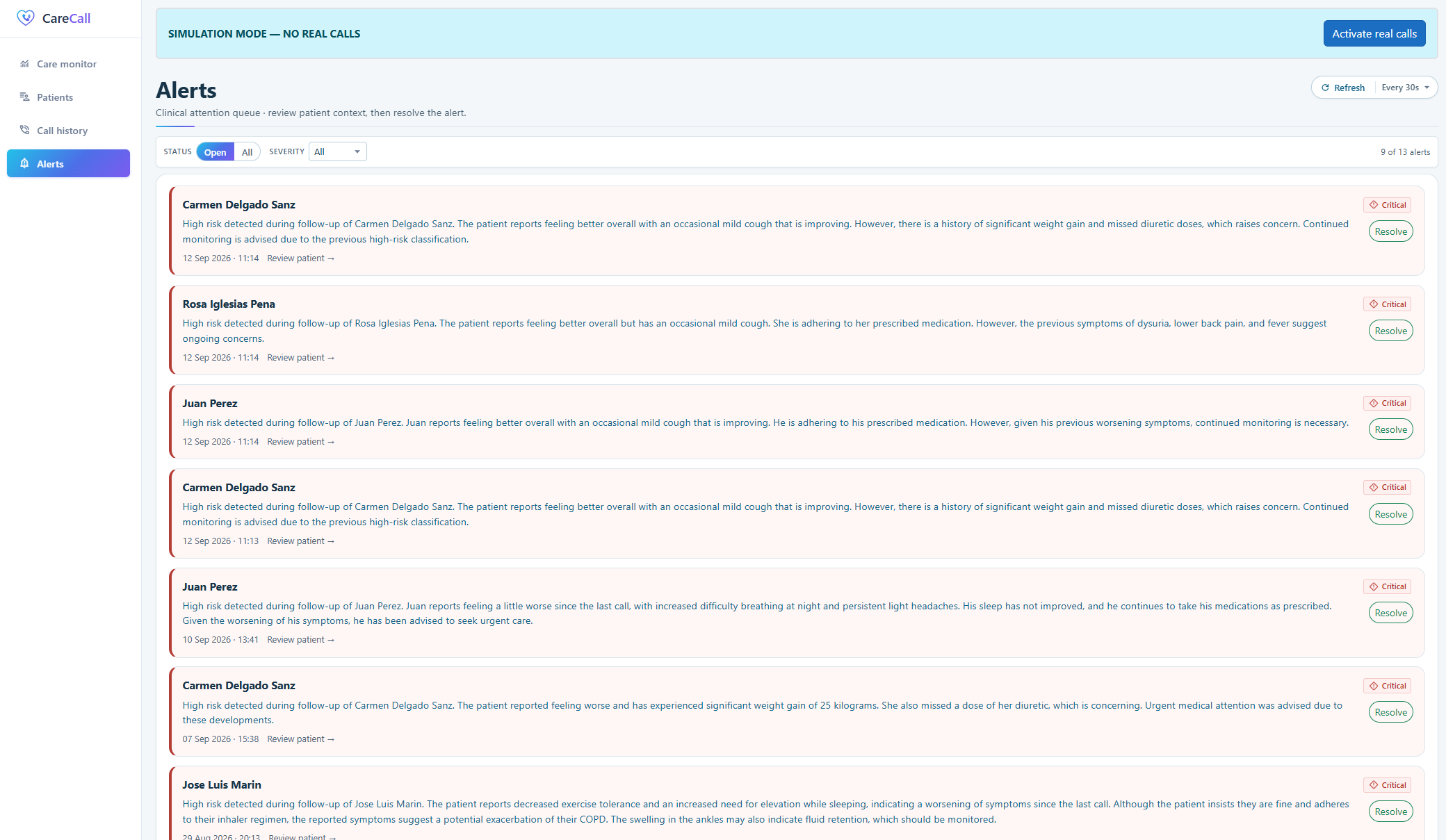
CareCall: Alerts screen (desktop)
-
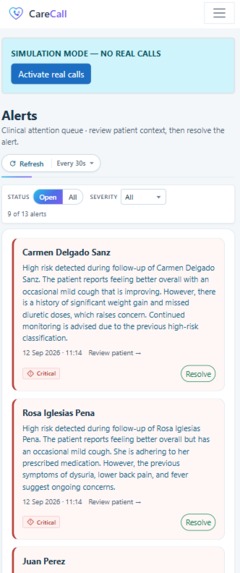
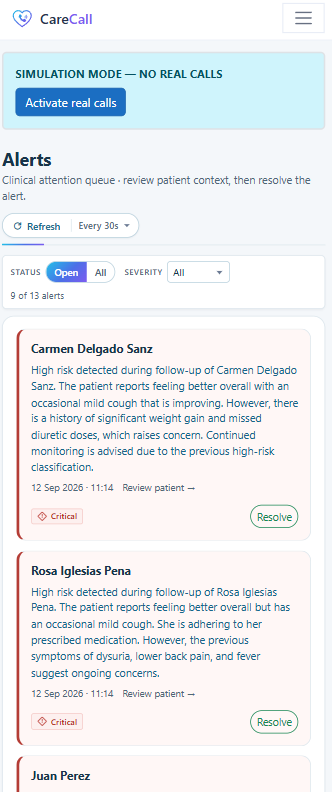
CareCall: Alerts screen (Mobile)
-
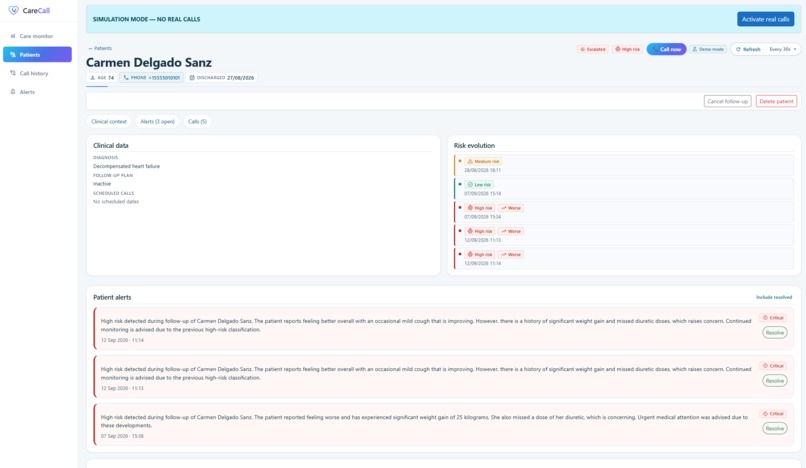
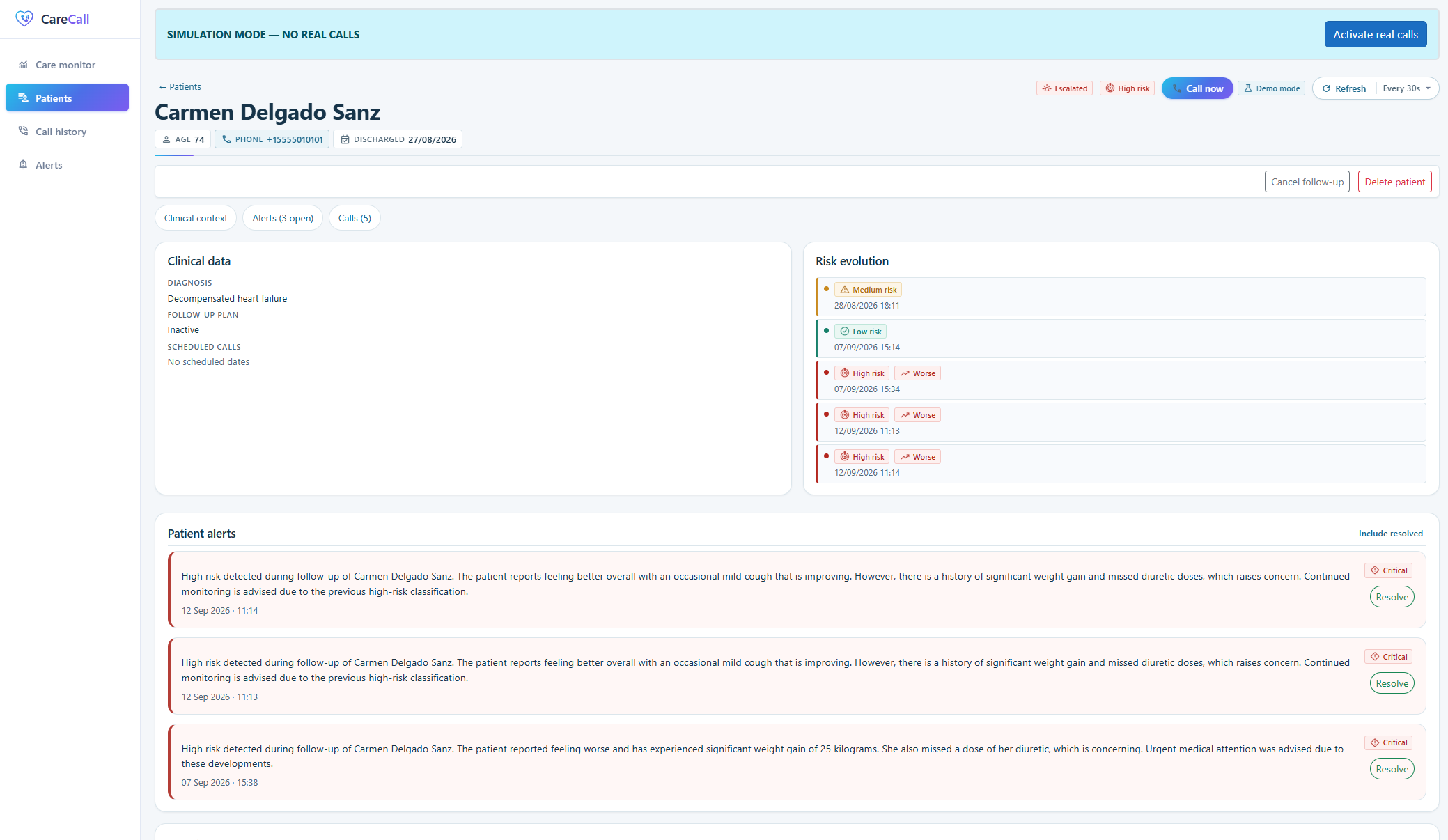
CareCall: Patient Record Screen 1 (Desktop)
-
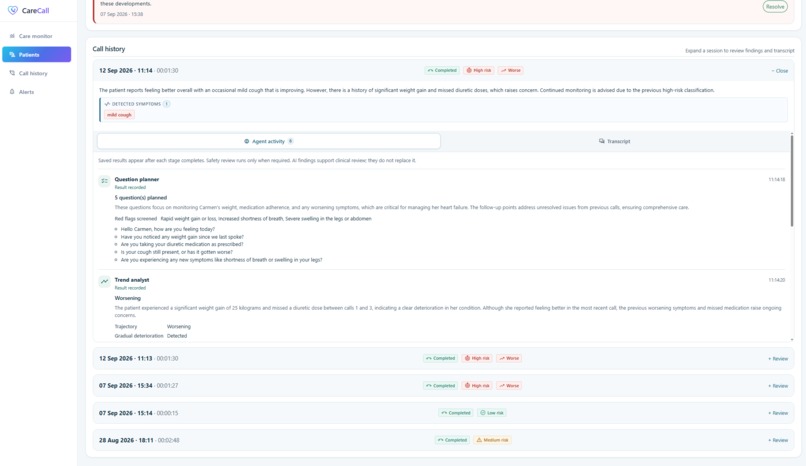
CareCall: Patient Record Screen 2 (Desktop)
Inspiration
Patients leave the hospital. Their risks don't.
Every day, patients are discharged from emergency departments believing the hardest part is over. Unfortunately, complications often appear after discharge, when patients are already back home.
Structured post-discharge follow-up can help healthcare teams identify potential complications earlier. However, healthcare professionals rarely have the capacity to manually follow up with every patient at scale.
At the same time, many of the patients who would benefit most from follow-up care, particularly older adults and vulnerable populations, may not use healthcare apps, patient portals, or wearable devices.
We asked ourselves:
What if every discharged patient could receive proactive follow-up without increasing the workload of healthcare professionals?
That question became CareCall.
What it does
CareCall is an AI-powered post-discharge patient follow-up platform built on top of CALL-E.
After a patient leaves the emergency department, CareCall schedules follow-up calls at key moments of recovery and can execute them through CALL-E when real-call mode is explicitly enabled.
Through AI-powered phone conversations, or safe simulations during evaluation, CareCall:
- Monitors patient recovery
- Detects warning signs and deterioration
- Assesses clinical risk
- Generates structured clinical summaries
- Creates alerts for healthcare professionals
- Adapts future follow-up schedules based on patient evolution
- CareCall supports professional clinical review; it does not diagnose, prescribe treatment, or replace emergency-care pathways.
Unlike app-based solutions, CareCall relies on something almost everyone already knows how to use:
A phone call.
How we built it
We focused on building a solution that was both technically robust and clinically explainable.
Core Platform
- .NET 10
- ASP.NET Core
- Blazor
- Entity Framework Core
- SQLite
AI Layer
- Semantic Kernel
- Azure OpenAI
- CALL-E
AI Architecture
CareCall uses a deterministic and auditable pipeline of specialized AI agents.
Question Planner Agent
Prepares personalized questions based on:
- Diagnosis
- Previous calls
- Follow-up objectives
- Potential red flags
Trend Analyst Agent
Looks at the patient's entire follow-up history and detects symptom progression over time.
Clinical Analyst Agent
Extracts:
- Symptoms
- Clinical summaries
- Risk classification
Devil's Advocate Agent
Provides an additional safety layer.
This agent can challenge uncertain conclusions and raise the assessed risk when evidence supports it.
Importantly, it can never lower risk.
Clinical Handoff Agent
Generates clinician-ready summaries using the SBAR framework.
Adaptive Scheduler Agent
Determines:
- Follow-up frequency
- Next call timing
- When monitoring can safely end
Every step is traceable through AgentTrace, providing transparency and accountability.
CALL-E acts as the communication layer that enables real patient conversations over the phone.
Challenges we ran into
The biggest challenge was not technical.
The hardest part was balancing:
- Clinical safety
- Simplicity
- Explainability
- User experience
We quickly realized that adding more AI agents would not necessarily improve outcomes.
Instead, we focused on building a deterministic workflow that healthcare professionals could understand and trust.
Another challenge was designing conversations that felt natural while still collecting enough structured information to support meaningful clinical assessment.
Finally, we spent significant effort ensuring that every risk assessment remained explainable and auditable.
Accomplishments that we're proud of
We are particularly proud of:
- Building a complete end-to-end healthcare workflow during a hackathon.
- Integrating real CALL-E phone conversations into the patient journey.
- Designing an auditable AI architecture instead of a black-box system.
- Creating a dashboard that allows clinicians to focus only on high-priority patients.
- Demonstrating how voice AI can create real-world impact beyond customer support and sales scenarios.
Most importantly, we created a solution that addresses a real healthcare problem.
What we learned
Throughout the project we learned several important lessons.
- Real-world impact matters more than technical complexity.
- Voice remains one of the most accessible user interfaces available.
- In healthcare, explainability is just as important as AI accuracy.
- Deterministic AI workflows are often preferable to autonomous systems when decisions affect people's health.
- CALL-E enables entirely new categories of healthcare applications that would be difficult to build through traditional interfaces.
Most importantly, we learned that a simple phone call can become a powerful healthcare tool when combined with the right AI architecture.
What's next for CareCall
CareCall was built during a hackathon, but the problem it addresses is very real.
Our next steps would include:
- Supporting additional post-discharge pathways.
- Integrating with electronic health record systems.
- Expanding clinician workflows and alerting capabilities.
- Adding multilingual support.
- Running pilot programs with healthcare providers.
- Evaluating outcomes such as earlier review and reduced avoidable readmissions.
Our vision is simple:
No patient should disappear from view immediately after leaving the hospital.
Because patients leave the hospital.
Their risks don't.
Powered by CALL-E. Built for real-world impact.
Built With
- .net
- agentic-ai
- ai-agents
- asp.net
- azureopenai
- blazor
- call-e
- entity-framework
- healthcare
- phone-calls
- semantic-kernel
- sqlite
- voice-ai

Log in or sign up for Devpost to join the conversation.