-
-
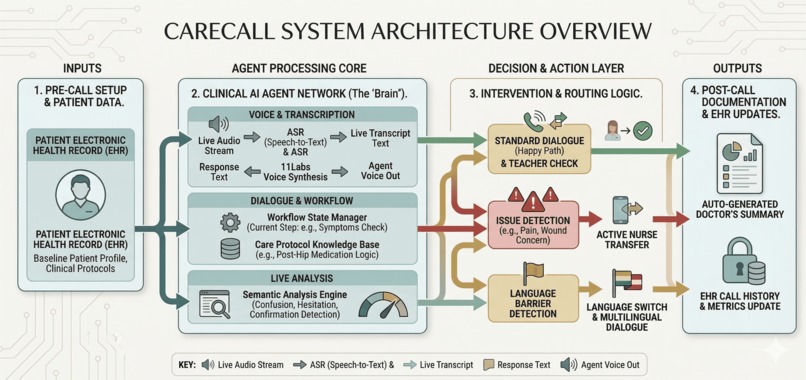
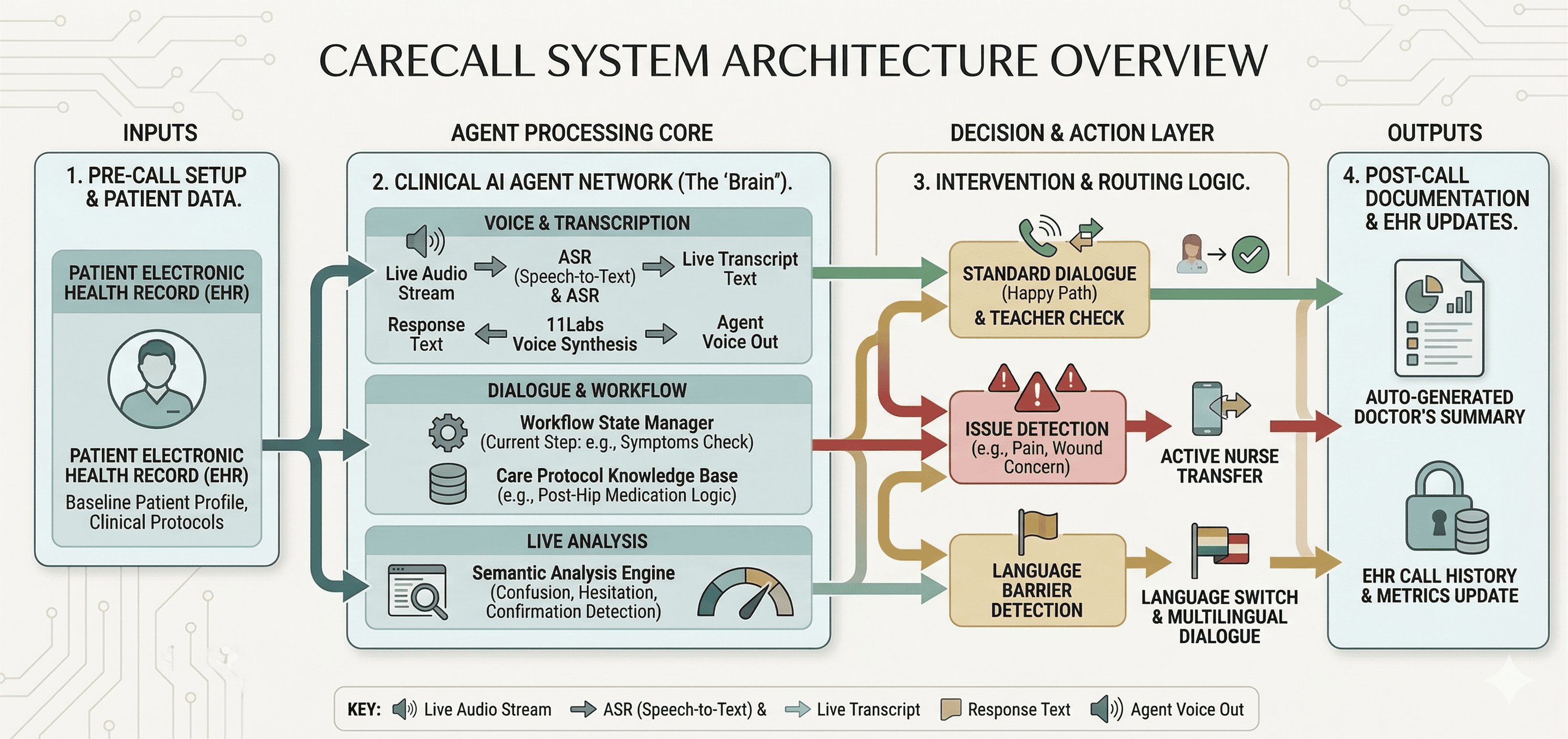
Architecture
-
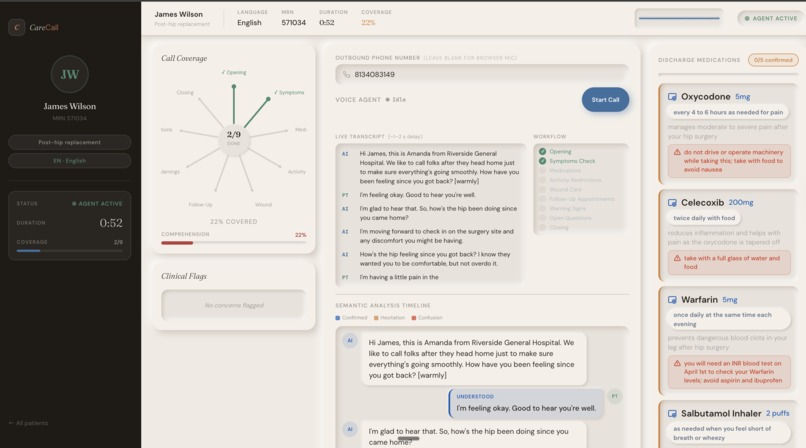
dashboard
-
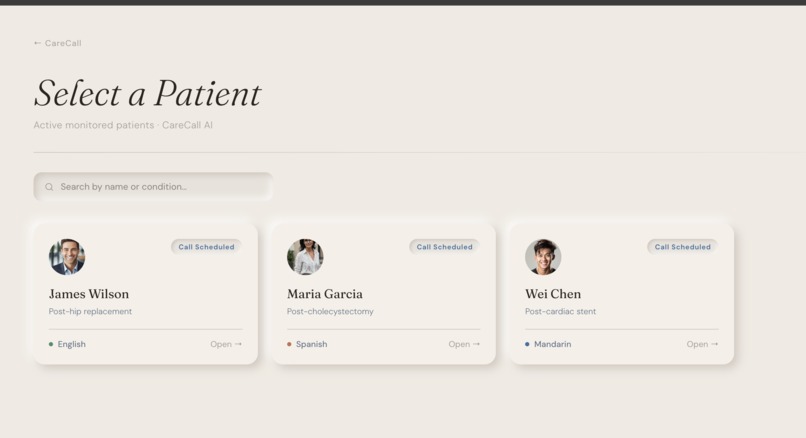
dashboard 2
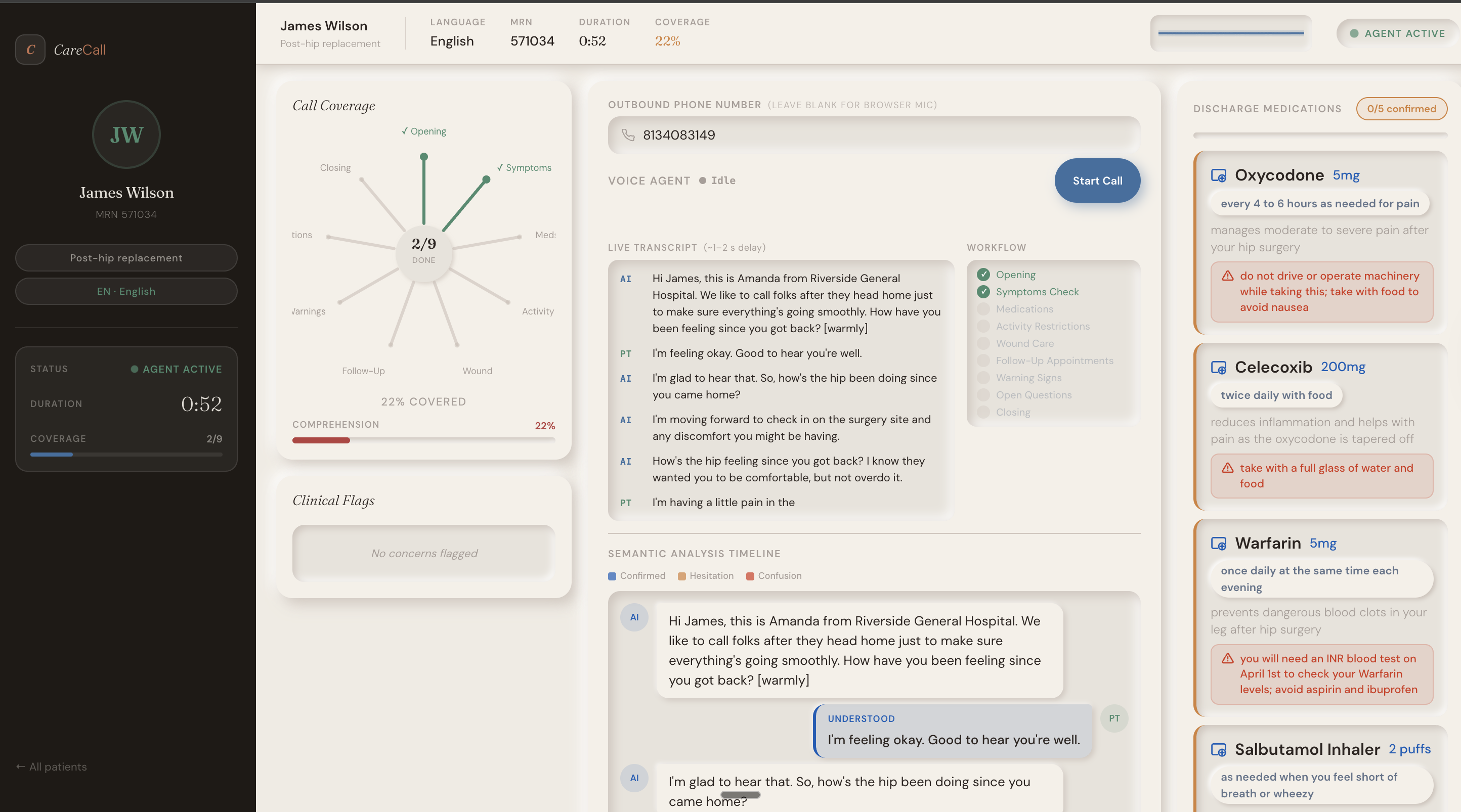
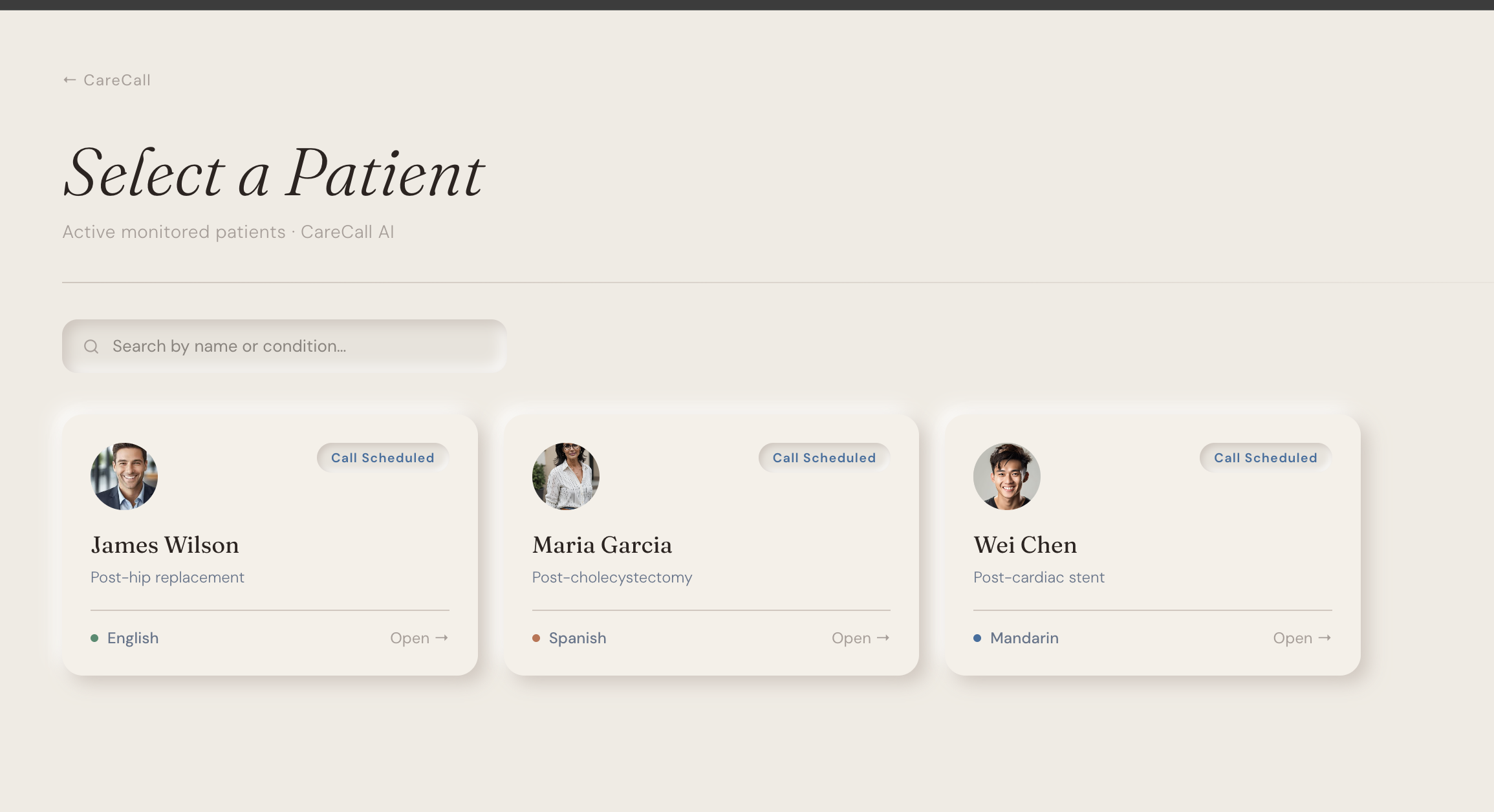
CareCall
Why: The discharge moment is broken.
- The average discharge conversation lasts just 76 seconds
- 50% of patients make a medication error within days of leaving the hospital
- 76% of 30-day readmissions are potentially preventable
Unfortunately, it is not uncommon for patients to leave the hospital with a folder of instructions, a bag of medications, and a lot of unanswered questions. For elderly patients, those with language barriers, or anyone navigating a complex recovery alone, that moment of discharge can be the most vulnerable point in their entire care journey. Many times, it is our grandparents, our parents, or our friends. It is people that we want to see healed, healthy, and happy. We built CareCall because we believe no patient should have to figure it out on their own.
The solution is a hand-off.
What it does
CareCall meets patients where they are.
For patients who aren't comfortable with technology: elderly individuals, those with mobility concerns, or anyone who simply needs a human touch, CareCall's AI voice agent calls them directly. Its familiar, and comfortable: there’s no app to download, no portal to log into, no barriers. There’s only phone call that walks them through everything they need to know, in their language, on their time..
Every call follows a clinically structured 9-step protocol covering:
- Opening
- Symptoms Check
- Medications
- Activity Restrictions
- Wound Care
- Follow-Up Appointments
- Warning Signs
- Open Questions
- Closing
No critical topic is ever skipped, rushed, or forgotten. Every patient. Every time.
For families and caregivers who want to stay involved, CareCall's interactive patient portal puts everything in one place:
- Prescribed medications, dosages, and refill tracking
- Scheduled follow-up visits and appointment reminders
- Recovery progress and care plan milestones
- Real-time updates accessible by the patient, family members, and care team simultaneously
Two access points. One seamless recovery.
Whether your patient picks up a phone or their daughter logs into a portal from across the country, CareCall ensures that the 76 seconds in that hospital room is never the last time anyone checks in.
Preventable readmissions are preventable. CareCall makes prevention possible.
How we built it
We put a lot of thought into the stack, we were thinking what would hold up when a real patient is on the other end of the line.
| Technology | Role |
|---|---|
| ElevenLabs | AI voice agent engine delivering natural, multilingual speech that patients can understand and trust |
| Twilio | Call routing, connectivity, and telephony infrastructure — reliable outbound calls to any phone, anywhere |
| Supabase | System of record for all patient data : demographics, prescriptions, and post-call history |
| Upstash Redis | Ultra-low latency key-value store powering real-time mid-call state sync between the AI agent and the dashboard |
| Vercel | Cloud hosting ensuring fast, secure, and globally available access to the clinical dashboard and patient portal |
| Gemini API | Powers intelligent post-call summarization before saving to Supabase and delivering via email |
Every layer of the stack was chosen with one priority in mind: so that when a patient picks up the phone, everything just works.
What makes CareCall's architecture distinct is how it handles the moment during the call. Most platforms treat conversation summaries as a post-call activity. CareCall uses a decoupled, serverless data layer to reflect the AI's progress in real time as it happens. While the voice agent converses with the patient, it continuously writes its current workflow step and any detected clinical flags directly into Upstash Redis. The dashboard polls this state every one to two seconds, meaning care coordinators see warnings, workflow progress, and comprehension scores animate live.
Accomplishments
One of the most unexpected and meaningful parts of building CareCall was learning how much the voice itself matters.
We spent a significant amount of time inside ElevenLabs wrestling with what it means for an AI to sound like it cares. We experimented with stability sliders, similarity settings, speaking pace, and emotional expressiveness. We tested different voice models, compared how different audio tags changed the feeling of a sentence, and listened, really listened, to how a slight adjustment in tone could make the same words feel either clinical and cold, or warm and human.
It turns out that the difference between a patient feeling heard and a patient feeling processed comes down to details most people would never notice. A small pause before acknowledging a symptom, or slightly slower pace when reviewing medications. The right voice saying the right words in the right way at a moment when someone might be scared, confused, or alone after what could be one of the darkest experiences of their life.
We had to learn how to engineer for empathy, and that is not something any of us expected to be doing when we started this project.
Every technical decision in CareCall, from the real-time state sync to the 9-step protocol to the voice configuration, was made with one person in mind: the patient on the other end of the line. Someone who just left the hospital. Someone who might not fully understand their diagnosis. Someone whose family might be hours away. Someone who, when their phone rings, deserves to feel like the person calling actually gives a damn.
Getting that right took more iteration than any other part of the build. And it was the most important work we did.
Built With
- elevenlabs
- gemini-api
- next.js
- python
- react
- supabase
- twilio
- typescript
- upstash-redis
- vercel

Log in or sign up for Devpost to join the conversation.