-
-
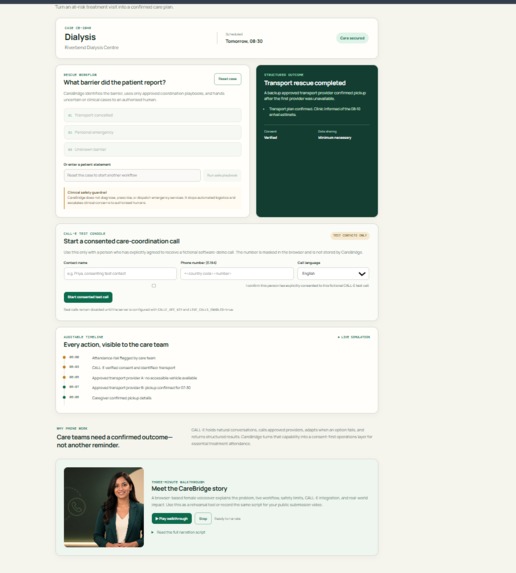
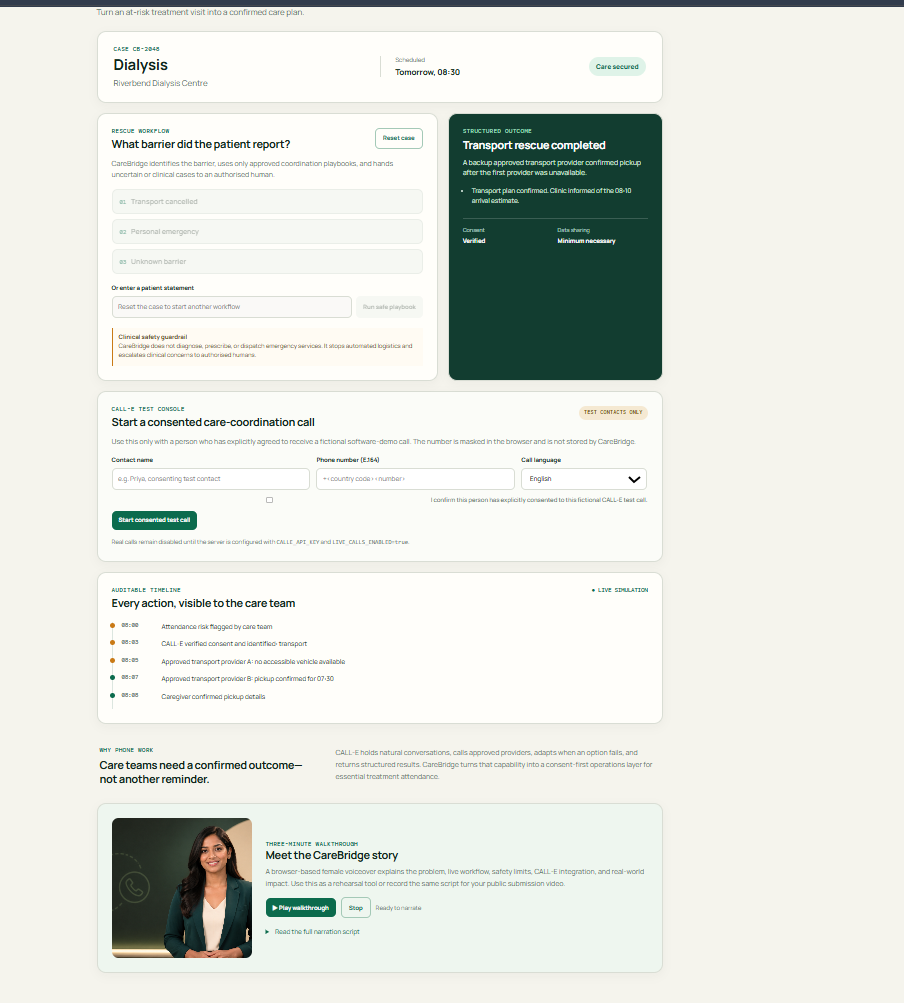
CareBridge dashboard showing a consent-first CALL‑E treatment-attendance rescue
Inspiration
Essential treatment appointments are often missed because of real-world coordination failures—not because a patient chooses to skip care. A cancelled transport provider, unavailable caregiver, delayed medicine pickup, or misunderstood appointment can put dialysis, infusion, and follow-up treatment at risk.
Care teams currently spend valuable time calling multiple people, often without a clear answer about whether the patient can actually attend. CareBridge was built to turn that uncertainty into a verified, safe outcome.
What it does
CareBridge is a consent-first treatment-attendance rescue agent powered by CALL-E.
When an authorised care team flags a patient as at risk within the next 24 hours, CareBridge calls a consenting patient or caregiver in the selected language, identifies the practical barrier, and follows only approved coordination playbooks.
It can coordinate transport, caregiver availability, medication access, and appointment clarification. It returns a structured result: Care Secured, Human Review Required, or Still At Risk, with an auditable timeline of every action.
How we built it
CareBridge is a Node.js and JavaScript web application with a dashboard, safe workflow engine, and CALL-E Developer API integration.
The project includes a consented-call console where an authorised user can enter a consenting test contact’s number, choose English or Hindi, and start a fictional CALL-E test call. The integration is protected by an explicit consent confirmation and a server-side API-key gate.
Challenges we ran into
The main challenge was building a useful agent without making unsafe decisions. A care-coordination agent must adapt to unexpected phone responses, but it must not diagnose, prescribe, or invent solutions.
We designed CareBridge so that personal emergencies, possible clinical concerns, and unfamiliar barriers stop automated logistics and move to an authorised human care coordinator.
Accomplishments that we're proud of
- A working treatment-attendance rescue dashboard with structured outcomes.
- Adaptive transport workflow: provider A unavailable, provider B confirms pickup, caregiver confirms details, then the case becomes Care Secured.
- Safe handling of personal emergencies and unknown barriers through human review.
- Consent-first CALL-E integration for fictional test calls.
- Synthetic data, masked contact details, and a visible audit timeline.
What we learned
A reminder only notifies a patient. Real care coordination requires verified outcomes across multiple people and organisations.
We learned that safety must be built into the workflow itself: consent, minimal data sharing, clear automation limits, and reliable human escalation make an AI agent more trustworthy.
What's next for CareBridge
Next, CareBridge can be piloted with a care organisation using its approved provider directory, language preferences, consent records, role-based access, and authorised clinical escalation policy.
Our goal is simple: help care teams know, before an essential treatment visit is missed, whether care is secured or a human needs to act.
Built With
- api
- artificial
- call-e
- communication
- css
- healthcare
- html
- intelligence
- javascript
- node.js

Log in or sign up for Devpost to join the conversation.