Inspiration
Care teams often have only a few minutes after an ED visit or discharge to answer the questions that matter most: Who needs outreach first? What medication risks changed? Is follow-up booked? Are there social or access barriers hidden in notes? Missing those signals can lead to avoidable readmissions, medication confusion, and delayed care.
CareBridge Sentinel was inspired by that high-stakes 72-hour window after discharge.
What It Does
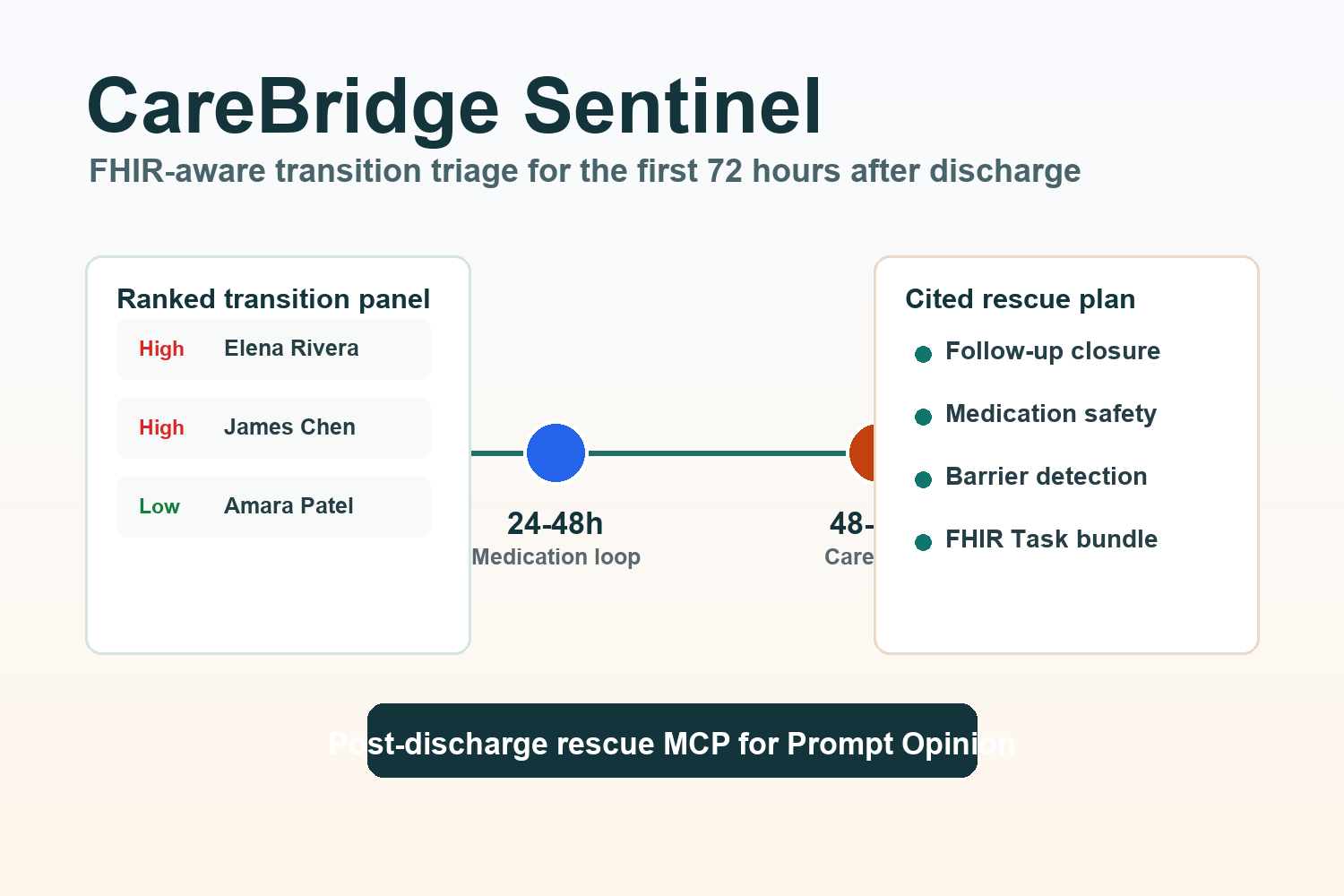
CareBridge Sentinel is a FHIR-aware MCP server for Prompt Opinion that helps healthcare agents triage post-discharge patients and create clinician-reviewable action plans.
It provides tools to:
- Rank a small post-acute patient panel by transition risk
- Build a cited 72-hour rescue plan for the highest-risk patient
- Surface medication safety issues, abnormal labs, care gaps, and follow-up risks
- Detect transition barriers from synthetic DocumentReference notes
- Generate draft FHIR
TaskandCommunicationRequestresources for clinician review - Draft patient outreach grounded in cited FHIR evidence
The core workflow is simple: triage the panel, pick the highest-risk transition, generate a rescue plan, create draft FHIR tasks, and prepare outreach for clinician review.
How I Built It
I built CareBridge Sentinel as a Python MCP server using FastAPI and FastMCP. It implements Prompt Opinion’s FHIR context extension so the server can receive authorized FHIR context through request headers.
The clinical logic reads synthetic FHIR R4 resources including Patient, Encounter, Condition, Observation, MedicationRequest, AllergyIntolerance, Appointment, DocumentReference, and more. It then produces structured, cited outputs that a Prompt Opinion agent can turn into concise care-manager workflows.
The project includes:
- Synthetic FHIR demo patients
- Local fixture mode for safe demos
- FHIR URL hardening
- PHI/token redaction checks
- Unit tests
- End-to-end MCP smoke tests
- Docker support
- GitHub Actions CI
Challenges
The hardest part was making the project feel useful without pretending to automate clinical decisions. Healthcare AI needs to be grounded, auditable, and careful. I focused on clinician-review workflows instead of autonomous action.
Another challenge was making the demo distinct from generic clinical summaries. The final project focuses on a specific operational wedge: the first 72 hours after discharge.
What I Learned
I learned how MCP tools can give healthcare agents reliable, scoped capabilities instead of asking a model to reason from raw chart data alone. I also learned how important it is to design around FHIR scopes, synthetic data, privacy boundaries, and clear evidence citations.
What’s Next
Next steps would include deploying the MCP server to a production HTTPS endpoint, publishing it in the Prompt Opinion Marketplace, testing against richer synthetic FHIR bundles, and adding more configurable transition-risk rules for different care-management programs.
Safety
CareBridge Sentinel is clinical decision support only. It does not store PHI, tokens, or patient records. All generated plans, tasks, and outreach drafts are intended for clinician review before action.


Log in or sign up for Devpost to join the conversation.