Inspiration
When I was 14, my mother suffered a stroke. Although she recovered, the period after hospital discharge was overwhelming for my family. We didn’t know what support existed, what we might qualify for, or what our next steps should be. My father had to call many relatives and doctors for help, which is really time-consuming and even dangerous. That experience inspired CareBridge, an AI-powered navigator that helps post-stroke caregivers understand available support programs and confidently move forward after discharge.
What it does
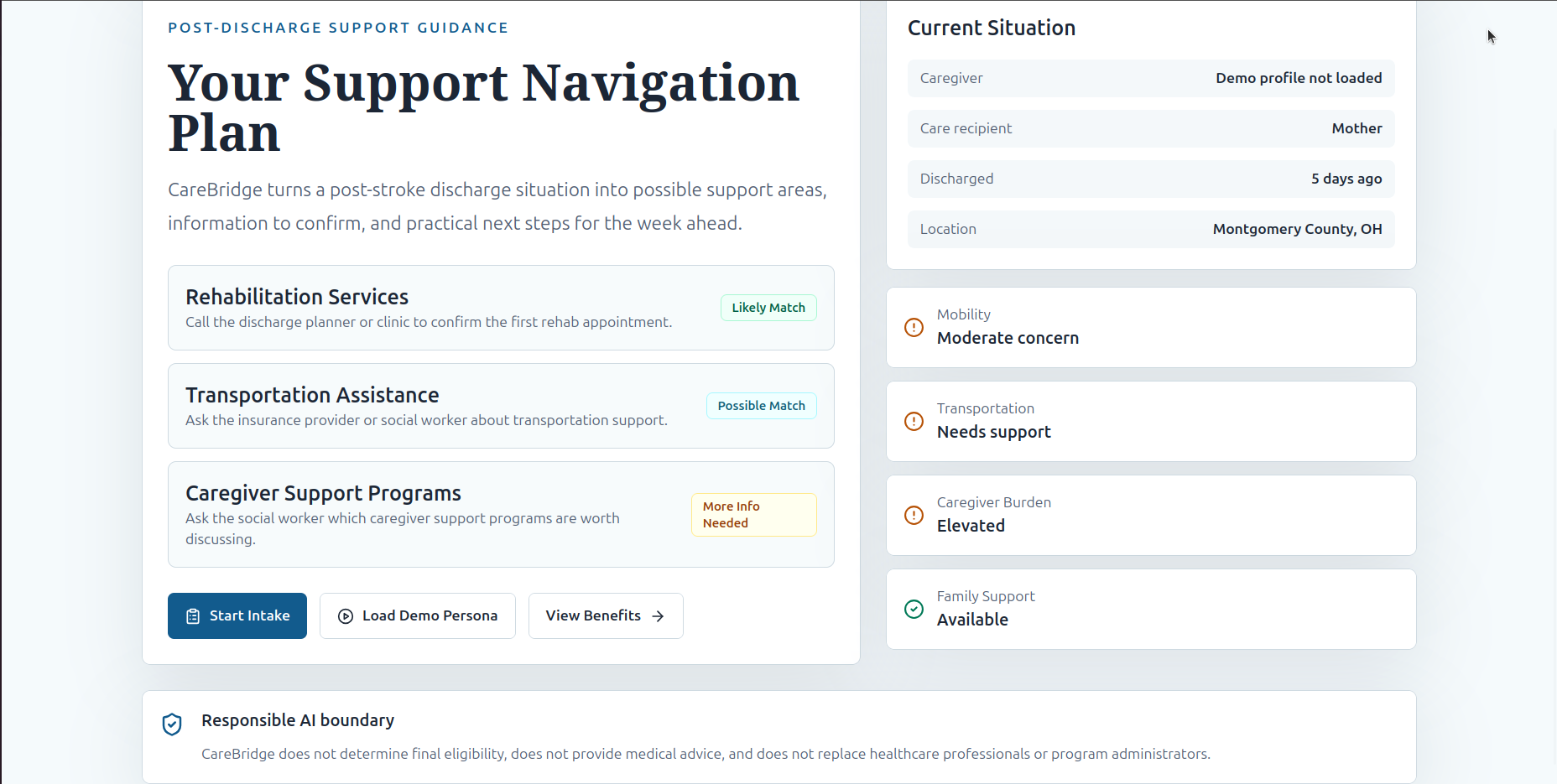
CareBridge helps caregivers answer one critical question: What should we do next, and what support may we qualify for?
Caregivers describe their situation by answering questions about mobility, transportation, insurance, caregiver availability, and follow-up care. CareBridge then uses AI to:
- Interpret the caregiver's situation.
- Identify potential barriers such as transportation or rehabilitation needs.
- Explain which support services they may benefit from.
- Prioritize next steps in plain language.
Caregivers also have the option to complete a short camera-based mobility assessment. The system transforms confusion into a personalized action plan instead of overwhelming families with dense information.
How we built it
We built CareBridge using three main components:
- AI Guided Intake – a conversational interface that collects information about the caregiver and patient's situation.
- Care Navigation Engine – a combination of LLM reasoning, rule-based logic, and resource retrieval that identifies support pathways.
- Rehab Snapshot AI – an optional computer vision module built with pose estimation to identify physical functional limitations.
Challenges we ran into
One of our biggest challenges was designing an AI system that supports, rather than replaces, healthcare professionals. Stroke recovery is highly individualized, and incorrect recommendations could create over-reliance on AI. To address this, CareBridge never makes medical decisions or guarantees eligibility.
Another challenge was ensuring transparency. We wanted caregivers to understand why recommendations were made, not simply receive a static list of resources.
Accomplishments that we're proud of
We are proud that CareBridge was inspired by a real family experience and addresses a problem that many caregivers face but rarely talk about. We are also proud that our solution goes beyond a simple resource directory. Instead of showing generic resources, CareBridge reasons over a caregiver’s unique situation and generates prioritized next steps. Finally, we successfully integrated computer vision mobility insights directly into the care navigation process.
What we learned
Through this project, we learned that navigating care after hospital discharge can be just as challenging as the medical recovery itself. We also learned that AI is most valuable not when it replaces human experts, but when it helps people better understand complex systems and make more informed decisions.
What's next for CareBridge
In the future, we plan to expand CareBridge to support additional conditions beyond stroke, such as traumatic brain injury (TBI) and post-surgical recovery. We also hope to integrate real community resource databases, multilingual support, and partnerships with healthcare providers and social workers to make care navigation more accessible for families everywhere.
Built With
- docker
- fastapi
- groq
- langchain
- mediapipe-pose
- openai-api
- pgvector
- postgresql
- pydantic
- python
- react-query
- sqlalchemy
- tailwind-css
- typescript
- vite

Log in or sign up for Devpost to join the conversation.