Inspiration
Healthcare often starts with a conversation, but many patients struggle to explain what they are experiencing clearly. Important symptoms, timelines, concerns, and questions can be difficult to organize, especially when someone is anxious, uncomfortable, or unsure what information matters.
We built CareBridge around a simple idea: before a patient meets a doctor, their story should already be understandable.
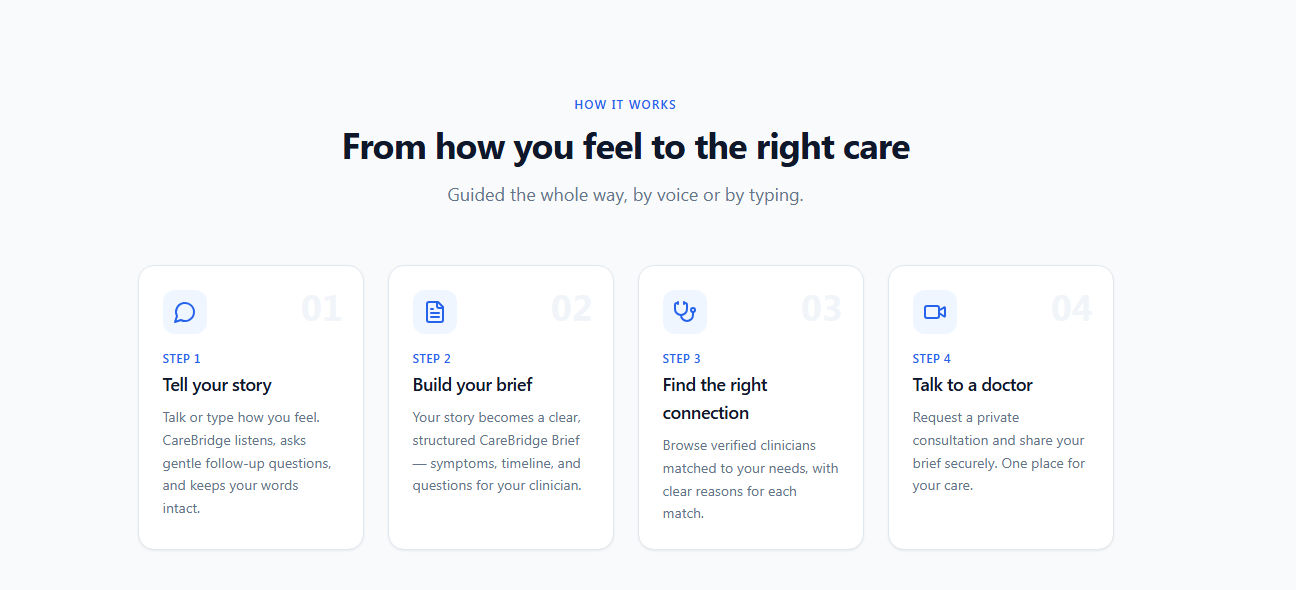
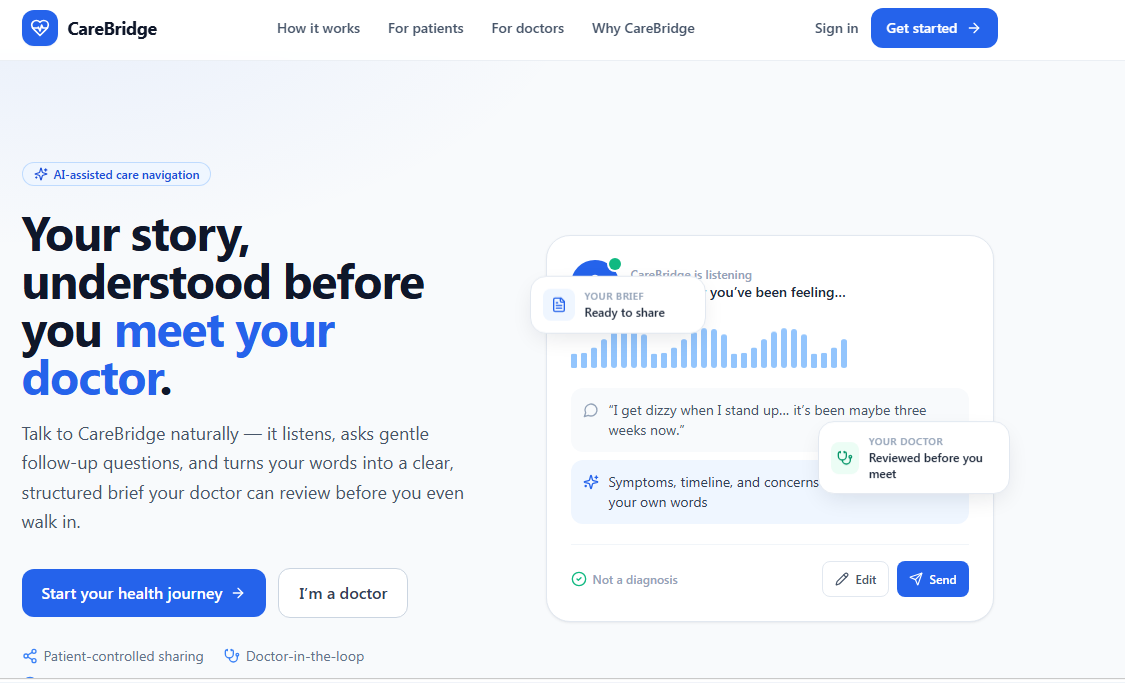
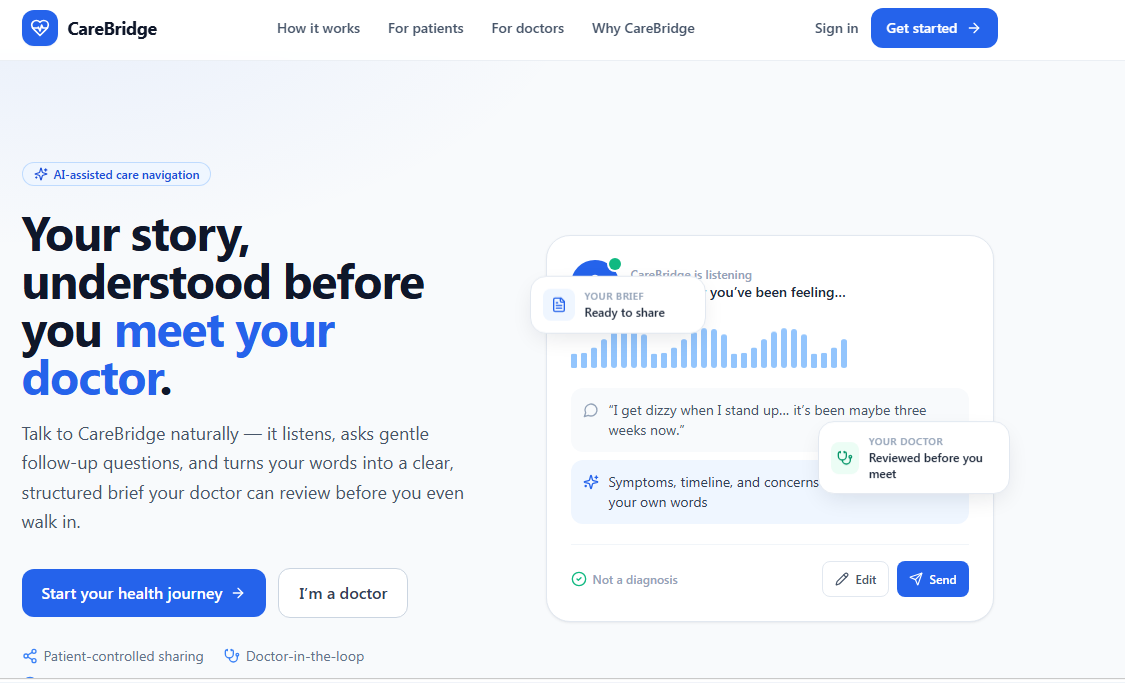
CareBridge lets patients describe what they are experiencing through a guided AI intake using either text or voice. Instead of trying to diagnose the patient, CareBridge organizes what the patient says into a clear, shareable CareBridge Brief containing their reported symptoms, timeline, concerns, questions, and other relevant context.
The patient can then discover doctors, see why a doctor may be a reasonable match, choose which brief to share, and request a consultation. Doctors receive the brief before accepting the request, allowing the first conversation to begin with context rather than starting from zero.
What we built
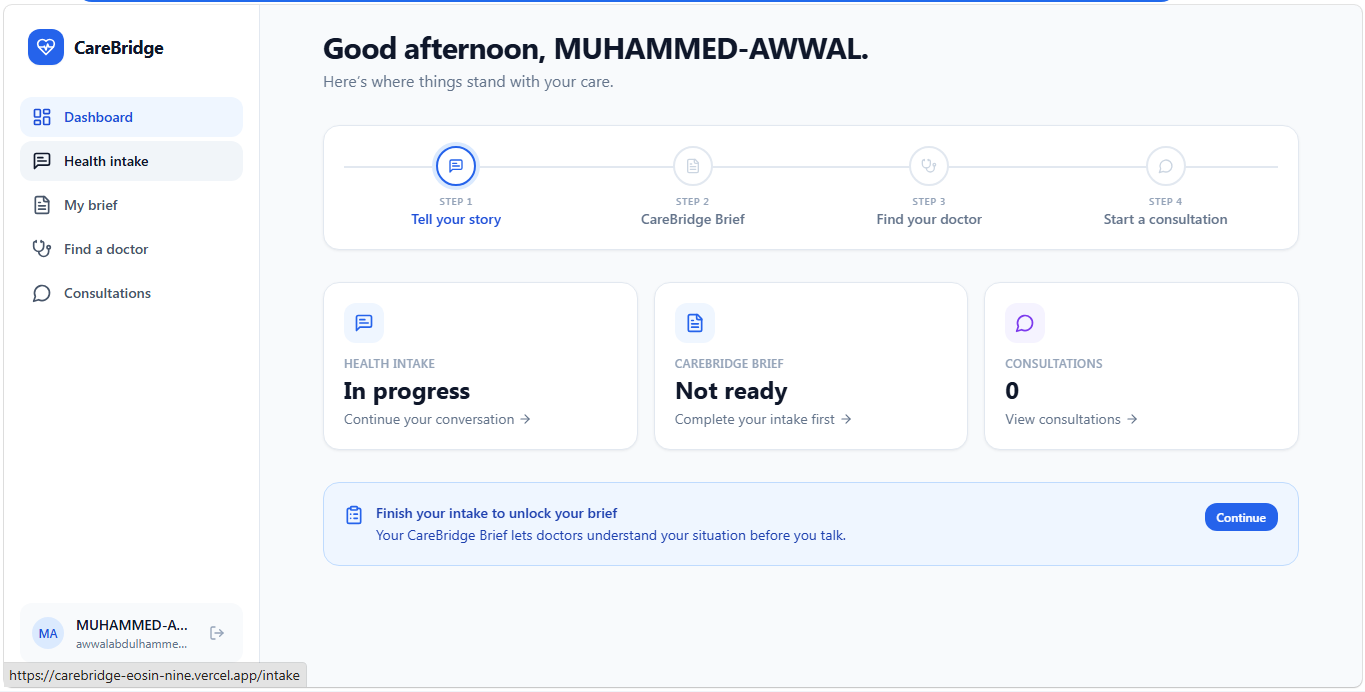
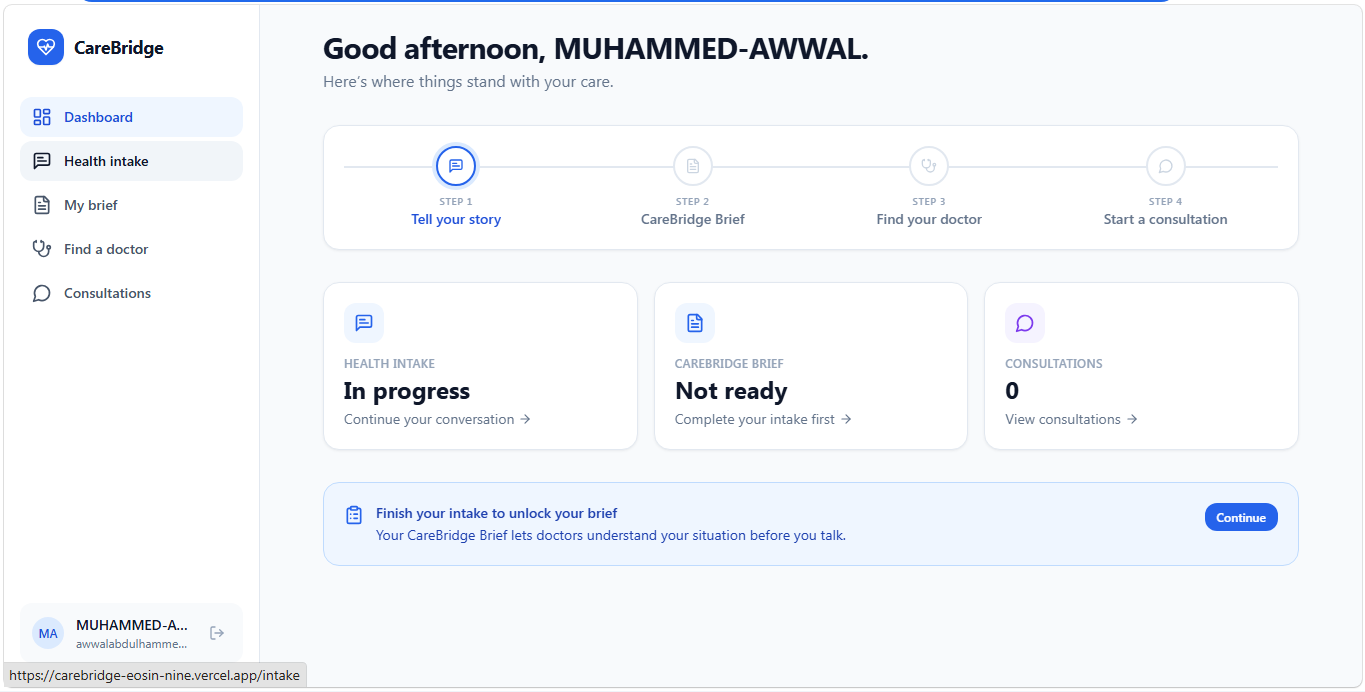
CareBridge is a full-stack patient-to-doctor care-navigation platform with separate patient and doctor experiences.
For patients, the journey is:
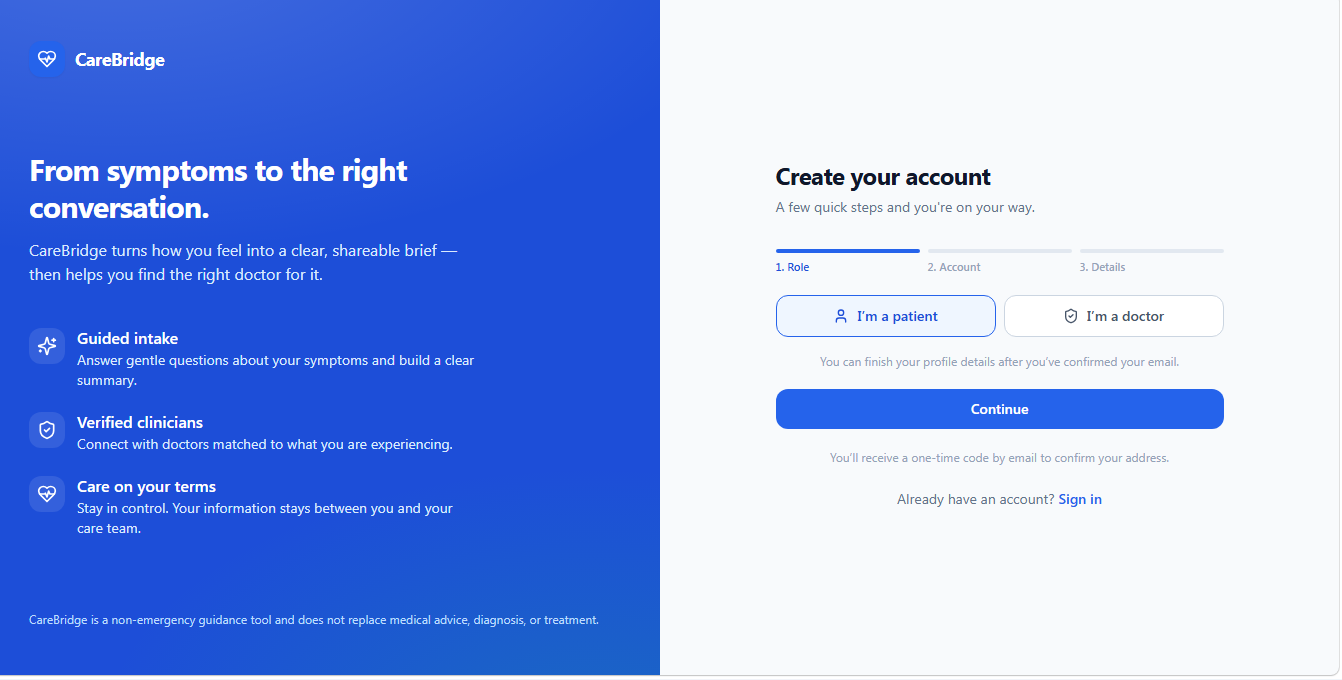
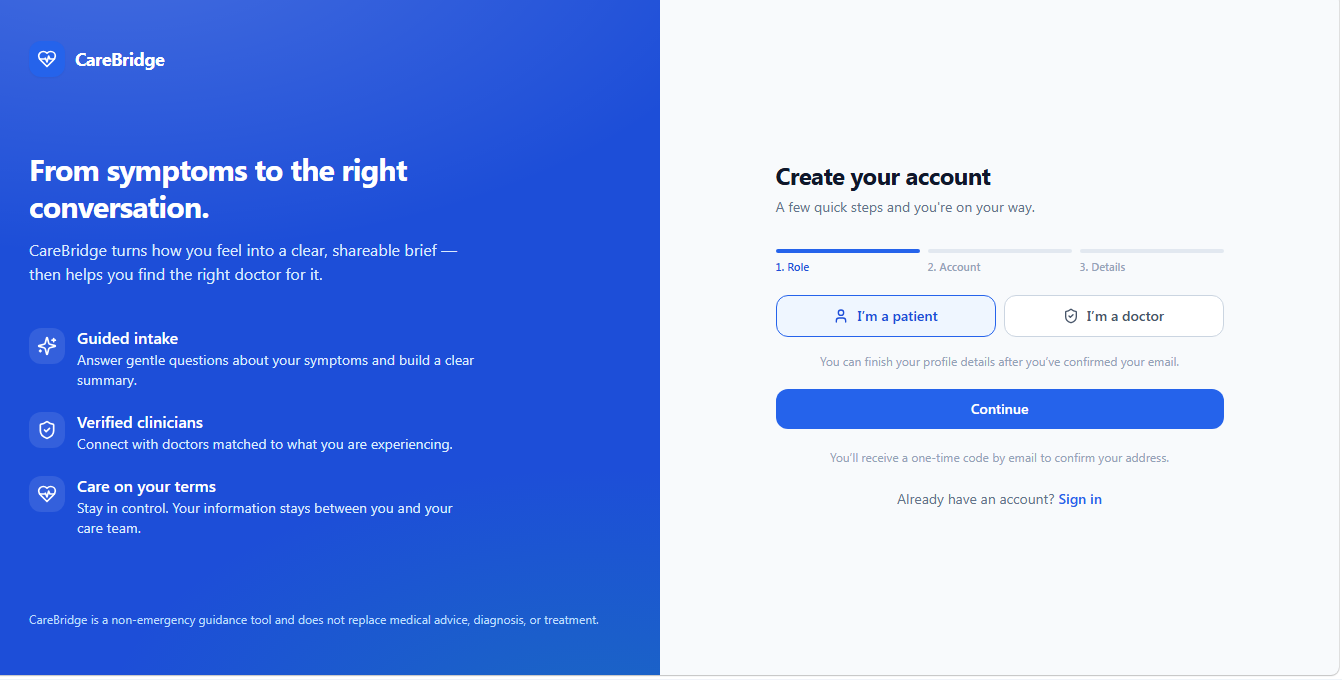
- Create an account and verify their email with a Supabase OTP.
- Complete their profile.
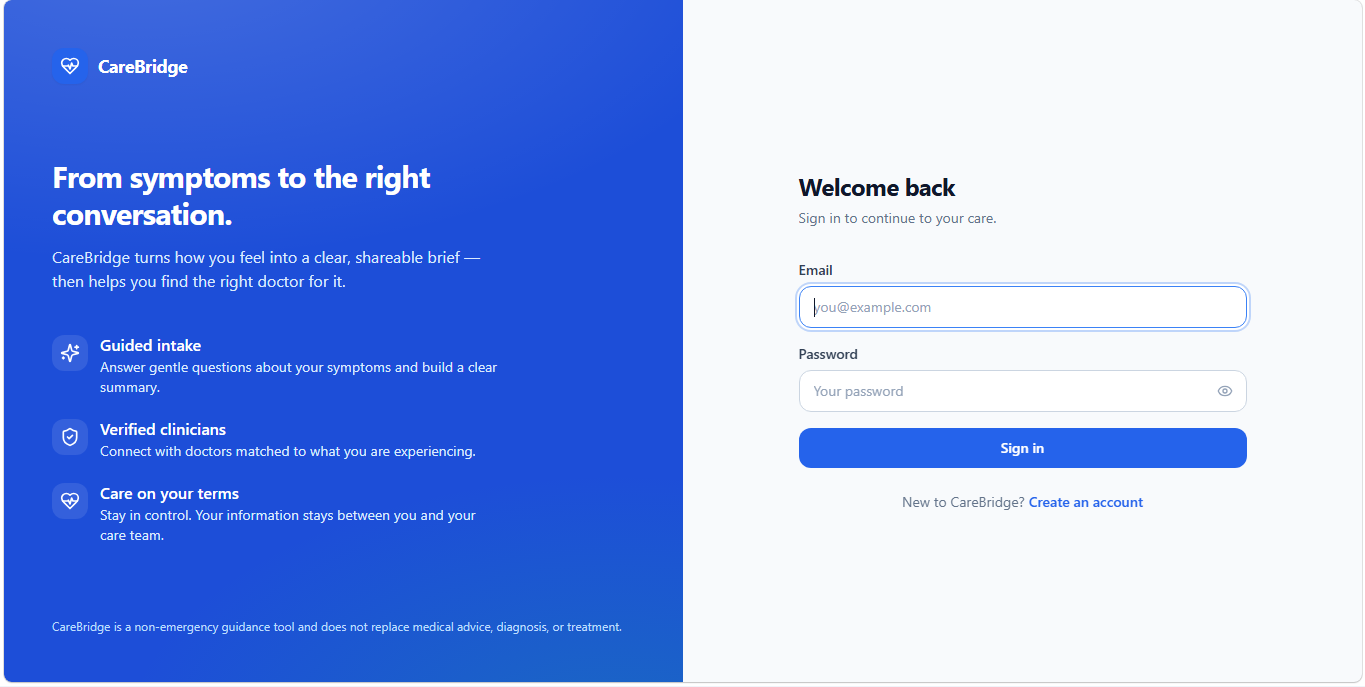
- Describe their health concern through guided text or voice.
- Review and edit what they said.
- Receive an AI-organized CareBridge Brief.
- Discover doctors using criteria-based recommendations and directory filters.
- Choose a brief and give consent to share it.
- Request a consultation.
- Chat with the doctor and track the consultation status.
For doctors, CareBridge provides:
- A dedicated doctor portal.
- Availability management.
- Pending consultation requests.
- A brief-at-a-glance view before accepting a request.
- Urgency indicators based on the patient's reported information.
- Accept/decline workflows with a required reason when declining.
- Active and completed consultations.
- Patient/doctor notes.
- Access to the shared intake transcript and CareBridge Brief.
- Consultation chat.
- Doctor profile management.
Voice-first experience
A major part of CareBridge is making the intake conversational rather than form-heavy.
Patients can speak instead of typing. Their speech is transcribed, displayed back to them as "You said...", and can be edited before being sent. CareBridge can also respond through voice, creating a more natural conversational experience.
The system falls back to text when browser speech capabilities or microphone permissions are unavailable.
Responsible AI
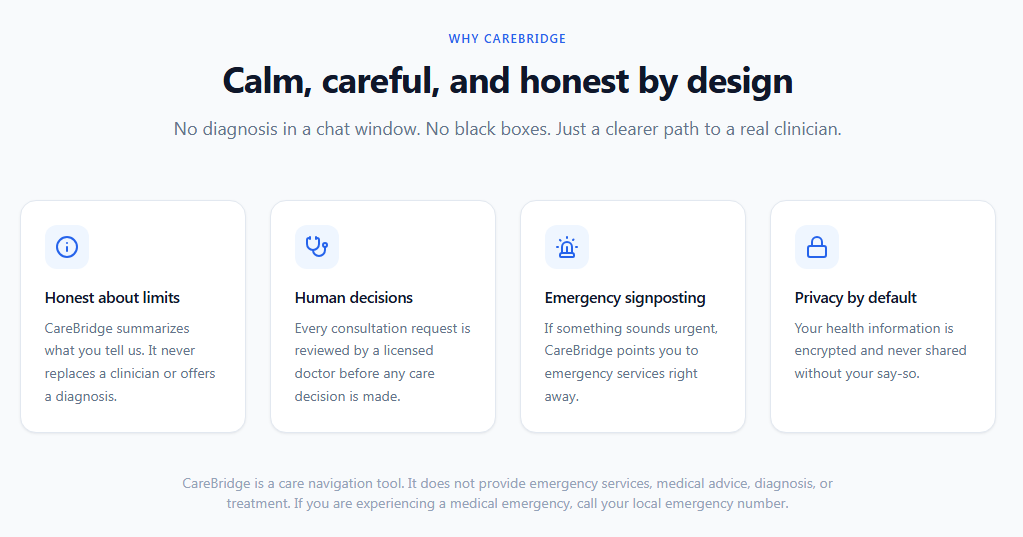
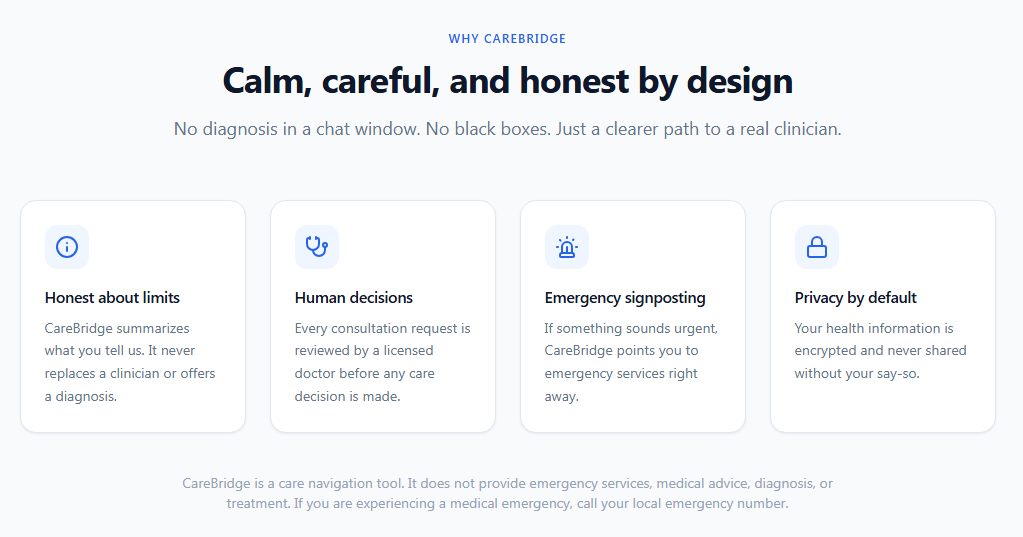
CareBridge is intentionally designed as a care-navigation and communication tool, not a diagnostic system.
The AI organizes patient-reported information, highlights information that may require attention, generates questions and summaries, and helps connect patients with doctors. It does not claim to diagnose conditions or replace professional medical judgment.
The patient's original information is kept distinguishable from AI-organized information in the CareBridge Brief, helping doctors understand what the patient actually reported versus what the system structured.
How we built it
The frontend is built with React, TypeScript, Vite, Tailwind CSS, React Hook Form, Zod, and TanStack Query.
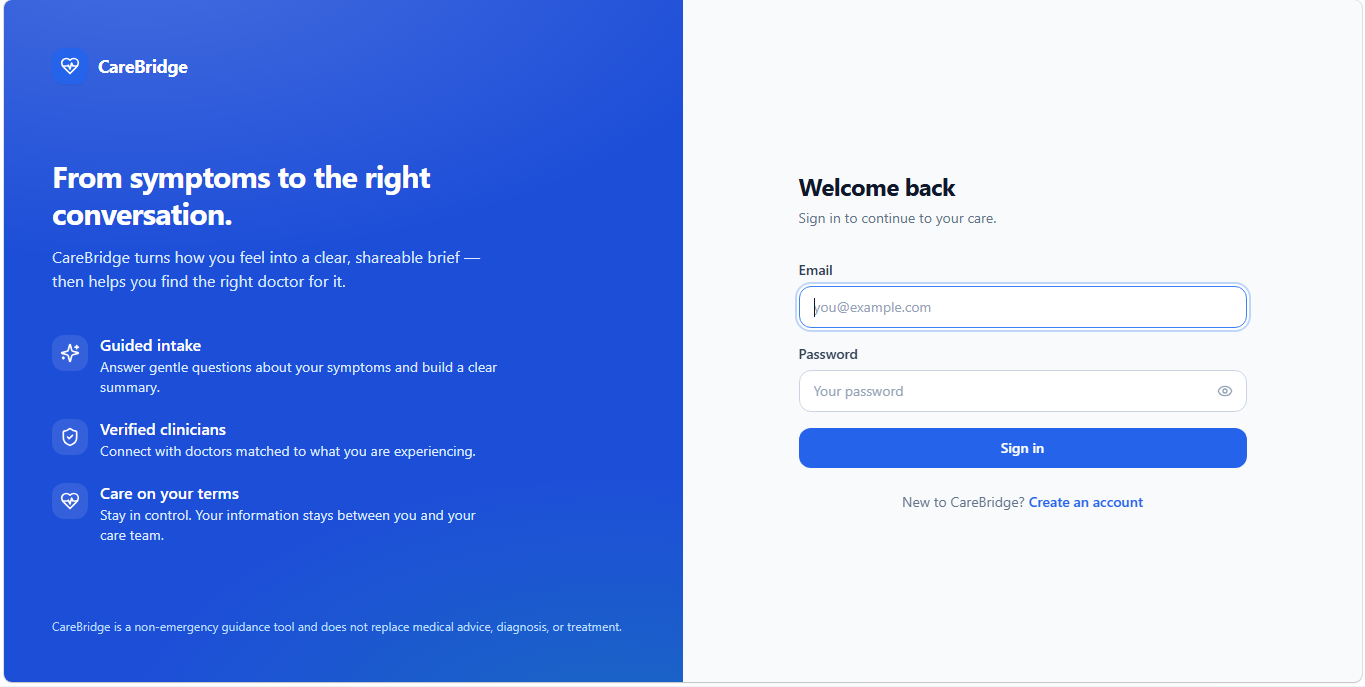
The backend is built with FastAPI and integrates with Supabase for authentication and data storage. Supabase Auth handles account creation, email verification, sessions, and tokens. The backend uses the verified Supabase identity as the source of truth for authorization.
AI functionality is exposed through a provider architecture so the application can use an AI model while also supporting a deterministic demo provider for reliable testing.
The voice experience uses the browser Web Speech APIs for speech recognition and text-to-speech.
Challenges
One of the biggest challenges was designing authentication around Supabase's current JWT signing architecture while keeping the FastAPI backend secure. We also had to ensure that user identity and roles could not simply be supplied by the client.
Another challenge was designing the AI experience so that it remains useful without crossing the line into medical diagnosis. We focused the AI on organizing the patient's own story and improving communication with a clinician.
We also built the voice experience so that it remains usable when microphone permissions, browser speech support, or speech recognition are unavailable.
What we learned
Building CareBridge taught us that a strong AI product is not simply about generating an impressive response. The surrounding workflow matters just as much.
The most valuable part of the system is the transition from:
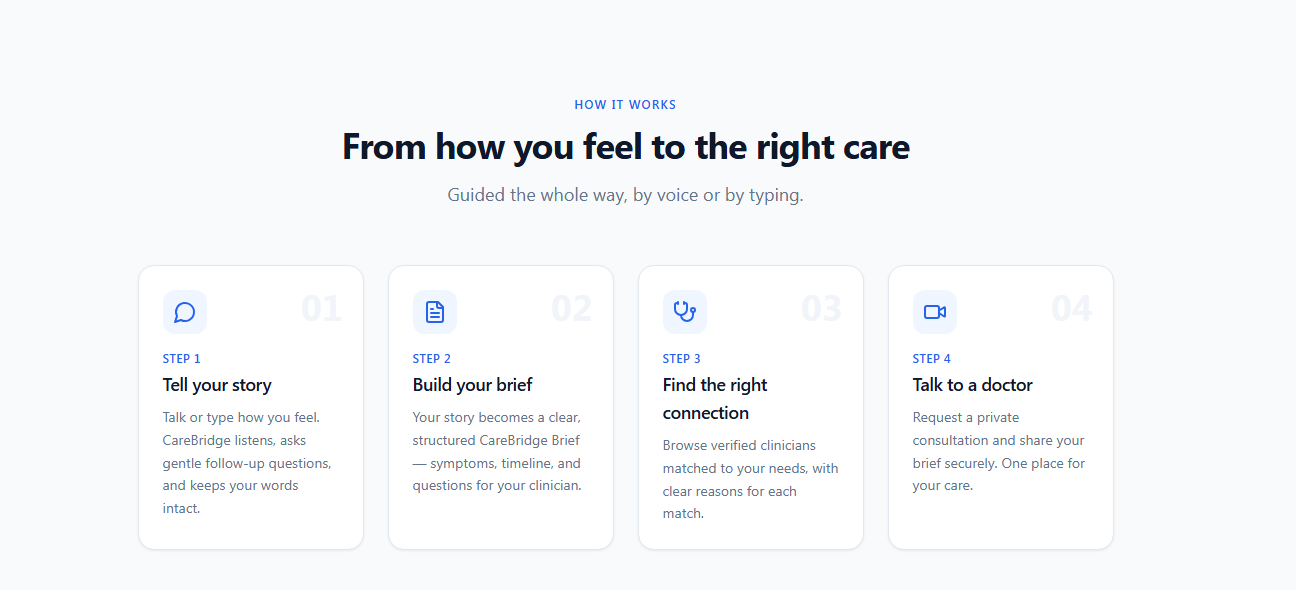
Patient story → structured brief → informed doctor discovery → shared context → consultation.
We designed every stage around reducing friction while keeping the patient in control of what information is shared.
What's next
Future versions could add richer clinician workflows, real-time communication, integrations with healthcare systems, stronger multilingual voice support, accessibility improvements, analytics for care teams, and additional safeguards for responsible AI use.
CareBridge's goal is not to replace the doctor.
It is to help the patient arrive at the right conversation better prepared.
Built With
- fastapi
- groq
- openai
- postgresql
- python
- react
- react-hook-form
- speech-recognition
- supabase
- supabase-auth
- tailwind-css
- tanstack-query
- text-to-speech
- typescript
- vite
- web-speech-api
- zod

Log in or sign up for Devpost to join the conversation.