-
-
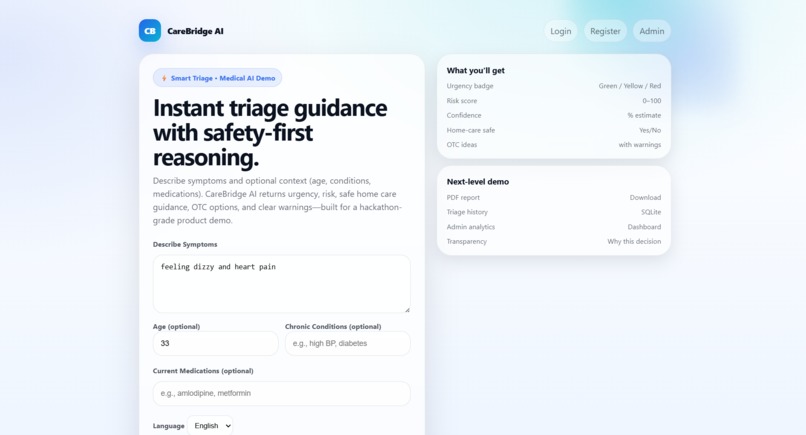
CareBridge AI
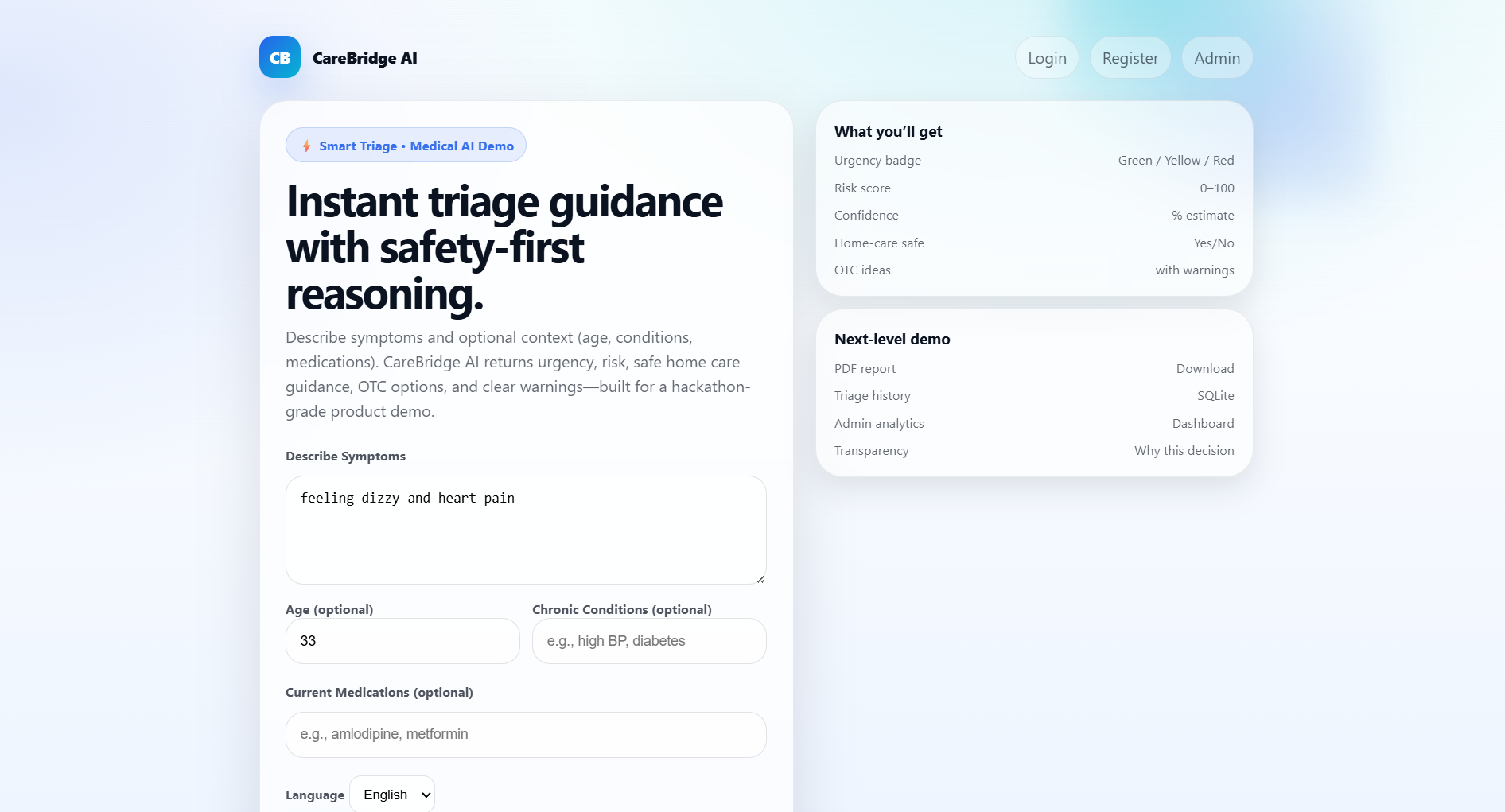
Inspiration
Healthcare triage is one of the most critical yet inconsistent parts of patient care. Many people either ignore serious symptoms or overwhelm emergency departments with non-urgent cases. We were inspired by a simple but powerful question:
What if anyone could access structured, intelligent medical triage guidance instantly?
CareBridge AI was created to bridge the gap between symptom uncertainty and safe, informed decision-making. We wanted to build a system that doesn’t just generate text — but provides structured risk analysis, emergency detection, and explainable reasoning
What it does
What it does
CareBridge AI is an AI-powered clinical triage assistant that: Analyzes user-reported symptoms Detects emergency red flags instantly Assigns urgency levels (Green / Yellow / Red) Generates a risk score (0–100) Provides recommended next steps Suggests safe over-the-counter guidance (when appropriate) Warns about medication and condition conflicts Stores cases in a structured database Provides an admin dashboard with case analytics Generates downloadable PDF triage reports It transforms free-text symptoms into structured medical decision support.
How we built it
CareBridge AI was built using: Python (Flask) for backend API and routing OpenAI API for structured medical reasoning SQLite for case history storage Jinja2 for dynamic HTML rendering Chart.js for admin analytics visualization ReportLab for generating downloadable PDF reports HTML/CSS for responsive UI design System Flow: User submits symptoms via web form. System checks for predefined emergency red flags. If no immediate red flags: The OpenAI model processes structured input. Returns JSON containing: Urgency level Risk score Recommended actions Explanation Case is saved to the database. Results are displayed and optionally exported as PDF. Admin dashboard aggregates risk distribution and urgency data. We focused heavily on structured JSON output enforcement to ensure reliability and consistency.
Challenges we ran into
Ensuring the AI returned valid structured JSON consistently Handling edge cases where the model output formatting broke Designing a triage logic that balances caution without over-triggering emergencies Managing environment configuration and API key security Building clean routing without mismatches (form action vs. Flask endpoints) Making the admin analytics dynamic and visually clear One of the biggest technical challenges was building a reliable JSON extraction layer to handle unpredictable AI outputs.
Accomplishments that we're proud of
Built a fully working AI triage pipeline end-to-end Implemented emergency red flag detection logic Designed a risk scoring system (0–100) Created a clean admin dashboard with urgency distribution visualization Integrated PDF export functionality Structured output enforcement for safer AI responses Successfully deployed a working Flask-based decision support system Most importantly, we built something that prioritizes patient safety and explainability, not just AI text generation.
What we learned
Structured prompting dramatically improves reliability. Guardrails are essential in healthcare-related AI. Emergency detection logic must be rule-based + AI-assisted. AI systems require fallback logic for robustness. Clean backend architecture prevents routing chaos. User trust depends on clarity, not complexity. We also learned how important it is to combine: Deterministic safety rules Probabilistic AI reasoning Structured data persistence
What's next for CareBridge AI (MOST IMPORTAN)
CareBridge AI is just the beginning. Our long-term vision is to transform it from a smart triage assistant into a connected emergency response ecosystem. In the future, we plan to collaborate directly with licensed doctors, hospitals, and healthcare networks to create a real-time medical response bridge. When the system detects a critical emergency — for example, when the risk score reaches a “Red” threshold — CareBridge AI will: Automatically notify the appropriate specialist Route the case based on symptom category Trigger instant doctor alerts Enable immediate video or voice consultation For example: If a patient reports severe chest pain → the system will notify a cardiologist. If symptoms indicate a potential stroke → a neurologist will be alerted. If there is a suspected fracture → an orthopedic specialist will be contacted. If respiratory distress is detected → a pulmonary or emergency physician will be notified. Instead of simply telling users to “seek care,” CareBridge AI will actively connect them to the right care provider.
We envision: Real-time specialist matching Emergency priority queues One-click video consultation Direct hospital intake notifications AI-assisted pre-consult summaries for doctors This ensures that when it truly matters, patients are not left navigating emergencies alone. CareBridge AI could evolve into an intelligent healthcare routing layer — one that sits between patients and providers, reducing response time and saving lives.


Log in or sign up for Devpost to join the conversation.