Inspiration
In many urban communities, especially across historically underserved neighborhoods in Metro Atlanta essential civic aid already exists. Programs like LIHEAP utility relief, CDFI microloans, emergency food pantry mobile pantries and commercial lease retention grants are actively funded. Yet, they remain buried across fragmented municipal agency portals, dense 40-page PDF guidelines and expired websites.
Residents and neighborhood small business owners face severe information friction, cognitive fatigue, and confusing eligibility requirements. When an entrepreneur is trying to keep a corner grocery open or a single parent needs urgent heating assistance, generic search engines and hallucinating chatbots either invent false deadlines or lead to dead ends.
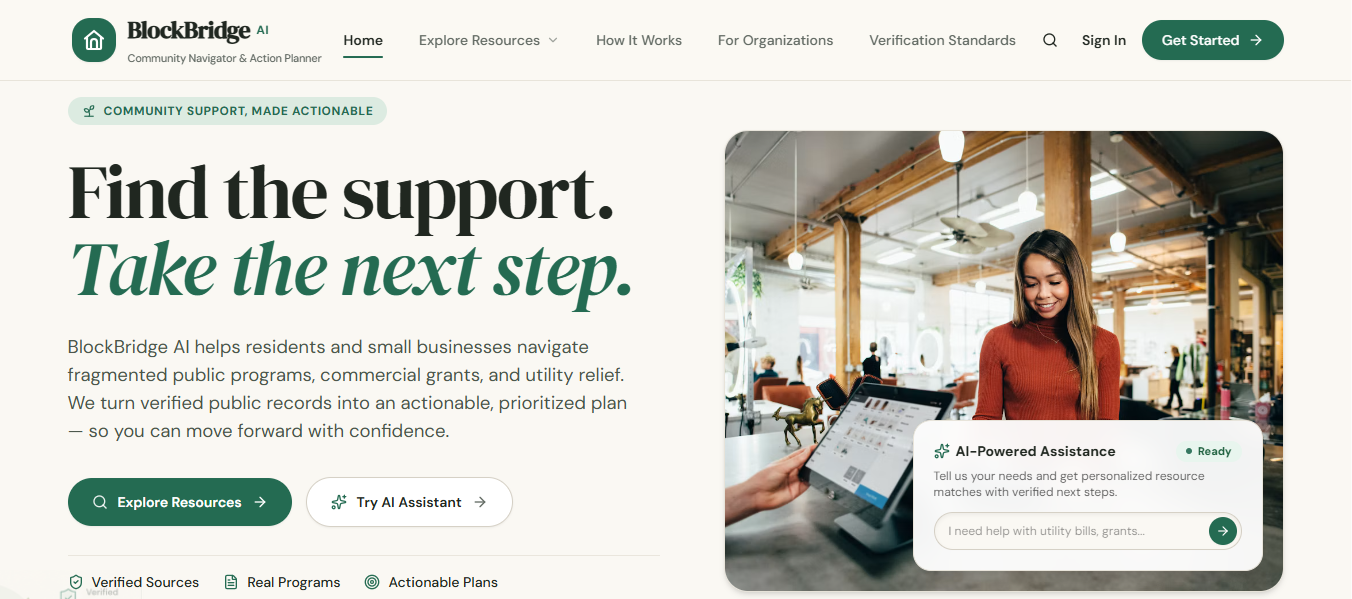
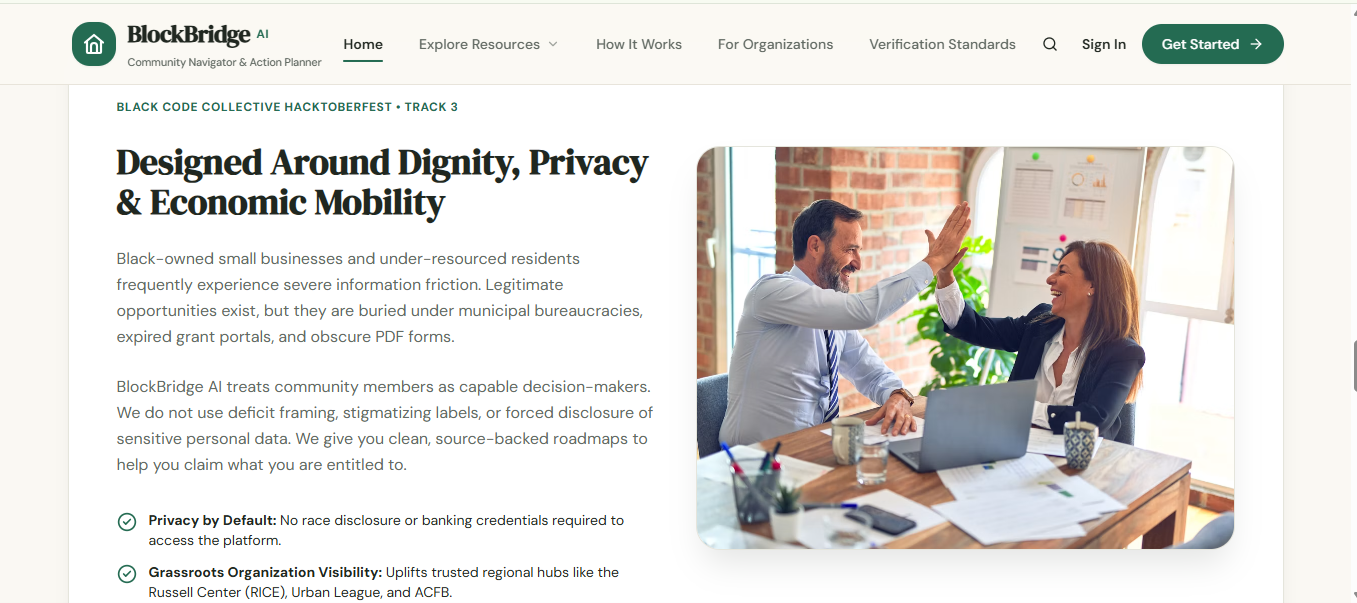
We built BlockBridge AI to replace this fragmentation with clear, verified navigation, transparent eligibility criteria, and structured follow-through roadmaps. Our mission was to build a dignified civic companion that respects users' time, provides authentic source-grounded answers, and ensures no community member has to navigate public support alone or in the dark.
What it does
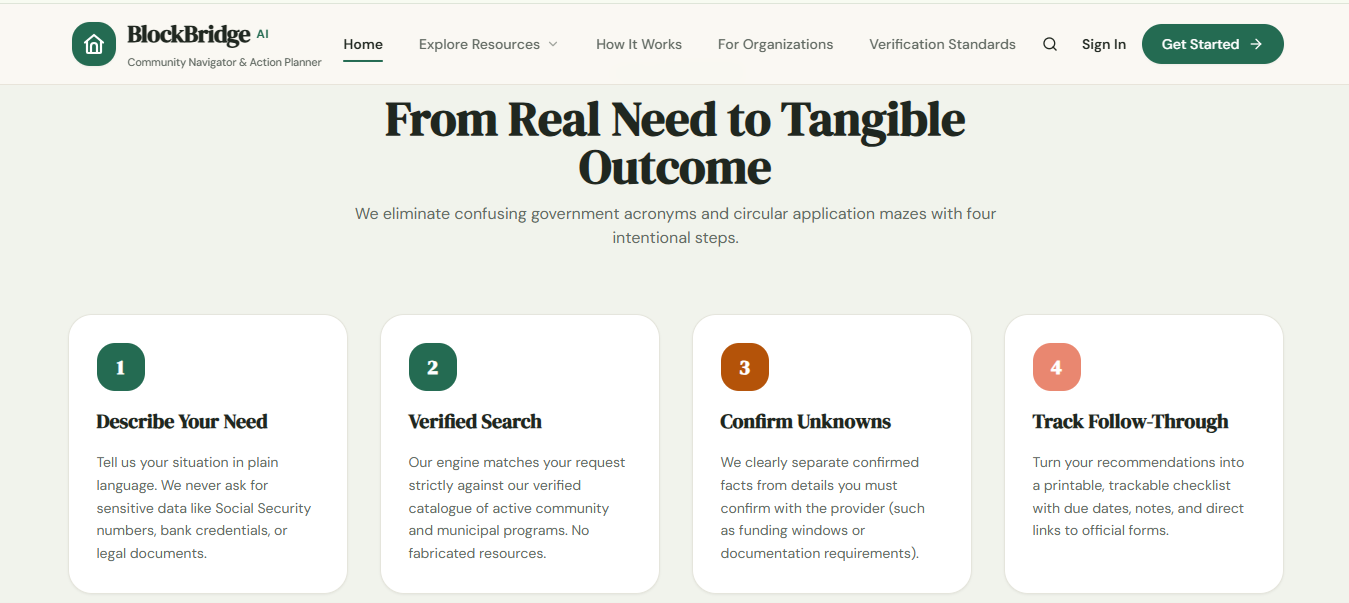
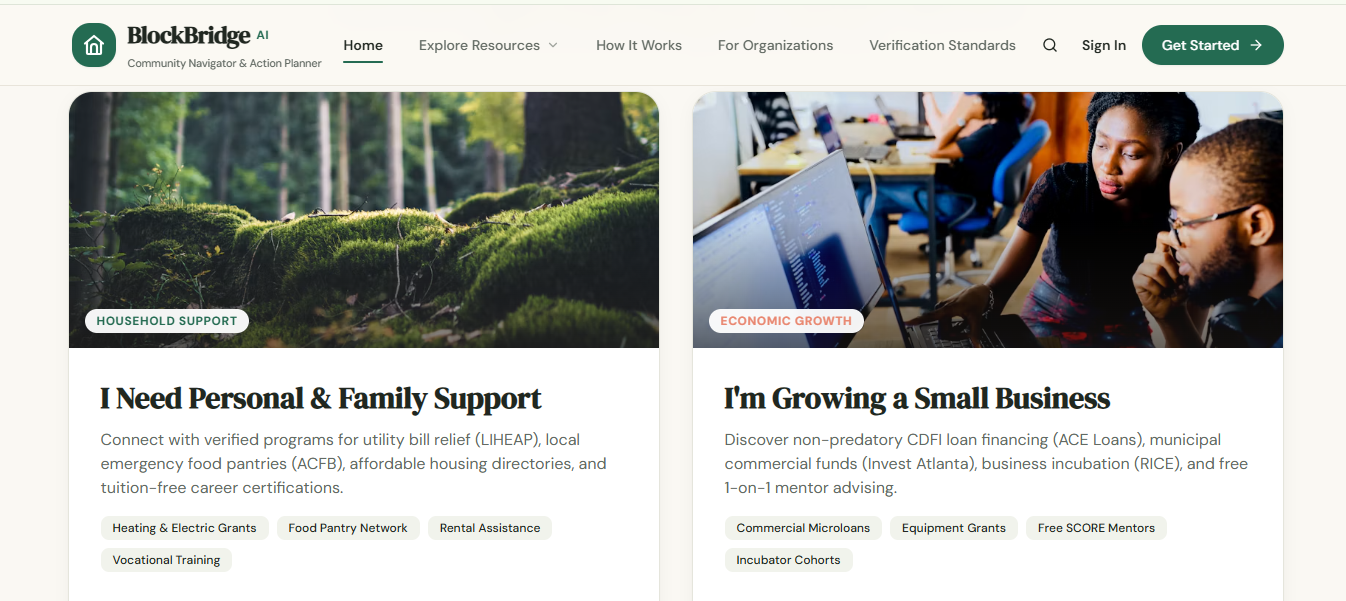
BlockBridge AI transforms unstructured community needs into concrete, actionable roadmaps through a source-verified civic pipeline:
- 🧭 Tailored Dual-Track Dashboards: Distinct, purpose-built workspaces for both Residents (scheduling utility relief deadlines, emergency food distribution dates, and housing voucher prerequisites) and Small Businesses (tracking capital readiness, commercial lease retention funds, and ( \$10\text{k} - \$40\text{k} ) microgrant milestones).
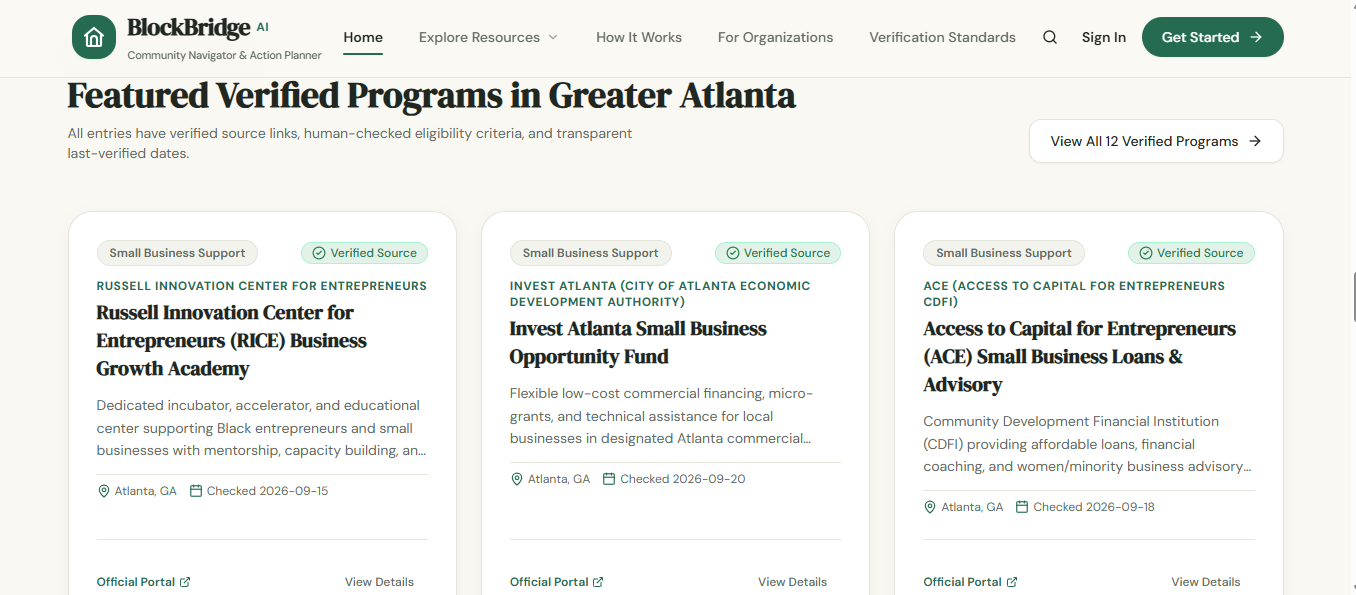
- ✨ Source-Grounded AI Resource Matching: Powered by Google Gemini 2.5 Flash and anchored strictly in a verified repository of authentic regional programs from Invest Atlanta, Russell Innovation Center for Entrepreneurs (RICE), ACE CDFI, Georgia DHS (LIHEAP), and the Atlanta Community Food Bank.
- 🔍 Radical Eligibility Transparency: The AI never guesses or falsely guarantees approval. It explicitly separates "What We Know (From Official Sources)" from "Items to Confirm with the Provider" (e.g., confirming active business registration with the City of Atlanta or proof of income below ( \le 60\% ) Area Median Income).
- 📋 Dynamic Action Plan Roadmaps: Converts matched programs into interactive, step-by-step checklists with required prerequisite document lists, custom user notes, live progress tracking, and clean 1-click printable/PDF exports for taking to local community centers.
- 🤝 Community Partner Intake Portal: Allows local non-profits, faith-based organizations, and CDFIs to submit neighborhood programs directly with real contact emails and official verification links.
- 🛡️ Human-in-the-Loop Civic Reviewer Queue: A protected moderation seam where civic reviewers inspect partner submissions and community error reports against official URLs before listings are published to the public catalogue.
- 👤 1-Click Judge & Reviewer Personas: Integrated with Supabase Auth for persistent sessions and 1-click test personas (Resident, Small Business Owner, Partner, and Civic Reviewer) for rapid evaluation.
How we built it
BlockBridge AI was engineered as a robust, production-ready civic platform:
- Frontend Architecture: Developed with React 18, TypeScript, and Vite, styled with Tailwind CSS using a custom civic editorial design system (Warm Ivory
#FAF8F3, Deep Charcoal#202720, Forest Green#246B52, and Soft Sage#DCEBE1) with typography powered by DM Serif Display and DM Sans, animated with accessible transitions. - Backend API Service: A high-performance FastAPI (Python 3.11+) service with Pydantic runtime schemas, providing multi-stage recommendation orchestration, health probes (
/api/health), and strict CORS origin validation supporting Vercel deployments. - Database & Persistence: Production persistence is powered by Supabase PostgreSQL with active Row-Level Security (RLS) across 8 public tables (
profiles,resources,saved_resources,action_plans,plan_steps,partner_submissions,resource_reports,audit_logs). A local SQLite engine (apps/api/blockbridge.db) serves as an offline deterministic test double for automated test runs. - AI Provider & Pipeline: Integrated with Google Gemini 2.5 Flash (
gemini-2.5-flash) via REST with strict catalog grounding, coupled with a zero-downtime deterministic fallback engine to guarantee reliable recommendations even during network outages. - Testing & Security Gates: Verified with automated test suites:
pytestverifying backend CRUD, search, matching, and admin route authorization, alongside end-to-end integration scripts testing Supabase GoTrue authentication and RLS tenant isolation.
Challenges we ran into
- Eliminating Hallucinations in Civic Assistance: Public program requirements (deadlines, geographic boundaries, income thresholds) are strict. We designed structured prompts and validation filters that prevent the AI from generating speculative rules, forcing it to cite authentic public program records and flag ambiguous requirements as items to confirm.
- Preventing PostgreSQL RLS Recursion: While securing the Civic Reviewer queue, initial role check queries on user profiles caused infinite policy recursion. We resolved this by implementing a PostgreSQL
SECURITY DEFINERfunction (is_admin()), allowing safe role checks without compromising user isolation. - Designing for Dignity Over Bureaucracy: Many government portals feel sterile, intimidating, and punitive. We deliberately crafted an editorial aesthetic inspired by community broadsheets—warm background tones, serif headings, human-centric photography, and zero corporate tech clichés.
Accomplishments that we're proud of
- Authentic Atlanta Community Data: Seeded with 12 authentic, source-verified programs across Metro Atlanta and Georgia with real portal links, income thresholds, and contact information.
- 100% Automated Test Pass Rate: 9/9
pytestunit tests pass cleanly, and remote Supabase E2E live database tests pass across all operational journeys (authentication, role-based access, AI matching, checklist persistence, and moderation). - True Tenant Isolation: Complete Row-Level Security ensuring residents, business owners, and partners can only view and mutate their own saved resources and action plans.
- Accessible Print & Export View: Generating clean, high-contrast print/PDF action checklists so residents without continuous smartphone access can bring a physical copy to agency meetings.
What we learned
- The Role of AI as an Organizer, Not an Authority: Generative AI creates the greatest civic value when it acts as an intake interpreter, translator, and organizer—never as an authoritative gatekeeper of public benefits.
- Designing for Information Scarcity: Community tech must be resilient: multi-tier caching, deterministic offline fallbacks, and low-bandwidth optimizations make platforms dependable when community members need them most.
What's next for BlockBridge AI
- Multi-City Regional Federation: Expanding our verified civic catalogue schema beyond Metro Atlanta to other urban centers including Detroit, Baltimore, Chicago, and Philadelphia.
- Multilingual Localization: Adding native Spanish, Amharic, and Vietnamese localized intake interfaces for multicultural urban neighborhoods.
- SMS Checklist Progress: Integrating Twilio SMS text alerts so residents receive milestone reminders and deadline notices directly on feature phones without requiring continuous broadband internet.
Built With
- ai
- css3
- fastapi
- git
- google-gemini
- html5
- llm
- postgresql
- pydantic
- pytest
- python
- react
- render
- rest-api
- row-level-security
- supabase
- tailwindcss
- typescript
- uvicorn
- vercel
- vite


Log in or sign up for Devpost to join the conversation.