-
-
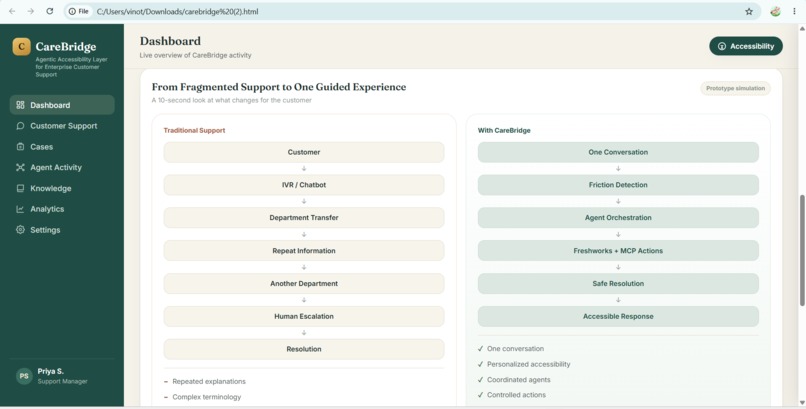
CAREBRIDGE DASHBOARD
-
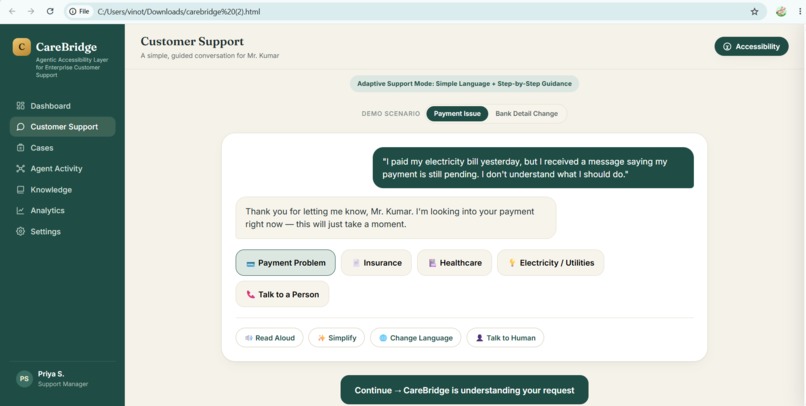
CUSTOMER SUPPORT
-
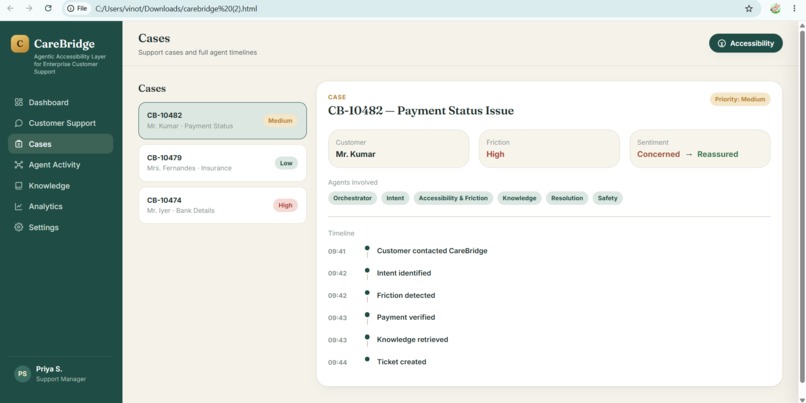
FRICTION DETECTION
-
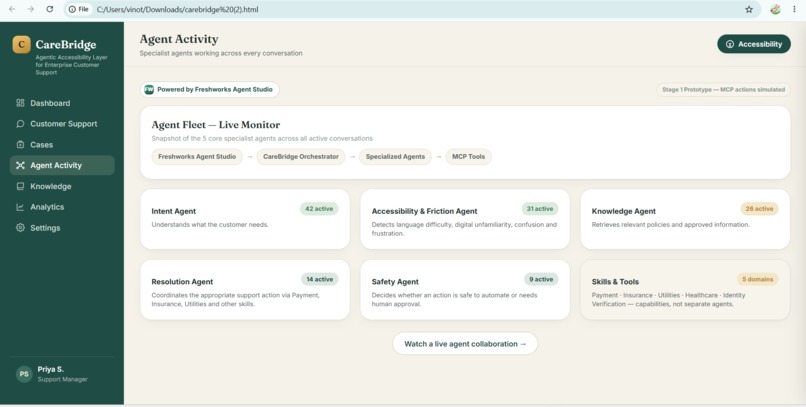
AGENT ACTIVITY
-
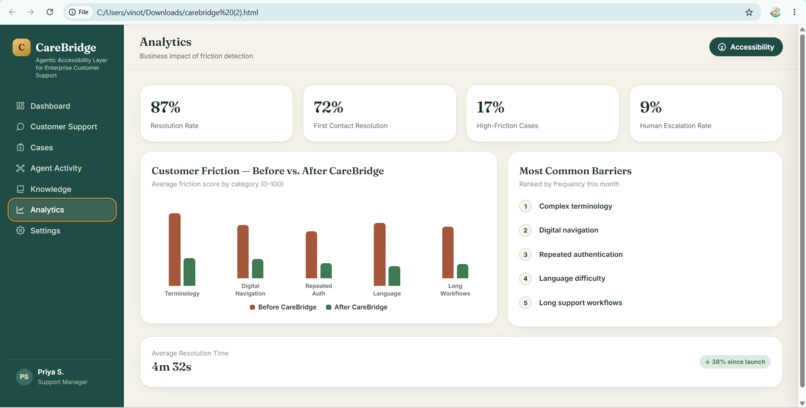
ANALYTICS
-
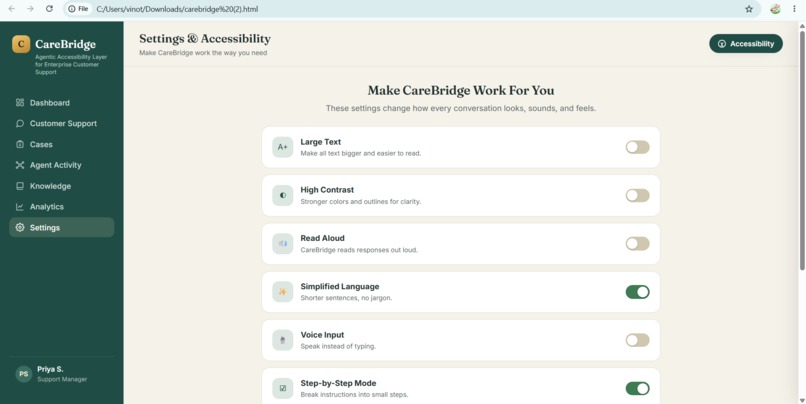
SETTINGS
The Problem
Customer support is becoming increasingly digital, but the experience is not equally accessible to everyone.
For many senior citizens, a simple support request can become a frustrating journey involving complex terminology, unfamiliar digital interfaces, repeated explanations, multiple departments, and uncertainty about what action to take.
The problem is not only that the system may fail to understand the customer.
It is that the system often fails to understand what is preventing the customer from getting help.
We wanted to solve that gap.
Our Solution — CareBridge
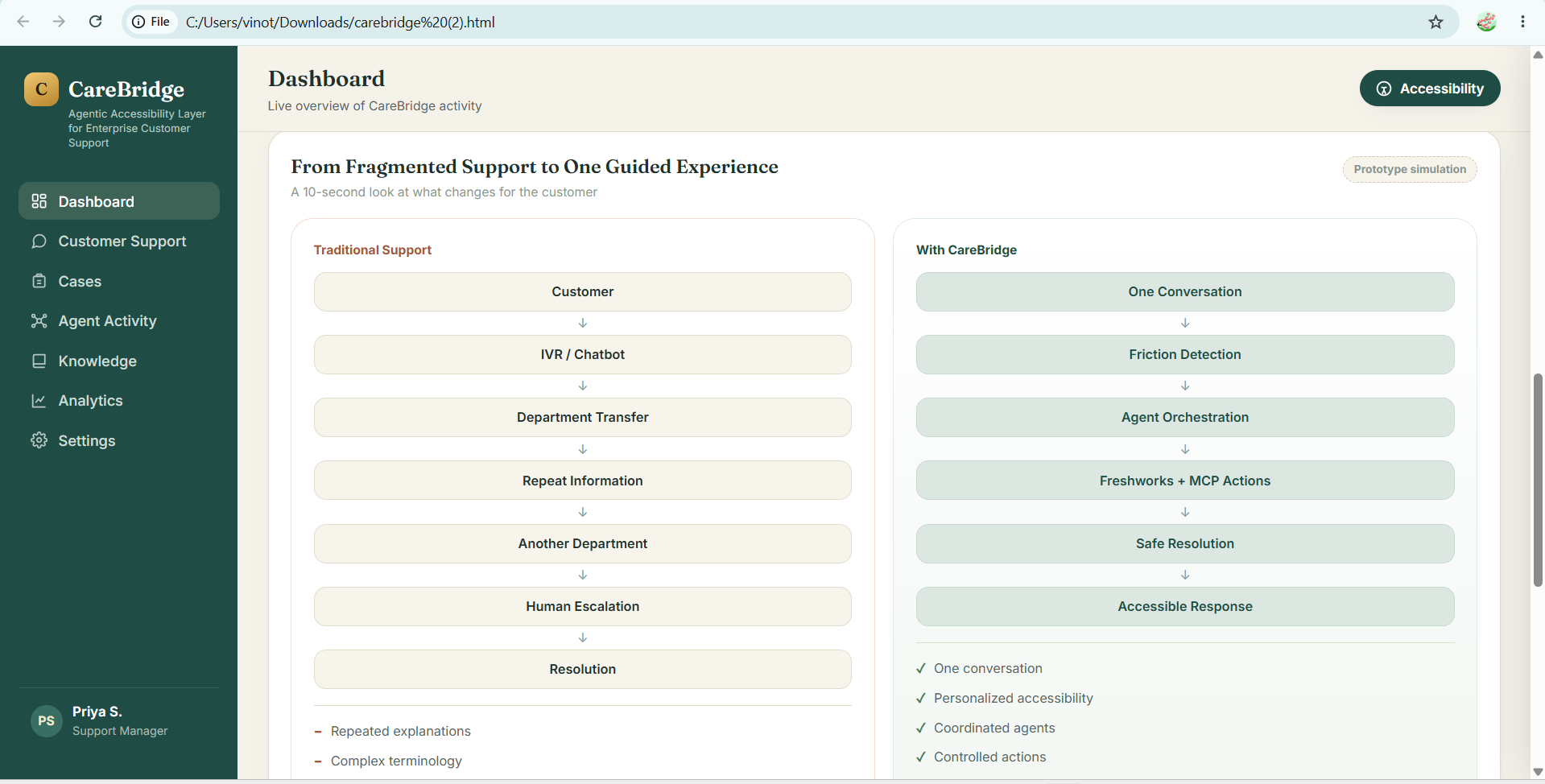
CareBridge is an agentic accessibility layer for enterprise customer support that helps senior citizens navigate complex service interactions through friction detection, multi-agent orchestration, MCP-connected enterprise tools, and safe human escalation.
Instead of forcing customers to understand how an organization is structured, CareBridge coordinates the complexity behind a single, simple conversation.
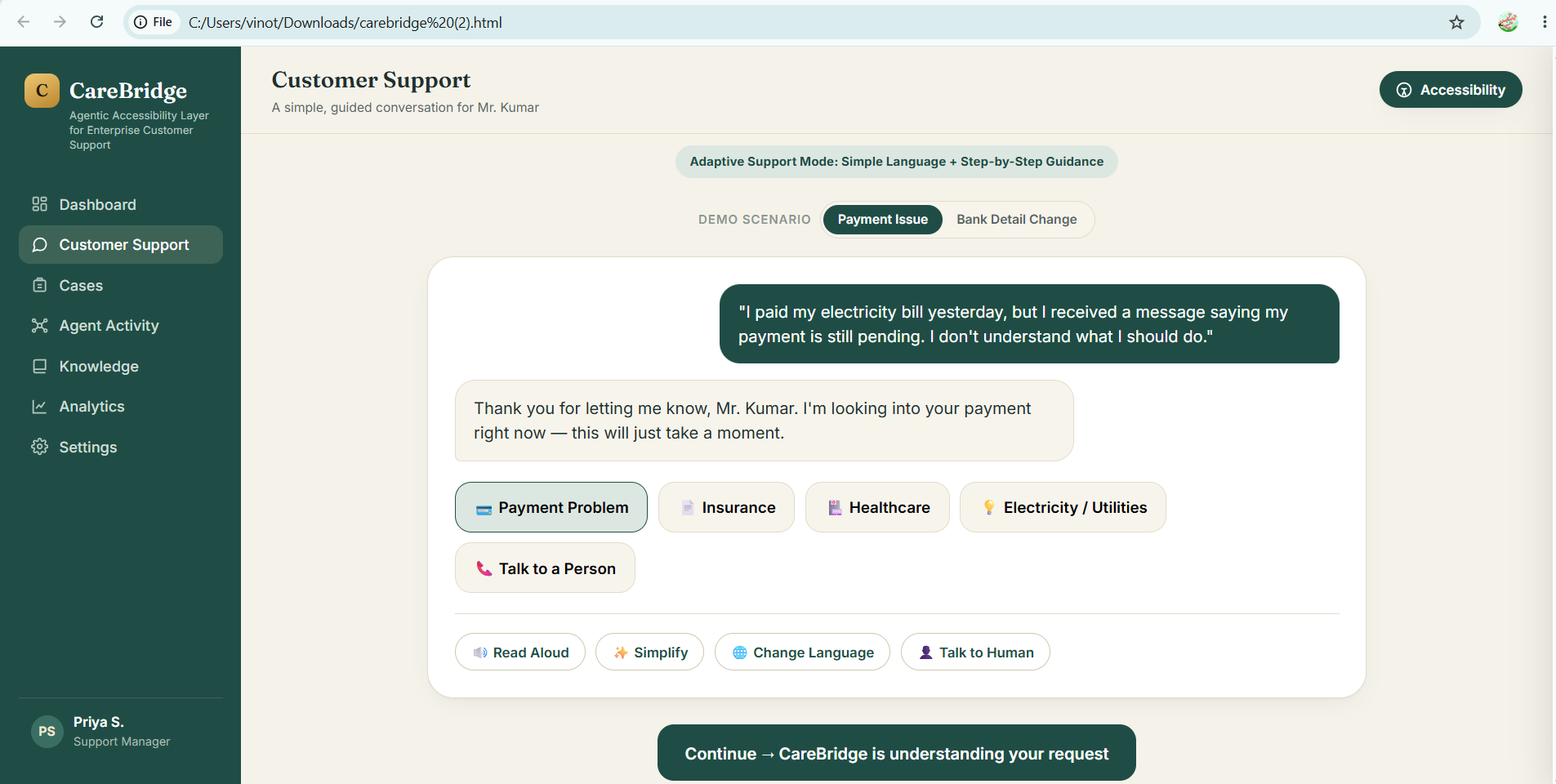
A customer can explain their problem naturally. CareBridge identifies the intent, detects communication and accessibility friction, adapts the experience, coordinates specialized agents, retrieves the required information, and performs controlled support actions.
The customer sees one simple experience.
Behind the scenes, multiple specialized agents work together.
What Makes CareBridge Different?
Traditional AI support mainly asks:
"What does the customer want?"
CareBridge asks two questions:
"What does the customer need?"
and
"What is preventing the customer from getting help?"
Our Friction Detection layer identifies barriers such as:
- Technical terminology
- Digital unfamiliarity
- Customer uncertainty
- Communication difficulties
- Need for simplified, step-by-step guidance
The system then adapts the support experience accordingly.
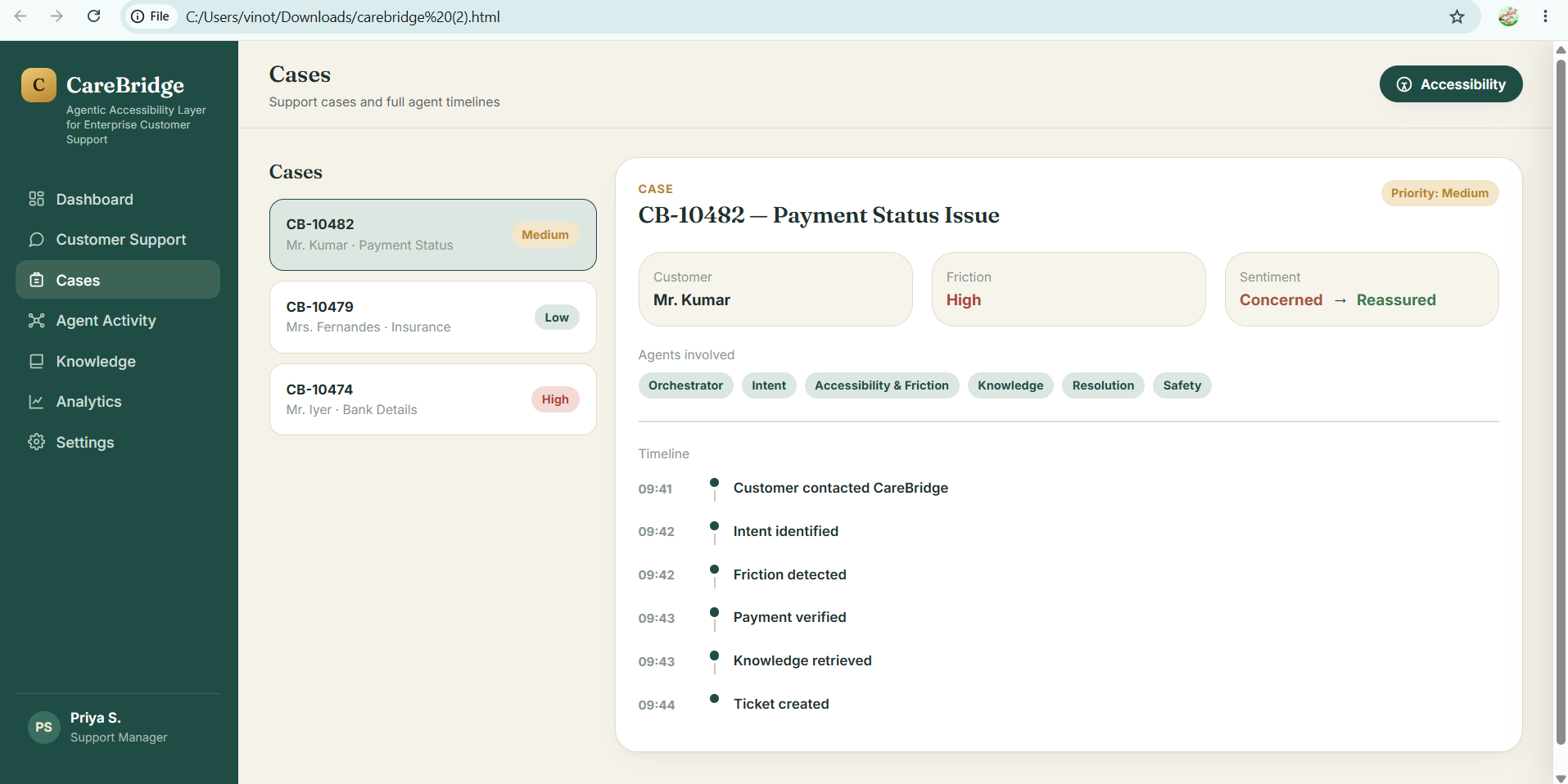
For example, when a customer reports that a utility payment was deducted but the account still shows "pending", CareBridge can identify the issue, activate an appropriate accessibility mode, coordinate the required agents, retrieve the payment and policy information, and create a support case.
The customer receives a simple explanation instead of being transferred between departments.
Multi-Agent Architecture
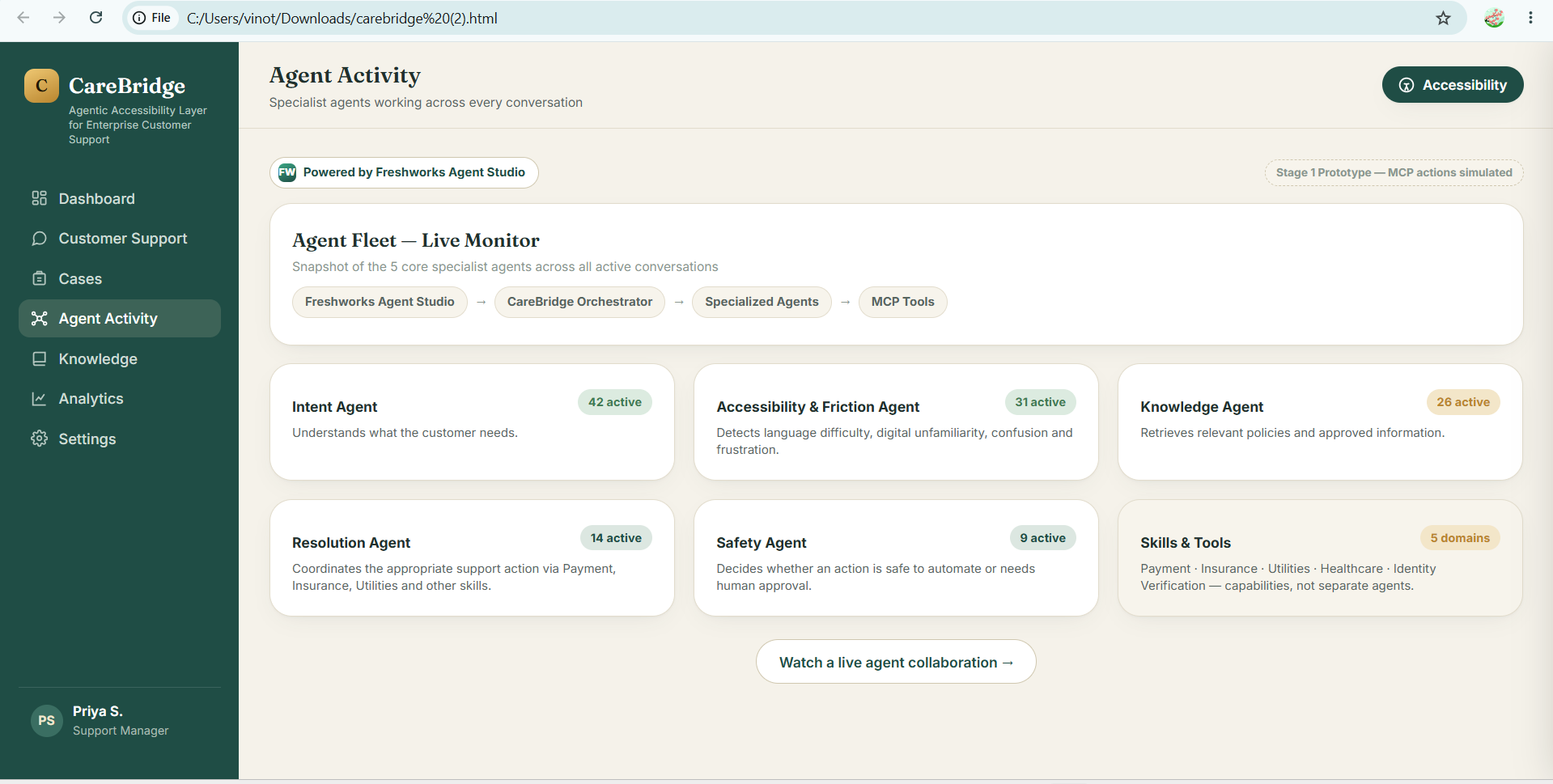
CareBridge uses a central Orchestrator Agent with specialized agents for different responsibilities:
- Intent Agent — understands what the customer needs.
- Accessibility & Friction Agent — identifies barriers that make the support journey difficult.
- Knowledge Agent — retrieves relevant and approved information.
- Resolution Agent — coordinates the appropriate support action.
- Safety Agent — determines whether an action can be performed automatically or requires human approval.
The orchestration layer is designed around Freshworks Agent Studio, while MCP provides a controlled interface between agents and enterprise capabilities.
MCP-Powered Enterprise Actions
CareBridge demonstrates MCP-based interactions with:
- Customer information
- Payment information
- Knowledge resources
- Freshworks support cases
For example, after verifying a payment-status issue, the system can create a support ticket through the demonstrated Freshworks MCP workflow.
The current Stage 1 prototype uses simulated MCP actions and does not claim a live Freshworks account connection.
Safe AI, Not Blind Automation
CareBridge is designed around a simple principle:
CareBridge automates assistance, not trust.
Low-risk activities such as retrieving information or creating a support ticket can be handled automatically.
Sensitive actions require additional verification and human involvement.
For example, if a customer asks to change bank account details, the Safety Agent identifies the request as high-risk and CareBridge stops autonomous execution and escalates it to a human support specialist.
This creates a human-in-the-loop boundary for agentic AI.
How We Built It
For the Stage 1 prototype, we focused on building a complete end-to-end experience rather than attempting to implement every possible enterprise integration.
The prototype contains:
- An accessible customer support interface
- Customer friction detection
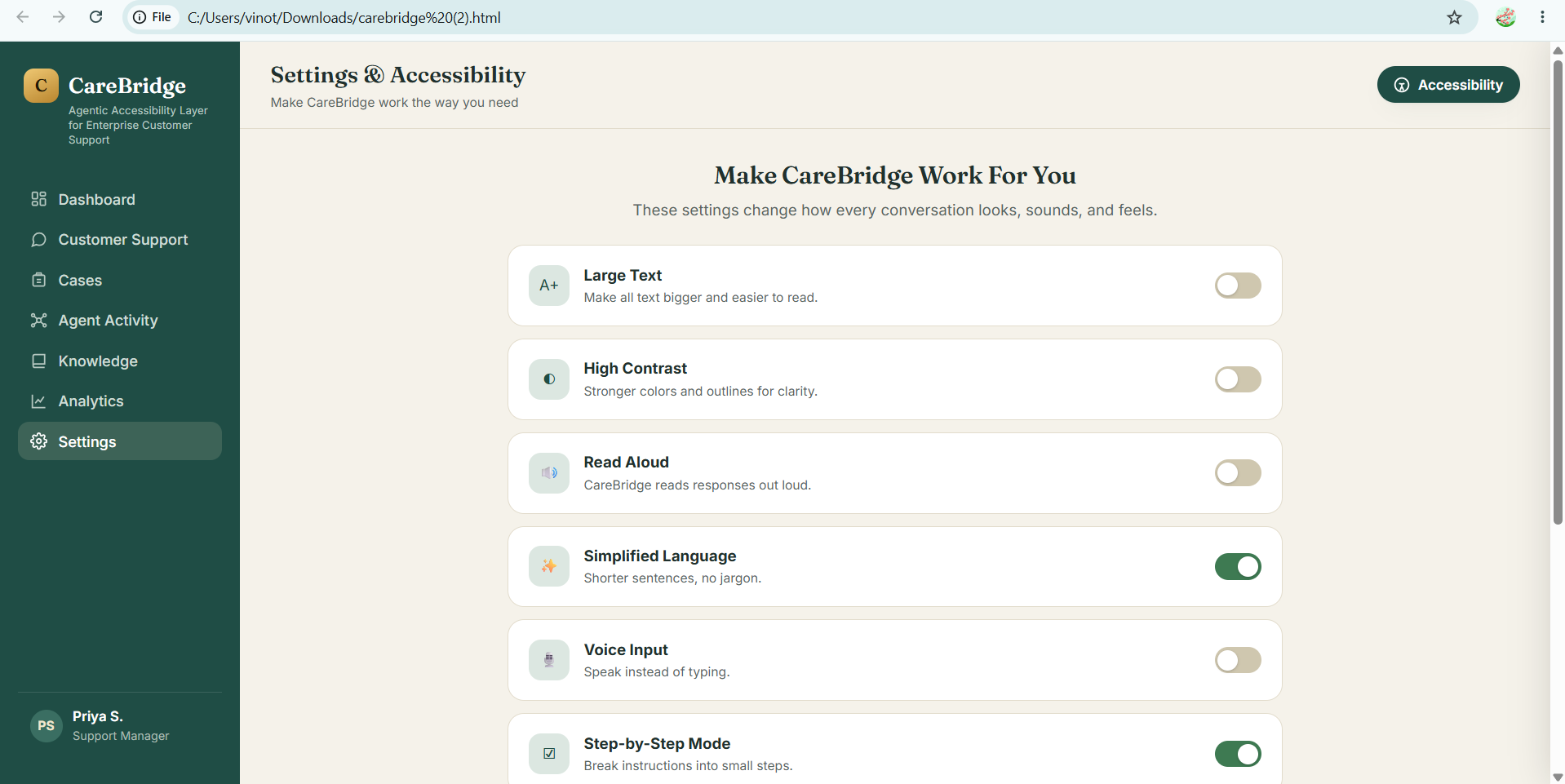
- Adaptive support modes
- Multi-agent orchestration visualization
- MCP tool activity
- Controlled action execution
- Human escalation for high-risk requests
- Case management
- Knowledge resources
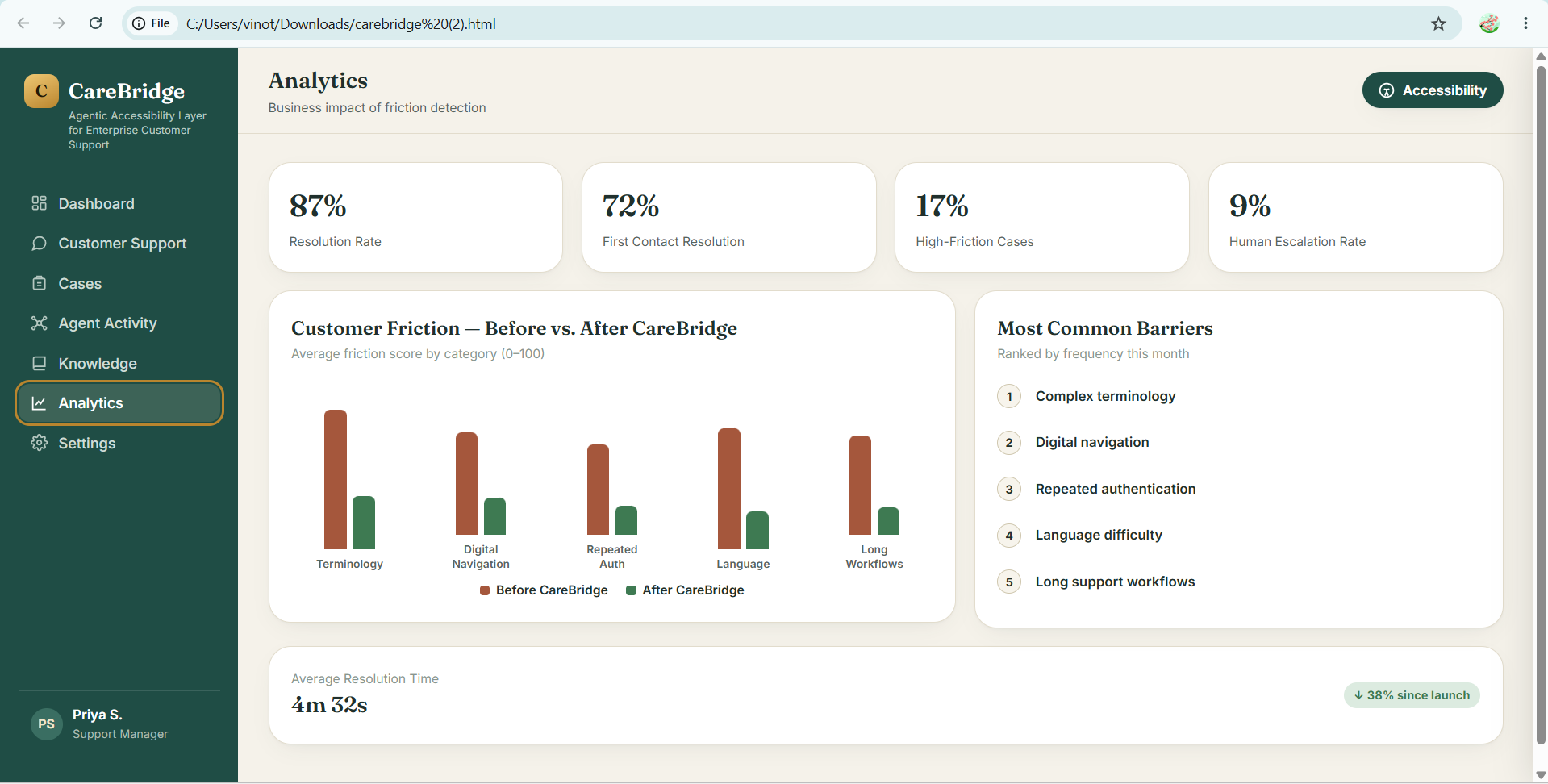
- Accessibility controls and analytics
The primary demonstration follows:
Customer Request → Friction Detection → Agent Collaboration → MCP Actions → Resolution
A second scenario demonstrates:
Sensitive Request → Risk Detection → Human Approval → Escalation
What Inspired Us
We were inspired by a simple observation:
Technology should reduce the effort required to get help, not make people learn how an organization works.
A customer should not need to understand which department owns a problem, which terminology to use, or which workflow to follow.
They should simply be able to explain what happened.
CareBridge is our attempt to make enterprise support more human-centered by putting the complexity behind the scenes and keeping the experience simple in front of the customer.
What We Learned
Building CareBridge helped us think beyond the idea of a single AI assistant.
We learned that effective agentic systems need:
- Clear separation of agent responsibilities
- Controlled tool access
- Human-in-the-loop boundaries
- Context-aware communication
- Accessibility as part of the workflow rather than an afterthought
- A clear distinction between information retrieval and actions
Most importantly, we learned that the goal of an AI support system should not simply be to produce a better answer.
It should be to create a better path to resolution.
Challenges
One of our main challenges was balancing automation with safety.
An agent that can perform actions autonomously can improve efficiency, but sensitive customer operations should not be treated like ordinary requests.
We therefore designed a risk-aware workflow where CareBridge can stop, request verification, and involve a human whenever the requested action crosses a defined safety boundary.
Another challenge was avoiding the design of yet another generic customer-support chatbot.
We addressed this by making Friction Detection and Adaptive Support the central product capability rather than treating accessibility as a simple translation feature.
Our Vision
CareBridge starts with senior citizens, but the underlying idea can extend to anyone who experiences friction when interacting with digital enterprise services.
Our vision is:
One conversation. Multiple specialized agents. Safer, more accessible customer support.
CareBridge aims to make enterprise support systems adapt to people — instead of making people adapt to enterprise systems.
Built With
- accessibility
- agent
- agentic
- agents
- ai
- css
- customer
- enterprise
- experience
- freshworks
- html
- human-in-the-loop
- javascript
- knowledge
- mcp
- multi-agent
- orchestration
- studio
- support

Log in or sign up for Devpost to join the conversation.