-
-
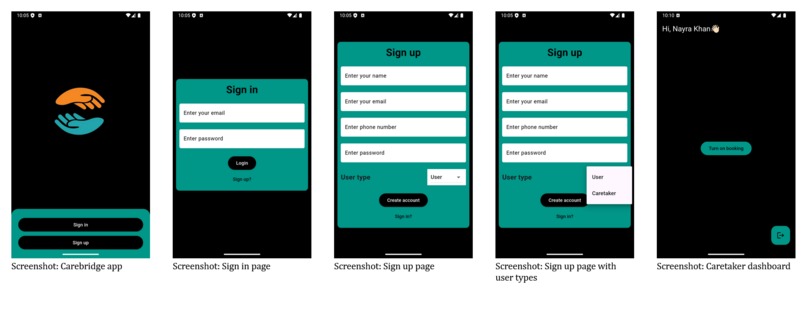
Index page, registration and sign up
-
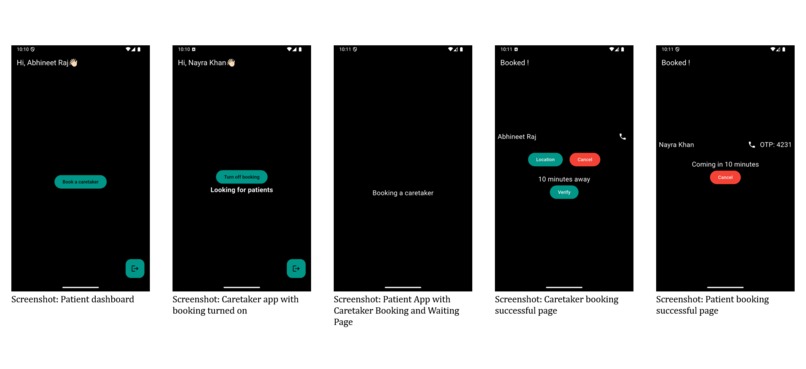
Booking & Cancellation
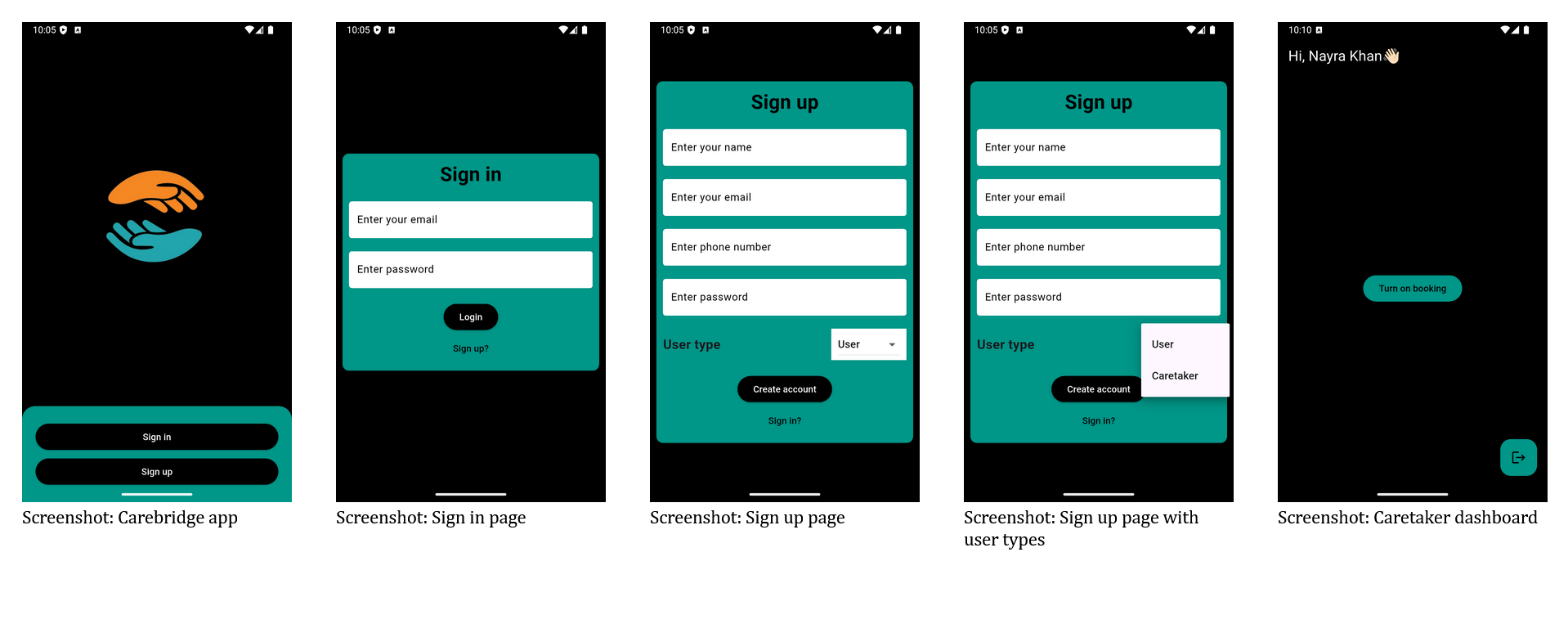
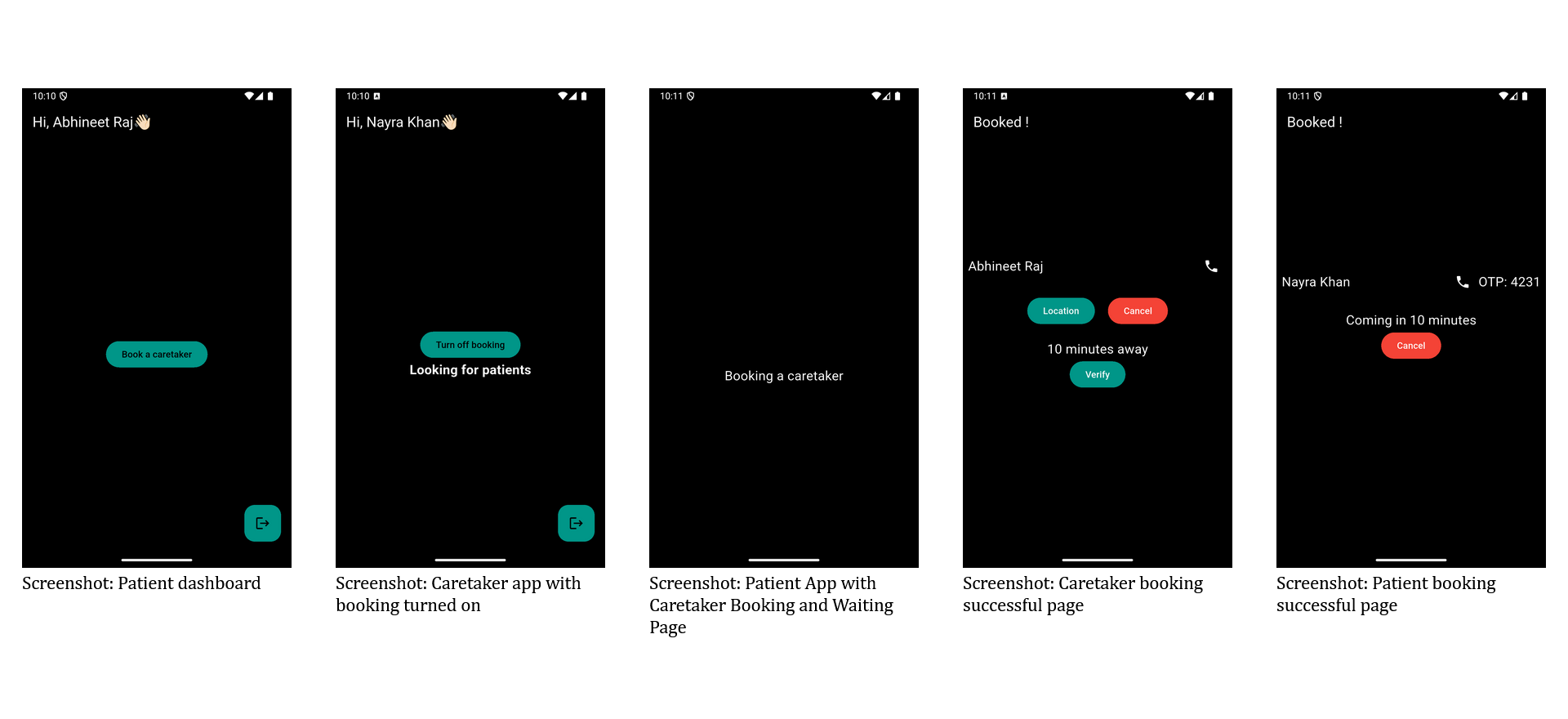
Elevator Pitch for Carebridge
In today’s world, the elderly often struggle with limited access to timely and reliable caregiving services. Caretakers face challenges in managing their availability and reaching the right patients, while patients find it difficult to connect with suitable caretakers, especially in remote or underserved areas. This creates inefficiencies and gaps in care that are critical for an aging population.
Carebridge is a mobile application designed to bridge this gap, efficiently connecting caretakers with elderly patients. Carebridge allows caretakers to manage their availability, enabling them to receive bookings when free. Patients can easily search for nearby caretakers and book their services with just a few taps, ensuring that caregiving services are available when needed. The app ensures a smooth and reliable user experience by facilitating real-time communication and secure OTP verification.
Aligned with Sustainable Development Goal 17 (Partnerships for the Goals), Carebridge fosters collaboration between healthcare providers, technology developers, and caretakers. By creating a seamless ecosystem for elderly care, Carebridge helps improve global healthcare outcomes. The platform enhances the efficiency of caregiving resources and expands access to quality care for elderly patients, promoting a partnership-driven approach that strengthens the delivery of healthcare services across the world.
Carebridge is more than just an app; it’s a movement toward accessible, efficient, and compassionate care, empowering both patients and caretakers to collaborate for better health outcomes.
Inspiration
The inspiration behind Carebridge stems from witnessing firsthand the challenges elderly individuals and their families face in accessing reliable and timely caregiving services. As the global elderly population continues to grow, it became apparent that current caregiving systems were not equipped to meet the increasing demand for quality care. Many elderly patients struggle to find appropriate caretakers, especially in rural or underserved areas, while caretakers face challenges managing their availability, leading to inefficiencies. This inspired the creation of Carebridge—a platform that not only connects patients with caretakers but also makes the caregiving process more efficient, accessible, and secure.
What it Does
Carebridge is a mobile platform that connects elderly patients with available caretakers in their area. It enables caretakers to sign up, set their availability, and receive bookings for caregiving sessions. Patients can easily search for nearby caretakers and book services based on proximity and availability. The platform also allows real-time distance tracking, ensuring both patients and caretakers know how far apart they are. Furthermore, Carebridge uses OTP (One-Time Password) verification to ensure that both parties feel secure about the caregiving process, preventing fraudulent activities and ensuring trust.
Through Carebridge, elderly patients can get access to timely caregiving services, while caretakers are better able to manage their schedules, leading to more efficient care delivery. The app's simplicity and ease of use make it a valuable tool for both patients and caretakers, especially in areas where caregiving resources are limited.
How I Built It
I built Carebridge using Flutter, a powerful framework for cross-platform mobile app development. This allows Carebridge to run on both Android and iOS with a single codebase. The backend of the app is powered by MongoDB, which stores the user profiles, caretaker availability, and booking data. I utilized Node.js to build the API that connects the mobile application to the database, ensuring smooth data flow and real-time updates.
The core features, including caretaker availability management, patient search, and OTP verification, were implemented using standard mobile development practices and API integration. For the front-end, I focused on creating a clean and user-friendly interface to ensure that elderly patients could easily navigate the app and book caregiving services with minimal effort. The app also integrates secure communication protocols to ensure the privacy and security of user data.
Challenges I Ran Into
One of the primary challenges I faced was creating an intuitive user interface (UI) that caters to the elderly population, who may not be as familiar with technology. The app needed to be both simple and easy to use, with clear instructions and minimal steps required for booking services. This required extensive user testing and feedback to refine the design and ensure accessibility.
Additionally, ensuring real-time updates of caretaker availability and seamless communication between caretakers and patients required robust backend infrastructure. I faced challenges in optimizing the database to handle multiple simultaneous users without delays or errors, especially when the app was used at scale. These technical hurdles required a combination of continuous testing, optimization, and load-balancing techniques.
Accomplishments That I'm Proud Of
I’m particularly proud of the app’s ease of use and its ability to facilitate seamless caregiving experiences for elderly patients. Despite the challenges of designing for an older demographic, I was able to create an interface that is intuitive, user-friendly, and accessible. The integration of real-time availability tracking and OTP verification also adds layers of security and reliability, ensuring that patients and caretakers can trust the platform.
I’m also proud of Carebridge’s alignment with Sustainable Development Goal 17, as it fosters partnerships between healthcare providers, technology developers, and caretakers, strengthening the ecosystem of elderly care. This platform is designed to scale, which means it can grow to meet the increasing global demand for elderly care services.
What I Learned
Through this project, I learned valuable lessons in user-centered design, particularly when building for a demographic with specific needs, such as the elderly. I gained insights into how to make technology more accessible and how to structure an app that promotes ease of use without compromising on functionality. On the technical side, I learned about scalable backend architecture and how to handle real-time data, ensuring the app performs well under various load conditions.
I also gained a deeper understanding of how technology can solve real-world problems and create value, especially in sectors like healthcare, where small improvements can have a massive impact on people's lives.
What's Next for Carebridge
The next steps for Carebridge involve scaling the platform to reach more regions and expanding the network of caretakers. One of the key areas of development will be integrating AI-powered matching algorithms that will connect patients with the most suitable caretakers based on their specific needs, preferences, and medical conditions. This will improve the quality of care and enhance the overall user experience.
Additionally, I plan to expand the services offered on Carebridge, such as adding medical consultations, therapy services, and even virtual care options, which would help broaden the scope of elderly care and offer a more comprehensive healthcare solution.
Finally, I will continue to focus on improving the app’s security features to ensure that patient and caretaker data is handled with the utmost privacy and protection.

Log in or sign up for Devpost to join the conversation.