-
-

Context-aware symptom and care diagnosis platform
-
Built around a multi-agent AI framework

Inspiration
More than 100 million Americans don't have a primary care provider. When something feels wrong, many turn to Google or a symptom checker. However, without the guidance of a provider, self-diagnosis fails to identify the right condition up to two-thirds of the time.
This creates a serious and underrecognized risk. When people are left to interpret their own symptoms, critical conditions go undetected, especially among the most vulnerable. Chronic pain patients, postpartum mothers, older adults, low-income communities, trauma-exposed populations such as veterans, and caregivers all face higher chances that their symptoms will be attributed to the wrong cause.
These populations are failed by self-diagnosis because health conditions rarely exist in isolation. Physical symptoms overlap with emotional and situational factors in ways that change what those symptoms actually mean. Depression hides underneath chronic pain, affecting up to 40% of pain patients, and worsens physical outcomes when it goes untreated.
We were inspired by Just-in-Time Adaptive Interventions (JITAIs), a framework from behavioral health research that uses real-time data to deliver personalized support at the exact moment of need.
We built AnchorCare to bring that adaptive, context-aware approach to the provider gap Americans face, connecting symptom interpretation, multi-layered triage, provider matching, and real-time support into one natural conversation.
What it does
AnchorCare is a multi-agent AI system that takes a patient's symptom conversation and helps them get personalized suggestions on what to do next. Through a voice call or chat, a patient describes what's going on in their own words. AnchorCare asks follow-up questions and connects them to the right providers with a care summary personalized to what that specific person is experiencing.
For the more than 100 million Americans without a primary care provider, AnchorCare is designed to fill the gap that self-diagnosis currently cannot. It detects multiple layers simultaneously: the physical symptom, the emotional context around it, the situational factors that change what that symptom means, and the behavioral signals that suggest someone needs immediate support.
How we built it
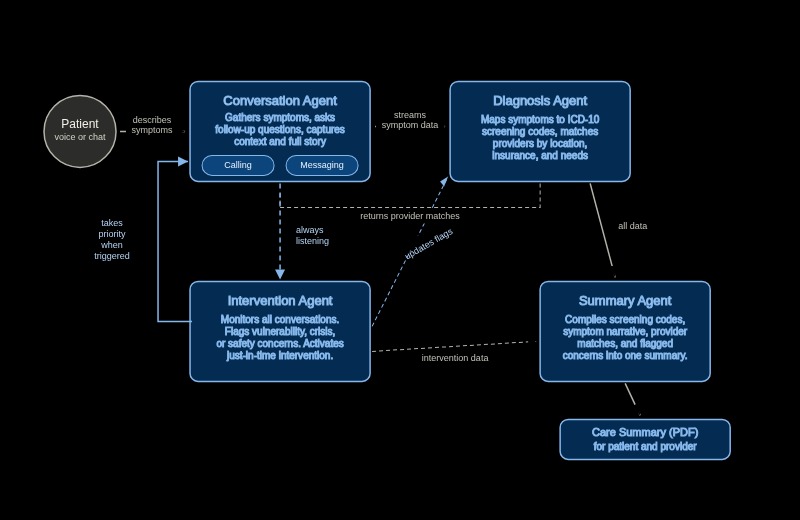
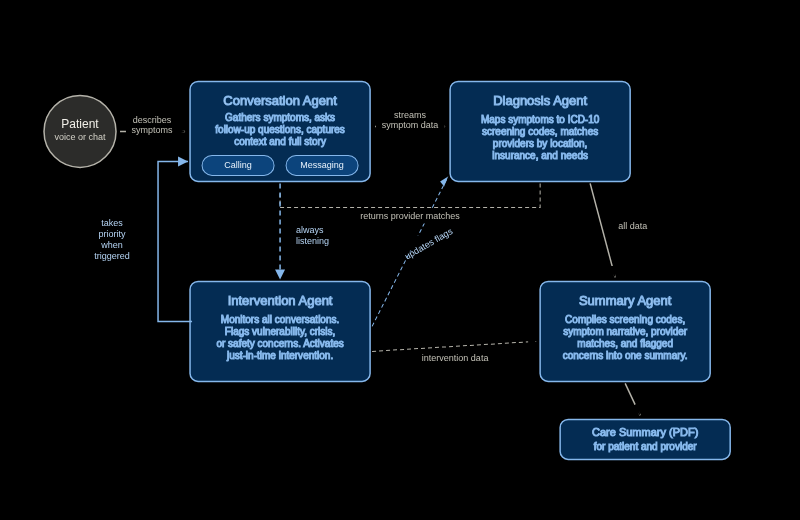
We built AnchorCare using a multi-agent architecture in Jaseci. Three agents work together to make this possible:
- Conversation Agent handles the dialogue through two subtypes: the Calling Agent for voice and the Messaging Agent for chat. It gathers symptoms and asks follow-up questions that surface the details a symptom checker would never capture.
- Diagnosis Agent maps what it hears to screening codes and matches providers by location, insurance, and the specific combination of needs identified.
- Intervention Agent runs in parallel, continuously monitoring every conversation as a just-in-time adaptive layer, sensing for flags that indicate a state of vulnerability. When triggered, it activates with targeted screening questions, relevant resources and hotlines, and updates its provider recommendations to reflect the full picture.
- Summary Agent compiles everything into a structured clinical summary the patient can bring to their appointment.
Challenges we ran into
One of the biggest challenges was getting our product to accurately flag context. When a user says "my partner pushed me but it's not a big deal" or "I'm going to fix this headache by bashing my head into a wall," the system can't take those statements at face value. It needs to recognize that the first is a potential domestic violence situation being minimized, and the second is a potential safety concern disguised as a casual remark.
In other words, getting the Intervention Agent to accurately flag these moments and activate the just-in-time intervention, without over-triggering on benign language or under-triggering on real concerns, was our biggest challenge.
Accomplishments that we're proud of
We are proud that AnchorCare is able to understand symptoms in context. It listens to how someone describes what they're going through, picks up on the emotional and situational layers, and is able to adapt its response specific to different layers of the query. We think this could serve the world in a meaningful way, and are excited to submit it as part of the Social Impact track for the hackathon.
What's next for AnchorCare
Near term, we plan to integrate real provider databases and insurance verification, improve the symptom-to-code pipeline with more nuanced pattern recognition, and add daily check-in functionality so users can track symptoms over time and bring that data to their provider. We also want to strengthen the personalization layer so returning users feel continuity across sessions rather than starting over each time.
Long term, we envision AnchorCare as a B2B care coordination layer for health systems, helping close the gap between what patients experience and what the clinical system captures. This includes clinician-facing tools where structured summaries flow into care workflows on products like MyChart.
Built With
- codex
- jascai
- opencode


Log in or sign up for Devpost to join the conversation.