Inspiration
Mental health is one of the most overlooked global crises of our time. Over 1 billion people worldwide live with a mental health condition, yet 75% never receive any treatment — due to stigma, cost, or simply not knowing where to turn. I've seen people around me struggle in silence, afraid to open up to anyone.
That's what inspired CareAI. I wanted to build something that felt less like a chatbot and more like a calm, caring presence — available at 3am when no one else is, free of judgment, and always there to listen. The idea wasn't to replace therapists, but to bridge the gap for the millions who can't or won't access traditional mental health support.
What it does
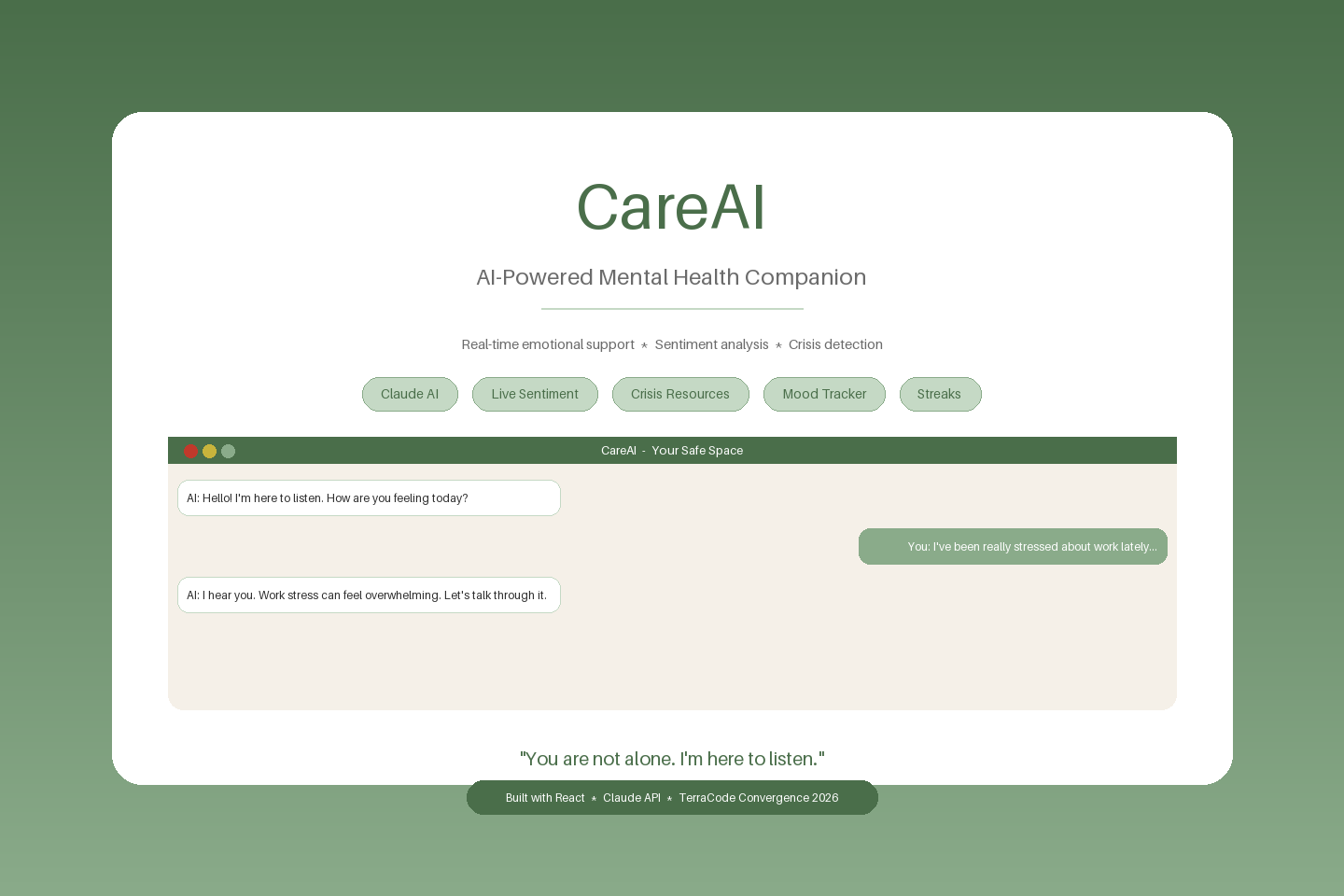
CareAI is an AI-powered mental health companion that provides real-time emotional support through empathetic conversation. Here's what it does:
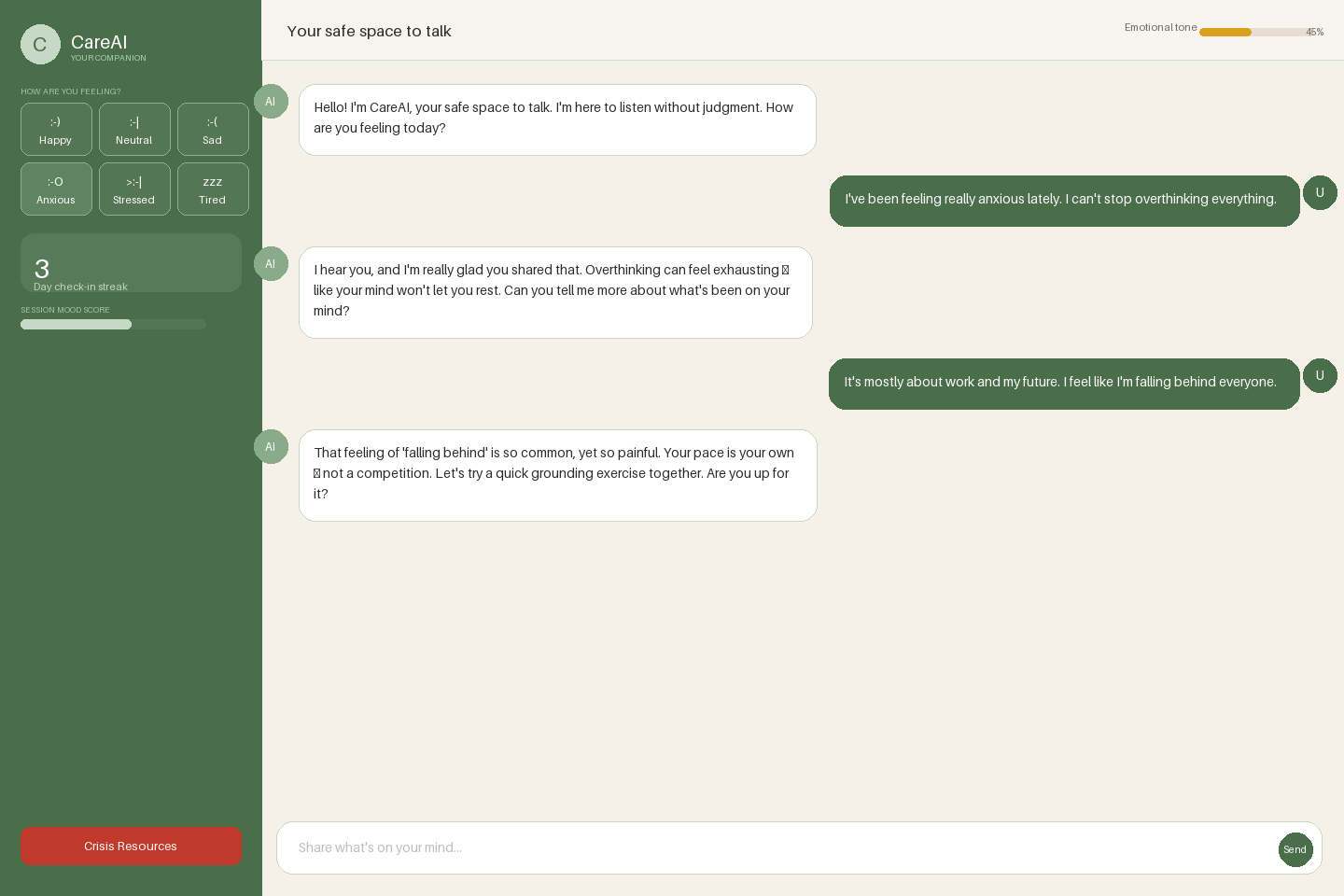
- Listens & responds with empathy — Powered by Claude (Anthropic), CareAI holds warm, human-feeling conversations tailored to mental wellness. It validates feelings, asks thoughtful follow-up questions, and suggests evidence-based coping techniques like breathing exercises and grounding methods.
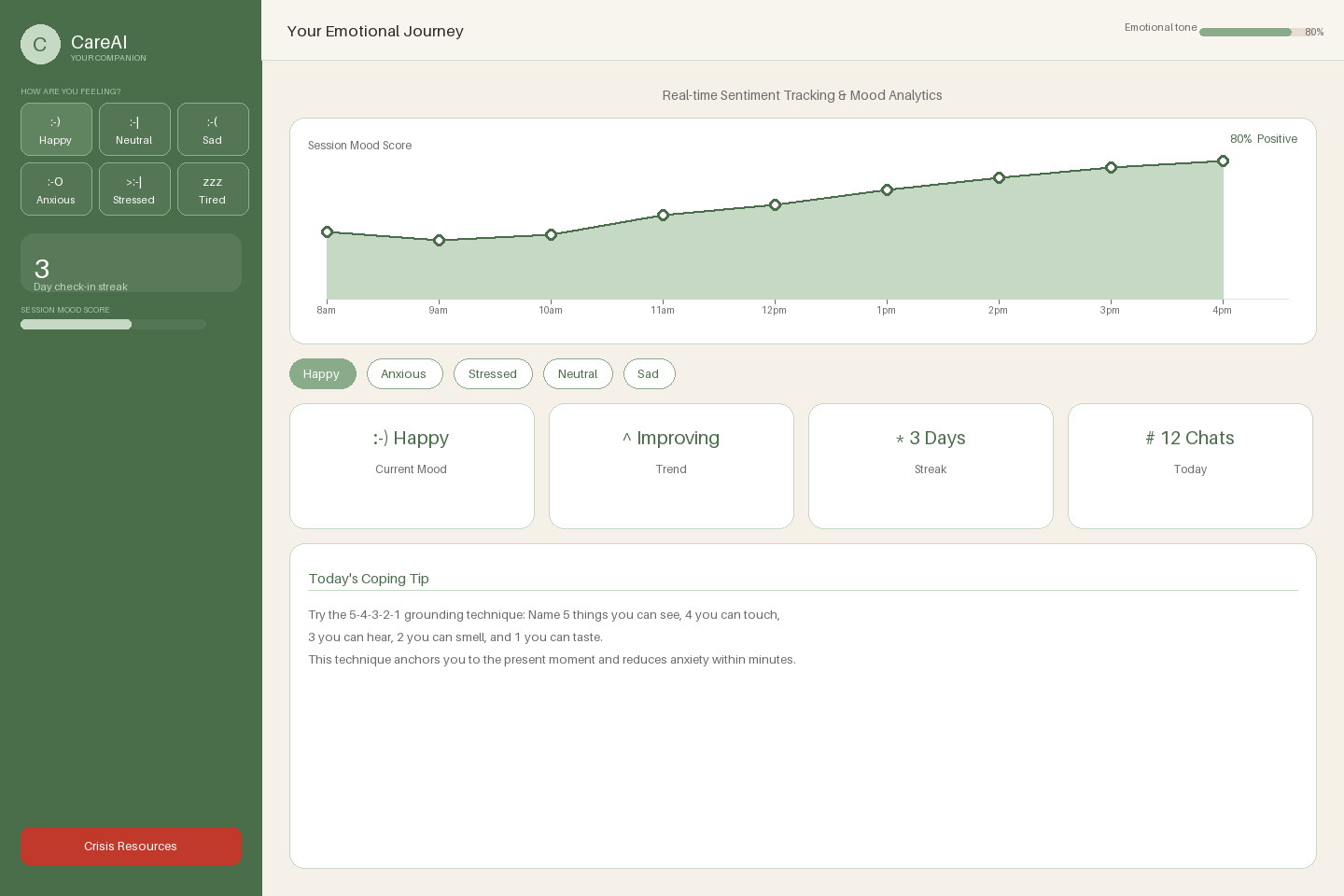
- Real-time sentiment analysis — Every message is analyzed for emotional tone. A live mood bar updates throughout the session, giving users a visual sense of their emotional arc.
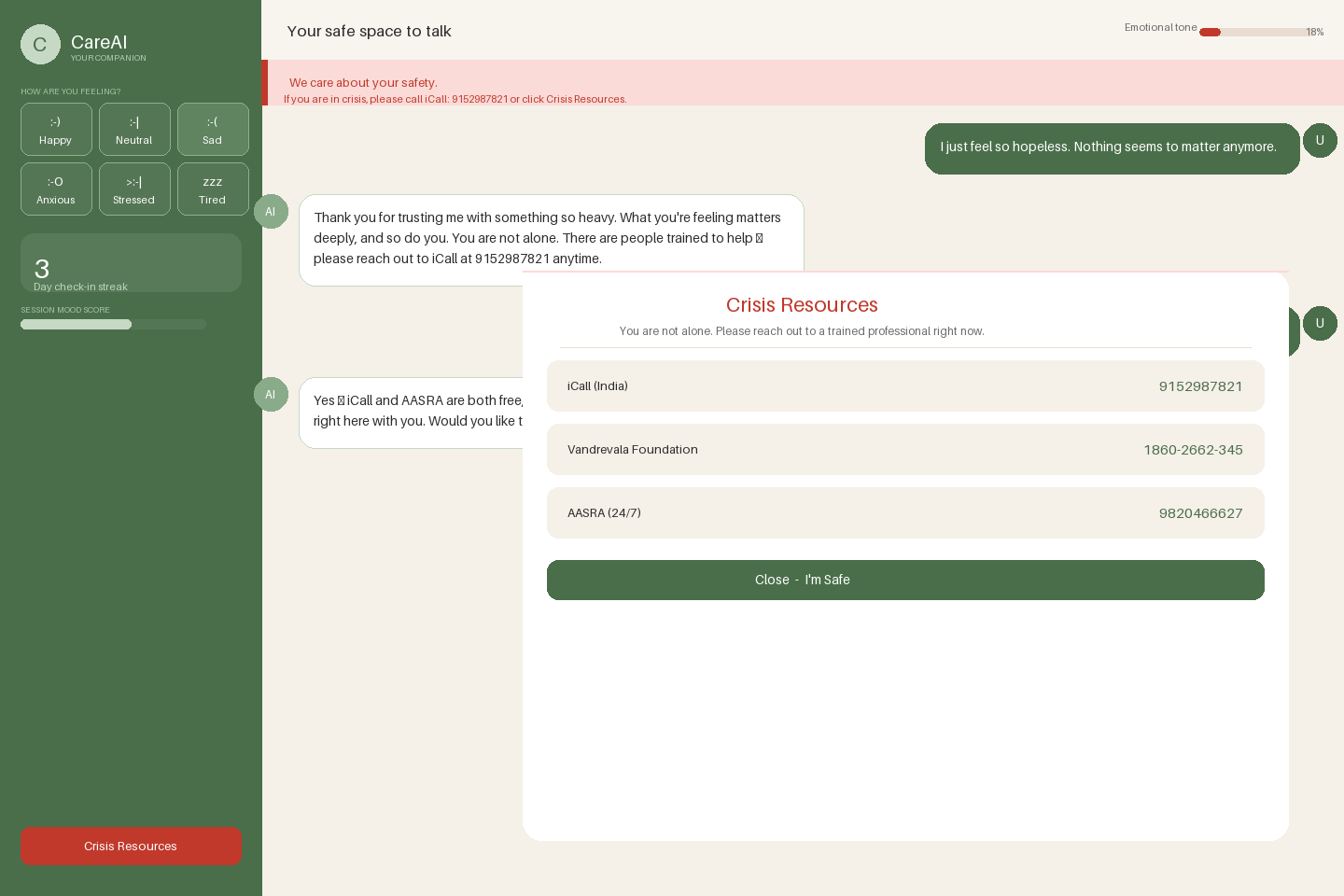
- Crisis detection — CareAI automatically detects distress-related keywords and instantly surfaces a warning banner with verified crisis helplines (iCall, AASRA, Vandrevala Foundation, and international lines).
- Mood check-in — A one-tap mood selector (Happy, Sad, Anxious, Stressed, Tired, Neutral) lets users log how they feel and kick off a tailored conversation instantly.
- Streak tracker — Encourages daily mental health check-ins by tracking how many days in a row a user has checked in — building a habit of self-awareness.
- Crisis Resources panel — A dedicated modal with Indian and international hotlines is always one click away.
How we built it
CareAI is built as a single-file React application — no complex build tools, no backend server required. Here's the tech breakdown:
- Frontend: React 18 (via CDN), custom CSS with CSS variables for a fully cohesive design system
- AI: Claude Sonnet API (Anthropic) with a specialized mental wellness system prompt that tunes the model to respond with empathy, never diagnose, and always surface professional help when needed
- Sentiment Analysis: Custom keyword-weighted scoring algorithm that updates a live mood score in real time based on the emotional content of each message
- Crisis Detection: Regex-based keyword matching on every user message, triggering an immediate UI alert and resource panel
- Design: Organic, calming aesthetic using Playfair Display (headings) and DM Sans (body) fonts, a sage green + warm cream palette, smooth CSS animations, and grain texture overlays
- Deployment: Static hosting via Netlify/Vercel — no backend needed
Challenges we ran into
- Balancing empathy with safety — Tuning the AI system prompt was harder than expected. Getting Claude to feel warm and human while consistently steering toward professional help (not playing therapist) required many iterations of prompt engineering.
- Crisis detection without false positives — Keywords like "hopeless" or "give up" can be used casually. Building a detection system sensitive enough to catch genuine distress without triggering unnecessarily took careful calibration.
- Single-file architecture — Keeping the entire app — React, CSS, logic, and AI integration — in one clean HTML file was a deliberate challenge for portability. Managing state, animations, and API calls without a bundler required disciplined code structure.
- Designing for emotional states — Unlike a productivity app, CareAI's users may be anxious, sad, or in crisis. Every design decision (color, font size, animation speed, button label) had to be intentional and calming — not stimulating.
Accomplishments that we're proud of
- Built a fully functional AI mental health companion in a single hackathon window — no placeholder screens, all features working live.
- Crisis detection works in real time — it correctly flags distress signals and surfaces resources immediately, which could genuinely help someone in a critical moment.
- The design feels distinctly human — multiple people who tested it said it didn't feel like a typical chatbot. That was the hardest thing to achieve and the thing we're most proud of.
- India-first crisis resources — most mental health tools default to US/UK hotlines. We made sure iCall, AASRA, and Vandrevala Foundation are front and center for Indian users.
- Achieved a working sentiment analysis system without any external NLP library — built entirely with a custom weighted keyword algorithm.
What we learned
- Prompt engineering is product design. The difference between a cold, robotic AI response and a warm, human-feeling one comes down almost entirely to how you structure the system prompt. This was the most valuable technical skill we sharpened.
- Mental health UX is a different discipline. Designing for vulnerable users taught us that every word, color, and animation carries weight. "Submit" feels harsh — "Share" feels safe. These distinctions matter enormously.
- Simplicity is powerful. A single HTML file that runs in any browser — no installs, no accounts, no friction — is often the most impactful version of a product. Accessibility starts at zero barriers to entry.
- AI can be a bridge, not a replacement. The most important lesson: CareAI works best when it points people toward human support, not away from it. Technology's role in mental health is to lower the first barrier — not to be the final answer.
What's next for CareAI
- Voice mode — Let users speak instead of type, making it even more accessible and natural, especially during moments of high distress
- Mood history & journaling — Persistent mood tracking over weeks and months so users can see emotional patterns and share them with a real therapist
- Personalized coping plans — Based on a user's recurring mood patterns, CareAI generates a custom daily wellness plan (breathing exercises, sleep tips, journaling prompts)
- Multilingual support — Hindi, Tamil, Bengali, and other Indian languages to reach users who aren't comfortable expressing emotions in English
- Therapist referral network — Partner with licensed mental health professionals so CareAI can make warm, informed referrals when a user is ready to take that step
- WhatsApp / Telegram integration — Meet users on platforms they already use daily, removing the barrier of downloading a new app ```
Built With
- claude-api-(anthropic)
- css3
- html5
- javascript
- react.js

Log in or sign up for Devpost to join the conversation.