Inspiration
Healthcare can be expensive, but the bigger problem is that patients often don't know what options they have to reduce that cost.
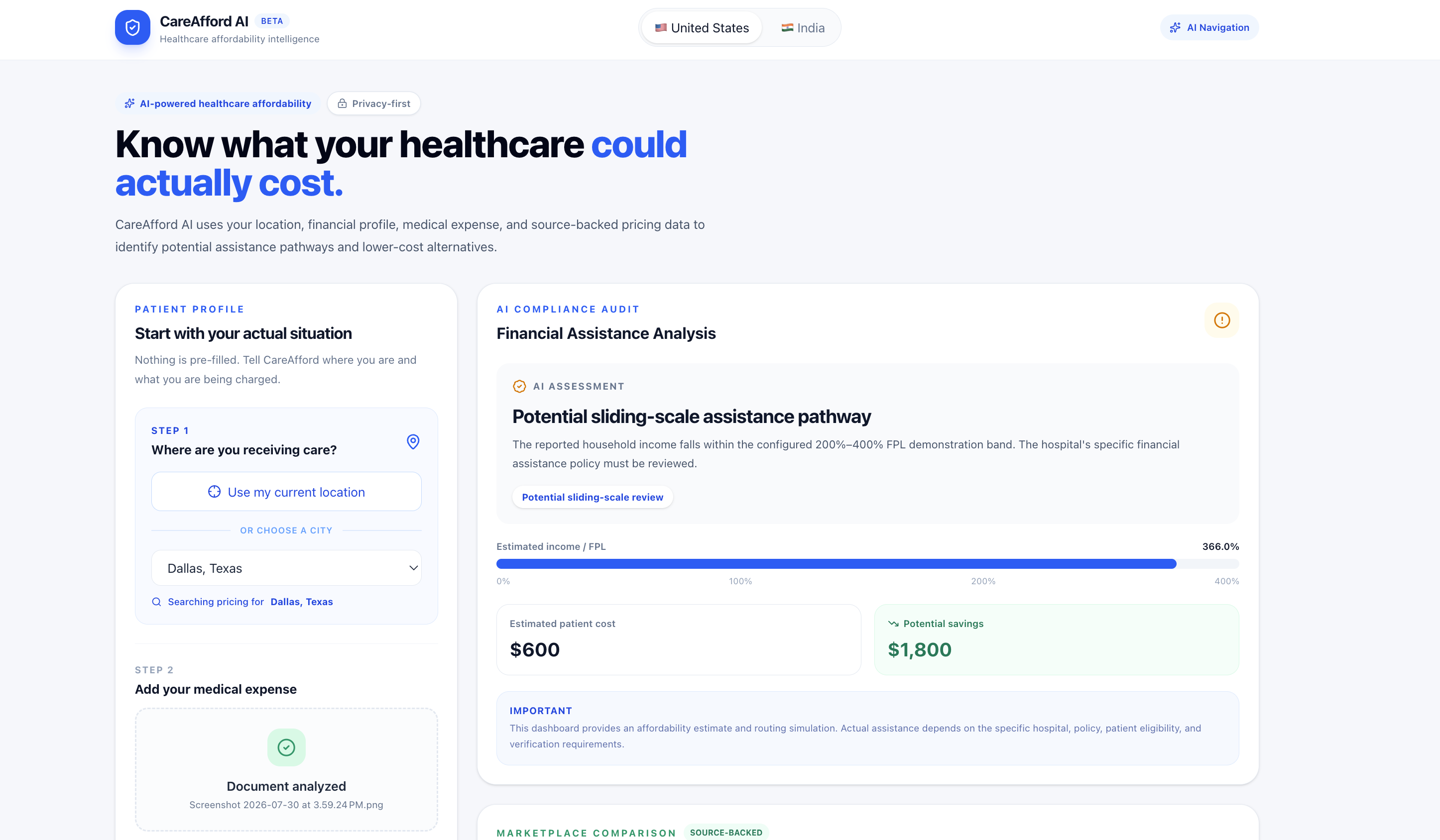
A patient may receive a large hospital estimate and immediately assume they have to pay the full amount. They may not know about financial-assistance programs, government healthcare schemes, or lower-cost providers nearby.
That inspired us to build CareAfford AI — a system that combines financial-assistance screening with healthcare price comparison and gives the patient a more affordable path to care.
What it does
Healthcare can be expensive, but the bigger problem is that patients often don't know what options they have to reduce that cost. A patient may receive a large hospital estimate and immediately assume they have to pay the full amount. They may not know about financial-assistance programs, government healthcare schemes, or lower-cost providers nearby.
That inspired us to build CareAfford AI — a system that combines financial-assistance screening with healthcare price comparison and gives the patient a more affordable path to care.
How we built it
Frontend
The frontend is built using:
React TypeScript Vite Tailwind CSS Lucide React
React manages the user interface and application state.
TypeScript gives us type safety for things like patient information, locations, marketplace providers, and API responses.
Tailwind CSS is used to create the responsive dashboard interface.
Backend
The backend is built using:
Python FastAPI Pydantic
FastAPI exposes REST APIs between the frontend and the affordability engine.
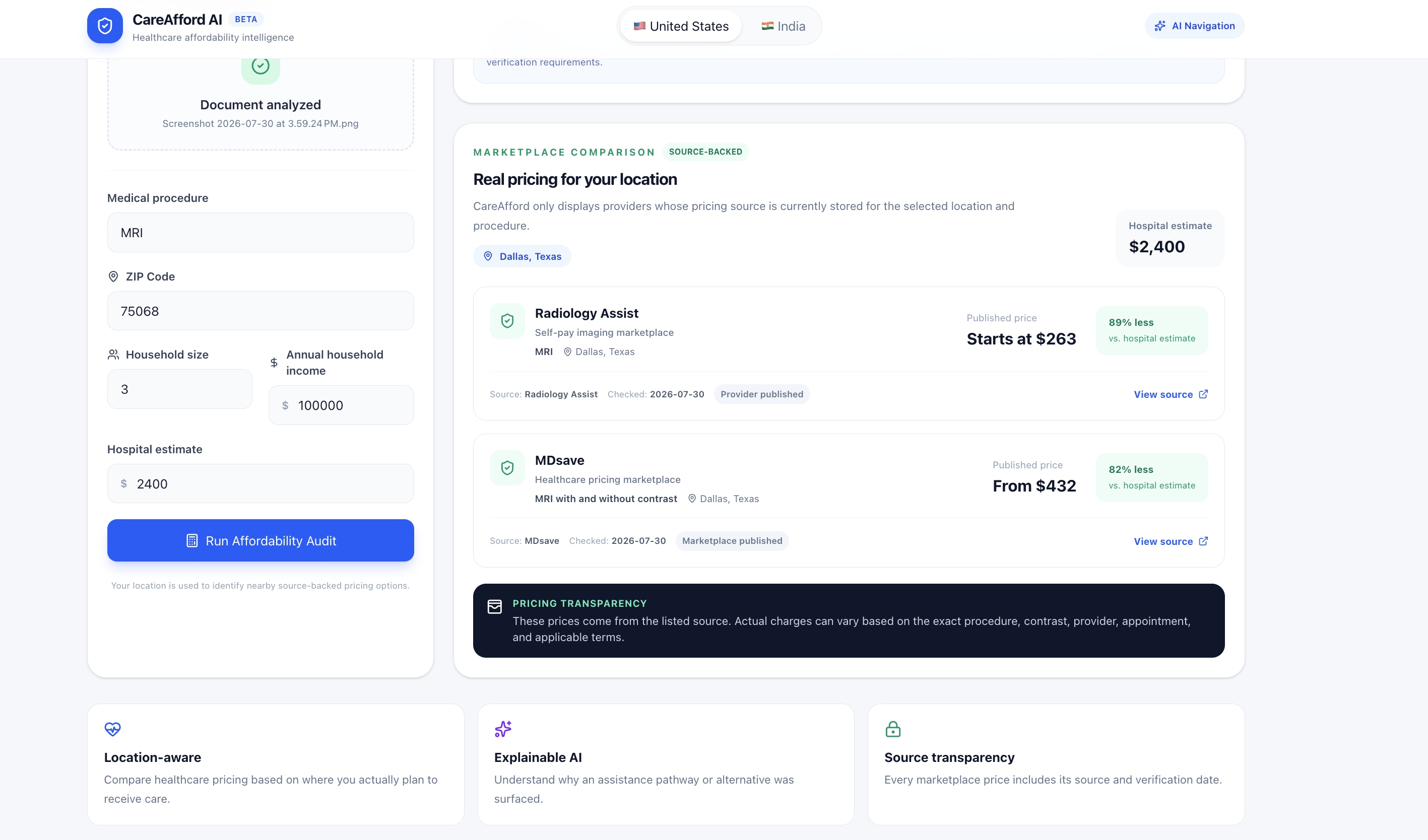
For example, when the user clicks Run Affordability Audit, the frontend sends the patient information and location to the backend.
Challenges we ran into
One of our biggest challenges was making healthcare pricing trustworthy.
Initially, it is easy to create a demonstration with sample hospitals and sample prices. But that does not represent a real healthcare navigation system.
We changed the architecture so that marketplace results contain the source and verification date for the price.
Another challenge was that healthcare rules are different between countries.
We couldn't simply create one universal formula. For example, the U.S. workflow can use Federal Poverty Level calculations as part of the screening process, while India's healthcare assistance system requires a different approach.
Another challenge was location awareness. A provider that is useful for someone in Hyderabad may be completely irrelevant to someone in Guntur or Dallas.
So we changed the architecture to make location a required part of the marketplace search.
Accomplishments that we're proud of
Location-aware architecture
The system can use the selected city or browser location to determine which providers should be shown.
Multi-market design
The application supports both United States and India, with different affordability logic for each market.
What we learned
The difficult part is combining AI with reliable data and deterministic business logic.
For example, calculating an FPL percentage is deterministic and should be handled by backend code.
Interpreting a complicated financial-assistance policy or extracting information from a medical bill is where AI becomes valuable.
What's next for CareAfford AI
The current version is a strong prototype, but the long-term goal is to make CareAfford a real-time healthcare financial navigation platform.
The next improvements are:
Real-time provider discovery
Integrate healthcare pricing APIs, provider directories, and publicly available price-transparency data so prices can be refreshed automatically.
Better location intelligence
Use geospatial services to calculate:
Exact distance Travel time Nearby providers Provider availability
Built With
- css
- fastapi
- lucide
- python
- react
- tailwind
- typescript
- vite

Log in or sign up for Devpost to join the conversation.