-
-
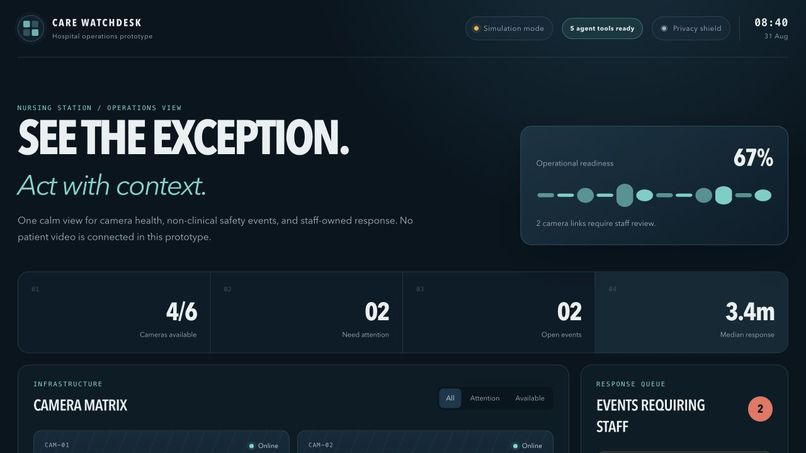
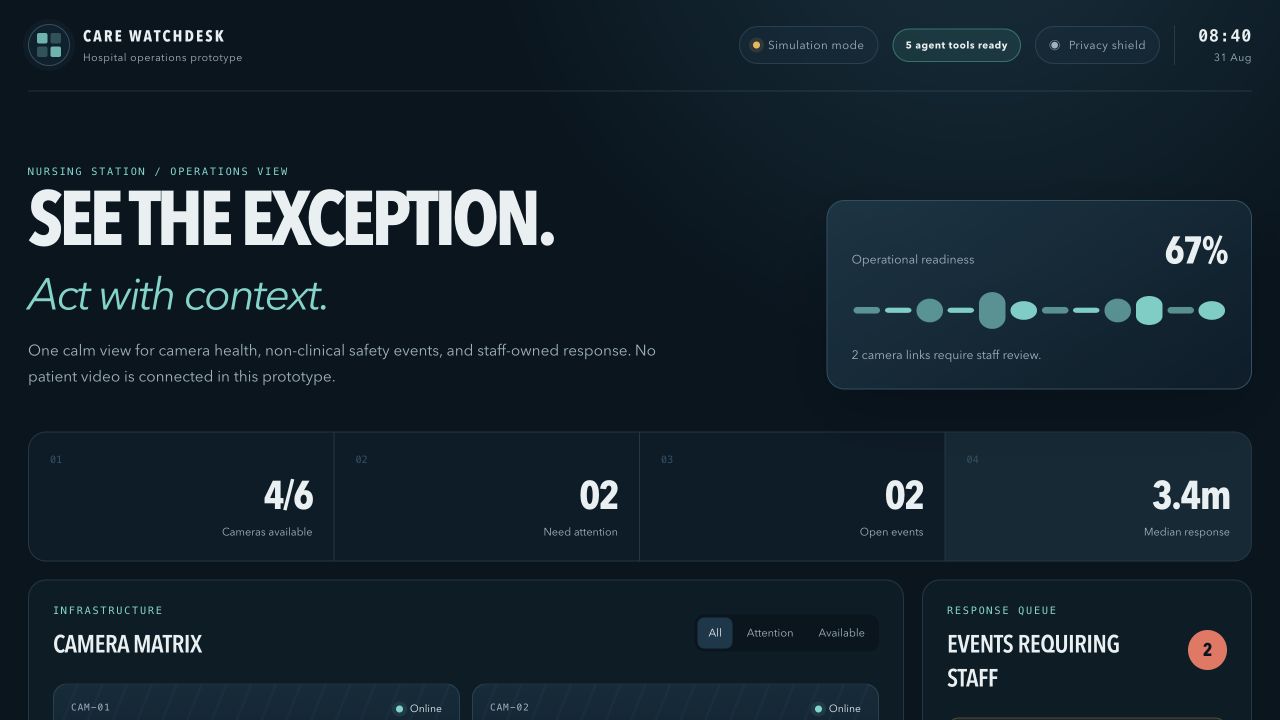
Care Command Center overview with source feeds and a clinician review queue.
-
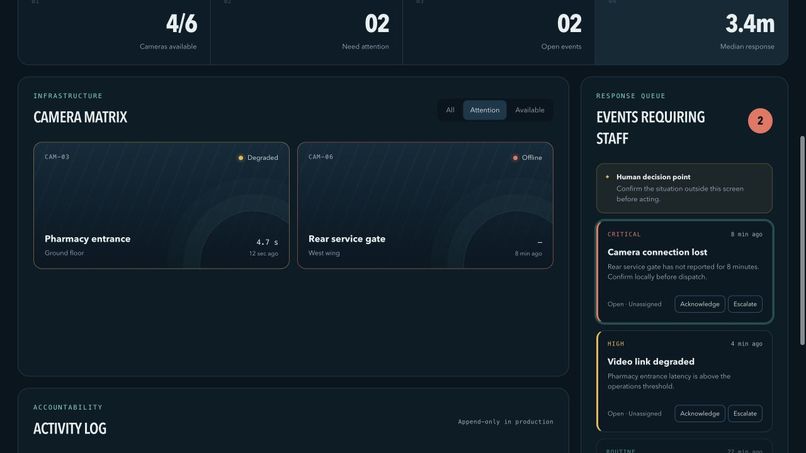
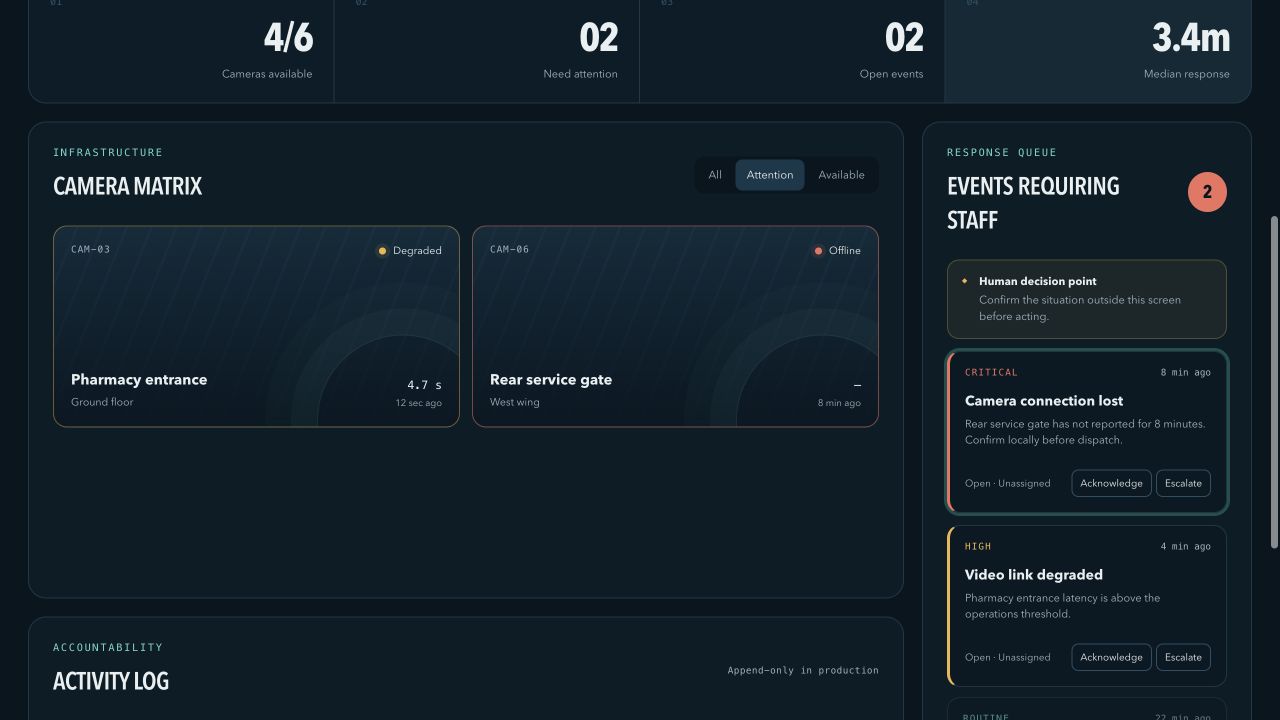
Source filters help an agent narrow camera and mobile observations.
-
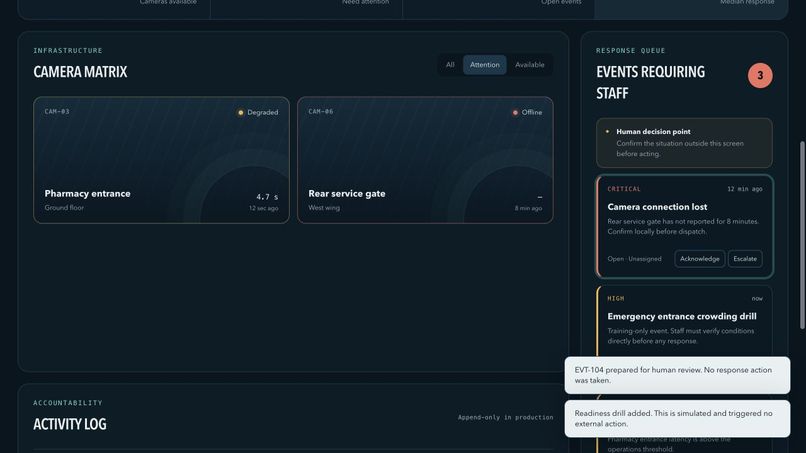
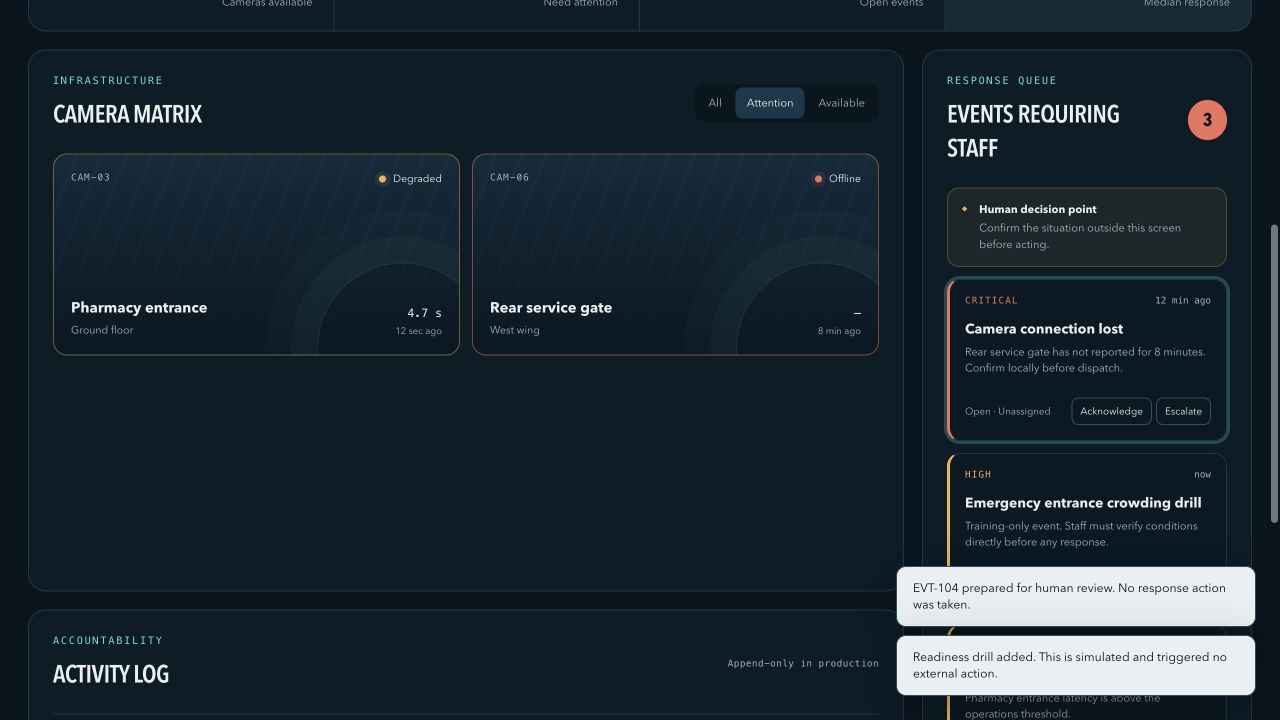
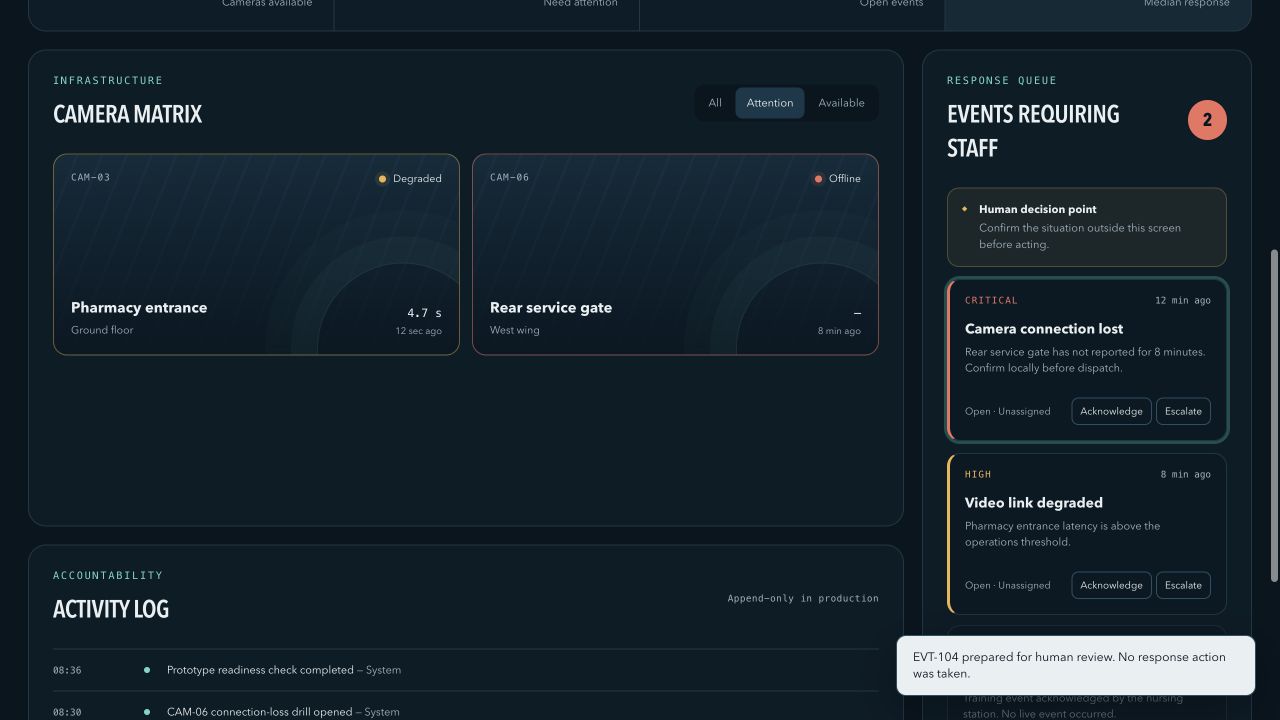
An observation is prepared for human review; no automated clinical action occurs.
-
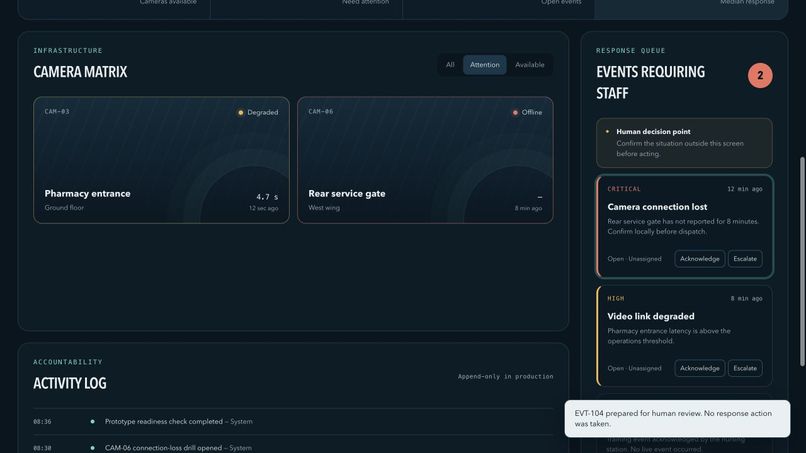
A training drill changes local state without external staff messaging.
Inspiration
Doctors and hospital leaders move between camera views, mobile observations, staff calls, and task lists while trying to keep clinical judgment clear. An agent can help gather context and coordinate the right role, but it should not turn an uncertain image into an autonomous diagnosis or treatment order. Care Command Center explores that boundary with a public, simulated environment containing no patient imagery or live hospital connection.
What it does
Care Command Center presents simulated fixed-camera and mobile observations, a clinician review queue, staff availability, and an activity log. Its six WebMCP tools let an agent:
- summarize the command center;
- list observations by status, urgency, and source type;
- prepare one observation for clinician review;
- draft a task for a staff role;
- read simulated role availability; and
- run a coordination drill.
Preparing an observation highlights the matching card and returns a verification checklist. Drafting a task leaves it pending. A doctor or authorized operator must independently verify the situation and use the visible Approve & queue action. The staff acknowledgment shown in the demo is simulated.
Why WebMCP
Without WebMCP, an agent must infer meaning from a dense dashboard and simulate clicks. With WebMCP, the page exposes a small typed contract that maps directly to its state. The agent can reliably answer “What needs review?”, “Prepare this observation for me,” or “Draft a task for the duty nurse” while the doctor stays in the same interface.
This creates a practical human-agent boundary: the agent compresses navigation and coordination, while the clinician retains the consequential decision.
What judges should notice
- WebMCP leverage: the agent invokes native typed tools backed by page state; it does not scrape labels or replay brittle clicks.
- Execution: one continuous workflow goes from an urgent simulated observation to review preparation, a structured staff-task draft, doctor approval, simulated staff acceptance, and an audit entry.
- Potential impact: hospital leaders can coordinate observations and staff from one interface without hiding uncertainty or transferring clinical authority to the agent.
- Creativity and ambition: the prototype applies browser-native agent tools to camera, mobile, clinician, and staff coordination while defining a realistic boundary for safety-critical work.
How we built it
The app is a dependency-free static site built with accessible HTML, responsive CSS, and JavaScript modules. webmcp.mjs registers six imperative tools through document.modelContext.registerTool(). Each tool has a JSON Schema, a precise description, and an explicit side-effect boundary. The summary, observation-list, and staff-directory tools declare readOnlyHint: true.
The WebMCP adapter calls the same state functions used by the visible interface, so agent and human actions cannot drift into separate behavior. Pure functions cover queue ordering and the draft -> approved -> queued -> accepted task transition. Tests verify both operational rules and the public tool contract.
Challenges
The hard design question was what an agent should do when a camera or mobile image could be clinically important. A direct diagnose_patient or change_device_setting tool would be unsafe and misleading. We instead created prepare_clinical_review: it highlights the observation, returns a checklist, and states clearly that no diagnosis, prescription, device change, or staff message occurred.
Staff coordination follows the same boundary. draft_staff_task creates a structured, pending task. The human must approve it before the simulated staff inbox accepts it. A real WhatsApp adapter is intentionally not connected.
Accomplishments
- Six working WebMCP tools discovered and executed in a WebMCP-enabled browser.
- A visible workflow from simulated camera/mobile observation to clinician review and staff-task approval.
- Separate clinical and operational safety boundaries.
- A reproducible public demo with no accounts, private data, or external systems.
- Tests covering queue and approval behavior plus a public MIT-licensed repository.
What we learned
For agent-facing clinical workflows, descriptions and approval boundaries matter as much as schemas. The useful role for an agent is often to collect context, prepare work, and make uncertainty visible. The doctor remains accountable for the decision.
What's next
Future work could add institution-approved authentication, secure mobile capture, camera and device adapters, EHR links, staff-channel adapters, immutable audit storage, role-based policy, localization, and a formal clinical-safety evaluation. Any real deployment would require privacy and security review, named-user access, retention limits, validation, and independent clinical governance.
Links
Built With
- chatgpt
- css3
- github
- html5
- in-app
- javascript

Log in or sign up for Devpost to join the conversation.