Inspiration
Family caregiving involves many small administrative commitments that depend on one another. If an appointment moves, the arranged ride may no longer work, the follow-up may fall outside its required window, and paperwork may reach the wrong office.
The caregiver usually becomes the coordinator. They must notice every consequence, contact each person or organization, and work out whether "sent" really means "received."
We built Care Relay to take on that coordination quietly while leaving consequential decisions with the caregiver.
What it does
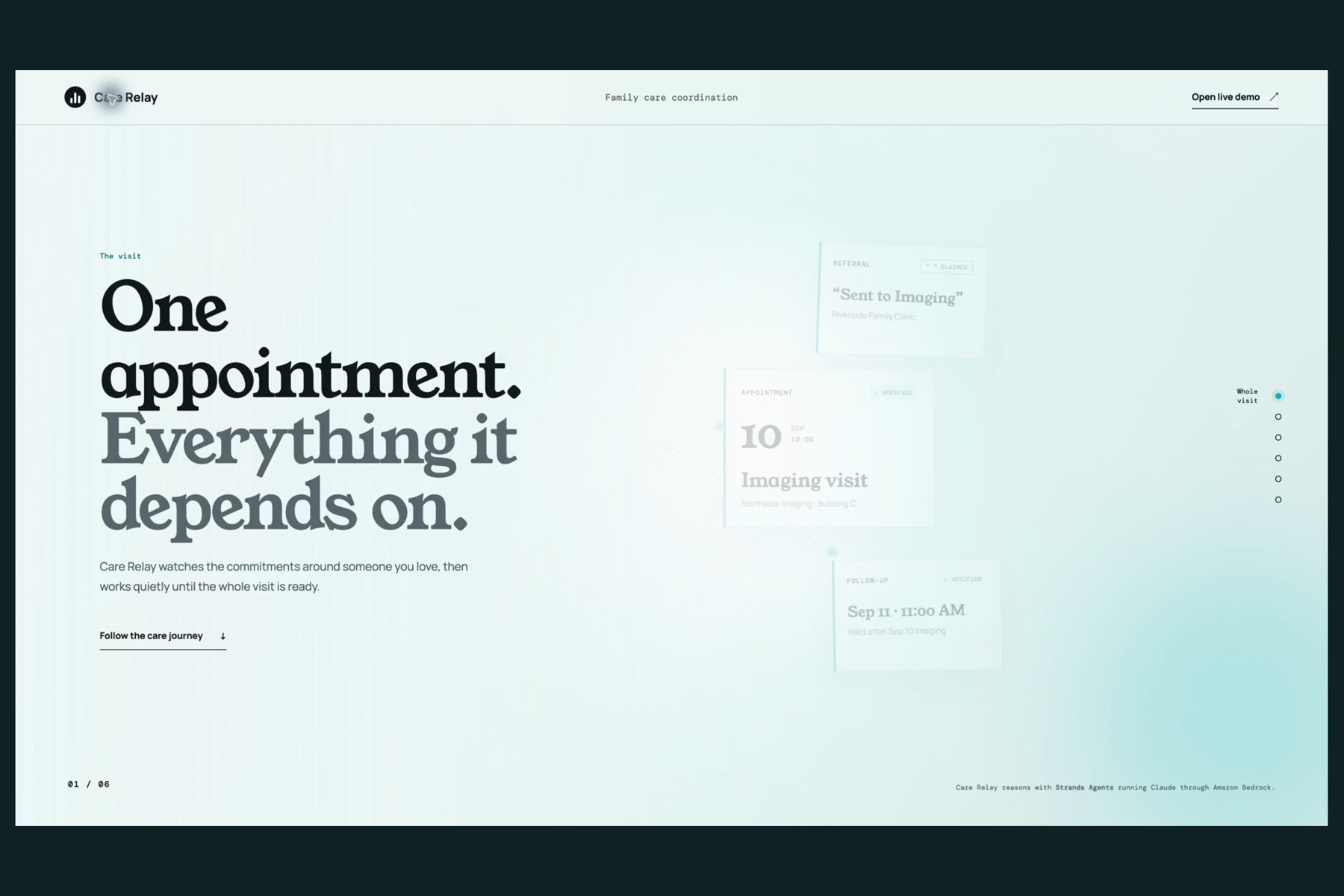
Care Relay coordinates the commitments surrounding a loved one's outpatient visit.
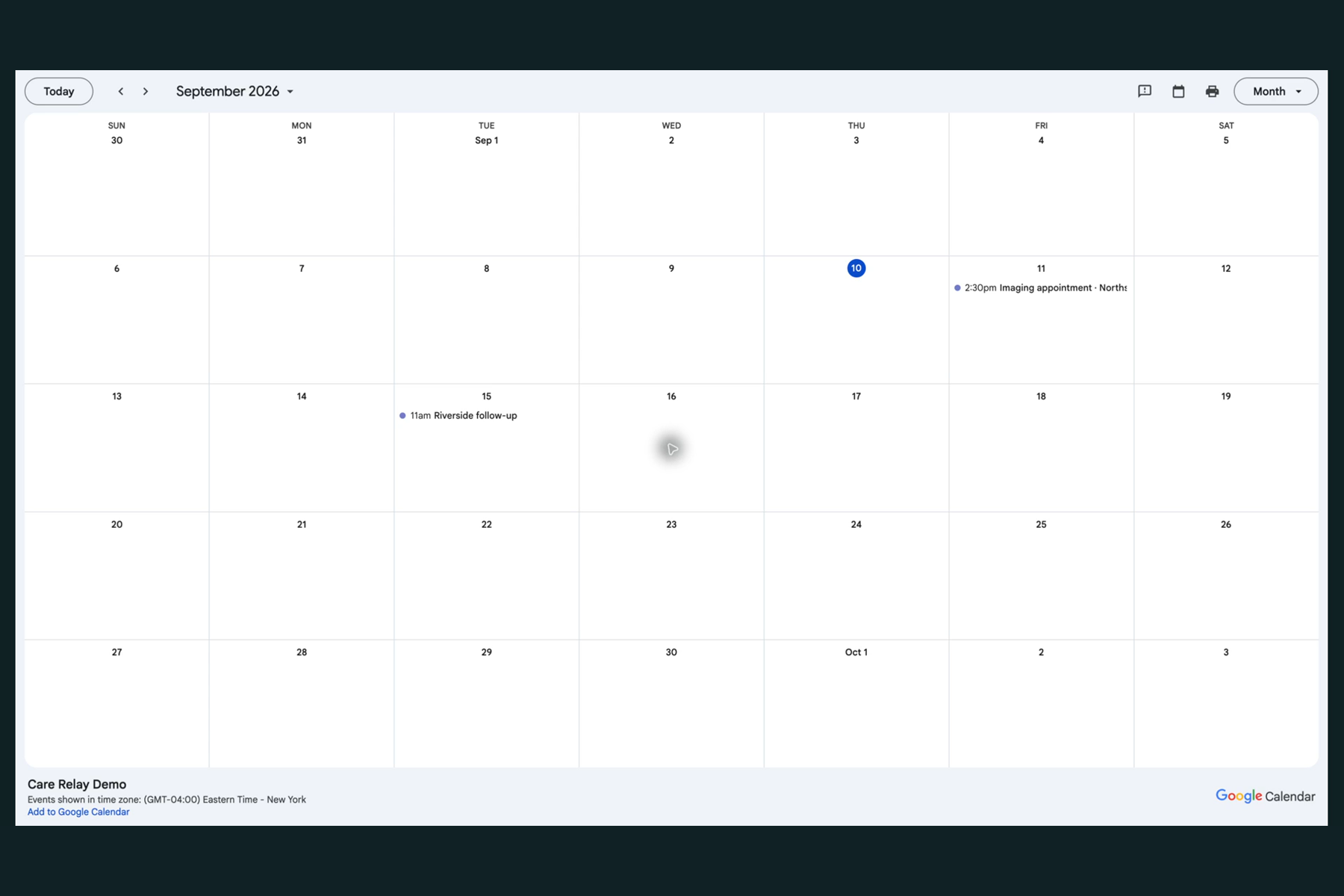
In our demo, an imaging provider changes Daniel's appointment time. Care Relay:
- Interprets the provider's message.
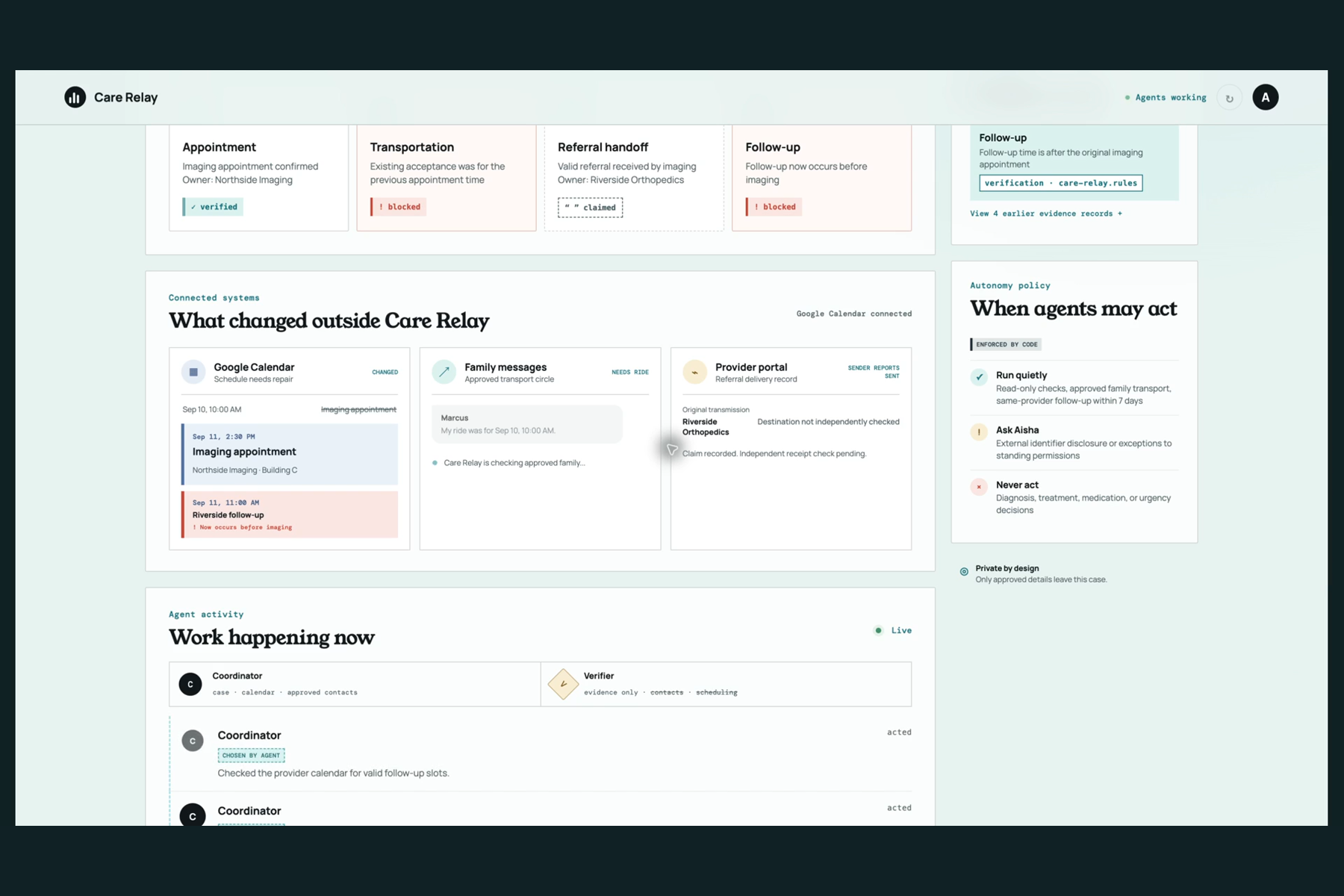
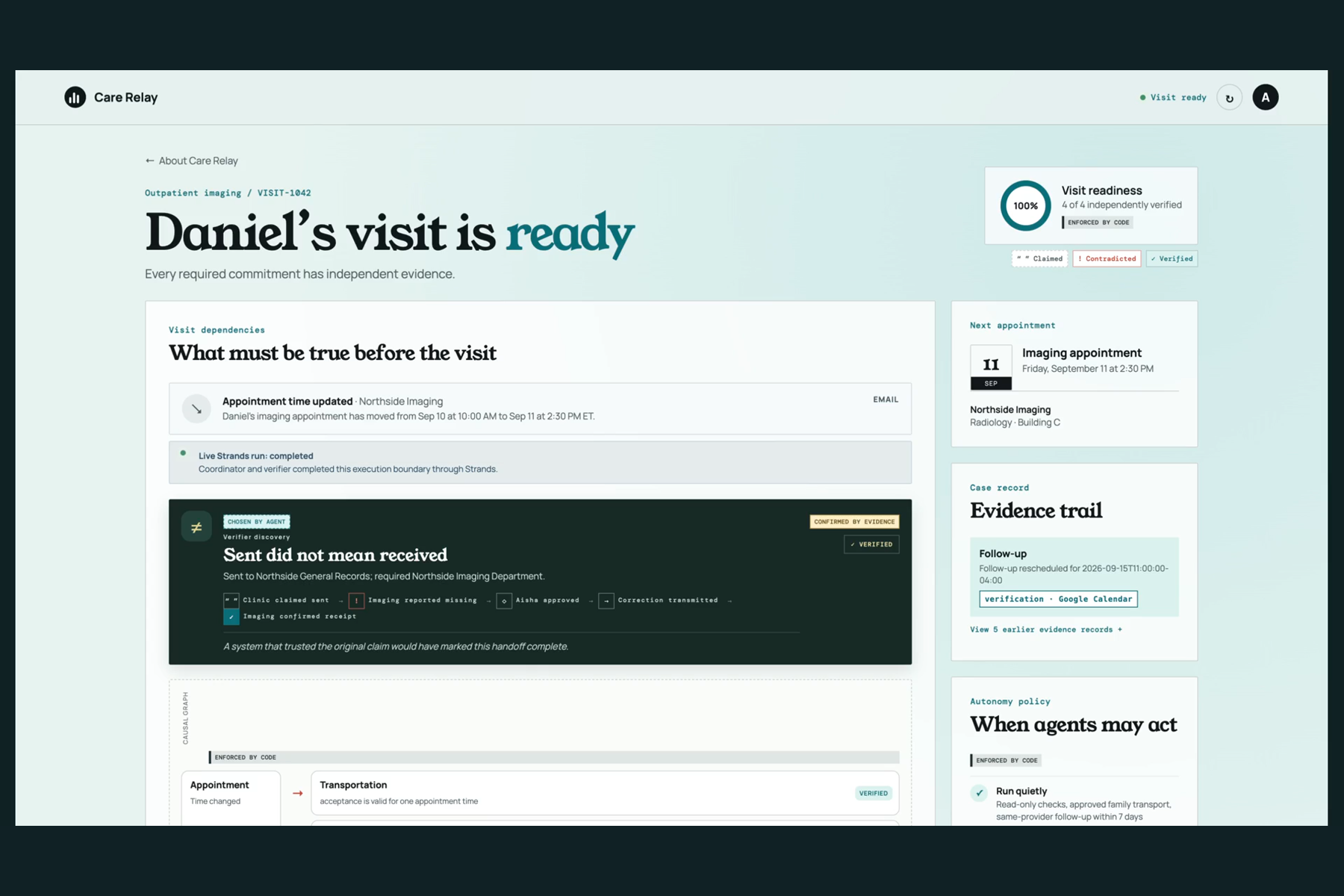
- Updates the appointment and identifies the affected dependencies.
- Finds replacement transportation within Aisha's approved family circle.
- Reschedules the follow-up within standing permission.
- Investigates a disputed referral handoff.
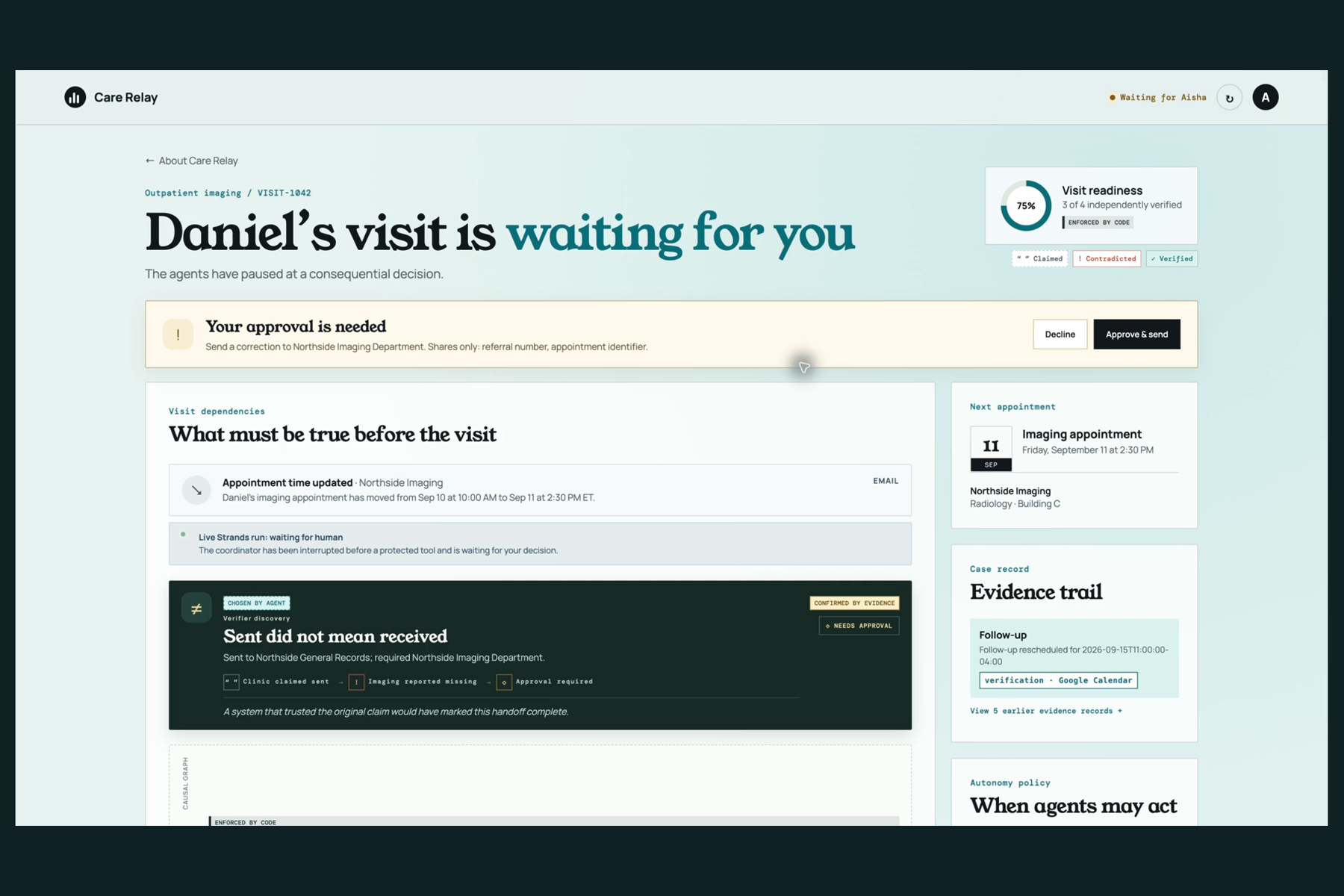
- Discovers that the referral went to general records instead of the imaging department.
- Stops before disclosing the referral identifier to another organization.
- Asks Aisha for approval.
- Sends the correction only if she approves.
- Independently verifies receipt before declaring the visit ready.
A claim that a task was completed cannot bring the visit to 100% readiness. Every required commitment needs supporting evidence.
Potential impact
Family care coordination is not an occasional edge case. The Caregiving in the U.S. 2025 report from AARP and the National Alliance for Caregiving estimates that 63 million Americans, nearly one in four adults, provide ongoing care for another person. Caregivers spend an average of 27 hours each week providing care, and 24% provide at least 40 hours.
Care Relay focuses on one part of that burden: the administrative work around care. Appointments, transportation, follow-ups, and referrals are separate commitments, but they depend on one another. When a schedule changes, the caregiver often has to discover and repair the whole chain again.
The demo follows one outpatient imaging visit so we can show that pattern from the first disruption through independent verification. The current MVP is imaging-specific. Its commitment, dependency, evidence, and approval model was designed to extend to other recurring workflows such as therapy appointments, equipment delivery, prescription pickup, and home-care scheduling. Those workflows are future work, not features claimed by this submission.
Care Relay does not automate medical judgment. It reduces repetitive coordination between providers, calendars, relatives, and administrative systems while keeping consequential actions under human control.
How we built it
Care Relay uses Strands Agents with Claude through Amazon Bedrock.
A Strands Coordinator decides what work is needed and delegates disputed evidence to a separately permissioned Verification Agent through the agents-as-tools pattern. The Verifier can inspect evidence, but it cannot contact family members, change schedules, disclose protected information, or approve actions.
Native Strands human-in-the-loop interruption pauses execution before sensitive information is disclosed. After Aisha decides, the same preserved agent run resumes from that boundary.
Strands lifecycle hooks expose model cycles, tool selection, execution status, latency, interruptions, and completion in the dashboard. The visible trace preserves tool structure while excluding sensitive argument values.
Regular application code handles the rules that should never depend on an LLM:
- permission enforcement
- approval scope and consumption
- date validation
- dependency state
- evidence classification
- readiness calculation
- idempotency
- the action ledger
The model can propose and coordinate actions, but it cannot grant itself permission or mark an unsupported claim as verified.
The application uses FastAPI, SQLite, HTML, CSS, and JavaScript. Care Relay persists case state, Strands sessions, and interrupt state so a pending approval can survive a process restart. The service also includes an AgentCore-compatible runtime contract, although AgentCore deployment is not claimed in the current submission.
Challenges we ran into
The hardest problem was preventing apparent progress from becoming false certainty.
During testing, the model correctly reported that verification was pending but ended its turn before performing the verification. We strengthened the completion boundary after catching that behavior. The deterministic readiness gate now refuses to close the visit until every mandatory commitment has the required evidence.
We also had to separate what the agent chooses, what application policy permits, and what external evidence confirms. The architecture and dashboard now identify these as distinct layers.
Retries created another problem. An agent, network request, or restored checkpoint may repeat a tool boundary. We made consequential tools idempotent so a retry cannot send the correction twice, reuse approval for another action, or create duplicate evidence.
What we learned
Agent autonomy works better when its limits are concrete and enforceable.
The Verification Agent is not the same model wearing a different label. It has a separate tool boundary and cannot perform the Coordinator's actions. Human approval is also enforced by application code rather than left to model judgment.
We learned to represent claims and verified facts differently. "The referral was sent" proves that somebody made a claim. It does not prove that the intended department received it.
We also learned that a useful agent interface must show uncertainty. The dashboard displays when an agent is checking something, which tool boundary it is using, how long the work took, and whether the result came from agent judgment, deterministic policy, or independent evidence.
What's next
Care Relay currently demonstrates one synthetic outpatient imaging journey in depth. The next product step is to make commitment types and dependency policies configurable, then add other recurring workflows such as therapy visits, equipment delivery, prescription pickup, insurance authorization, and home-care scheduling.
Future work would replace synthetic counterparties with consented integrations and move persistence to managed AWS infrastructure. Care Relay will remain limited to administrative coordination. It will not diagnose conditions, recommend treatment, change medication, or determine medical urgency.
Built With
- agentcore
- agents
- amazon
- amazon-web-services
- bedrock
- claude
- css3
- docker
- fastapi
- html5
- javascript
- multiagent
- python
- sqlite
- strands
- uvicorn

Log in or sign up for Devpost to join the conversation.