-
-
Dashboard
-
trust report
Facility Trust Desk
Inspiration
Healthcare planners, NGOs, and grant organizations often rely on spreadsheets, directories, and self-reported facility information when deciding where to allocate funding or refer patients. A facility may claim to offer ICU, NICU, emergency, trauma, or maternity services, but verifying those claims is typically a slow, manual process that requires reviewing websites, brochures, and fragmented records.
We wanted to build a system that helps decision-makers answer a simple but critical question:
Can this facility actually do what it claims?
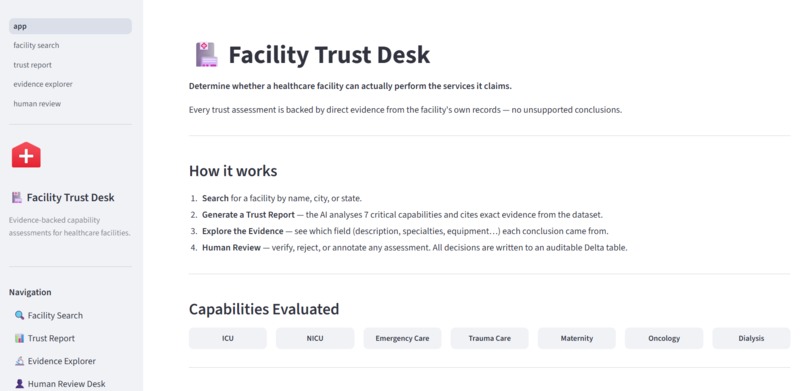
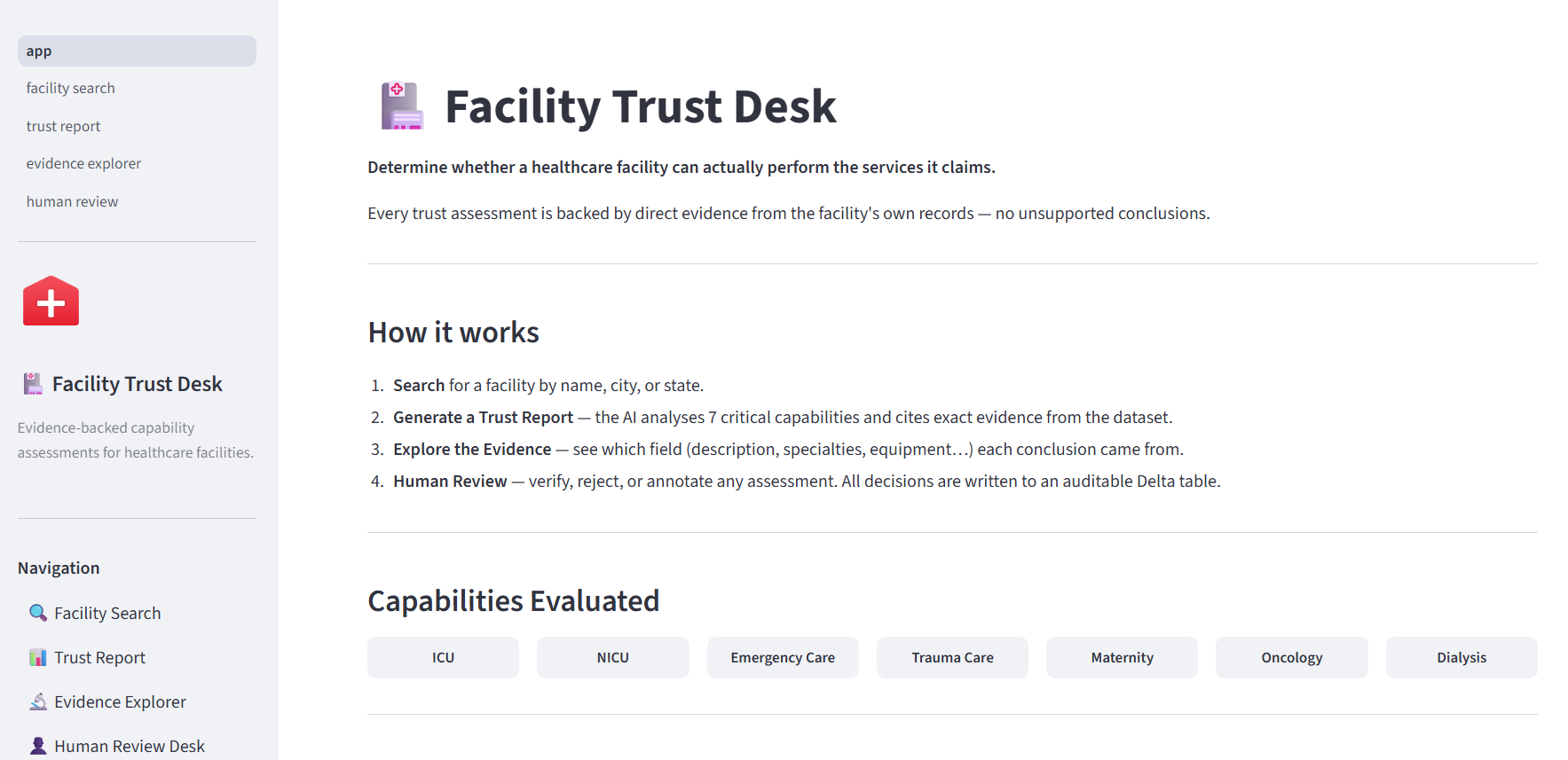
Facility Trust Desk transforms messy healthcare facility data into evidence-backed trust assessments that are transparent, auditable, and easy for non-technical users to understand.
What It Does
Facility Trust Desk analyzes healthcare facility records from the Virtue Foundation Dataset and evaluates key clinical capabilities such as:
- ICU
- NICU
- Emergency Care
- Trauma Care
- Maternity Services
- Oncology
- Dialysis
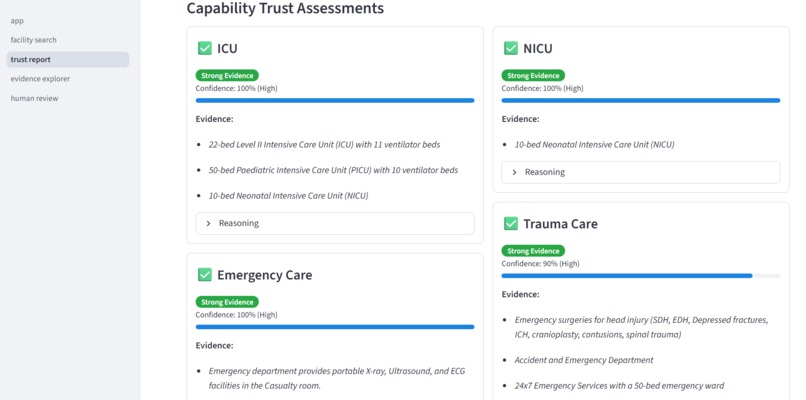
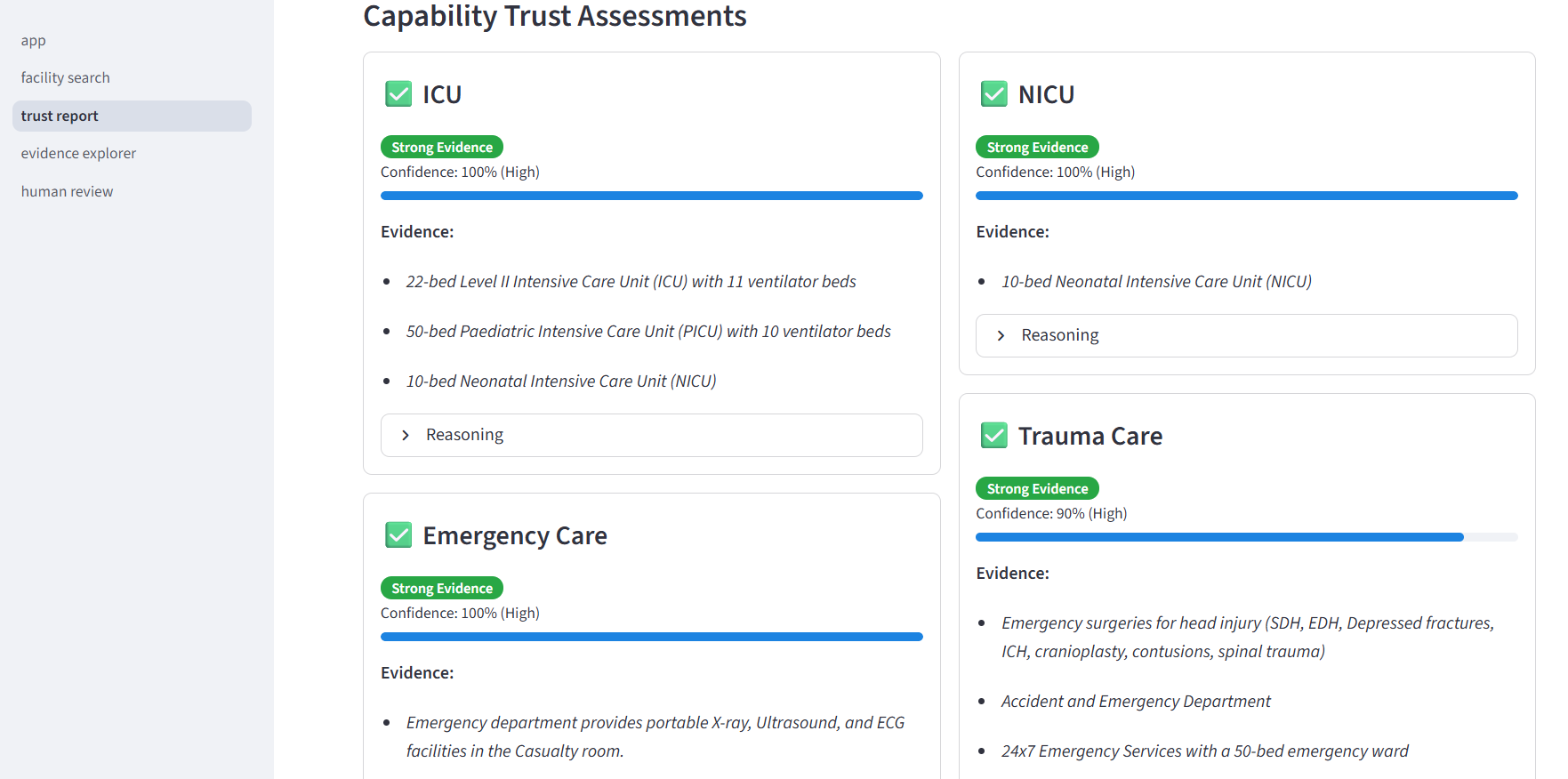
For every capability, the system:
- Assigns a trust level
- Generates a confidence score
- Identifies supporting evidence
- Highlights missing evidence
- Explains the reasoning behind the assessment
Rather than presenting claims as facts, the application communicates uncertainty and provides traceable evidence for every conclusion.
How We Built It
The application is built entirely on Databricks.
Data Layer
We used the Virtue Foundation healthcare facility dataset available through Unity Catalog. The dataset contains facility descriptions, specialties, procedures, equipment, capabilities, geographic information, and source references for healthcare facilities across India.
AI Assessment Engine
For each facility, the application evaluates capabilities using an LLM-powered assessment pipeline.
The model analyzes multiple evidence sources:
- Description
- Specialties
- Procedures
- Equipment
- Existing capability statements
Seven capability assessments are generated in parallel, producing:
- Trust level
- Confidence score
- Evidence snippets
- Missing evidence indicators
- Human-readable reasoning
To improve performance and reduce inference costs, generated assessments are cached in a Delta table so facilities are only evaluated once.
Evidence Explorer
One of the core goals of the project was explainability.
Every assessment links directly back to the evidence used by the model. Users can inspect the exact specialties, procedures, equipment, and descriptions that contributed to a score.
This creates an auditable trail rather than a black-box AI decision.
Human Review Workflow
AI should assist human experts, not replace them.
The Human Review Desk allows users to:
- Verify facility capabilities
- Reject incorrect assessments
- Add review notes
- Maintain a permanent audit history
All review actions are stored in Delta tables within Databricks, creating a complete review trail for accountability and governance.
Challenges We Faced
Messy and Uneven Data
Facility records varied significantly in quality and completeness.
Some facilities contained detailed equipment lists and procedures, while others had only brief descriptions. Designing a scoring system that could communicate uncertainty honestly was one of the biggest challenges.
Avoiding False Confidence
A key challenge was ensuring the AI did not overstate its conclusions.
Instead of simply returning a score, we designed the system to explicitly identify missing evidence and explain why confidence was lower for certain capabilities.
Performance
Generating multiple capability assessments for every facility can be computationally expensive.
To address this, we implemented parallel capability evaluation and Delta-based caching so assessments are generated once and reused.
What We Learned
Through this project we learned that trust is often more important than prediction.
Users are far more likely to trust AI-generated recommendations when they can:
- See the supporting evidence
- Understand the reasoning
- Review missing information
- Override decisions when necessary
We also learned how Databricks can be used as a complete application platform by combining Unity Catalog, Delta Tables, SQL Warehouses, Foundation Models, and Databricks Apps into a single end-to-end solution.
Impact
Facility Trust Desk reduces a process that can take days or weeks of manual verification into a transparent, evidence-backed assessment that can be generated in seconds.
By combining AI assessment, human review, and full auditability, the platform helps healthcare organizations make better funding, planning, and referral decisions with confidence.


Log in or sign up for Devpost to join the conversation.