CareNest: AR Bottle Tracking for Sleep-Deprived Parents
No more mental math, no more "is this still good?"—CareNest gives every caregiver the same real-time bottle safety view, so your whole care community stays in sync.
Inspiration
Since their last Reality Hack, one of our teammates had a baby. Suddenly the 3 AM feedings were real—and so was the mental fog. "When did I make this bottle? Is it still safe? Did my partner already feed her?" These questions haunted every feeding, and the stakes felt impossibly high.
Infant feeding follows strict safety windows that exhausted parents must track entirely from memory. Breast milk left at room temperature expires in 4 hours. Formula in just 2. Once a baby's mouth touches the bottle, the clock accelerates—discard within 1-2 hours regardless of what's left. Parents coordinate across day and night shifts using sticky notes, text messages, and sheer hope that nothing falls through the cracks.
The problem multiplies with community care. When grandma arrives to babysit, she needs a full briefing on which bottles contain what, when each was prepared, and what the rules are. When the nanny hands off to the night shift parent, context gets lost. Daycare workers managing multiple infants face even greater complexity.
We built CareNest because we believe no parent should have to do mental math with their baby's health—and no caregiver should need a 15-minute briefing to help safely. We wanted to externalize the cognitive load of infant feeding into AR, turning every bottle into a smart container that anyone in the care community can instantly understand.
What It Does
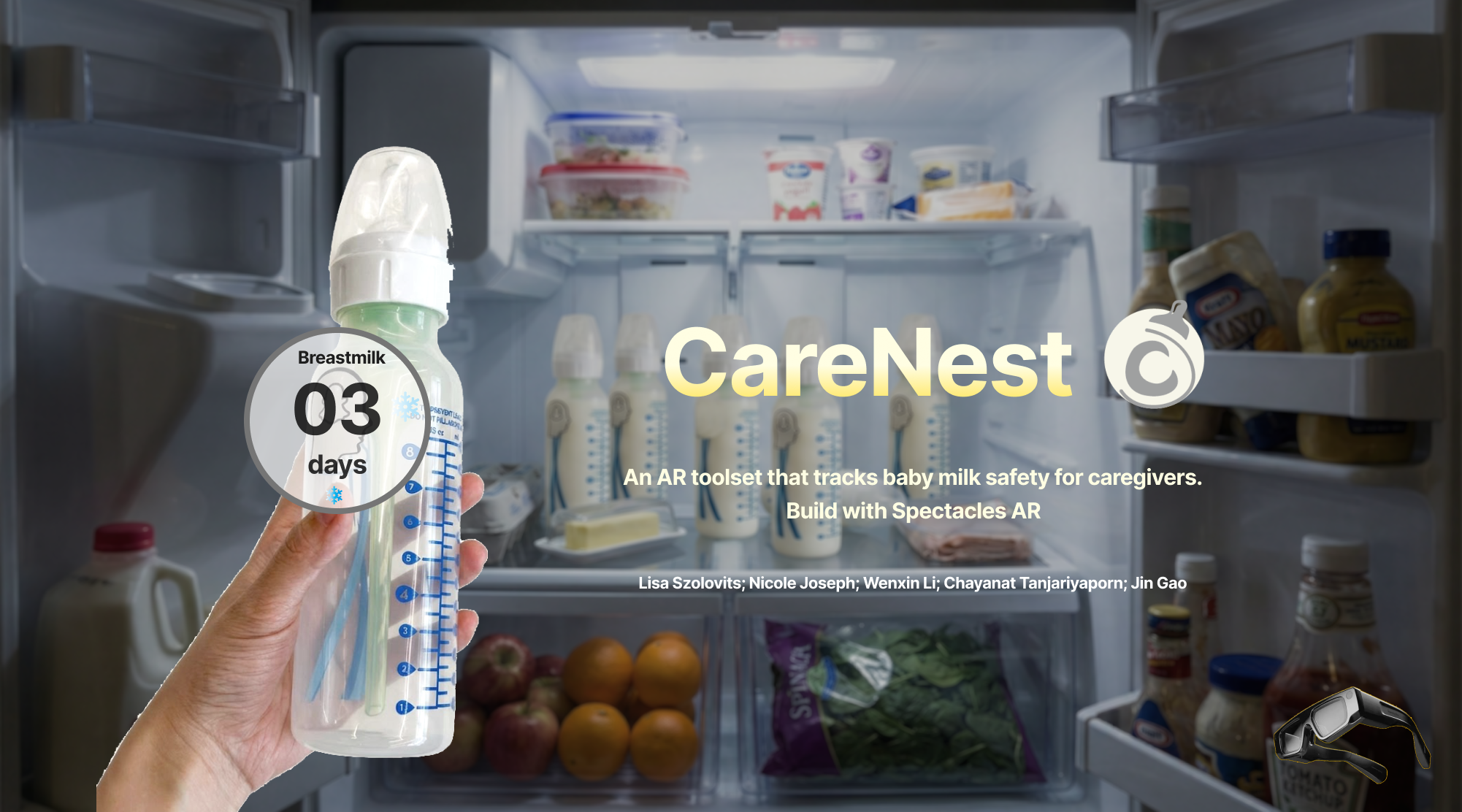
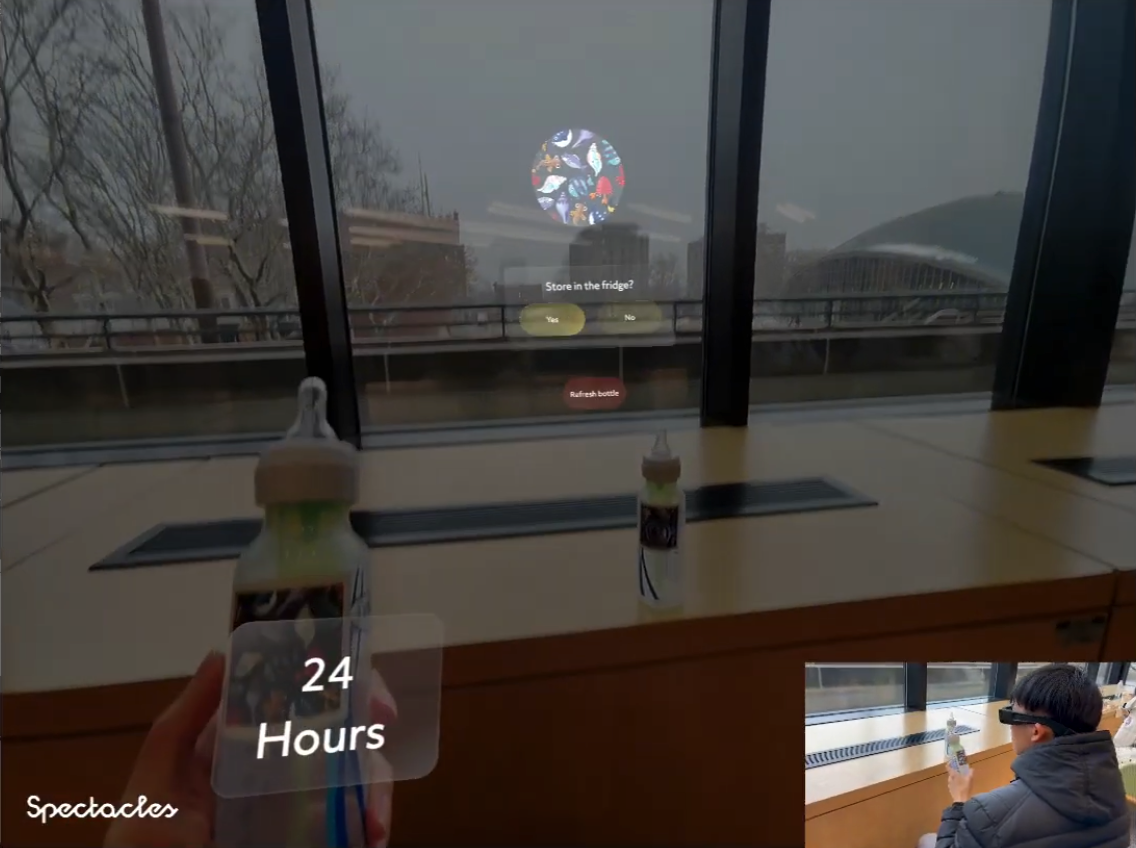
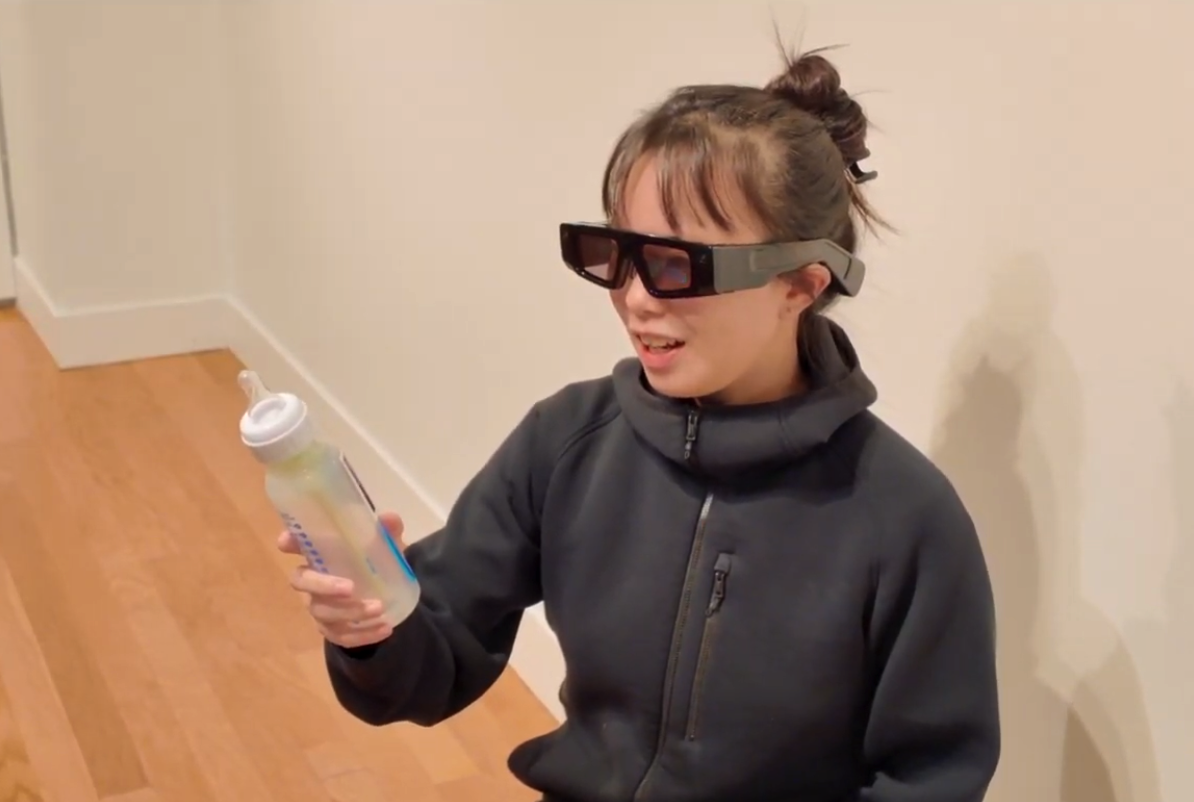
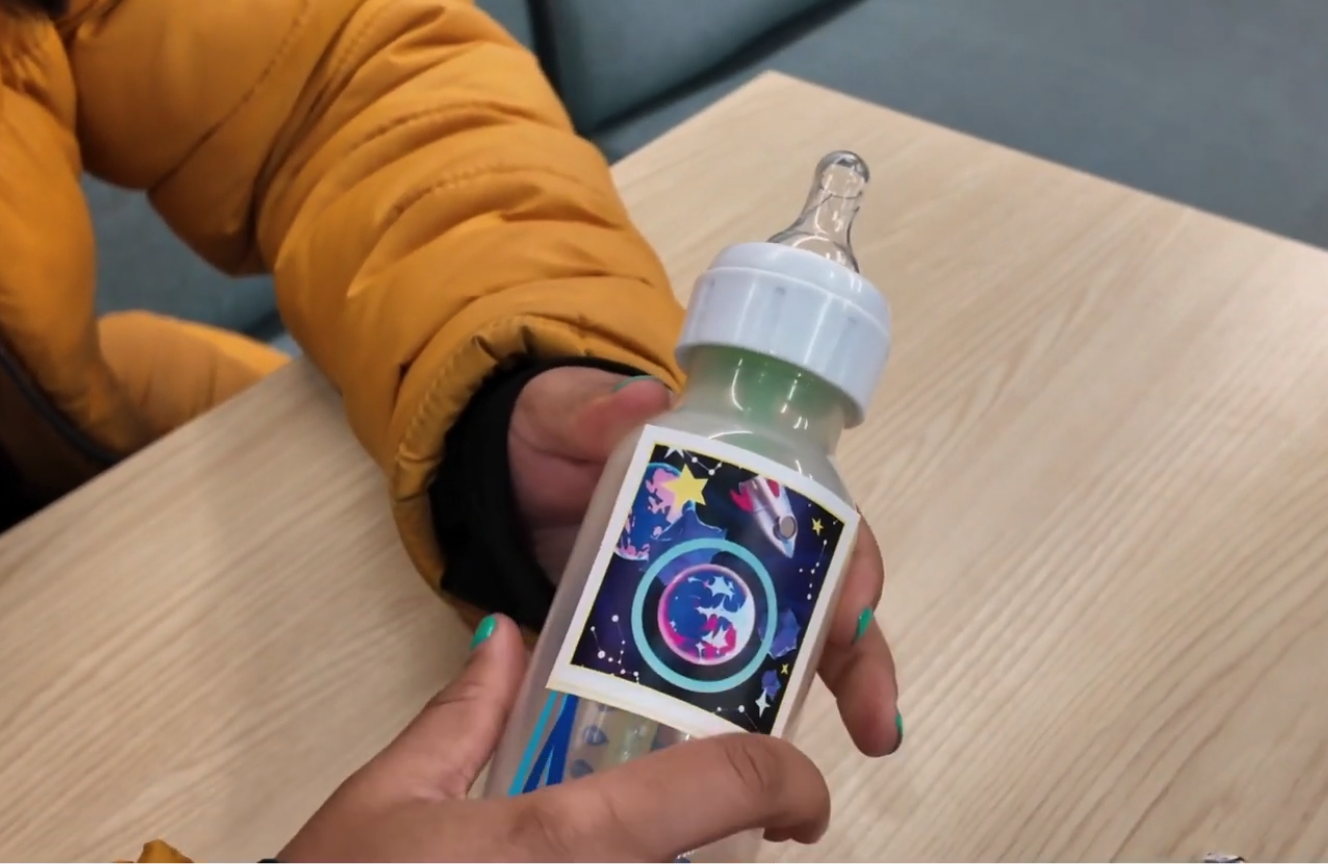
CareNest transforms ordinary baby bottles into intelligent, self-documenting containers using Snap Spectacles and simple marker stickers. When any caregiver looks at a bottle through Spectacles, they instantly see an AR overlay displaying exactly what they need: the milk type, current storage status, a real-time countdown to expiration, and a color-coded safety indicator—green for safe, yellow for expiring soon, red for expired.
The experience is designed for exhaustion. No menus to navigate, no buttons to press for basic information. Just look at the bottle and know. The overlay anchors to the physical bottle, following it naturally as you move.
Beyond passive display, caregivers can interact with bottles through simple gestures. Tap to change storage status when moving a bottle from fridge to counter. Tap to start a feeding session, which automatically applies the stricter expiration window. Tap to dispose when finished, logging the feeding event for the family's records.
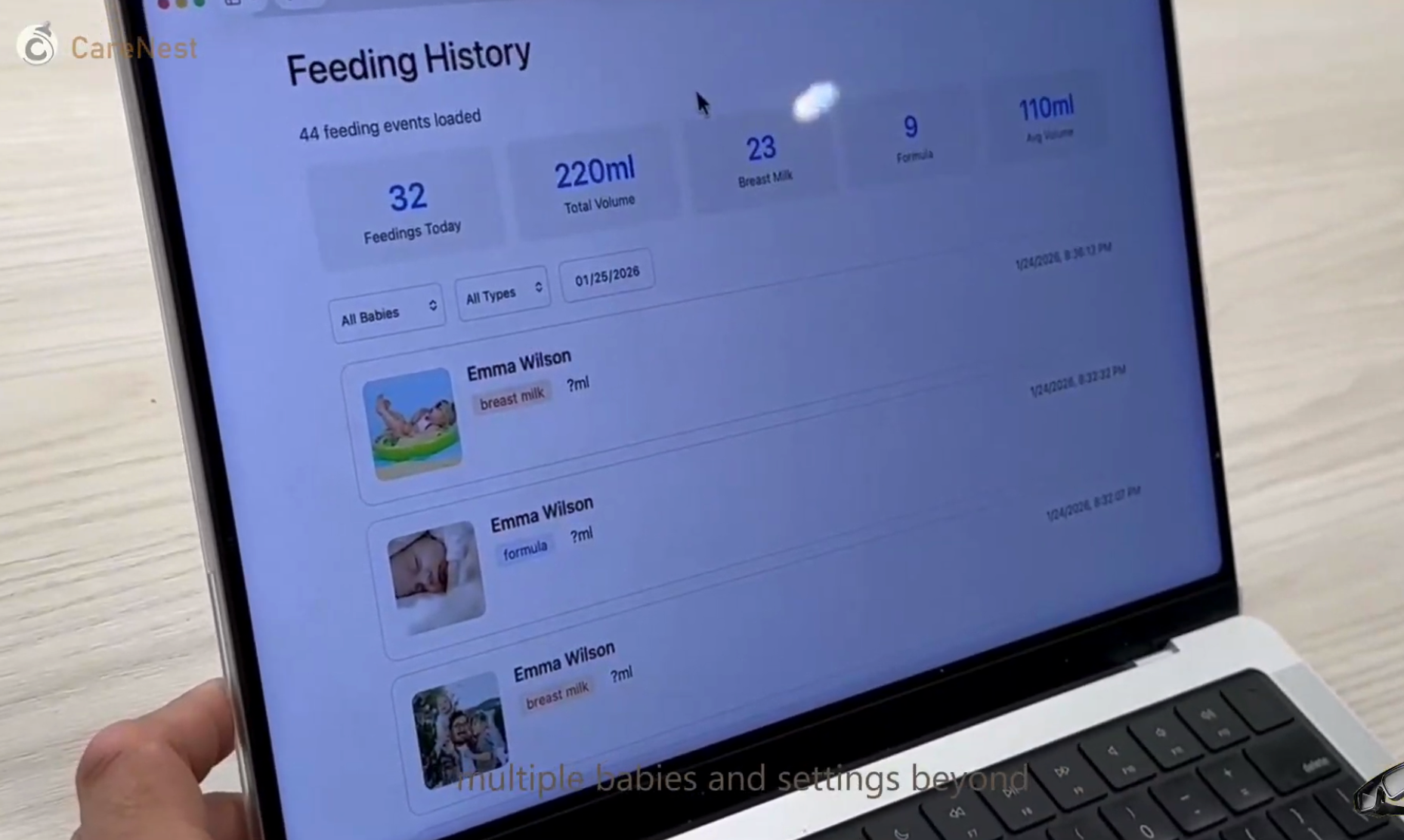
The real power emerges through synchronization. When Dad starts a feeding in the nursery, Mom's web dashboard updates within 200 milliseconds. When the nanny logs a bottle at 2 PM, grandma sees it reflected when she arrives at 5. Every caregiver—whether using Spectacles, the web interface, or eventually a mobile app—operates from the same real-time truth. No more conflicting information, no more "I thought you already fed her."
An AI assistant extends the experience beyond visual overlays. Parents can ask natural questions like "which bottle should I use next?" or "how much has she eaten today?" The assistant draws on embedded CDC, AAP, and WHO guidelines combined with the family's actual bottle states and feeding history. Responses are grounded in authoritative medical sources and personalized to the moment.
How We Built It
Our architecture centers on Snap Cloud's Supabase integration, which provided the integrated backend we needed without stitching together multiple services.
The database layer uses PostgreSQL with a carefully designed relational schema. Caregivers connect to care recipients through a many-to-many assignment table, enabling complex real-world scenarios: shared custody arrangements, rotating nanny schedules, daycare enrollment alongside family care. Each bottle tracks its current state—milk type, storage status, preparation time, and crucially, a server-computed expiration timestamp. Feeding events log every session with iCal-compatible fields for future calendar integration.
For the AI assistant, we embedded official CDC, AAP, and WHO infant feeding guidelines into a PostgreSQL-native vector store using the pgvector extension. Gemini's text-embedding-004 model generates 768-dimensional embeddings for semantic search. When a parent asks a question, the system performs cosine similarity search to retrieve relevant guidelines, fetches current bottle states and recent feeding events, then constructs a context-rich prompt for Gemini 2.0. The response incorporates real-time data—"Bottle 3 expires in 2 hours, use it next"—grounded in authoritative sources.
Edge Functions written in Deno handle all business logic server-side. The bottle-status function manages the complete bottle lifecycle: scanning marker codes, setting milk types, changing storage status, computing expiration times, and logging disposal. Every expiration calculation follows CDC/AAP rules encoded as the single source of truth—breast milk gets 4 hours at room temperature and 96 hours refrigerated; formula gets 2 hours and 24 hours respectively; feeding windows are 2 hours and 1 hour. Clients never compute these rules locally, eliminating any possibility of inconsistent safety determinations.
Supabase Realtime enables the instant multi-device synchronization that makes CareNest feel magical. Database changes broadcast via WebSocket subscriptions to all connected clients. The architecture ensures that whether a bottle update originates from Spectacles, the web dashboard, or a future mobile app, every other client reflects the change within 200 milliseconds.
The Spectacles experience built in Lens Studio keeps the AR layer lightweight. marker detection triggers an API call to the bottle-status Edge Function, which returns the complete bottle state with computed fields. The lens renders this as an overlay anchored to the detected marker—no complex local logic, just display what the server provides.
Challenges We Ran Into
Real-time synchronization across heterogeneous clients proved more complex than anticipated. Spectacles, web browsers, and mobile apps each have different connection characteristics and failure modes. We addressed this by funneling all mutations through Edge Functions, ensuring atomic database updates complete before Realtime broadcasts propagate. This guarantees that all clients receive consistent state rather than partial updates.
Timer precision across devices required careful thought. If Mom's phone and Dad's Spectacles show different "time remaining" for the same bottle, trust in the system collapses. We solved this by storing absolute UTC expiration timestamps server-side. Clients compute countdown displays locally from the authoritative timestamp—eliminating clock sync issues while keeping displays responsive.
Gemini Live API integration for voice interaction pushed us through several iterations. WebSocket audio streaming required proper binary handling, PCM encoding at 16kHz input and 24kHz output, and graceful reconnection logic. The available models for Live API changed during development, requiring quick pivots in our approach. We designed the voice client to fail gracefully back to text interaction when streaming isn't available.
Designing for sleep deprivation shaped every decision. Early prototypes required too many taps, too much reading, too much cognitive engagement. We stripped the interface down to glanceable information—look at bottle, see countdown and color, know immediately if it's safe. Every additional interaction became optional rather than required.
Accomplishments We're Proud Of
We built a true community care architecture. The many-to-many relationship between caregivers and care recipients isn't just a database design choice—it's a statement about how infant care actually works. Parents, grandparents, nannies, daycare workers, and neighbors can all participate in a child's feeding safely, each seeing the same real-time information, each contributing to the shared history.
Our AI assistant is grounded in medical authority. The RAG pipeline ensures responses trace back to embedded CDC, AAP, and WHO sources rather than general model knowledge. When a parent asks about refreezing thawed breast milk, the answer comes from official guidelines stored in pgvector, not hallucinated from training data.
We achieved zero-briefing handoffs. Grandma arrives, puts on Spectacles, looks at a bottle, and knows everything she needs to feed the baby safely. No texts asking "which one is which?", no phone calls interrupting the parents' rare chance to sleep, no sticky notes falling off bottles. The information lives with the bottle itself.
The server-side authority model ensures safety-critical consistency. Every device shows the same expiration time because every device receives timestamps from the same authoritative source. When the question is "is this safe for my baby?", there's only one answer across the entire care community.
What We Learned
Sleep deprivation must be treated as a primary design constraint, not an edge case. Our target users haven't slept properly in weeks or months. Every interaction must be completable by someone operating at reduced cognitive capacity. This insight drove us toward glanceable AR overlays, voice queries, and the complete elimination of mental math from the feeding workflow.
Community care represents the future of parenting. Nuclear families trying to handle infant care alone burn out. Technology should lower the barrier for grandparents, neighbors, and professional caregivers to help safely. The isolated parent struggling alone at 3 AM is a failure of both social structures and the tools we build. CareNest is our small contribution toward making community support practical.
Server-side authority matters for safety-critical applications. Client-side computation might be faster or work offline, but when inconsistent results could harm a baby, the server must be the single source of truth. We accepted the tradeoff of requiring connectivity in exchange for guaranteed consistency.
AR has unique power for contextual information. Displaying bottle status on a phone requires finding the phone, unlocking it, opening the app, and locating the right bottle in a list. Spectacles display the information exactly where you need it—on the bottle itself, visible the moment you look. The reduction in friction is transformative for exhausted parents.
What's Next for CareNest
Voice interaction through Gemini Live API will enable truly hands-free queries. Parents holding a crying baby can ask "is this bottle still good?" and receive a spoken answer without touching any device. We have the architecture in place and are working through the audio streaming implementation.
Feeding pattern analytics will surface insights from the accumulated history. "She's eating more in the mornings this week" or "average feeding volume has increased since last month" can support conversations with pediatricians backed by actual data rather than foggy parental memory.
Smart fridge integration could automate storage status updates. When a bottle moves from refrigerator to counter, the system could detect this automatically rather than requiring manual status changes. Temperature sensors on bottles themselves might eventually enable even more precise safety tracking.
A mobile companion experience will extend CareNest to caregivers without Spectacles. Using phone camera marker detection through Snapchat's camera platform, any caregiver can access the same real-time bottle information. This dramatically expands who can participate in the care community while maintaining the synchronized single-source-of-truth model that Spectacles provide as the primary AR experience.
Eventually, we envision CareNest expanding beyond infant feeding. The core architecture—physical objects with AR overlays, real-time synchronization, community access control, AI assistance—applies to medication tracking for elderly care, pet feeding coordination, and any domain where multiple caregivers must coordinate around time-sensitive physical items.
CareNest: Because exhausted parents shouldn't have to remember when they made the bottle.
Built With
- lensstudio
- postgresql
- snap
- supabase
- typescript


Log in or sign up for Devpost to join the conversation.