-
-
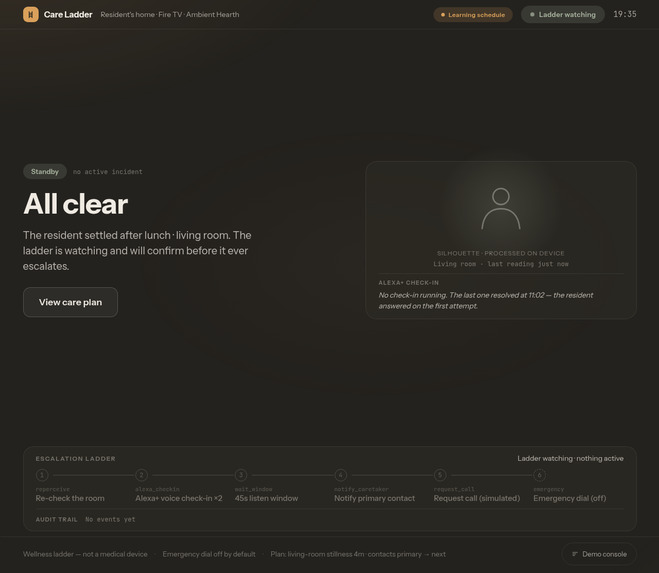
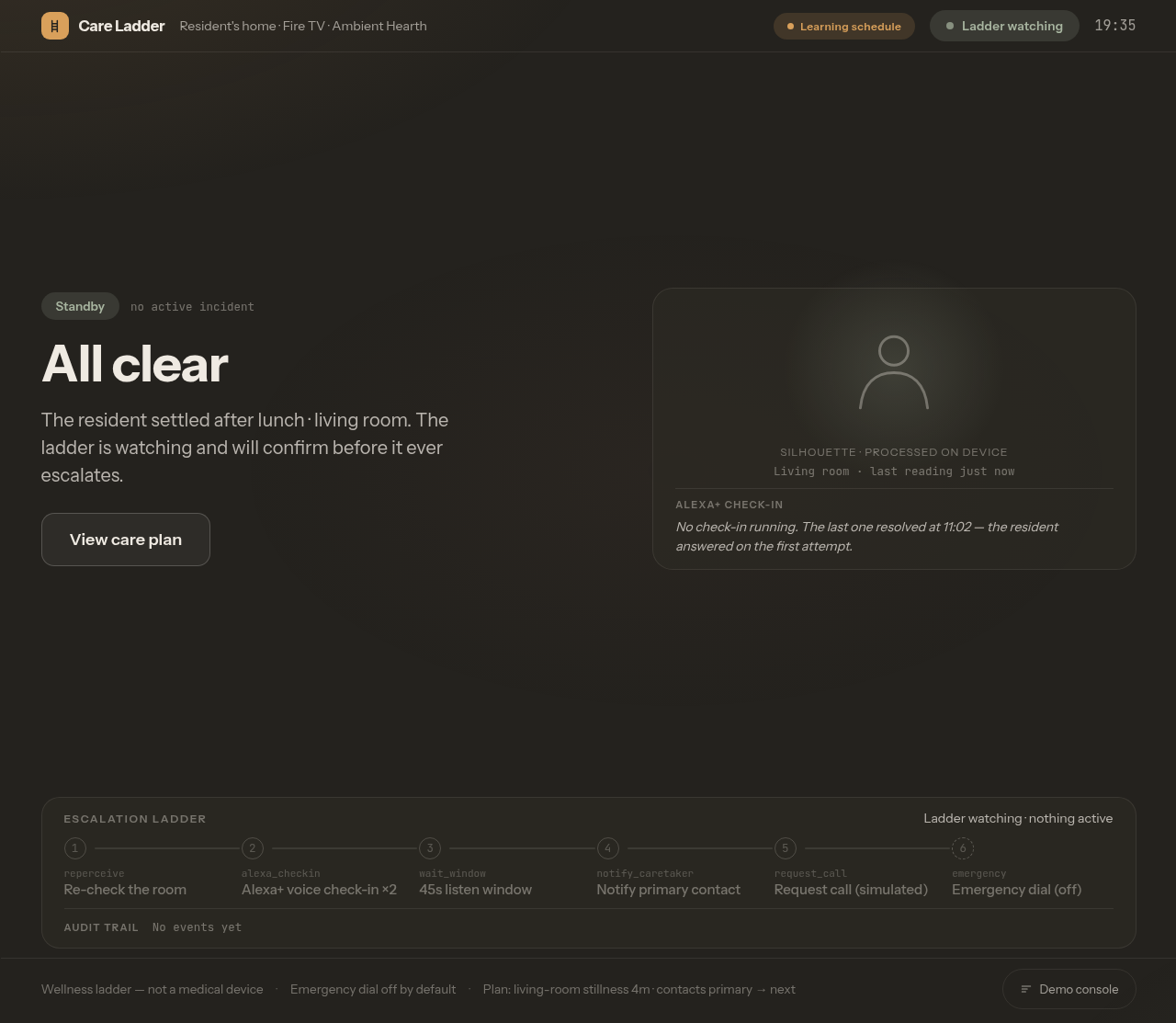
Calm home: All clear on Fire TV. Ladder watching, standby.
-
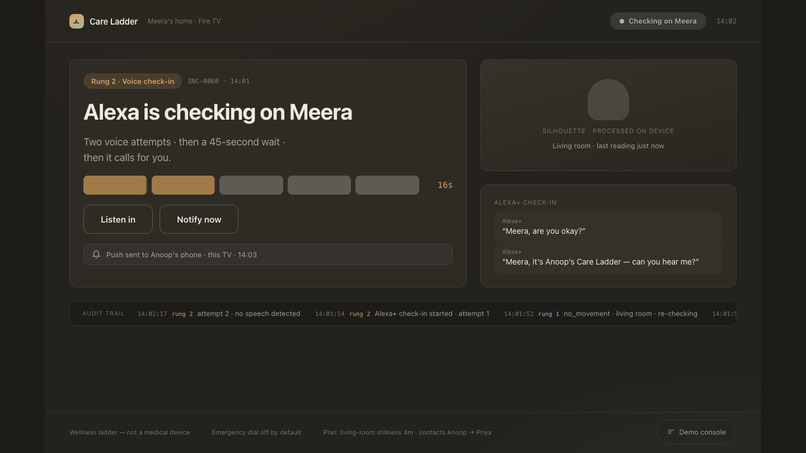
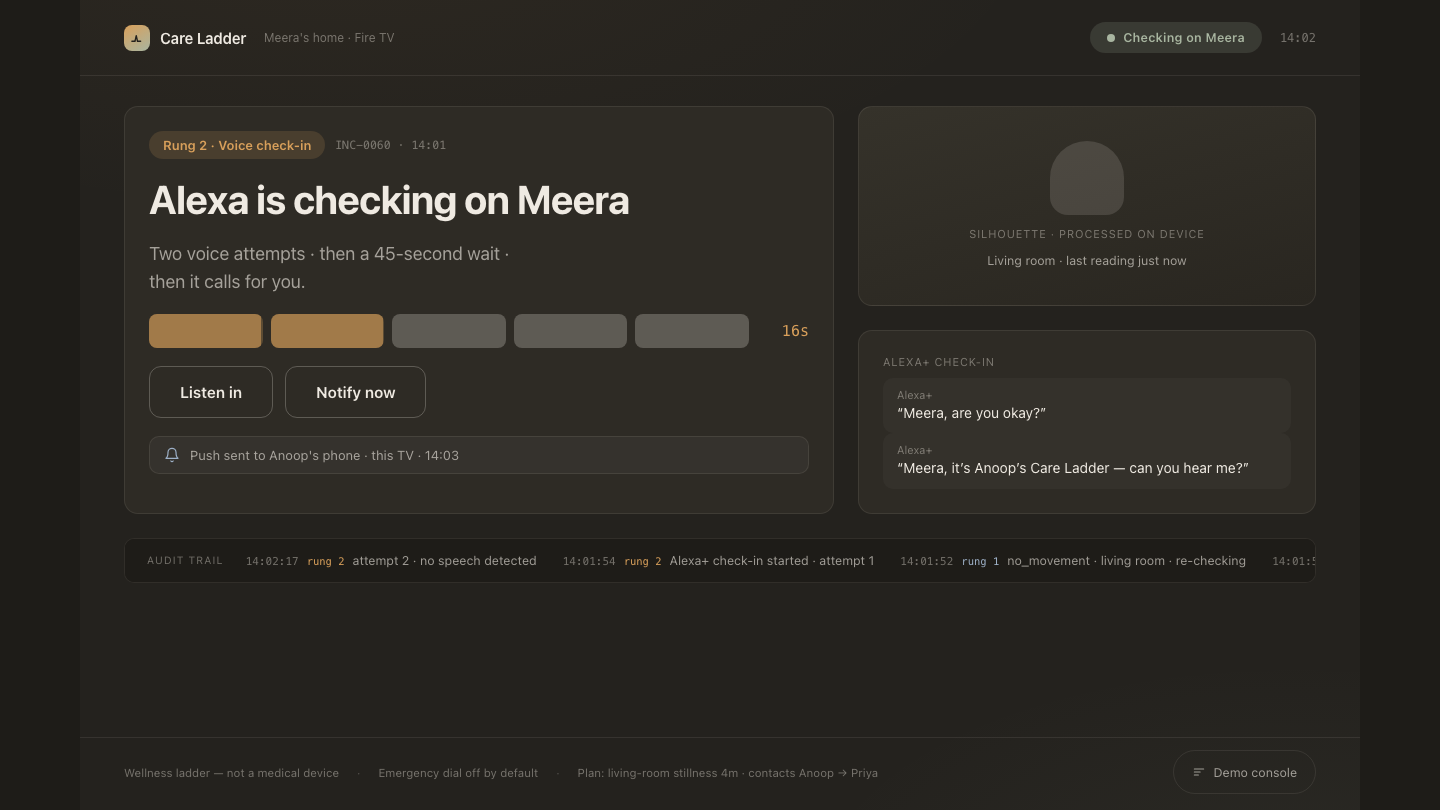
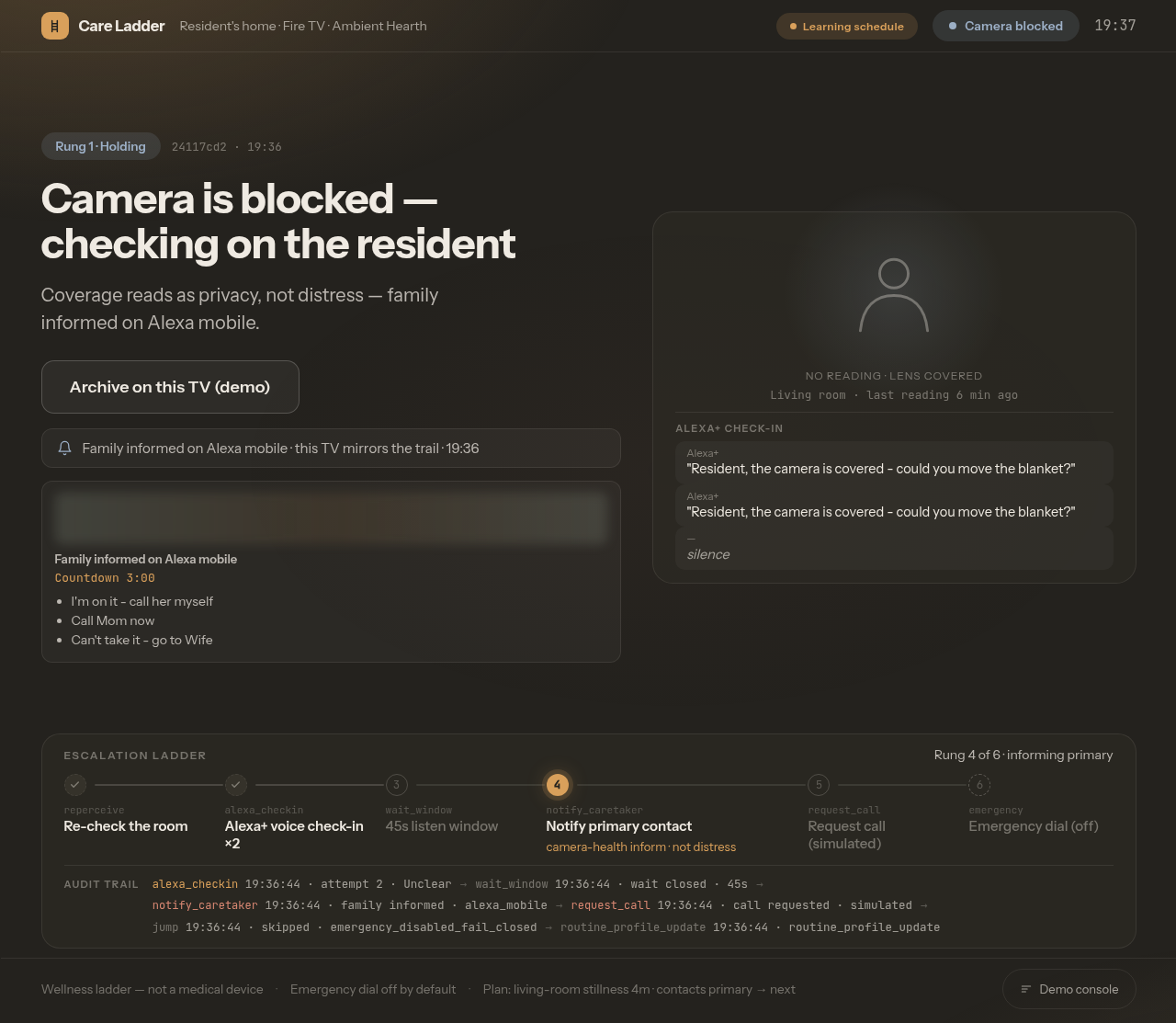
Alexa+ voice check-in on Fire TV (living-room timeline).
-
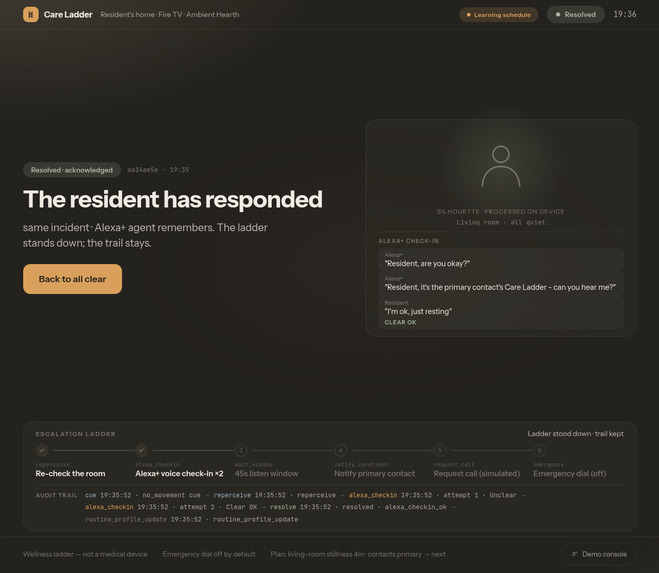
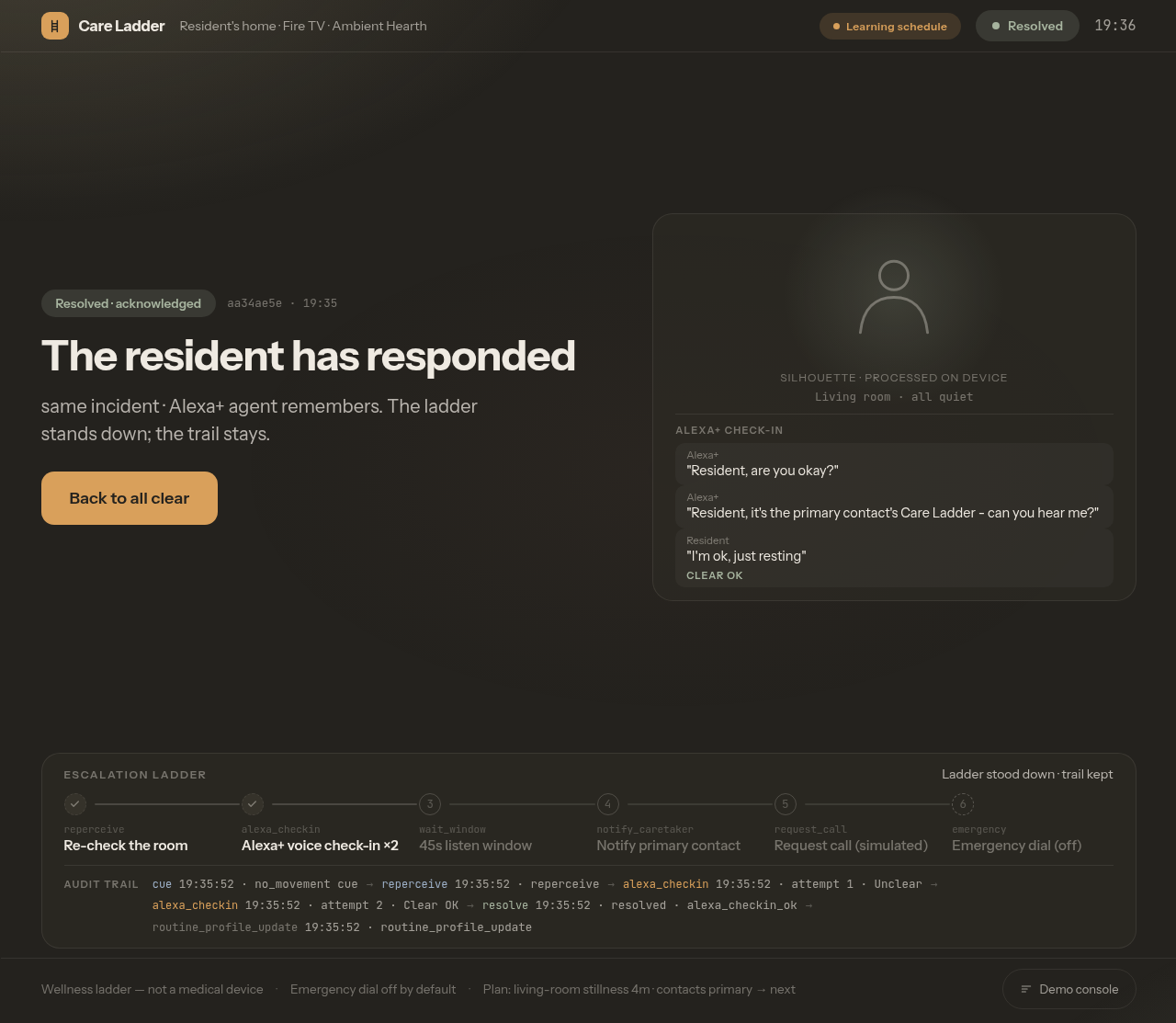
Resident answered Clear OK on Fire TV.
-
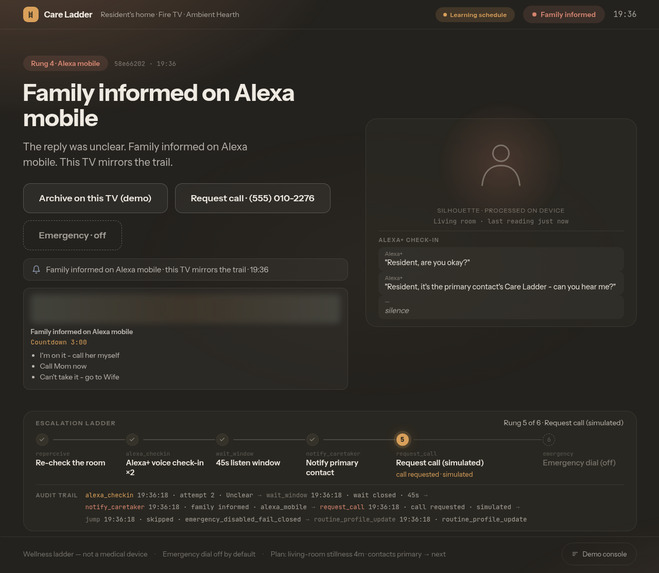
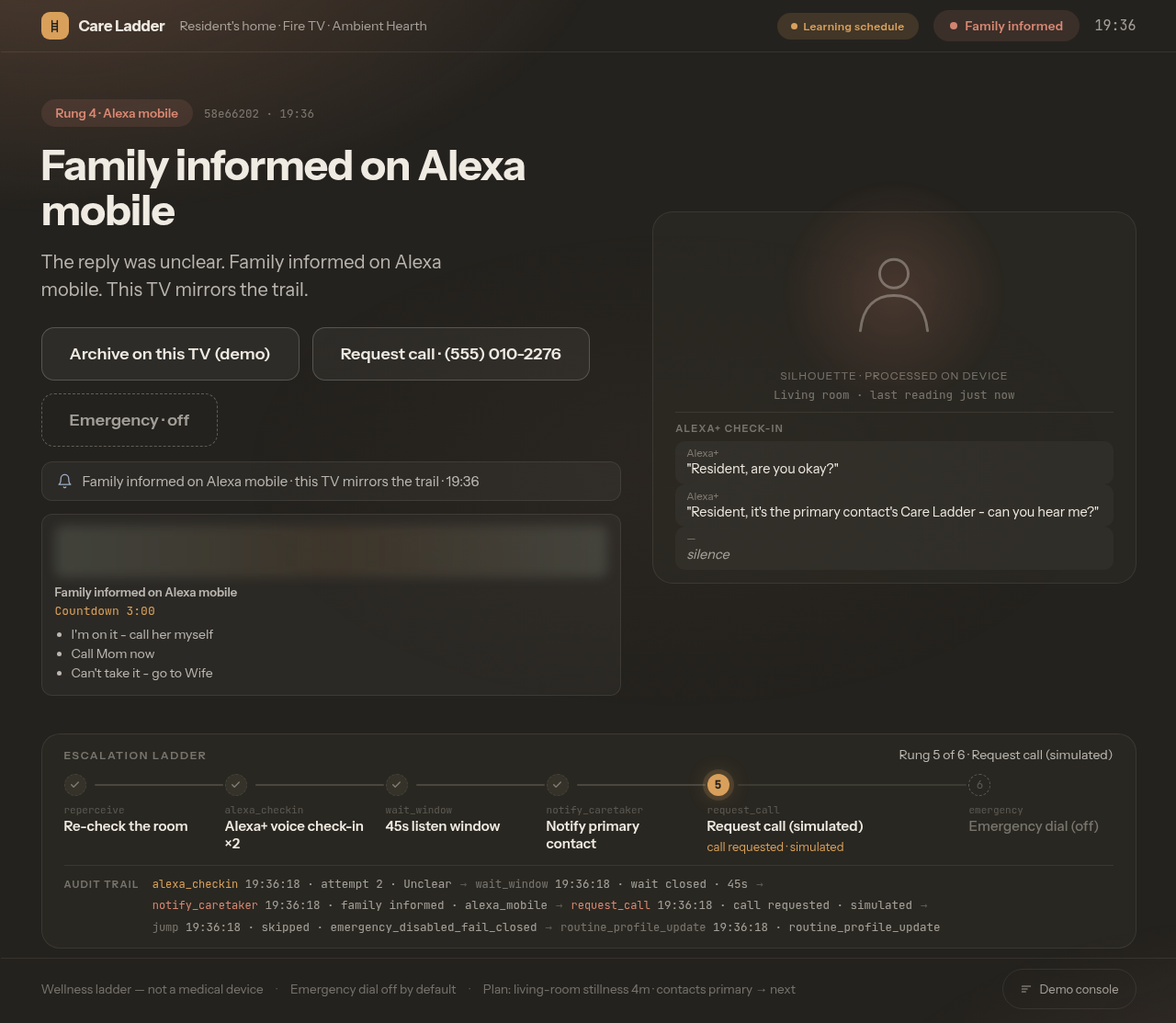
Family informed: caregiver notify mirrored on Fire TV with audit trail.
-
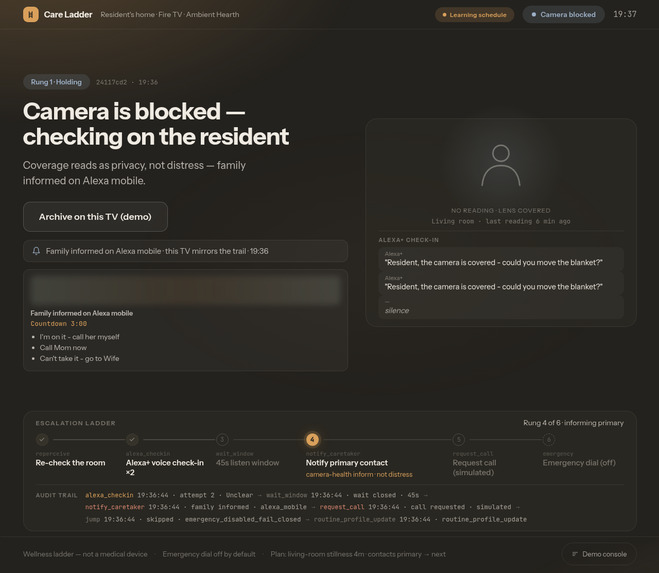
Camera covered is privacy, not distress (Path B).
-
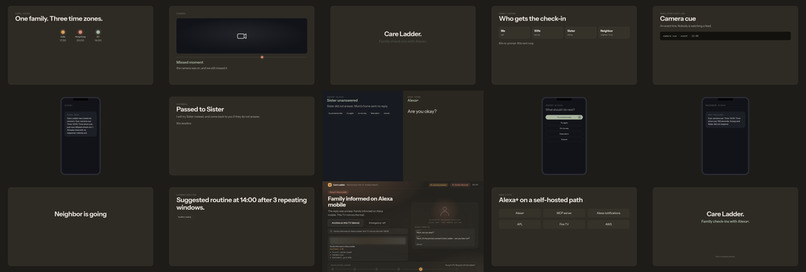
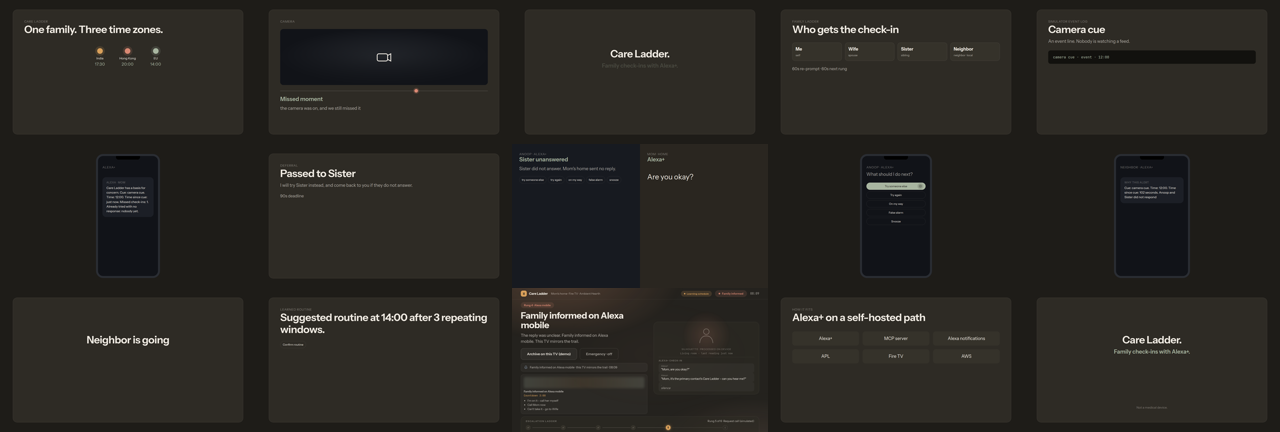
Demo contact sheet: product loop stills.
-
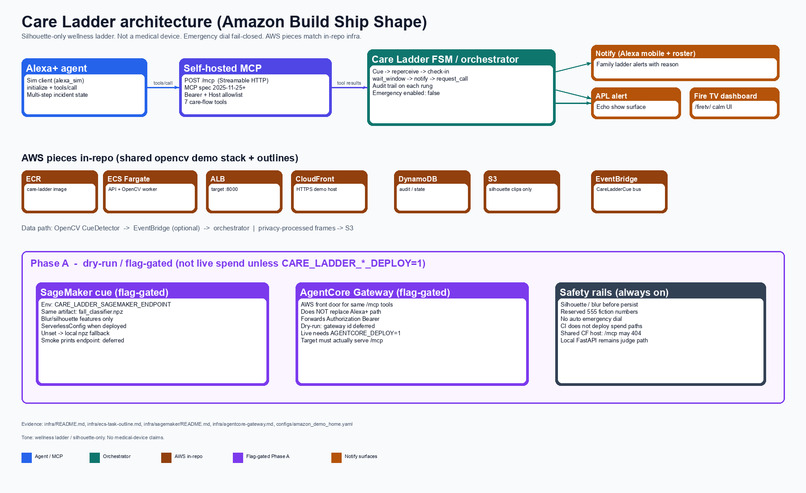
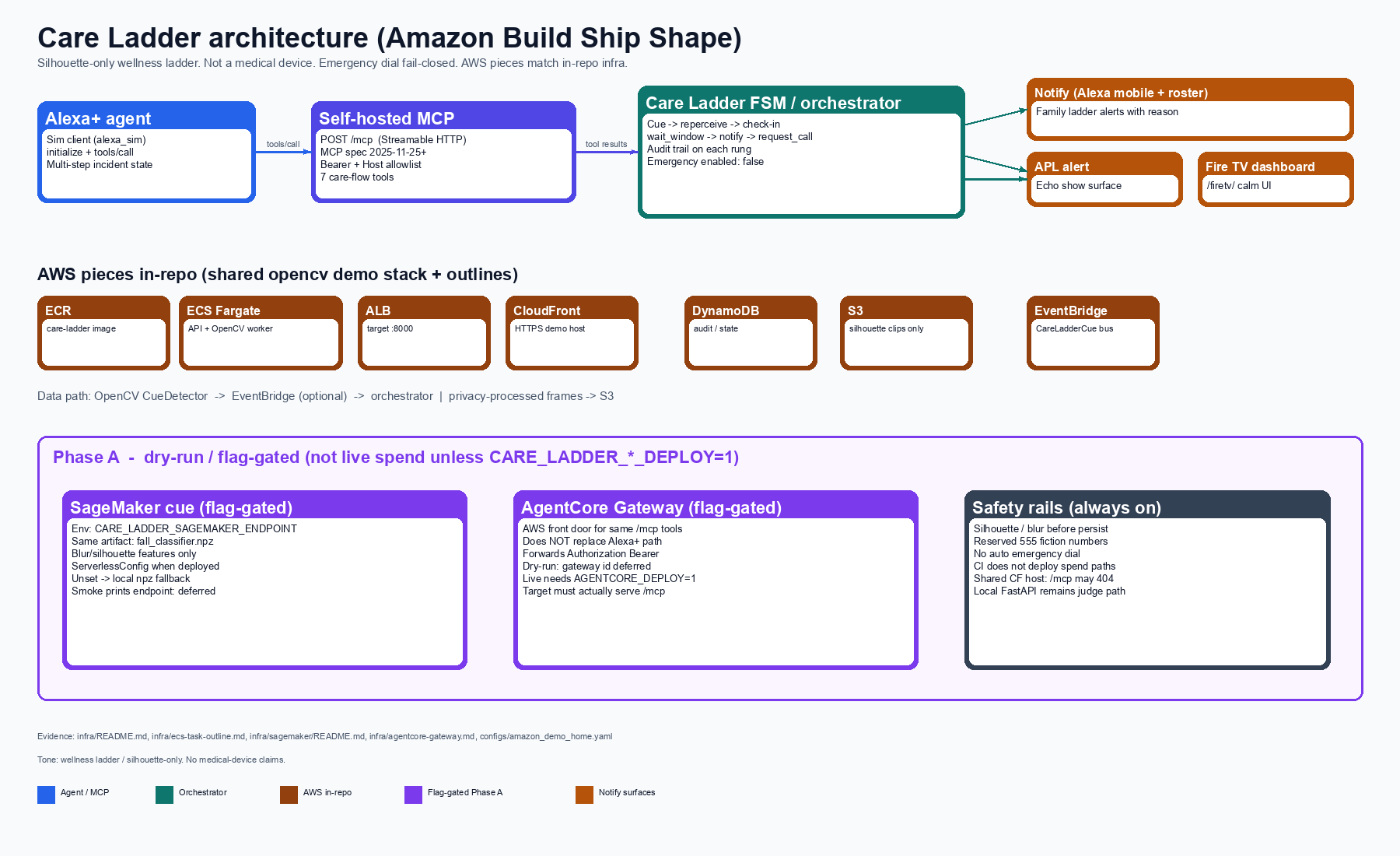
Architecture: Alexa+ MCP to ladder to Fire TV and AWS.
-
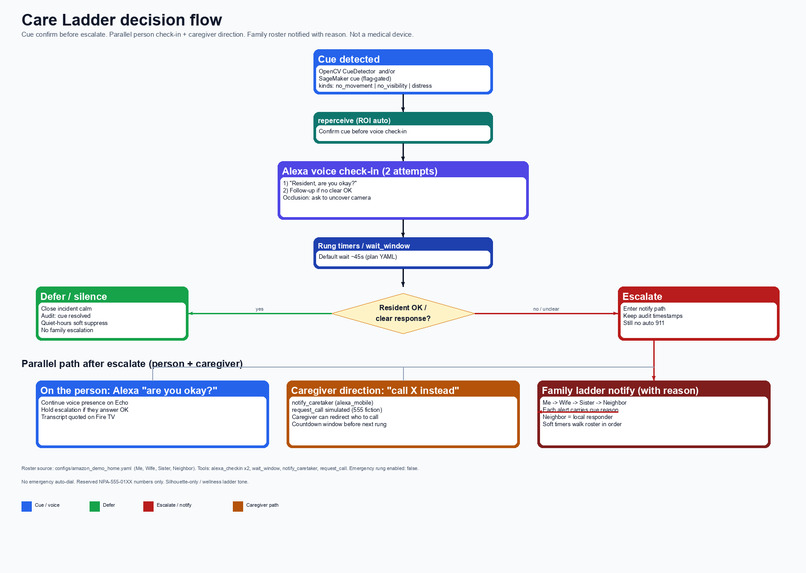
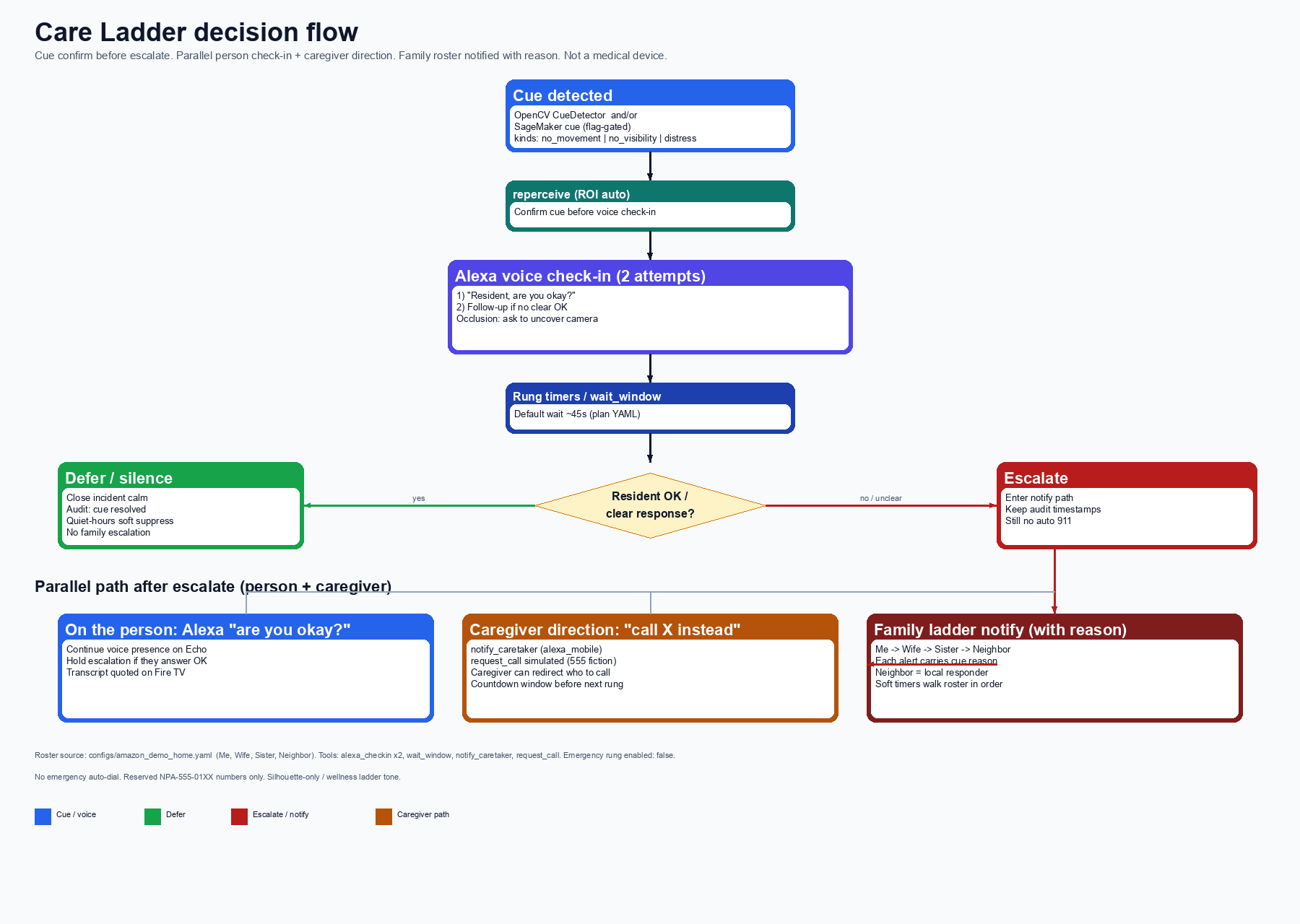
Decision flow: cue, check-in, escalate, family ladder.
Inspiration
My mother lives alone in India. I live in Hong Kong, and my sister lives in the EU. She refused assisted living, and she refused a full-time caretaker. It is her home and her life, and I respect that.
We tried a home camera. She hated being watched, and honestly it did not solve much. Neither my sister nor I could watch a feed 24/7 from opposite sides of the world. She also often forgets to charge her phone, so when she was out of camera view and not answering, we ended up making panicked calls asking neighbors to go check on her.
In the past six months she fell four times. Once she was hurt badly enough that she had to drag herself to reach a phone. That one stays with me.
I did not want another screen to stare at. I wanted something anywhere in her home that could ask her if she is okay, even when her phone is dead, and then make sure the right person in our family actually responds, in the right order, with the reason attached. Nobody watching. Just someone always answering. That became Care Ladder, built on Alexa+.
What it does
Care Ladder turns Alexa+ into a calm check-in and escalation system for families who live far from someone who lives alone.
- Alexa+ checks in by voice, anywhere in the house. It works even when the person's phone is dead.
- Cues start the ladder, not a live feed. A camera cue (from a fall classifier) or a missed learned routine starts the ladder. The camera only acts on cues. Nobody has to watch a feed.
- A family-configured escalation ladder. The family sets the order. Mine is Me, then my wife, then my sister, then our neighbor, who lives in the same city and can physically go check. Care Ladder walks the rungs with soft timers: a re-prompt at 60 seconds, then the next rung after another 60 seconds.
- Every alert carries the reason. The cue type, the time, time since the cue, missed check-ins, and who already did not respond. The neighbor's alert states the basis for concern, so it is not treated as a false alarm.
- Caregiver voice intents on Alexa mobile. Acknowledge, false alarm, on my way, need a second look, snooze (5 minutes), call someone else instead (a deferral with a 90 second deadline), and "how is [household]" (the last cue, the last acknowledgment, and whether things have been open or quiet since).
- When the ladder goes quiet, Alexa+ asks two people at once. If the deferred person does not respond, or the whole ladder goes silent, Alexa+ asks the primary caregiver for direction (try someone else, try again, on my way, false alarm, snooze). In parallel, it asks the person at home, "Are you okay?" Her answer (okay, needs help, or silence) goes straight to the primary caregiver.
- Local responder flow. The neighbor can say "I'm going", and then "she's okay" or "needs help". Each update is reported back to the primary caregiver.
- Learned schedule. After three repeating windows, Care Ladder proposes pinning a routine for a caregiver to confirm. It alerts the roster when the schedule changes. A missed routine triggers a soft escalation, not a fall-level one.
- APL notify card on Alexa. A thumbnail or placeholder, the household label, the time since the cue, and on-screen buttons that mirror the voice options.
- Fire TV (supporting). A 10-foot ambient view of the household's status.
Care Ladder is not a medical device, and it does not call emergency services. It helps a family make sure one of them responds.
N/A this build. No paid tier; family wellness ladder for the hackathon demo.
How we built it
Alexa+ is the heart of Care Ladder. I built a self-hosted MCP (Model Context Protocol) server that Alexa+ talks to over Streamable HTTP. The server holds the ladder logic, the timers, the household state, and the caregiver intents, and Alexa+ turns them into natural conversation: checking in with my mother wherever she is at home, asking me for direction, and taking updates from the neighbor.
- Alexa+ voice intents for caregivers and the local responder, plus the at-home "Are you okay?" check-in.
- Alexa mobile notifications to deliver each alert, with the reason attached.
- APL for the notify card, with buttons that mirror the voice options.
- Fire TV web app for the 10-foot ambient view.
- Python for the server and the ladder engine, and OpenCV for the camera cue pipeline. The fall classifier was trained on a Kaggle fall dataset.
- AWS for hosting: ECS Fargate, ECR, CloudFront, and an Application Load Balancer, with optional DynamoDB, S3, and EventBridge.
- edge-tts (US English neural voices) for the demo video voiceover.
Being honest about where it stands: Care Ladder is not a certified or published Alexa skill yet. Much of the Alexa side is exercised through an in-repo simulator, so the whole ladder can be run and tested end to end. During the project, a real Alexa mobile notification did reach my phone.
Why Alexa+? I switched to Alexa from Google Home when Google Home stopped supporting BluOS devices. Living with Alexa+ day to day, I found it capable and friendlier than Google Home, and friendly is exactly what a check-in for my mother needs to be.
Challenges we ran into
- Designing for silence. The hard case is not someone saying "on my way". It is nobody saying anything. Making the ladder handle a deferral that goes unanswered, or a whole ladder going quiet, without dead ends took the most thought. The answer was to ask the primary caregiver for direction and ask the person at home "Are you okay?" at the same time.
- Making alerts trustworthy. An alert that just says "check on her" gets ignored. Every alert had to carry its reason (cue, time, time since cue, missed check-ins, who already did not respond), especially for the neighbor, who needs to know this is real.
- Respecting privacy. My mother hated being watched. The camera had to act only on cues, so nobody ever needs to look at a feed.
- Testing Alexa without a published skill. Since this is not a certified skill, I built an in-repo simulator to exercise the Alexa side, while still getting a real Alexa mobile notification through to my phone.
- Keeping it calm. Soft timers, gentle re-prompts, and soft escalation for missed routines, so the system does not treat every late breakfast like an emergency.
Accomplishments that we're proud of
- A complete escalation ladder that walks real family roles in order, with soft timers, deferrals, and a path forward when people go silent.
- The parallel moment: Alexa+ asking me what to do while also asking my mother "Are you okay?" at home, and bringing her answer straight back to me.
- Alerts that explain themselves, so a neighbor knows the basis for concern.
- A real Alexa mobile notification reaching my phone during the project.
- 204 automated tests passing.
- The whole project is public and MIT licensed.
What we learned
- Families do not need more video. They need the right person to respond, and to know why.
- Voice anywhere in the house matters more than any app when the person you care about forgets to charge her phone.
- Alexa+ through MCP is a natural fit for this kind of conversation. The server holds the rules, and Alexa+ makes them sound human.
- Silence is a state that has to be designed for, not an error.
- Good escalation is gentle. Re-prompts and soft timers make people more willing to keep a system like this switched on.
What's next
- Taking Care Ladder from the simulator toward a certified, published Alexa+ experience.
- Running it with my own family, with my mother, my wife, my sister, and our neighbor on the ladder.
- Turning on the optional AWS pieces (DynamoDB, S3, EventBridge) for persistent history and scheduling.
- Refining the learned schedule with real caregiver confirmations.
- Growing the Fire TV ambient view as a supporting surface.
Built With
- alexa+
- alexa-mobile-notifications
- amazon-cloudfront
- amazon-dynamodb
- amazon-ecr
- amazon-eventbridge
- amazon-web-services
- apl-(alexa-presentation-language)
- aws-application-load-balancer
- aws-ecs-fargate
- edge-tts
- fire-tv
- kaggle
- model-context-protocol-(mcp)
- opencv
- python
- streamable-http

Log in or sign up for Devpost to join the conversation.