Inspiration
The inspiration behind CARE-Graph AI stemmed from a critical paradox in modern data ecosystems: while artificial intelligence and automated geospatial analytics advance rapidly, the traditional ecological knowledge (TEK) and ancestral territories of indigenous peoples in the Amazon basin (such as Vale do Javari and Xingu Park) are frequently treated as public domain commodities. Without robust legal and technical barriers, unauthorized commercial entities can exploit genetic resources and cultural heritage, bypassing Free, Prior, and Informed Consent (FPIC) and violating frameworks such as Brazilian Biodiversity Law (Law 13.123/2015). We were inspired to build a system that transforms abstract ethical guidelines into active, enforceable software code to operationalize the CARE Principles (Collective benefit, Authority to control, Responsibility, Ethics).
What it does
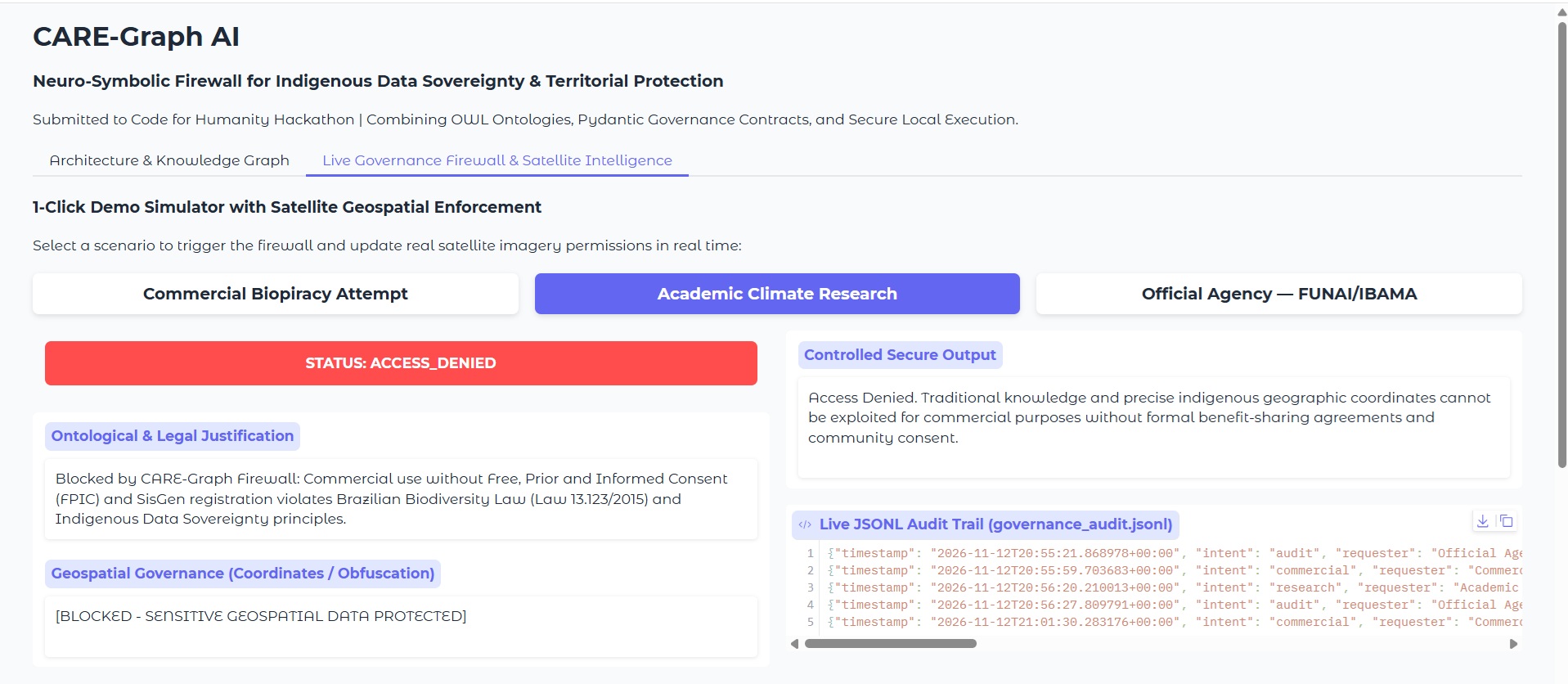
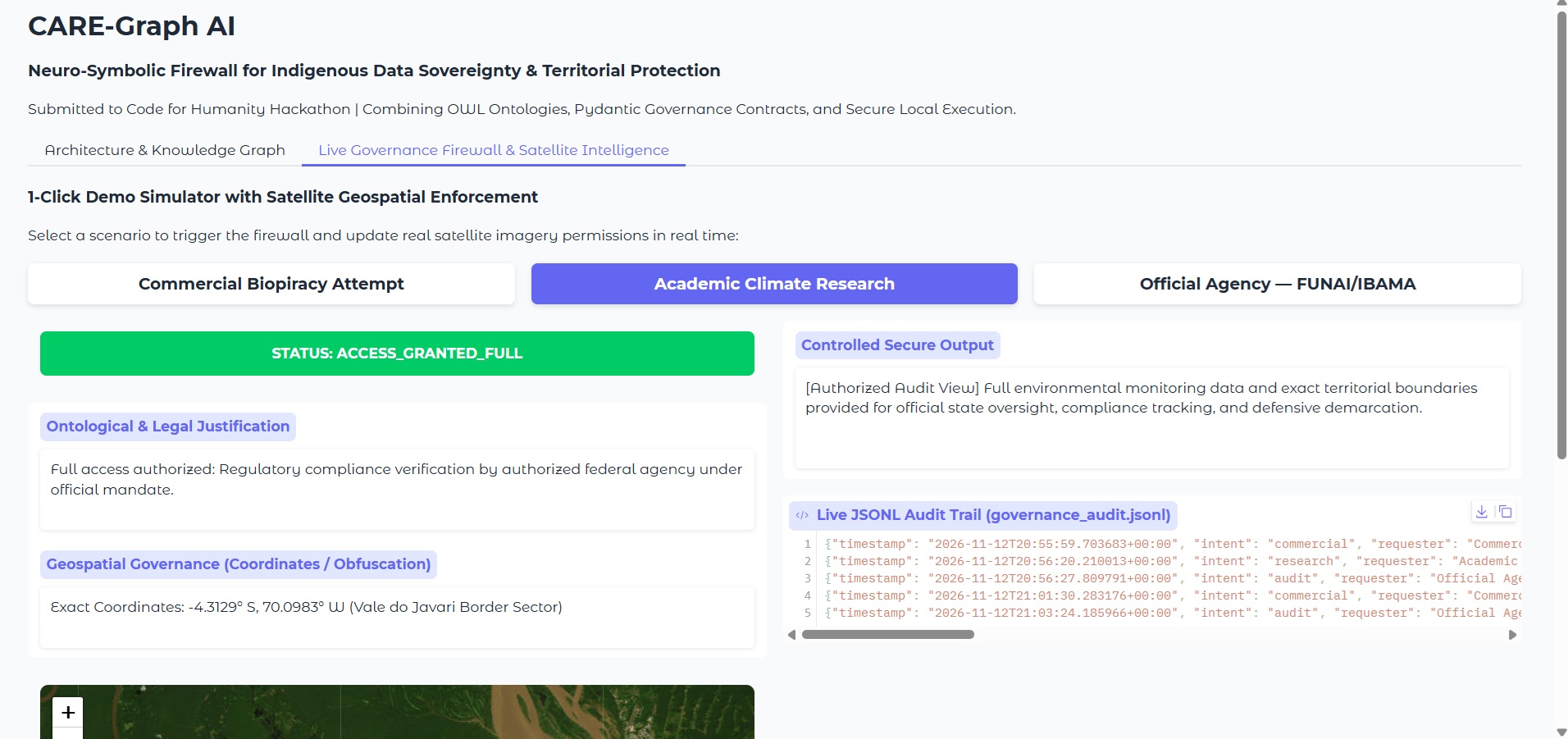
CARE-Graph AI acts as a real-time neuro-symbolic governance firewall positioned directly between sensitive downstream databases and external API or portal queries. The system performs the following core functions:
- Symbolic Legal Reasoning: Evaluates incoming request metadata against formal OWL ontologies via
owlready2to enforce compliance with indigenous jurisprudence and statutory regulations. - Deterministic Governance Contracts: Utilizes Pydantic to enforce strict structural type safety and validation schemas for every decision payload.
- Tier-Based Geospatial Enforcement: Dynamically adapts high-resolution satellite imagery (Esri World Imagery via
folium) based on authorization tiers—automatically blocking unauthorized access, obfuscating granular GPS coordinates for academic research ($ACCESS_GRANTED_OBFUSCATED$), or unlocking full precision strictly for authorized state oversight ($ACCESS_GRANTED_FULL$). - Immutable Audit Trail: Cryptographically records every evaluation event into an append-only
JSONLaudit stream for absolute transparency and accountability.
How we built it
CARE-Graph AI was engineered using a robust hybrid architecture combining symbolic logic and modern Python tooling:
- Ontology & Reasoning Engine: We developed custom OWL ontologies using
owlready2to model semantic relationships between protected territories, vulnerability tiers, traditional knowledge nodes, and legal frameworks. - Type Safety & Validation: We built core request ingestion and decision serialization models using Pydantic contracts to guarantee zero policy drift or structural ambiguity.
- Geospatial & Interface Layer: We integrated Gradio for interactive real-time simulation and deployed dynamic map tile rendering using Folium sandboxed in secure UI widgets.
- Logging Pipeline: We implemented a cryptographic, append-only
governance_audit.jsonllogging system to track all transaction metadata.
Challenges we ran into
- Bridging Legal Logic and Code: Translating context-dependent indigenous jurisprudence and statutory compliance rules (like Law 13.123/2015) into rigid ontological axioms required careful iterative refinement to ensure the system reasoned accurately without loopholes.
- Balancing Geospatial Utility and Security: Handling remote sensing data presented a delicate trade-off: ensuring that legitimate academic research could access broad ecological context ($E_{context}$) without ever exposing the granular, life-threatening coordinate vectors ($v_{gps}$) of isolated communities.
Accomplishments that we're proud of
- Successfully operationalizing the CARE Principles into executable, production-grade software code rather than static documentation.
- Building a seamless neuro-symbolic bridge where symbolic reasoning (
owlready2) and deterministic validation (Pydantic) work in perfect harmony. - Implementing a dynamic, tier-based geospatial masking mechanism that turns satellite maps into active instruments of territorial protection.
What we learned
- We gained profound insights into how technical architecture can actively defend human rights and data sovereignty, shifting the paradigm from extractive digital colonialism to community-led data stewardship.
- We mastered the practical integration of neuro-symbolic pipelines, discovering how combining symbolic interpretability with modern developer frameworks provides the ideal foundation for high-stakes legal and governance applications.
What's next for Care Graph AI
- Multi-Community Ontology Expansion: Scaling our OWL ontologies to encompass broader indigenous jurisprudence models across other Amazonian biomes and international indigenous territories.
- Decentralized Audit Storage: Integrating cryptographic ledger mechanisms (such as verifiable append-only trees) for decentralized indigenous council oversight.
- Production API Gateway Deployment: Packaging the firewall as a lightweight, containerized microservice middleware ready for direct integration into official governmental and institutional data portals.
