-
-
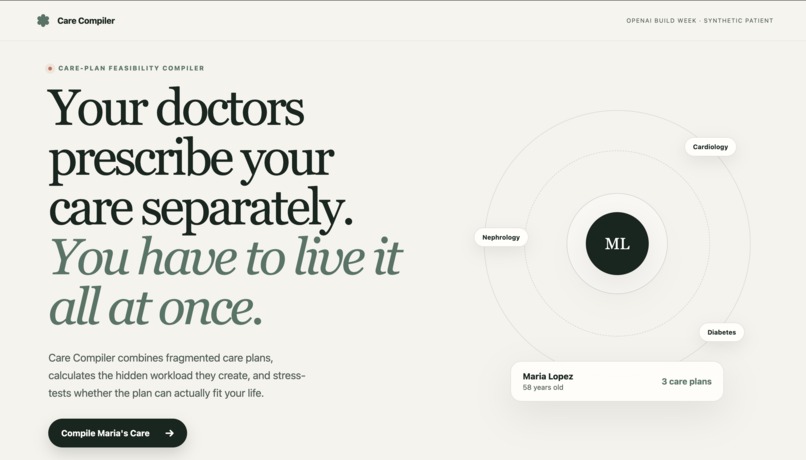
Care Compiler Overview
-
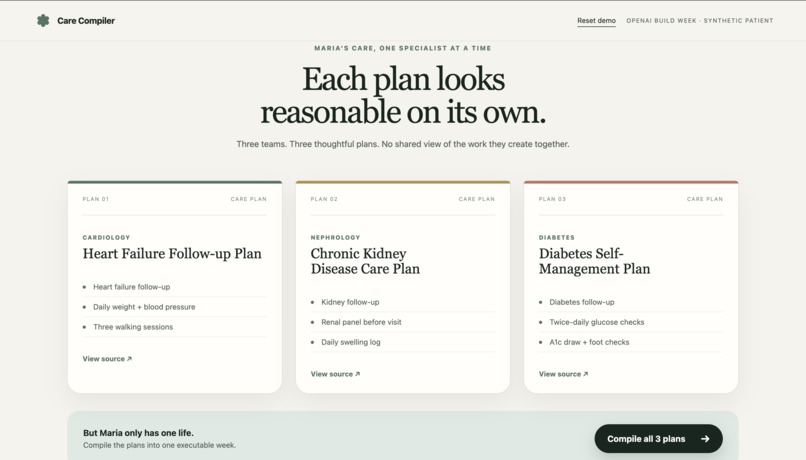
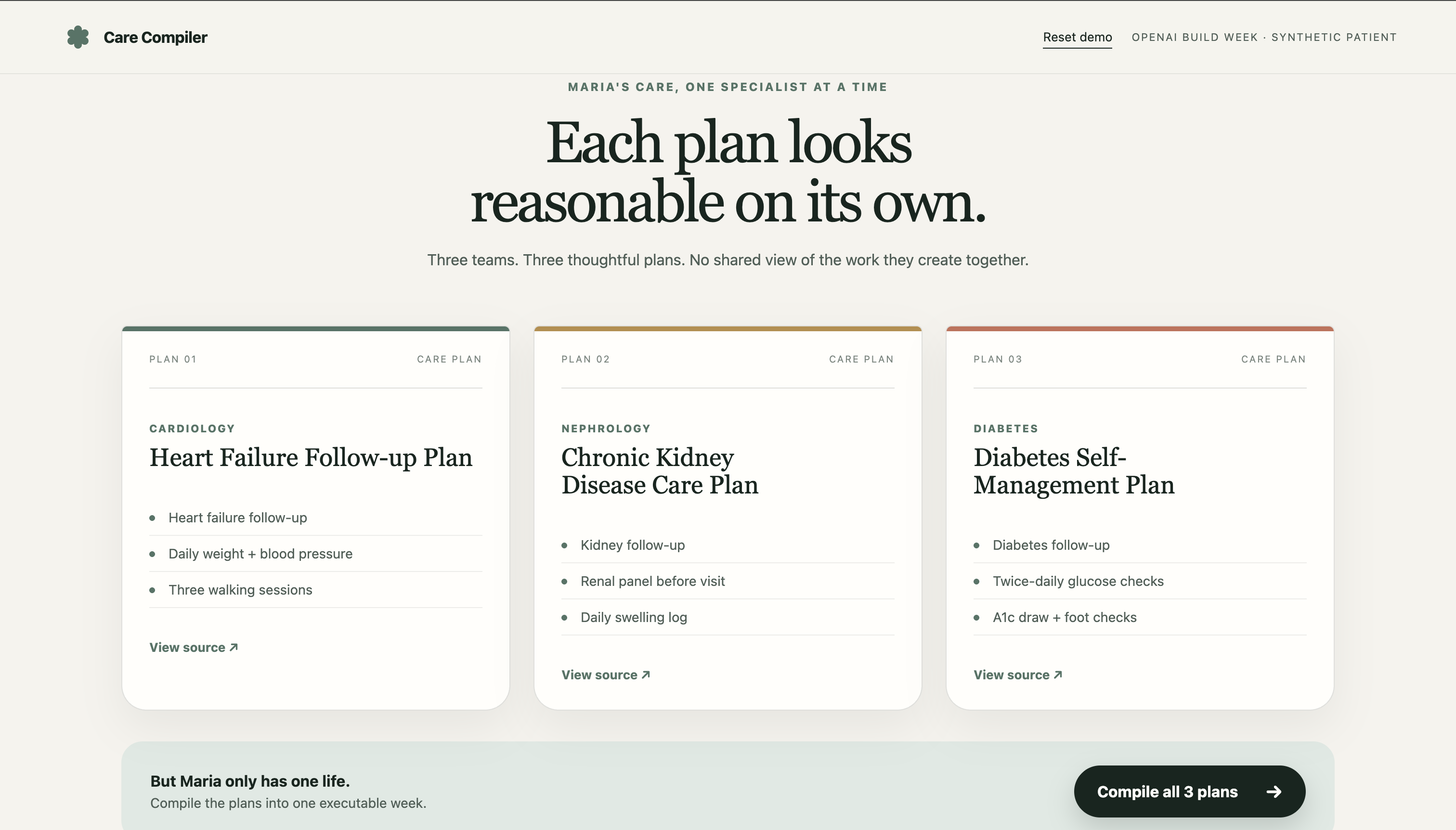
Individual Care Plans
-
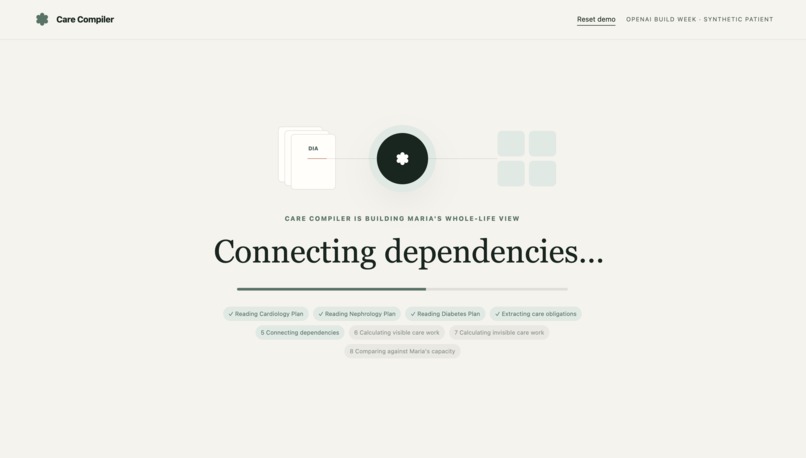
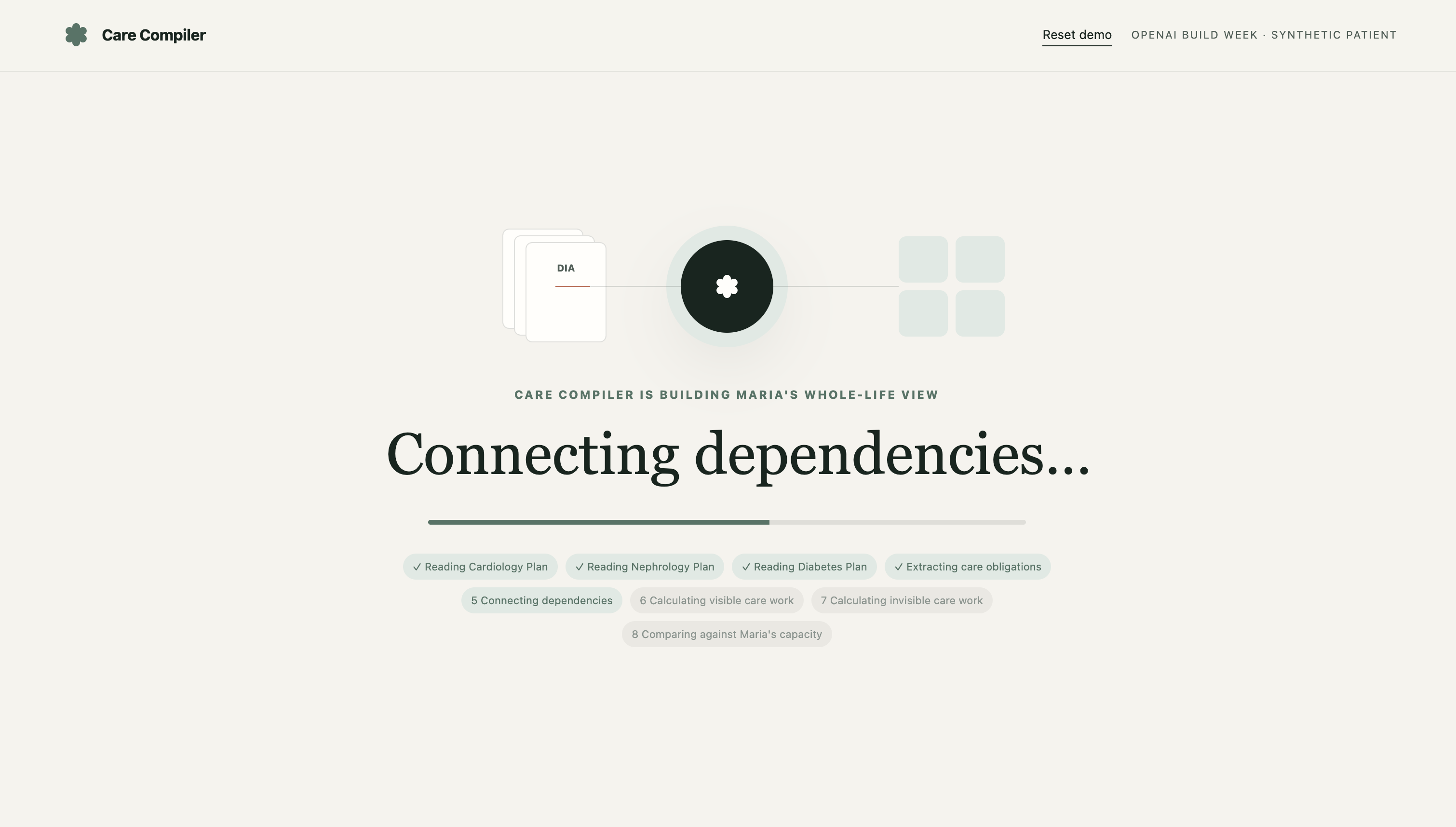
AI Care Compilation
-
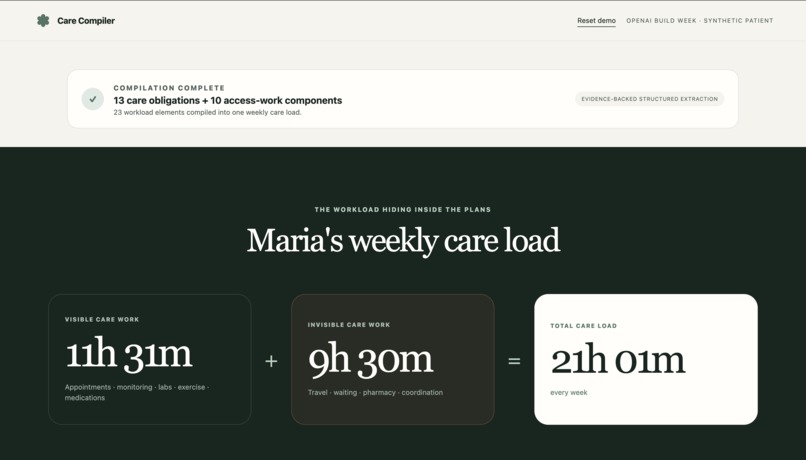
Weekly Care Burden
-
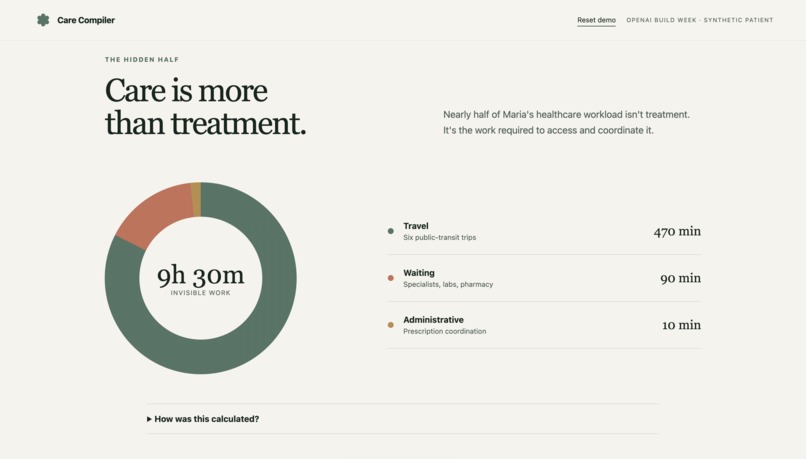
Invisible Care Work
-
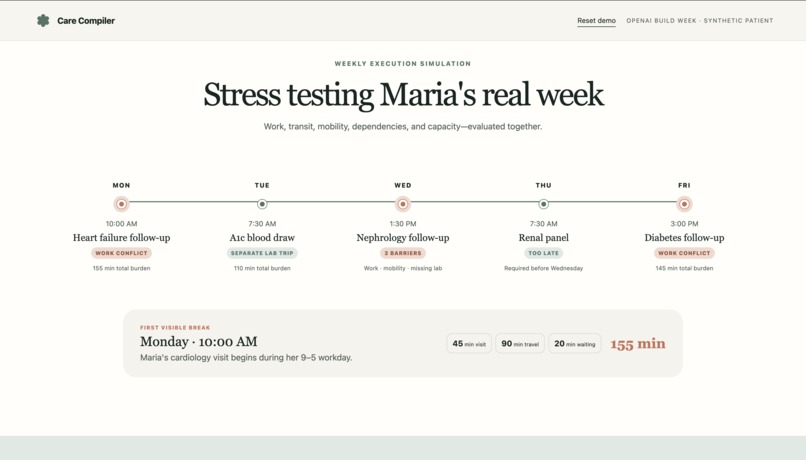
Weekly Plan Simulation
-
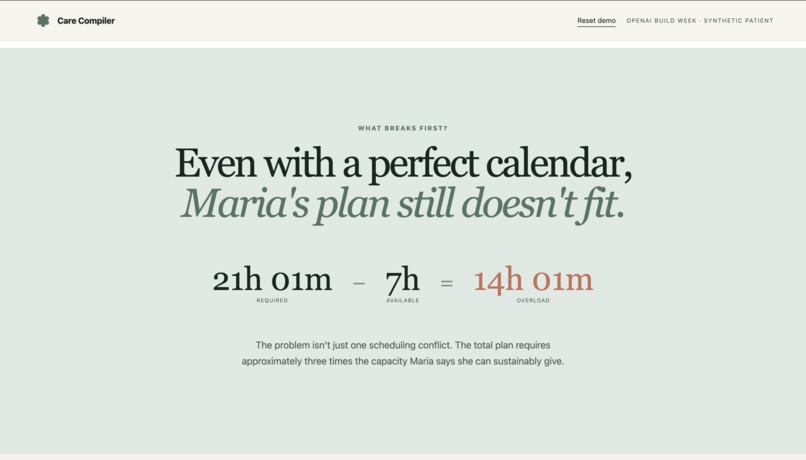
Patient Capacity Overload
-
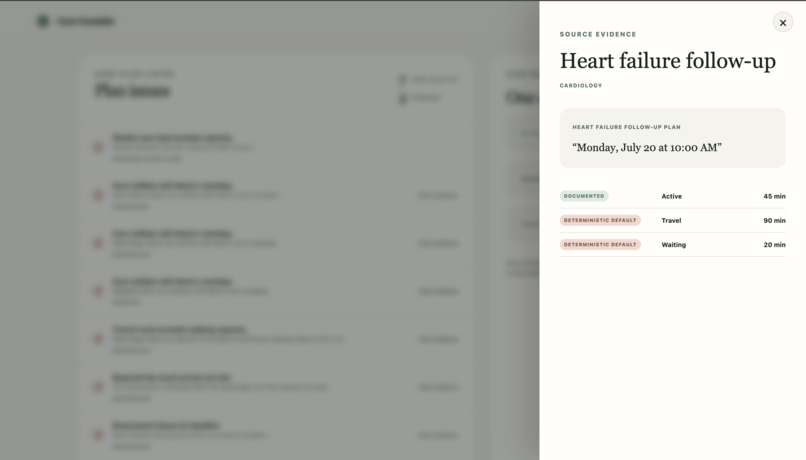
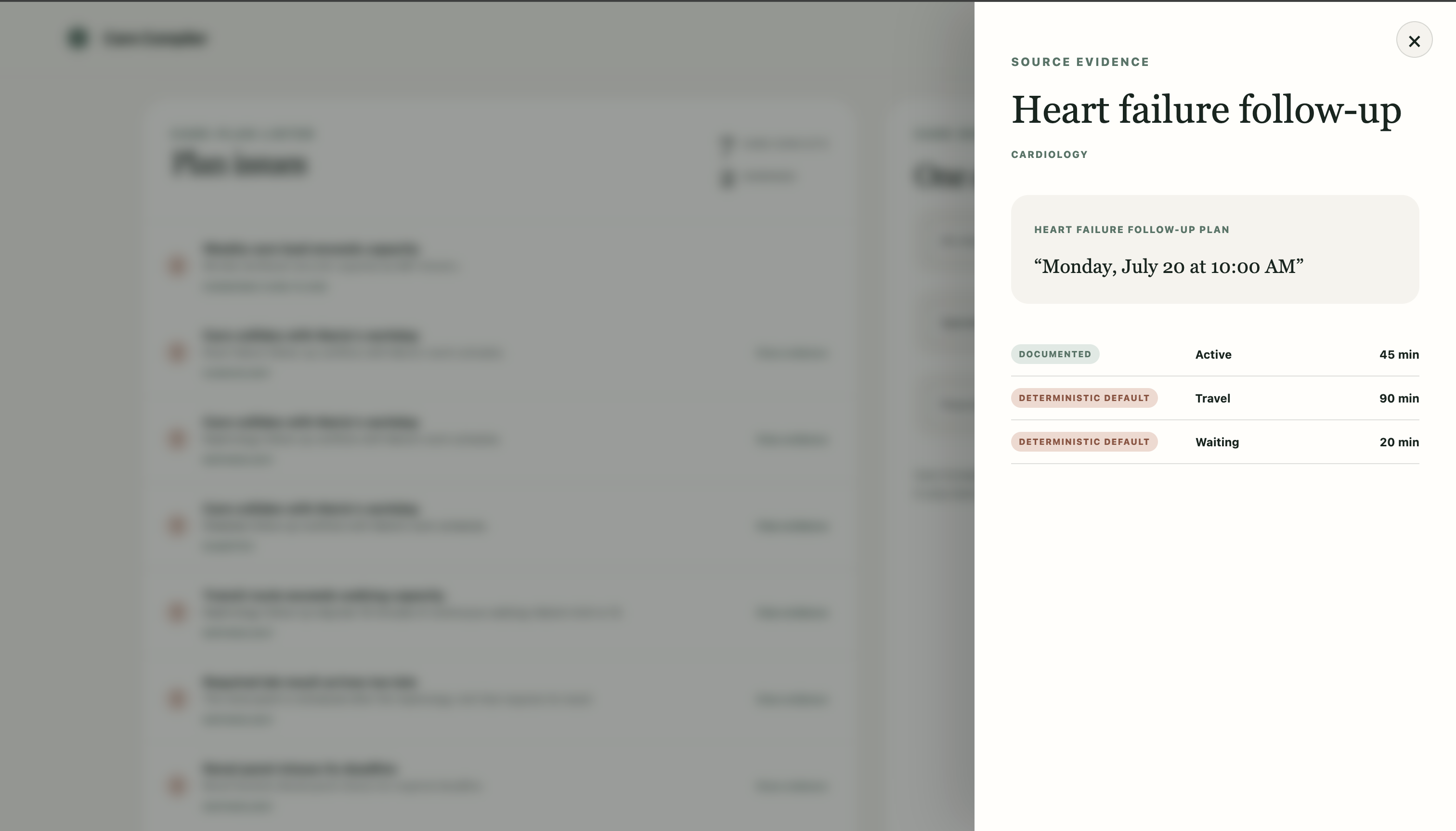
Cardiology Source Evidence
-
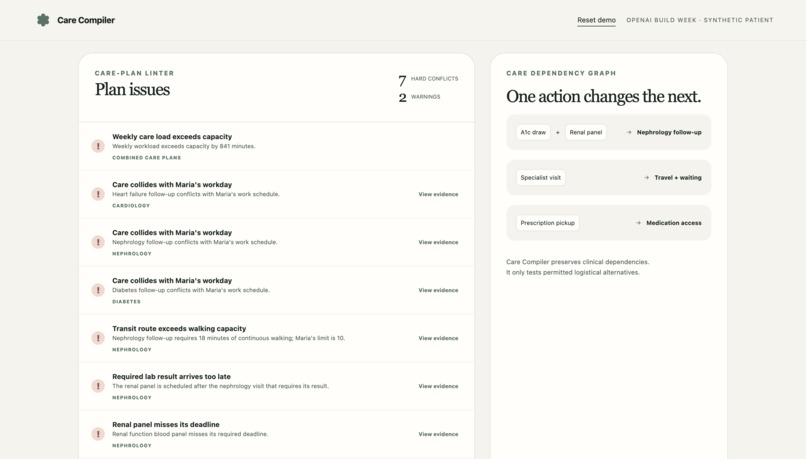
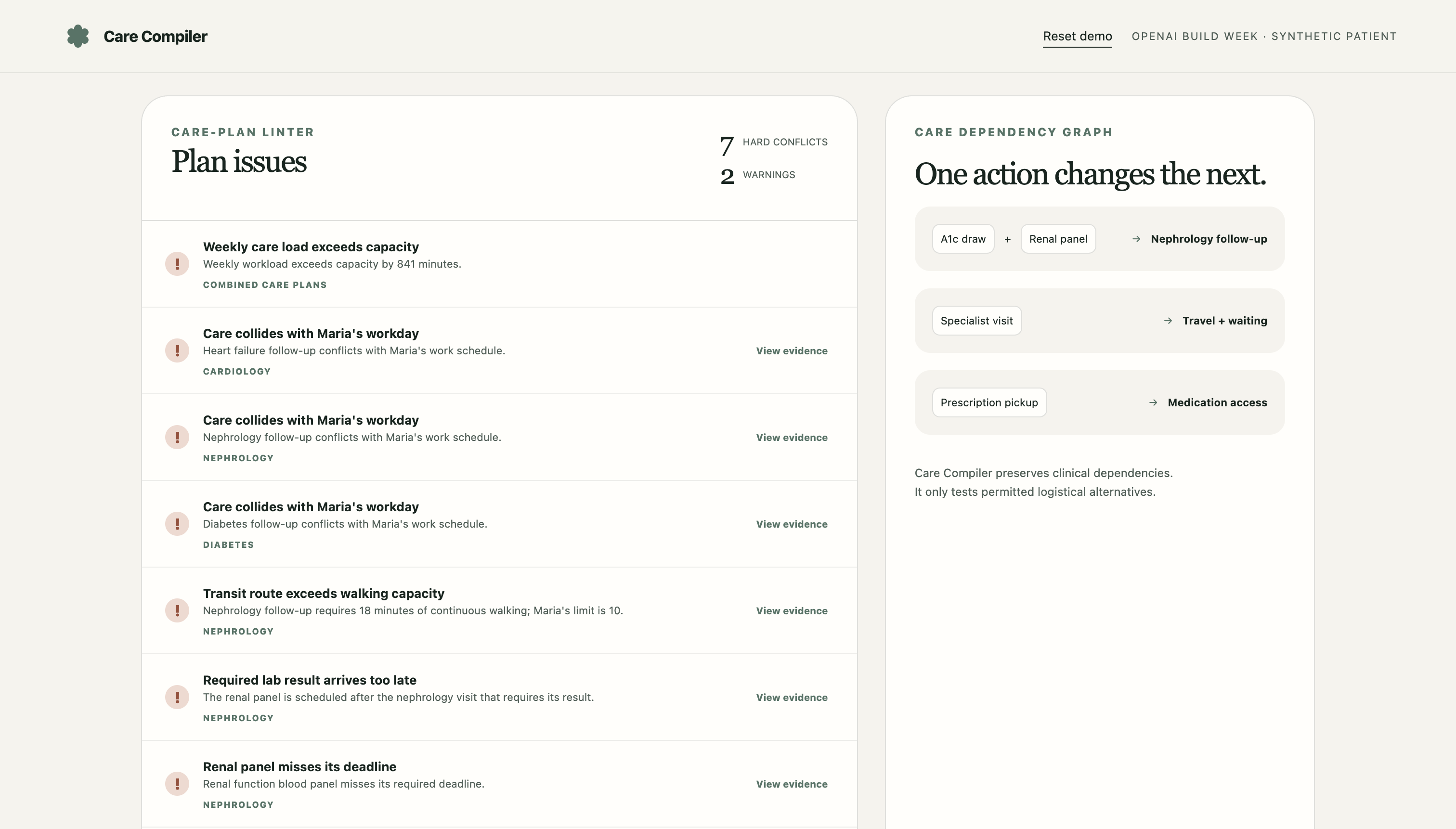
Care Plan Conflict Detection
-
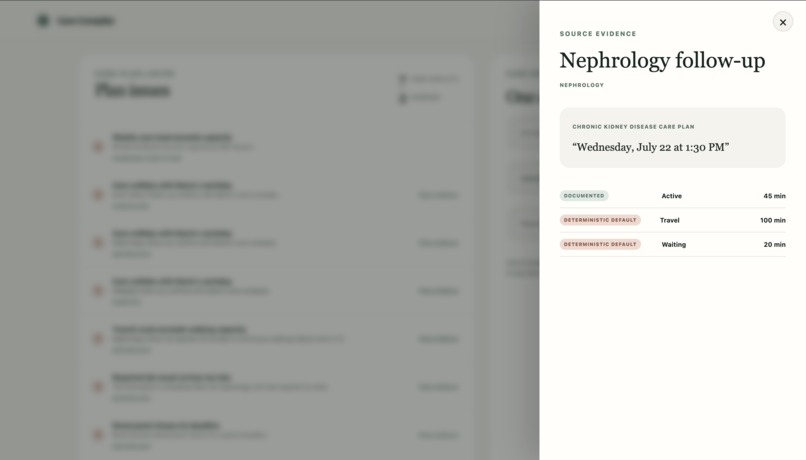
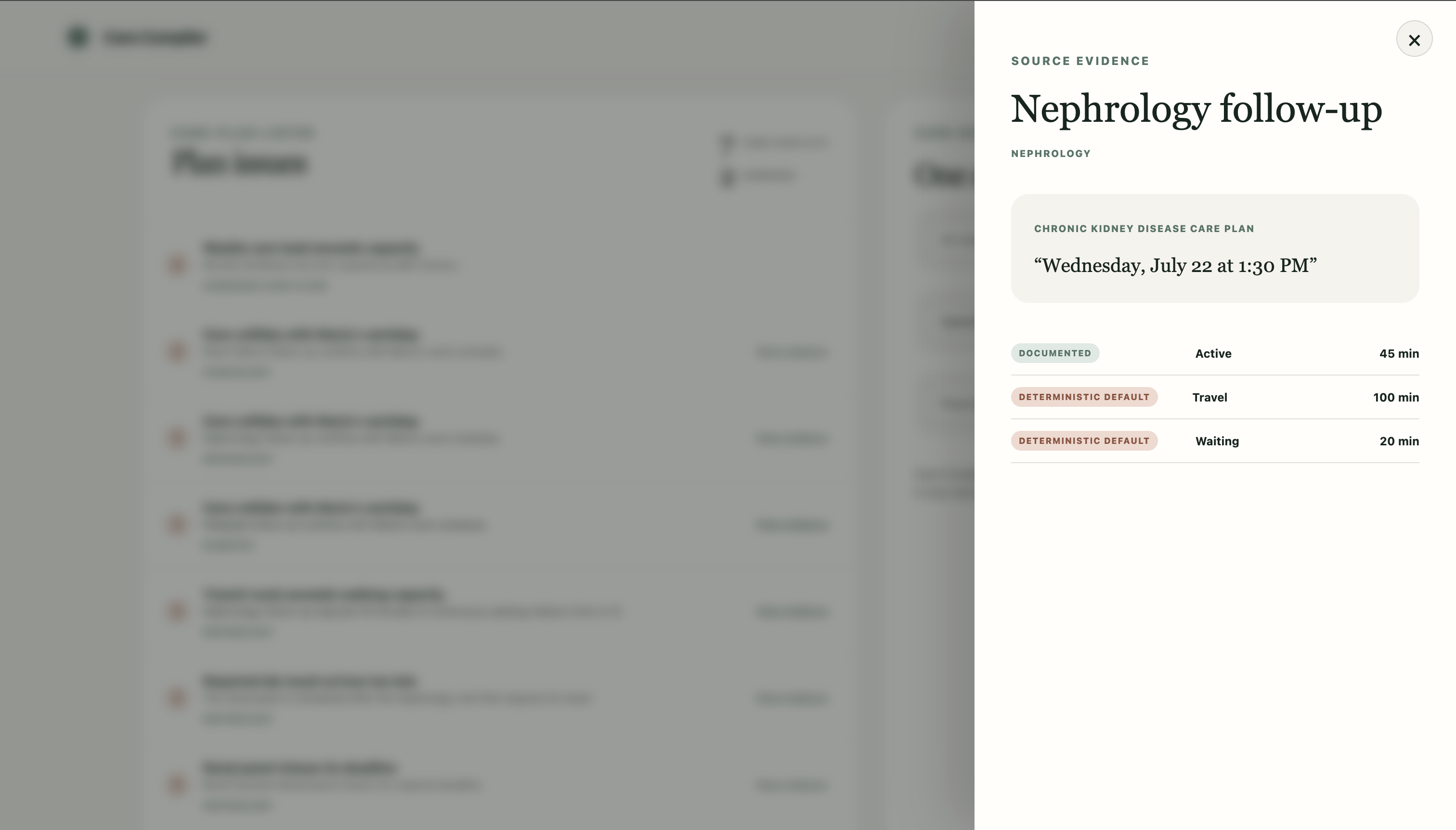
Nephrology Source Evidence
-
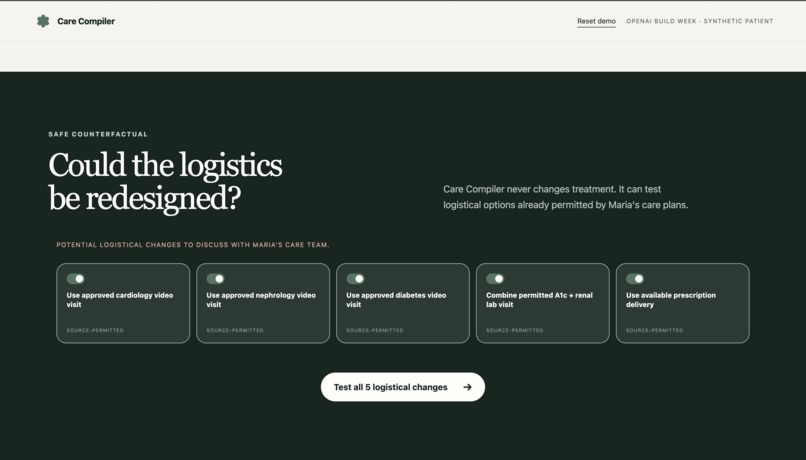
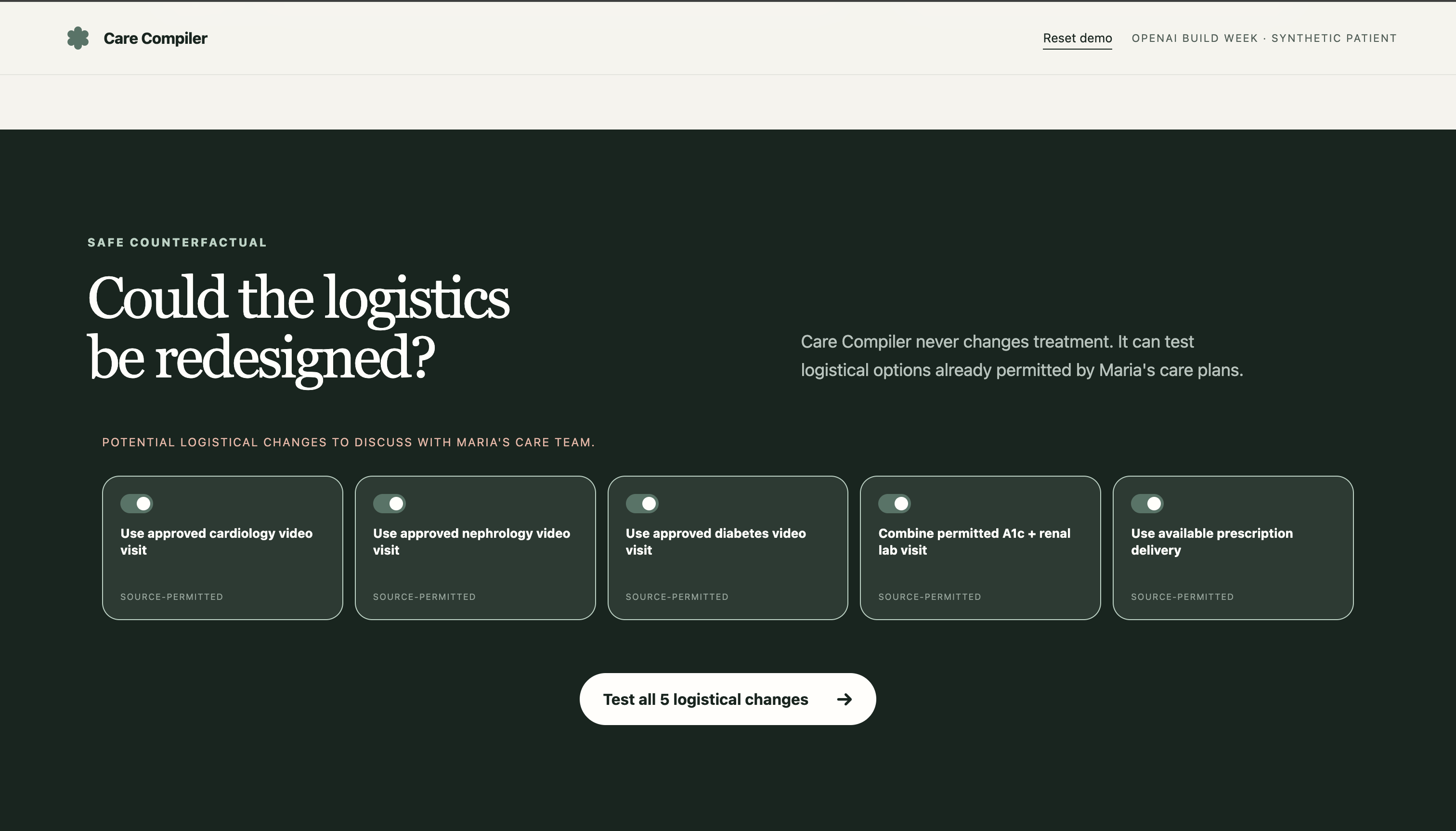
Logistical Care Redesign
-
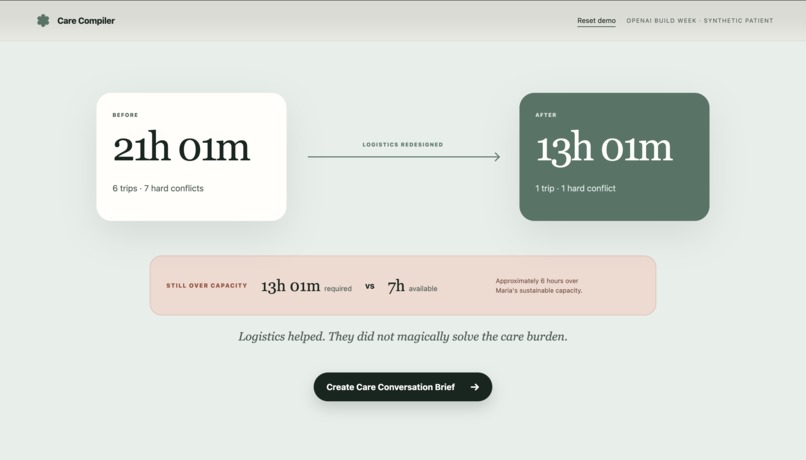
Before-and-After Comparison
-
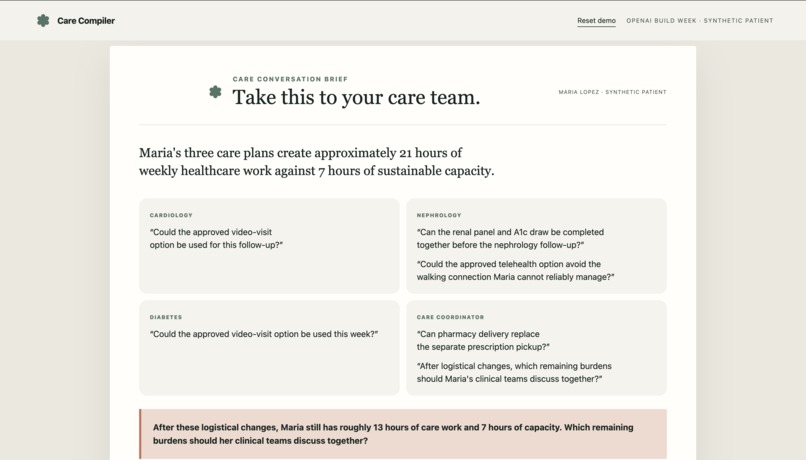
Care Conversation Brief
-

Patient-Centered Care
Inspiration
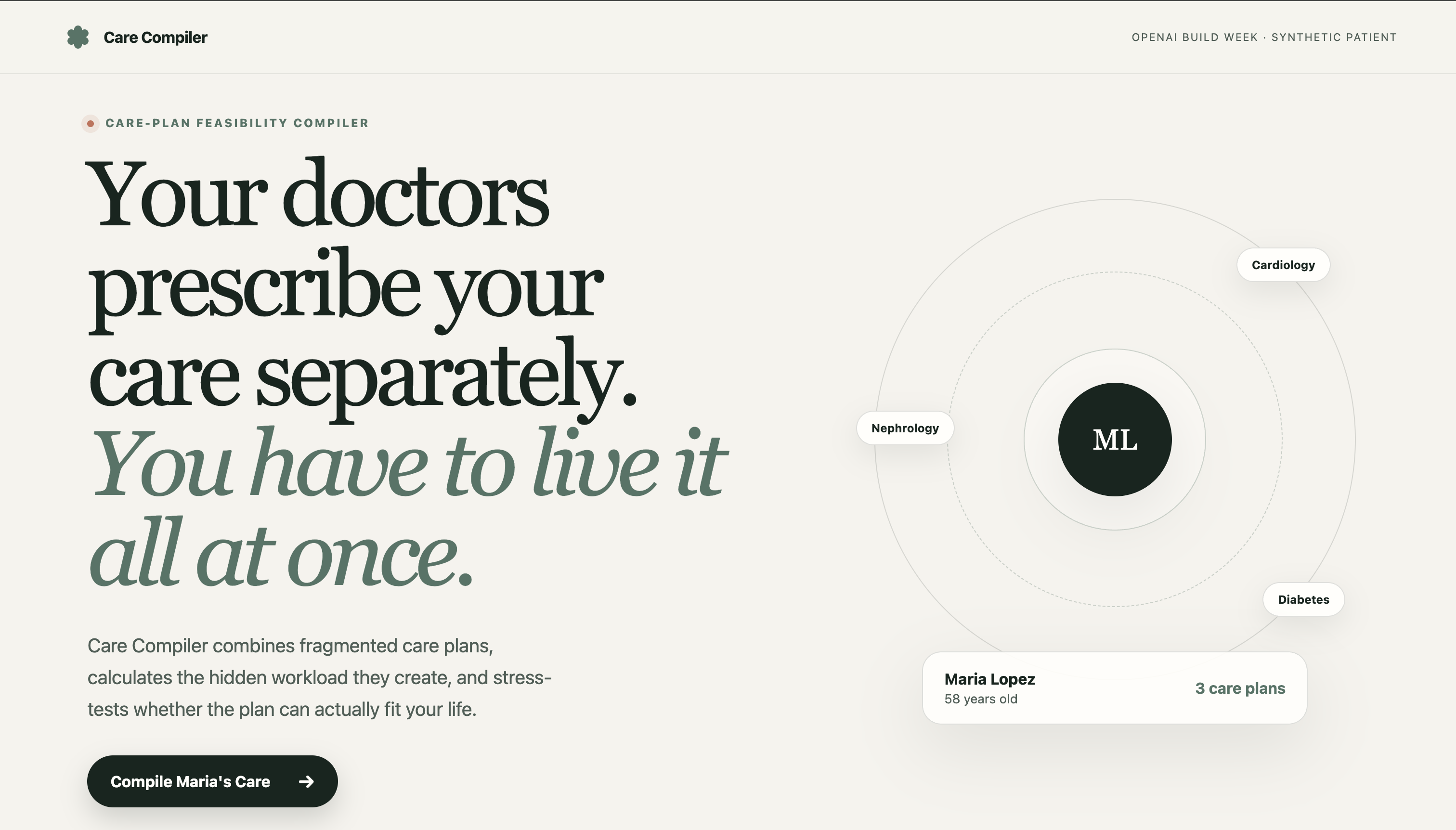
Care is usually prescribed one condition at a time, but patients have to live all of it at once.
Research on treatment burden shows that managing multiple chronic conditions can create substantial cumulative work across appointments, medications, monitoring, travel, waiting, and coordination.
We wanted to ask:
What if every care plan is medically reasonable, but the combined plan is practically impossible to execute?
What it does
Care Compiler combines fragmented care plans with a patient’s real-life constraints and asks:
Can this person actually live this plan?
For the Build Week demo, we use Maria, a synthetic patient, with three preloaded care plans:
- Cardiology
- Nephrology
- Diabetes
Her synthetic Life Capacity Profile includes her work schedule, transportation, mobility limitations, support availability, and sustainable weekly care capacity.
Care Compiler reveals:
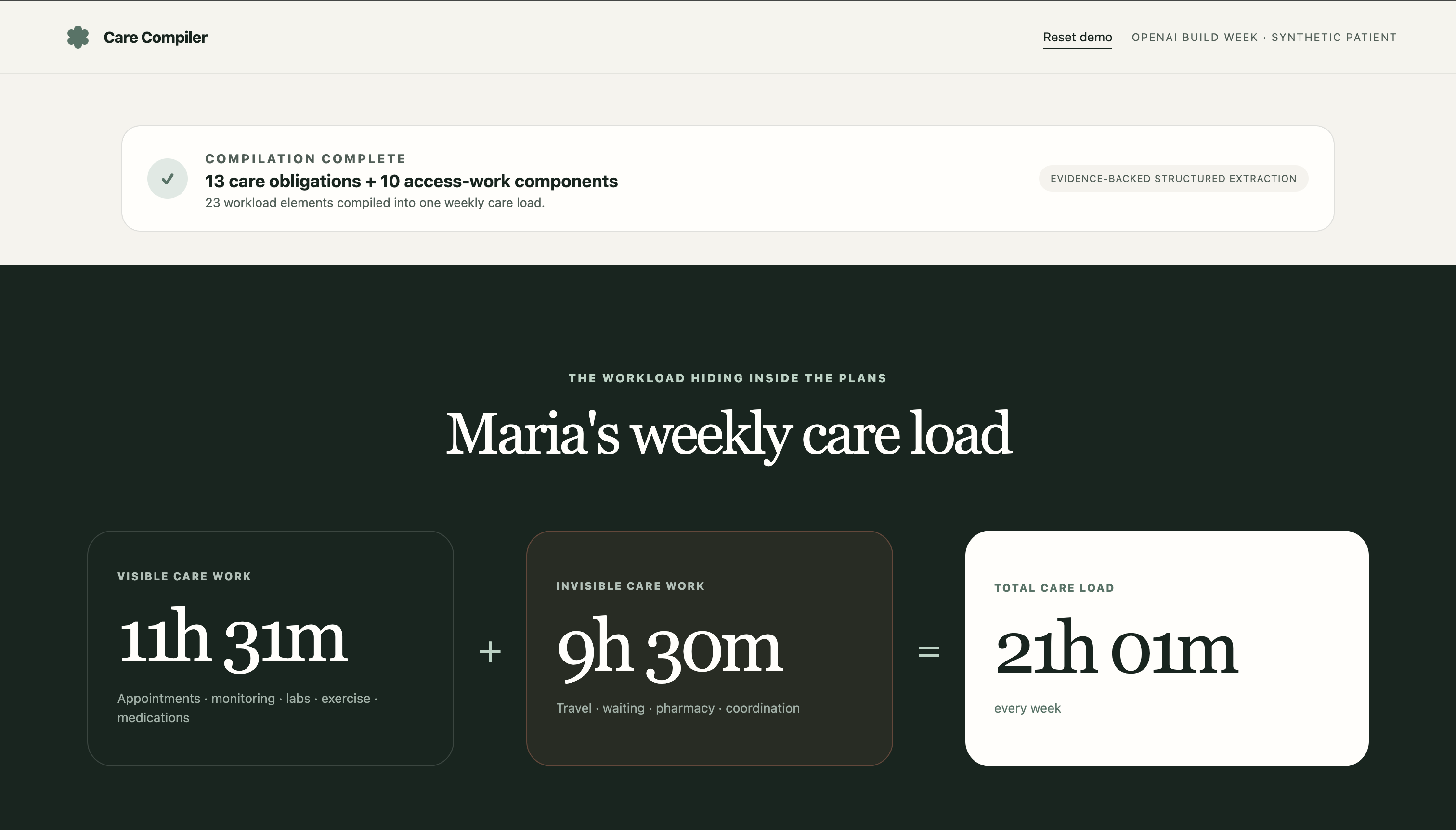
- 11h 31m of visible care work
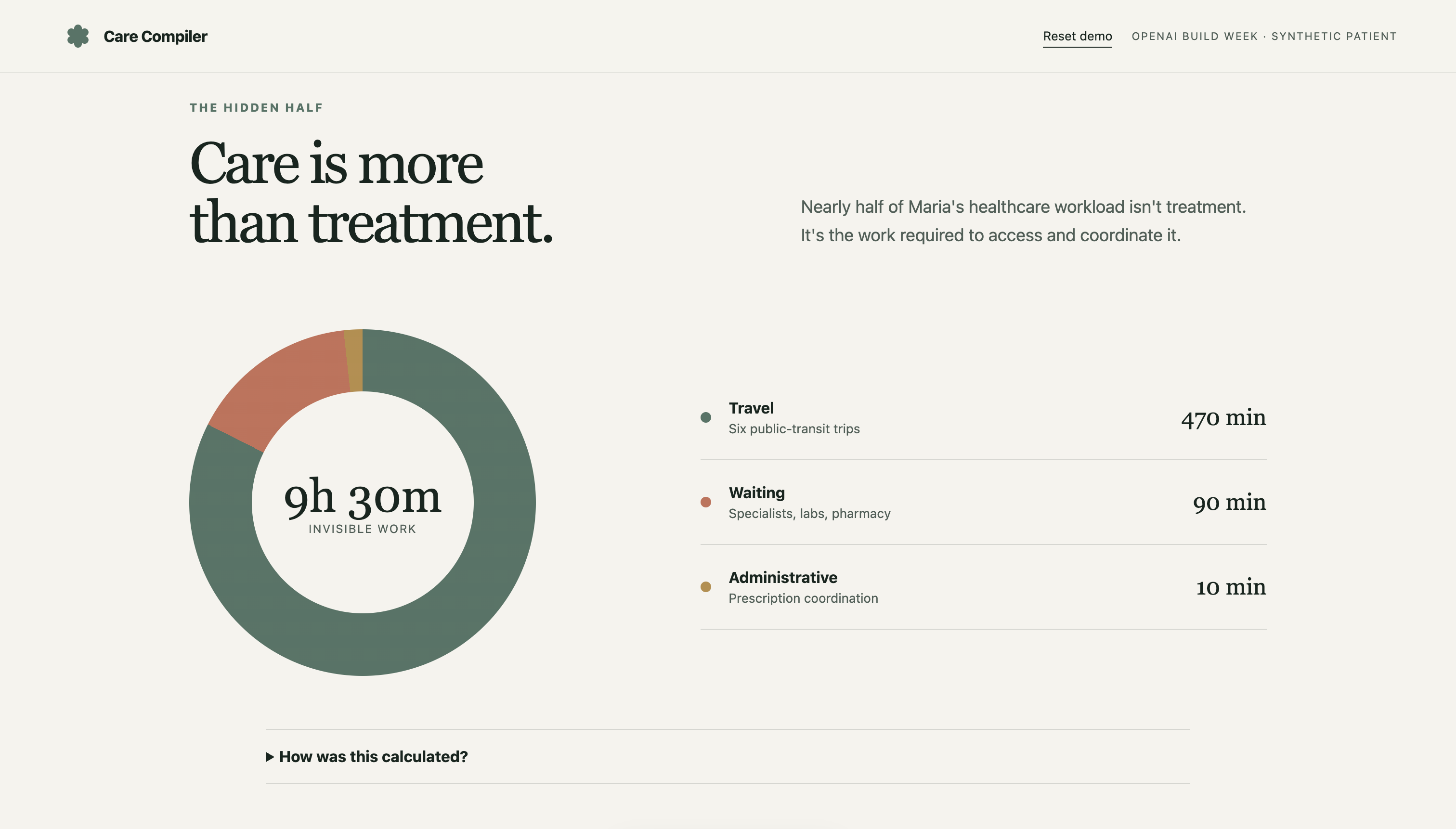
- 9h 30m of invisible care work
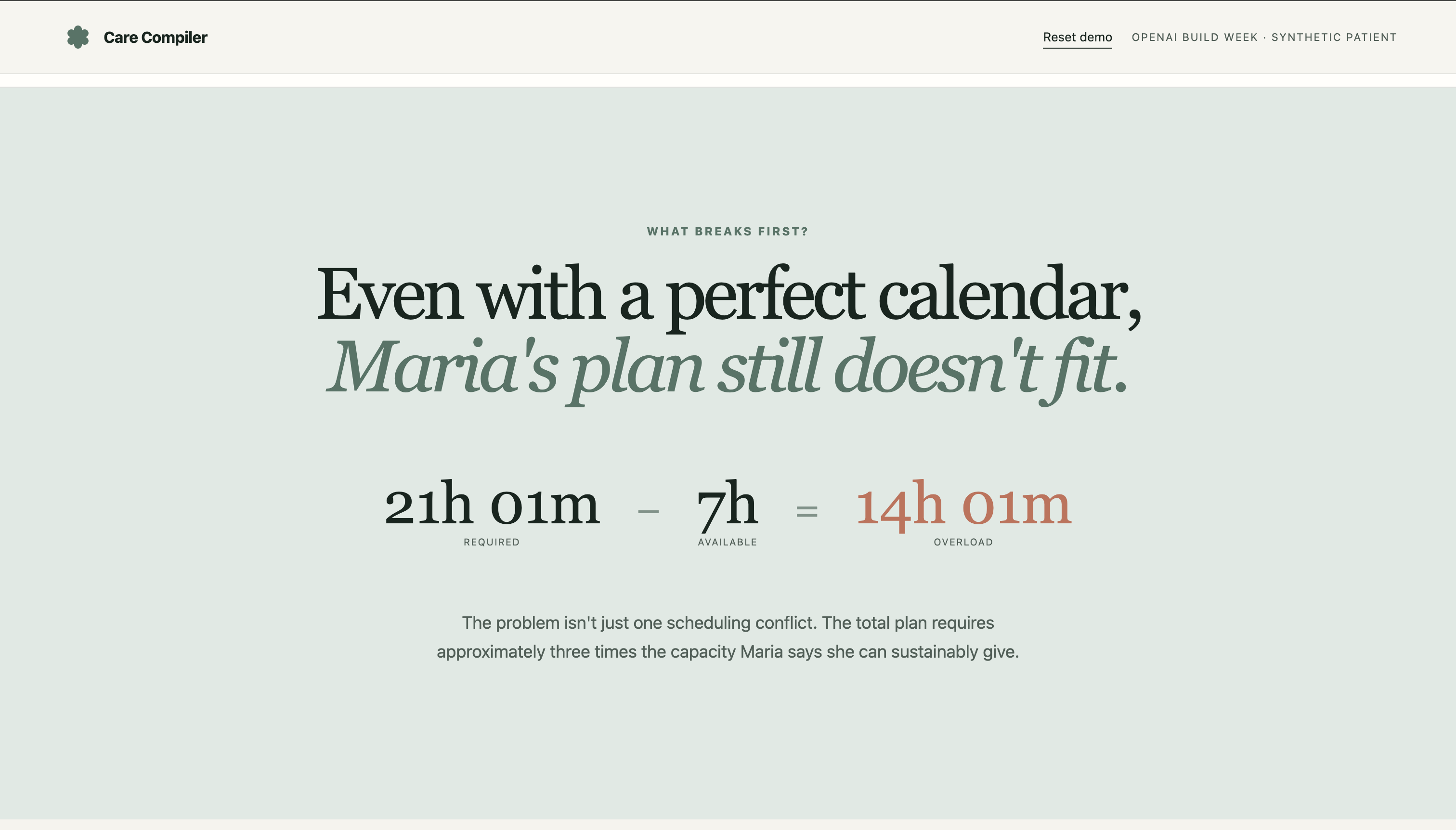
- 21h 01m required each week
- 7h of sustainable weekly capacity
- 14h 01m of overload
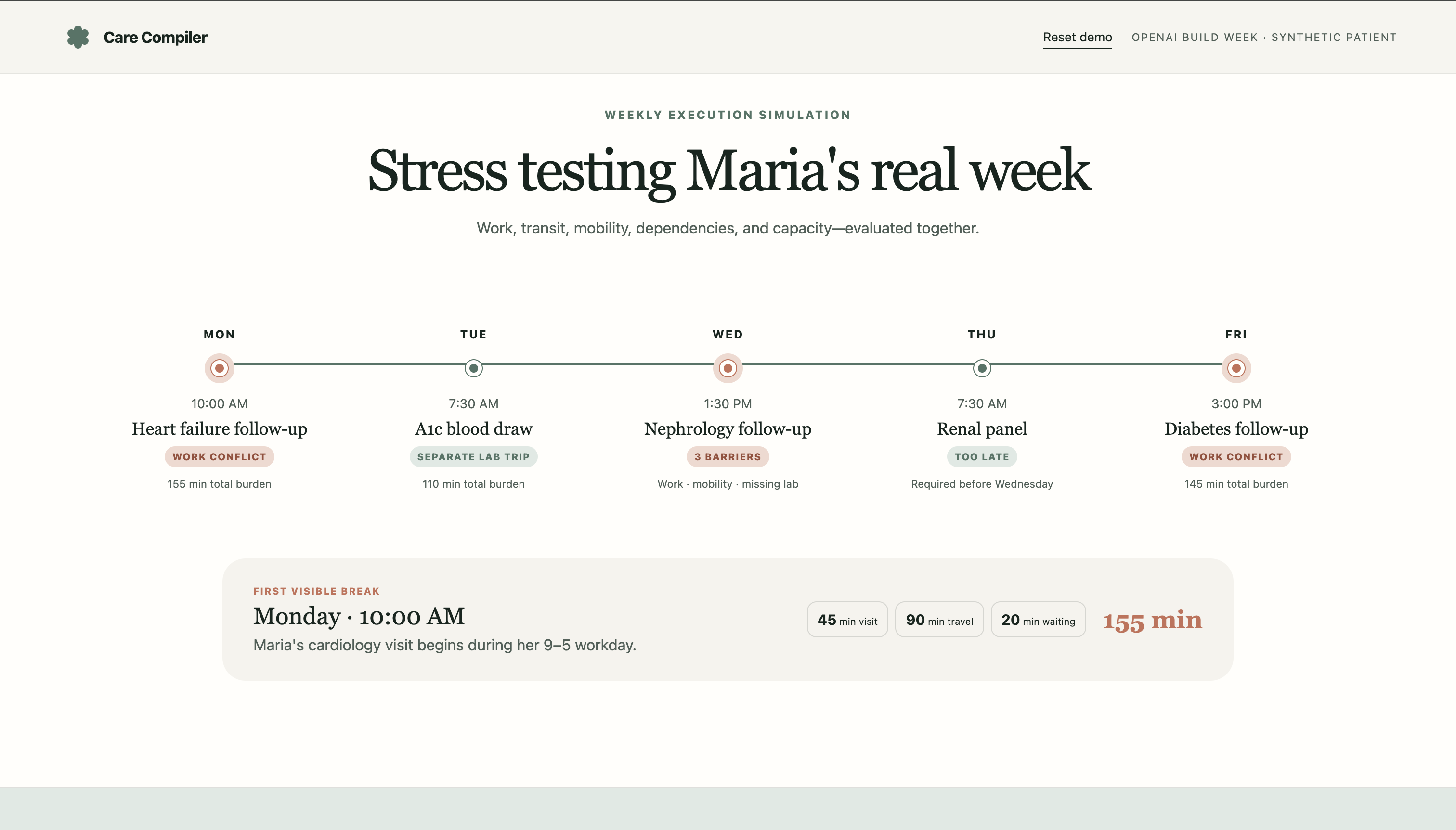
It then stress-tests Maria’s week, identifies what breaks first, and tests only logistical changes explicitly permitted by her care plans.
The result:
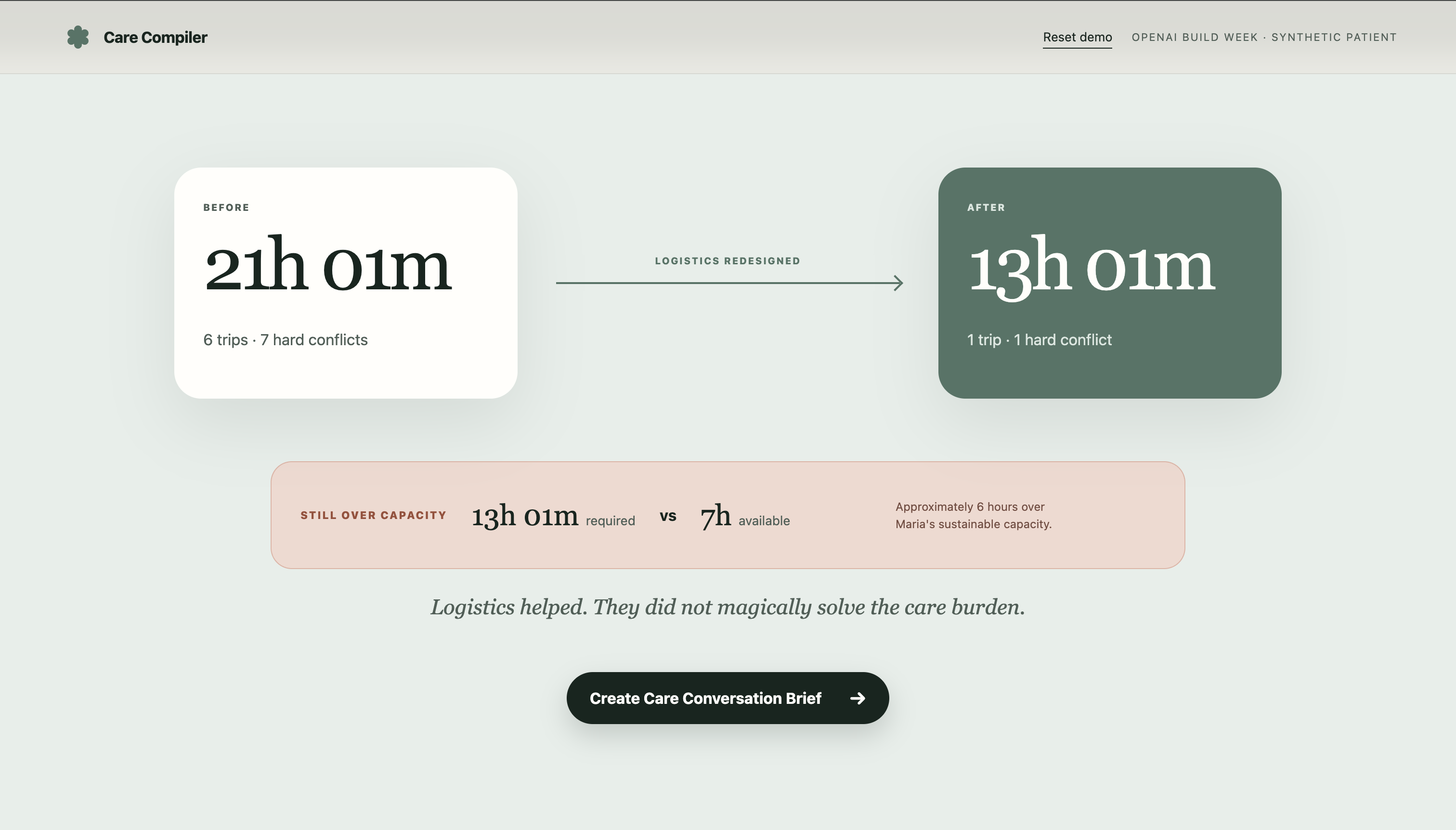
- 21h 01m → 13h 01m
- 6 trips → 1
- 7 hard conflicts → 1
But Maria is still 6h 01m over capacity.
In the full product, users would upload care-plan PDFs, photos, or discharge instructions and complete a short Life Capacity Profile covering:
- Available healthcare hours
- Work and family schedule
- Transportation
- Mobility limitations
- Caregiver support
Care Compiler would then compile those inputs into one feasibility model.
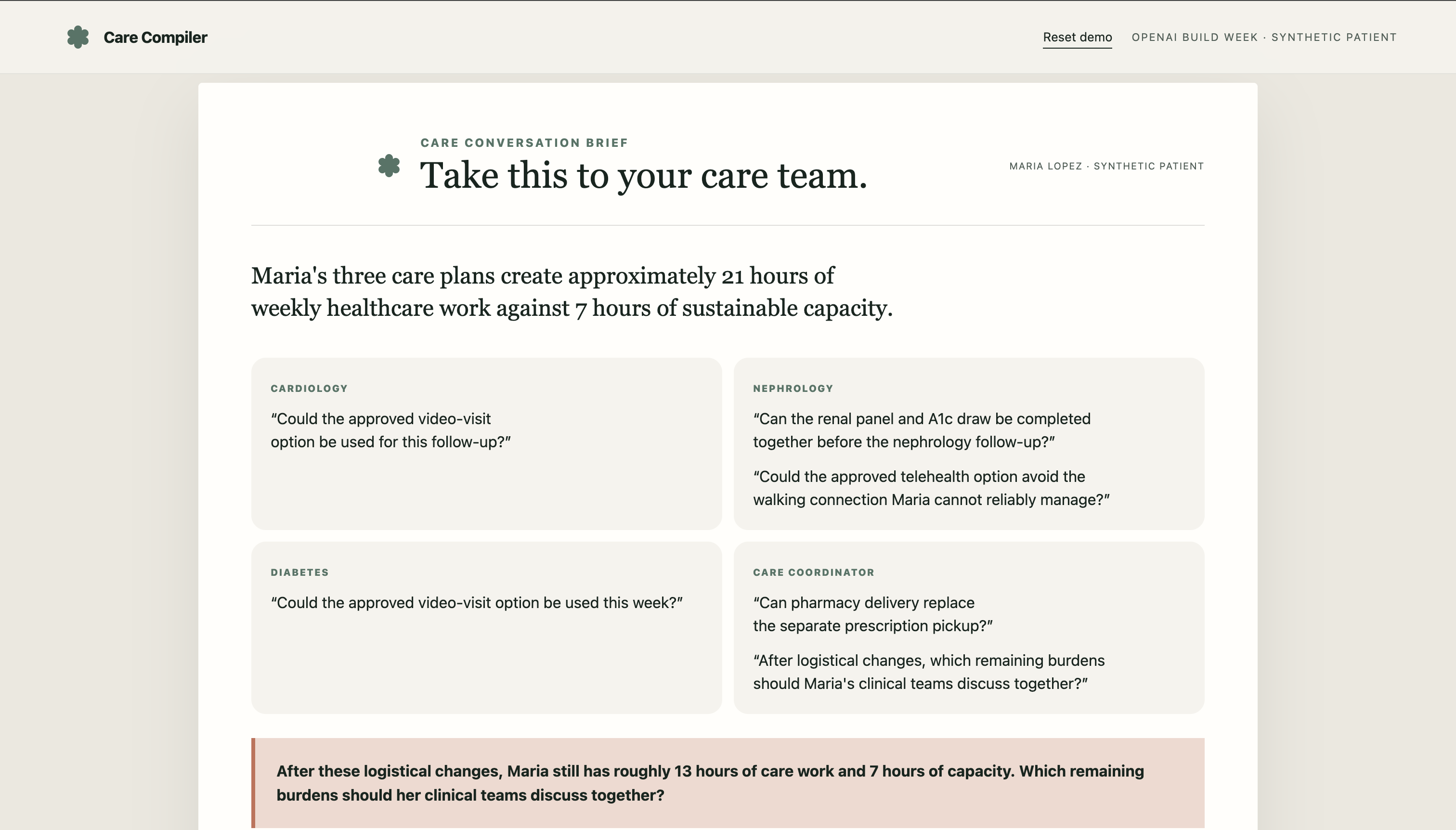
It does not decide which care a patient should skip. It creates an evidence-backed conversation brief for the patient and their care teams.
How we built it
GPT-5.6 is integrated through the OpenAI Responses API with Structured Outputs to extract evidence-backed obligations from care-plan text.
A deterministic TypeScript engine then calculates:
- Visible and invisible workload
- Recurrence and weekly occurrences
- Dependencies and deadlines
- Transportation and mobility conflicts
- Workload versus patient capacity
- Source-permitted counterfactual scenarios
Codex was our primary engineering partner for architecture, implementation, safety boundaries, testing, debugging, interface development, and deployment preparation.
The application includes a validated deterministic fallback when live API access is unavailable or an extraction fails strict validation. The interface never claims that a live GPT-5.6 request succeeded when fallback is active.
How it works
Care-plan sources
        ↓
GPT-5.6 structured extraction
        ↓
Zod validation + evidence verification
        ↓
Canonical Care Graph
        ↓
Deterministic workload + capacity engine
        ↓
Weekly feasibility stress test
        ↓
Source-permitted logistical counterfactuals
        ↓
Care Conversation Brief
Challenges we ran into
The hardest challenge was separating AI interpretation from deterministic decision logic.
We deliberately prevented GPT-5.6 from changing medications, dosages, treatments, monitoring requirements, deadlines, or clinical priorities.
We also had to ensure that schema-valid model output was still semantically safe. This required additional safeguards for:
- Evidence verification
- Temporal grounding
- Recurrence expansion
- Combined versus per-occurrence duration
- Unsupported or incomplete scheduling information
Another challenge was modeling invisible care work—travel, waiting, pharmacy, and coordination—without inventing unsupported values.
Accomplishments that we're proud of
We built a working care-plan feasibility compiler with:
- Evidence and provenance for extracted obligations
- Deterministic workload and capacity calculations
- Weekly stress testing
- Dependency and deadline validation
- Temporal-grounding safeguards
- Safe logistical counterfactuals
- A care-team conversation brief
- 49 passing automated tests
- A production-ready deployed demo
Most importantly, the product remains honest:
Logistics can help without pretending they solve everything.
What we learned
The biggest insight was that adherence is not always only a motivation problem.
Sometimes the combined care plan may exceed the patient’s available time, transportation, mobility, energy, or support.
Before asking:
“Did the patient follow the plan?”
we should sometimes ask:
“Was the plan possible to follow?”
We also learned that LLMs are most reliable when their role is constrained.
GPT-5.6 interprets the care plans. Deterministic software decides how the workload is calculated and whether it fits the patient’s life.
What's next for Care Compiler
Next, we want to add:
- PDF and photo care-plan upload
- Patient Life Capacity Profile onboarding
- Calendar integration
- Personalized travel estimates
- Caregiver mode
- Real-world validation with consented patients and caregivers
- Care-management workflow pilots
The current Build Week experience intentionally uses synthetic data so the demonstration is safe, repeatable, and free of protected health information.
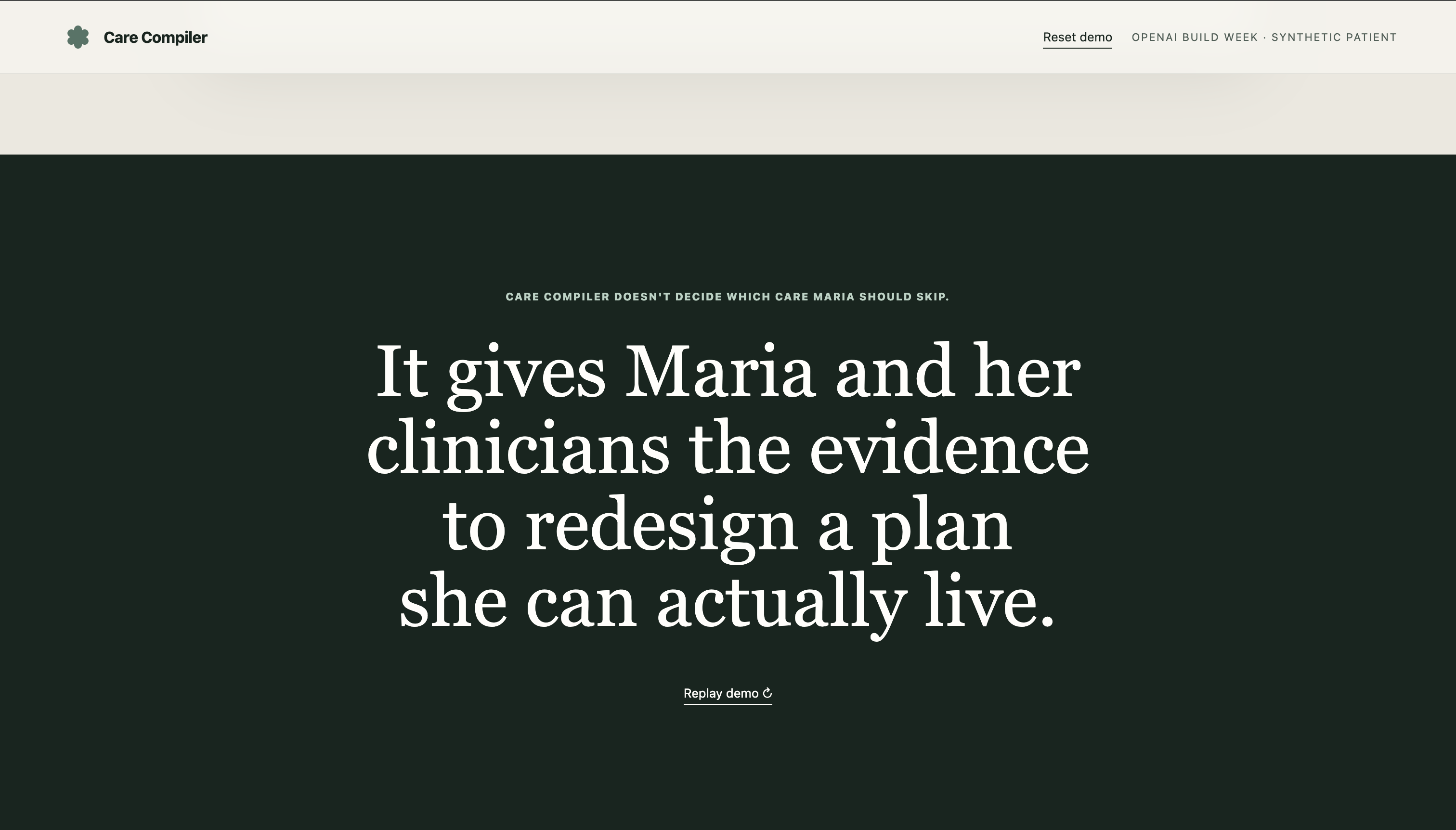
Care Compiler gives patients and care teams the evidence to redesign a plan a person can actually live.
Built With
- codex
- gpt-5.6
- next.js
- openai
- openai-responses-api
- react
- typescript
- vercel
- vitest
- zod

Log in or sign up for Devpost to join the conversation.