🧭 Care Compass
From ten thousand unreliable healthcare records to decisions you can trust — at every scale, from one patient to a whole population.
💡 Inspiration
Virtue Foundation handed us a dataset of 10,088 Indian healthcare facilities, and the first thing we realized is that it's a directory of claims, not truth. A clinic can list an ICU, an oncology unit, a maternity ward — with nothing behind it. For the people who actually rely on this data — an NGO coordinator deciding where to send a critically ill patient, or where to place the next medical mission — acting on an unverified claim isn't just messy, it's dangerous.
That tension became our north star: what if every claim carried its own evidence and its own uncertainty — so a non‑technical planner could turn this mess into decisions they could stand behind?
We were just as inspired by how Virtue Foundation actually works. They don't only treat patients — they make invisible problems visible to the organizations that can intervene at scale. When childhood stunting and anaemia spike in a district, the people who need to know are WHO, UNICEF, the state health department, and local NGOs. When an outbreak hits, local clinics and community health workers have to be activated. When a district's children are under‑immunized, someone has to run the campaign. We wanted a platform that carries a single decision all the way up — from one patient, to a chokepoint in a region, to a population‑scale, multi‑organization response.
🏥 What it does
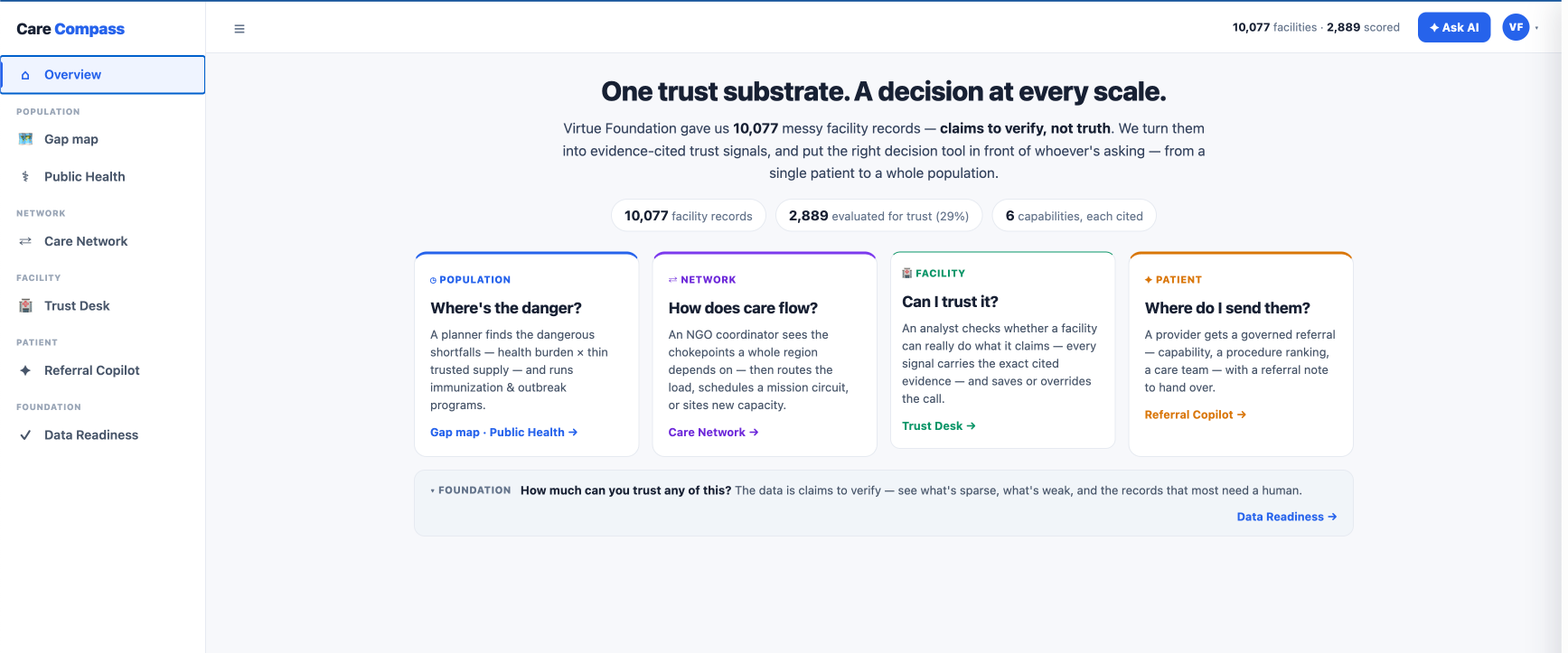
Care Compass grades every facility claim against its exact cited source text, with a confidence level — and an honest "we don't know yet" where the data is too thin to call. On top of that trust layer, it puts a decision tool at every scale:
◷ Population — find the danger, then act on it
- Care‑desert map — gaps by capability, weighted by NFHS‑5 health burden, so you see where thin trusted supply meets the highest need (not just where there are few hospitals).
- 💉 Agentic immunization campaigns — find the lowest‑coverage districts that also have the local supply to run a campaign, then draft the campaign and refer it to the health department.
- 📊 Disease‑burden benchmarks — prevalence of diabetes, hypertension, child anaemia, and stunting versus the national baseline, surfacing the worst districts — including the anaemia × stunting child‑nutrition crisis, since they travel together.
- 🦠 Outbreak response — designate isolation facilities from local capacity and brief each provider with targeted outreach (alerts, resources, and community‑health‑worker activation).
- 🌐 Multi‑organization escalation — when a district's burden crosses the line, an agent drafts the escalation that brings in WHO, UNICEF, the state health department, and NGOs — turning a data point into a coordinated, visible call to action.
⇄ Network — see how care flows
Coordinate a referral agent from every facility to reveal the chokepoints a whole region depends on — and flag the ones whose own evidence says they can't actually deliver. Then route the load, schedule a visiting‑specialist circuit, or site new capacity.
🏥 Facility — verify it
Per‑capability trust signals with the cited evidence, a corroboration cross‑check (specialists, beds, sources), and one‑click analyst override saved to Lakebase.
✦ Patient — refer them
A governed multi‑agent referral that cites its evidence, refuses over‑claims, ranks by capability for a specific procedure, and hands over a referral note.
And an AI assistant runs the same governed tools from any page — ask in plain language ("where should I add ICU capacity in Bihar?") and it acts, showing its work.
🧱 How we built it
Databricks Marketplace data → trust signals extracted offline with Foundation Model APIs → Lakebase (serverless Postgres) → served as a Databricks App, with live agents (Claude on Foundation Model APIs) running over one shared, governed tool substrate.
🤝 Honest by design
We're explicit about the limits — no patient records, no clinical outcomes, no payer network — and we say so in the product. Every signal is "a claim to verify, not a certified fact," uncertainty is shown not hidden, and where the data can't support a claim, the app tells you. Honesty about what we don't know is the whole point.
Built With
- databricks
- fastapi
- javascript
- lakebase
- mcp
- python

Log in or sign up for Devpost to join the conversation.