-
-
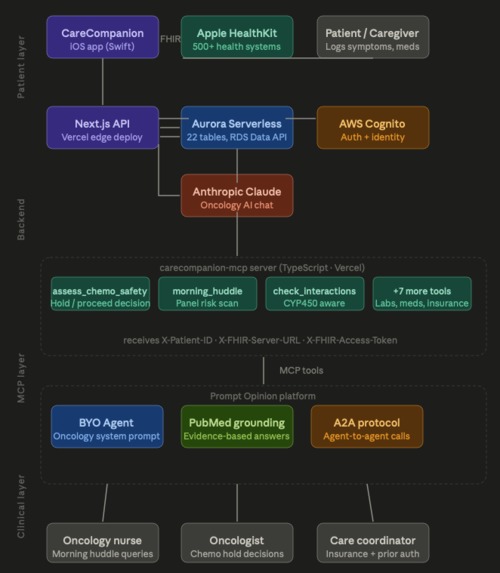
Care Companion Workflow
-
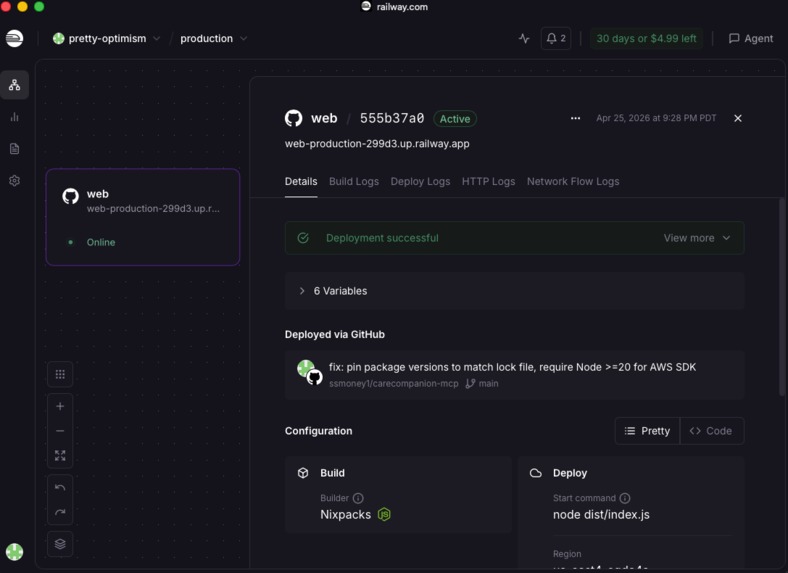
Railway deployment of MCP server
Inspiration
My co-founder and I both watched our parents go through cancer. What struck us wasn't just how hard the treatment was — it was how chaotic the logistics were. Medications from different doctors, lab results on paper, appointments across multiple hospitals, and nobody coordinating any of it. The patient is already sick and somehow also has to be their own care manager. We built CareCompanion because we lived that.
What it does
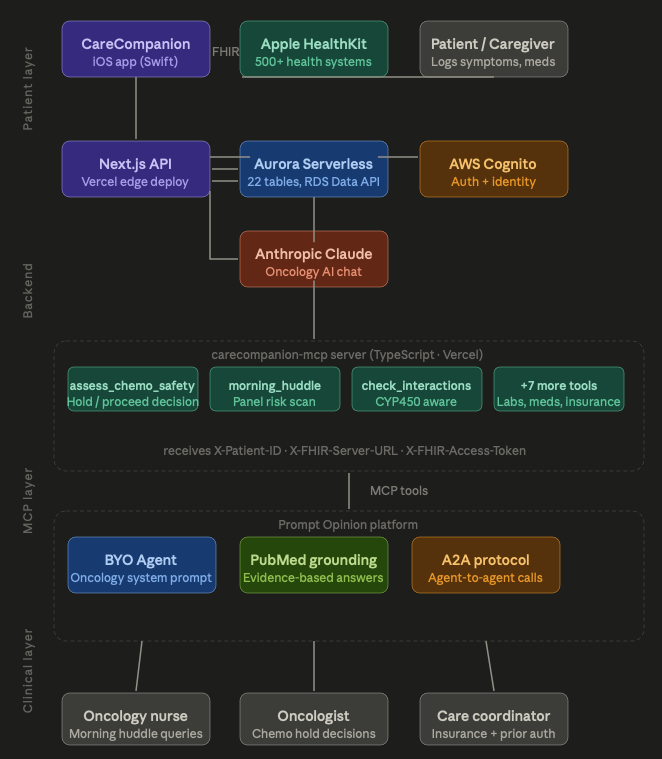
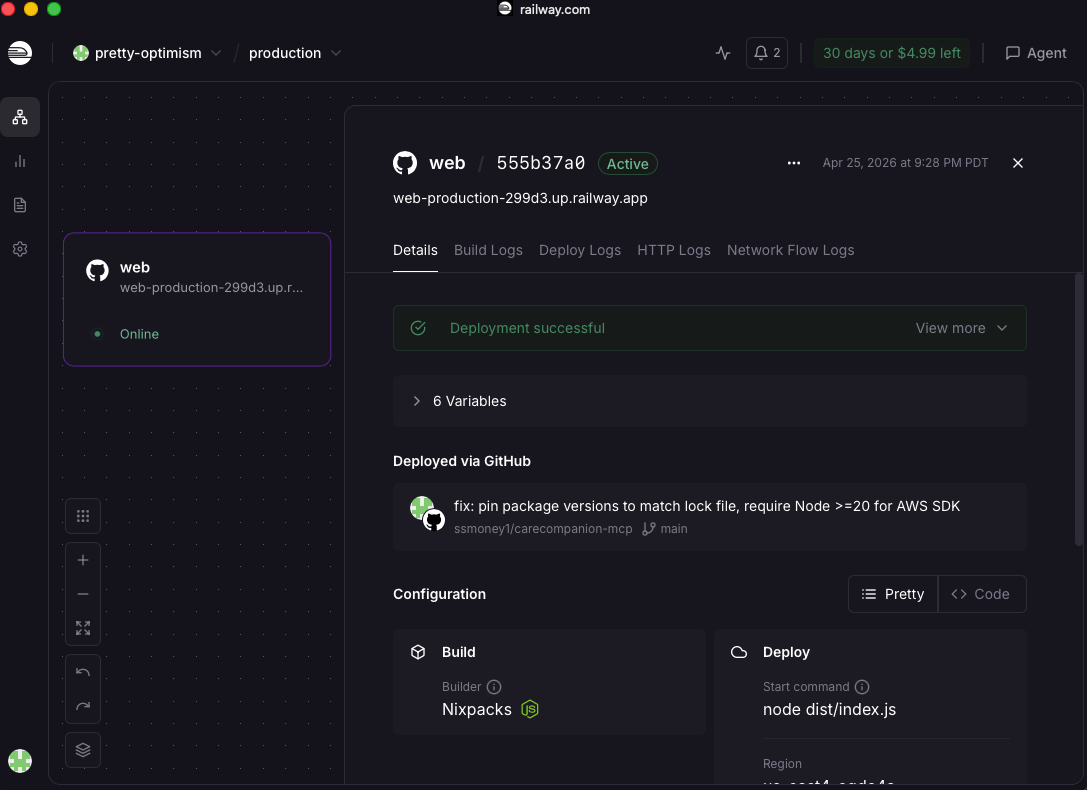
CareCompanion is a free AI-powered app for cancer patients and caregivers that consolidates medications, labs, appointments, insurance, and symptoms in one place. It connects to hundreds of health systems through Apple HealthKit and FHIR so data syncs without manual entry. The core product gives patients and caregivers a single source of truth for their entire cancer journey. A multi-agent AI system powered by Claude Sonnet 4.6 handles everything from medication management and CYP450-aware drug interaction checking, to insurance navigation and prior authorization tracking, to lab result interpretation with oncology-specific reference ranges. Caregivers can log symptoms daily, set medication reminders with adherence tracking, prep for appointments with AI-generated question lists, and share a living health summary with their care team — all in one place. We also built a long-term memory system so the AI remembers medication changes, appointment outcomes, and personal context across sessions without users ever repeating themselves. We're now expanding into the clinical side. We've built and deployed an MCP server on Railway that sits on top of our oncology data layer and exposes clinical tools to care teams — a chemo safety checker that reads recent CBC labs to recommend hold or proceed decisions, a CYP450-aware drug interaction checker tuned to chemo regimens, lab trend analysis, and a morning huddle report that proactively surfaces which patients need attention before anyone thought to ask. The MCP server is live; the Prompt Opinion agent layer is the immediate next step.
How we built it
CareCompanion is a Next.js 14 and Expo/React Native monorepo running on an all-AWS HIPAA-compliant stack — Aurora Serverless for the database, Cognito for auth, and Vercel for deployment. We use Drizzle ORM, the Vercel AI SDK, and a six-specialist multi-agent architecture where Claude Haiku 4.5 handles routing and domain analysis in parallel before Claude Sonnet 4.6 generates the final response. The mobile app integrates natively with Apple HealthKit for passive data sync and delivers push notifications for medication reminders and clinical alerts. The MCP server is a TypeScript service deployed on Railway with SMART scope declarations and FHIR patient context routing, ready to receive patient context through request headers on every tool call once we configure the Prompt Opinion agent layer on top. All demo data is synthetic. No real patient data was used anywhere.
Challenges we ran into
The hardest problem wasn't technical — it was figuring out what actually matters in a clinical workflow. A tool that waits to be asked isn't useful when doctors don't know to ask about a patient they don't already know is in trouble. That insight drove the morning huddle concept: instead of a reactive query interface, the agent proactively scans all patients and surfaces who needs attention. Building that required rethinking how tools aggregate across patients rather than just responding to individual queries. On the patient side, the challenge has always been reducing friction. Cancer patients are exhausted. If syncing their data requires effort, they won't do it. Getting HealthKit and FHIR integration tight enough that data just appears was critical to the product actually working.
Accomplishments that we're proud of
CareCompanion is a live product at carecompanionai.org that actual cancer patients and caregivers use. That's what we're most proud of — not a demo, a real thing people rely on during one of the hardest experiences of their lives. The full stack — 88+ API endpoints, 101+ React components, a six-agent AI system with 16 callable tools, long-term memory, medication reminders, document scanning, insurance tracking, and a native mobile app — was built by a small team that knew this problem personally. The morning huddle on the clinical side is also something we're proud of. The insight that reactive tools fail in clinical settings and you need proactive alerting came from genuinely thinking through how nurses and oncologists work. That piece changes what CareCompanion can be for an entire care team, not just the patient at home.
What we learned
The hardest problem in healthcare AI is not building the intelligence. It's fitting into workflows that already exist. A great tool nobody opens is worthless. Clinical value only matters if it shows up where people already look and surfaces things they would not have thought to ask for. We also learned that the gap between a patient app and a clinical tool is smaller than we thought. The same data, routed through the right interface, serves completely different users. A caregiver using CareCompanion on their phone and an oncology nurse using it through a clinical agent are looking at the same underlying data. That realization changes how we think about the whole platform.
What's next for Care Companion AI
The immediate next step is completing the Prompt Opinion agent integration on top of our deployed MCP server — configuring the BYO agent with an oncology system prompt, PubMed grounding for peer-reviewed clinical backing, and guardrails to keep conversations clinically focused. After that, proactive background alerting — a nightly process that checks patient symptom logs and fires alerts when something crosses a threshold, without anyone having to ask. Longer term, bidirectional FHIR sync so patient-reported data flows back into the EHR, and eventually pattern detection across patients — if two people on the same regimen report the same unusual side effect in the same week, that should surface as a signal. No EHR does this because no EHR has the patient-reported data. CareCompanion does.
Built With
- anthropic-claude
- aws-aurora-serverless
- aws-cognito
- bun
- drizzle-orm
- expo-52
- expo-router-4
- husky
- next-auth-v5
- next.js-14
- playwright
- posthog
- react-18
- react-native-0.76
- recharts
- resend
- sentry
- tailwind-css
- turborepo
- typescript
- upstash-redis
- vercel
- vercel-ai-sdk-v6
- vitest
- zod


Log in or sign up for Devpost to join the conversation.