-
-
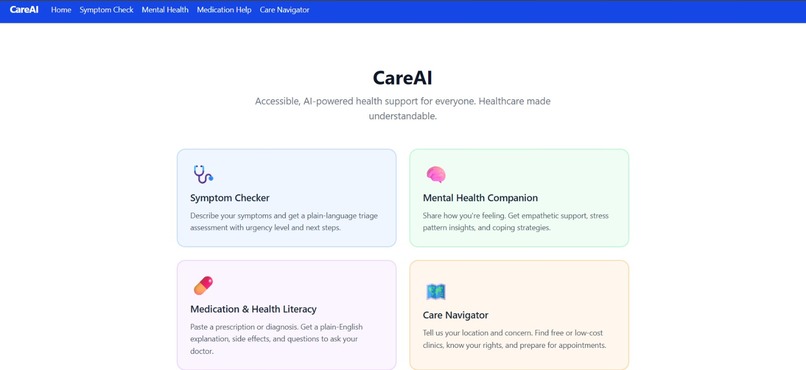
Came Ai Homepage
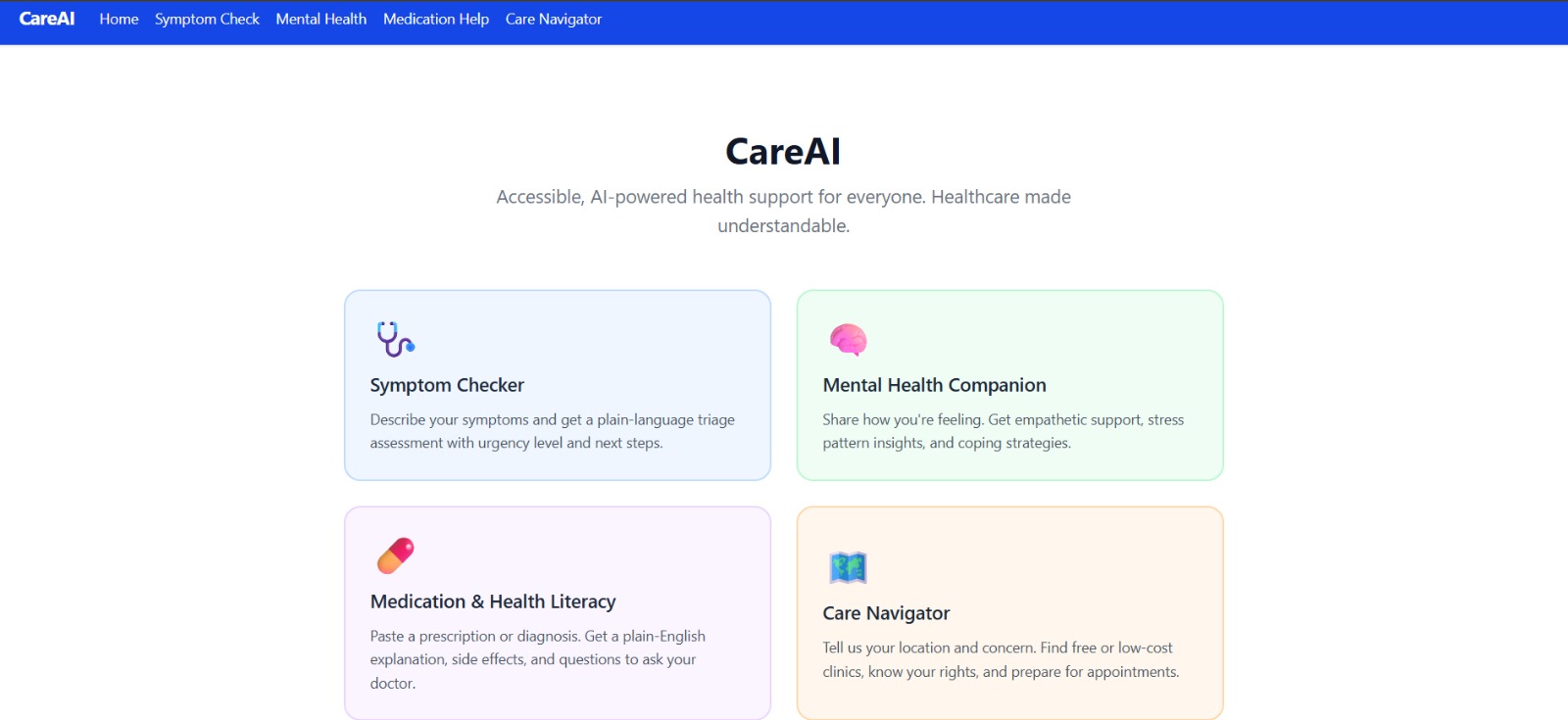
CareAI — Project Story
Inspiration
Healthcare is one of the most important parts of human life — and one of the most inaccessible.
Most people have experienced the anxiety of not knowing whether a symptom is serious, the confusion of reading a prescription they don't understand, or the helplessness of searching for affordable care and hitting a wall. The problem isn't a lack of medical knowledge in the world — it's a lack of access to it.
We asked: what if everyone had a knowledgeable, empathetic health companion in their pocket — one that speaks in plain English, never judges, and is available 24/7?
That question became CareAI.
What It Does
CareAI is a four-in-one AI-powered health companion that democratizes healthcare access. Each tool addresses a distinct barrier people face:
🩺 Symptom Checker & Triage
Describe your symptoms in plain language. CareAI assesses urgency — LOW, MEDIUM, HIGH, or EMERGENCY — explains possible causes, and tells you what to do next: rest at home, call a doctor, or go to the ER. It never definitively diagnoses, but it gives you clarity when panic would otherwise take over.
🧠 Mental Health Companion
Share how you're feeling — a journal entry, a description of your stress, or just what's weighing on you. CareAI responds with empathy and validation, identifies burnout or stress signals, and suggests 2–3 evidence-based coping strategies. It gently encourages professional support when the signals warrant it.
💊 Medication & Health Literacy
Paste a prescription, drug name, diagnosis, or medical report. CareAI translates it into plain everyday English — what the drug does, common side effects, important warnings — and suggests the questions you should be asking your doctor. Medical literacy shouldn't require a medical degree.
🗺️ Care Navigator
Describe your location and health concern. CareAI helps you identify the right type of care, find free or low-cost options (community health centres, FQHCs, sliding-scale clinics, telehealth), understand your rights as a patient, and walk into an appointment prepared.
How We Built It
The architecture is intentionally lean — built end-to-end in under 45 minutes at a hackathon.
Backend: Python + FastAPI
A single main.py exposes four POST endpoints, each backed by a carefully crafted system prompt. The key insight was that a single well-designed prompt per endpoint, combined with a capable model, is all the "intelligence layer" needed — no RAG, no vector databases, no complex pipelines.
POST /symptom-check → medical triage system prompt POST /mental-health → empathetic companion system prompt POST /med-literacy → medical translator system prompt POST /care-navigate → patient advocate system prompt
Each endpoint receives { "message": "..." } and returns { "response": "..." } . Dead simple.
Frontend: React + Vite + Tailwind CSS
The key frontend decision was a single shared ChatInterface component that every feature page reuses. It handles message state, the send/receive cycle, auto-scroll, loading state, and color theming via an accentColor prop. Four pages — one component.
React Router v7 handles navigation between a Home hub page and the four feature pages.
The Data Flow
User types in React → ChatInterface sends POST to FastAPI (/api/*) → FastAPI builds [system prompt + user message] → OpenAI GPT-4o returns a response → ChatInterface renders the reply in the chat bubble
No database. No authentication. State lives in React component state — intentionally ephemeral for privacy.
Challenges We Ran Into
1. Time constraint 45 minutes from nothing to a working demo is brutal. Every decision had to be the fastest path to a working product. We chose FastAPI because routes are 3 lines of Python. We chose a single ChatInterface component to avoid writing four similar UIs.
2. Prompt engineering under pressure The quality of each tool lives or dies in its system prompt. Writing four distinct, responsible, role-appropriate system prompts quickly — while making sure they're safe, empathetic, and clear — required deliberate thinking even under time pressure.
3. Corporate SSL proxy Connecting to the OpenAI API through a corporate network required configuring a custom httpx client with SSL verification disabled to trust the proxy — a non-obvious hurdle that cost time mid-build.
4. Responsible AI in healthcare Healthcare AI carries real responsibility. Every prompt had to be calibrated to be helpful without overstepping — never definitively diagnosing, always encouraging professional care for serious symptoms, always keeping mental health responses warm and non-judgmental. Getting the tone right matters as much as the information.
What We Learned
• System prompts are the product. In healthcare AI, the quality of the interaction is entirely determined by how well the system prompt defines the AI's role, constraints, and tone. Engineering the prompts is as important as engineering the code.
• Shared components scale fast. One ChatInterface component powering four completely different features is a reminder that good abstractions multiply your output — especially under time pressure.
• AI lowers the access barrier. The moment we tested the Care Navigator and it gave genuinely useful guidance to someone describing being uninsured and in need of care, the potential of this kind of tool became very real. The gap between people who can afford healthcare navigation and those who can't is real — and AI can close it.
• Build for the user, not the demo. Even in a hackathon, the instinct was to make sure the mental health companion didn't feel clinical, and that the symptom checker communicated urgency clearly without causing panic. That care for the user experience makes the difference.
What's Next
CareAI is a hackathon MVP, but the problem it addresses is real and large. If we were to take it further:
• Persistent conversation history with opt-in user accounts • Location-aware care search using real clinic databases (HRSA, 211, open health APIs) • Multilingual support — healthcare barriers disproportionately affect non-English speakers • Voice input for users who are unwell or have low literacy • Integration with wearable data for richer symptom context • Crisis detection in mental health conversations with escalation paths to real resources
Built With
- chatgpt
- css
- fastapi
- gpt
- gpt-4o
- javascript
- node.js
- openapi
- pydantic
- python
- python-dotenv
- react
- router
- tailwind
- uvicorn
- vite

Log in or sign up for Devpost to join the conversation.