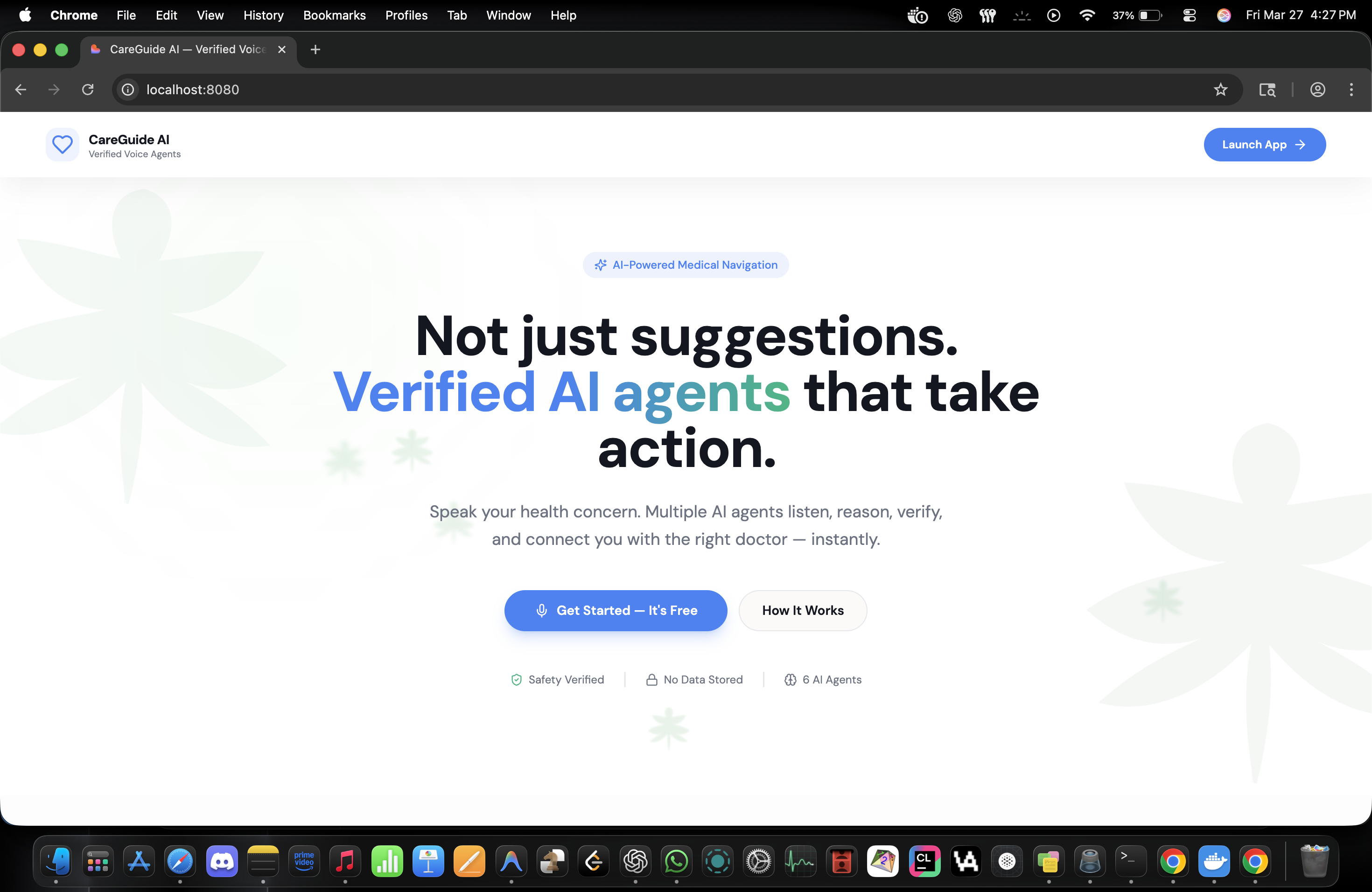
Inspiration Navigating the healthcare system is overwhelming — especially when you're sick. You Google symptoms, get terrifying results, and still have no idea which doctor to see. We wanted to build something that feels like having a trusted medical navigator in your pocket. One that listens to you speak naturally, reasons about what you said using multiple AI perspectives, independently verifies its own output for safety, and connects you to the right specialist — all in under a minute.
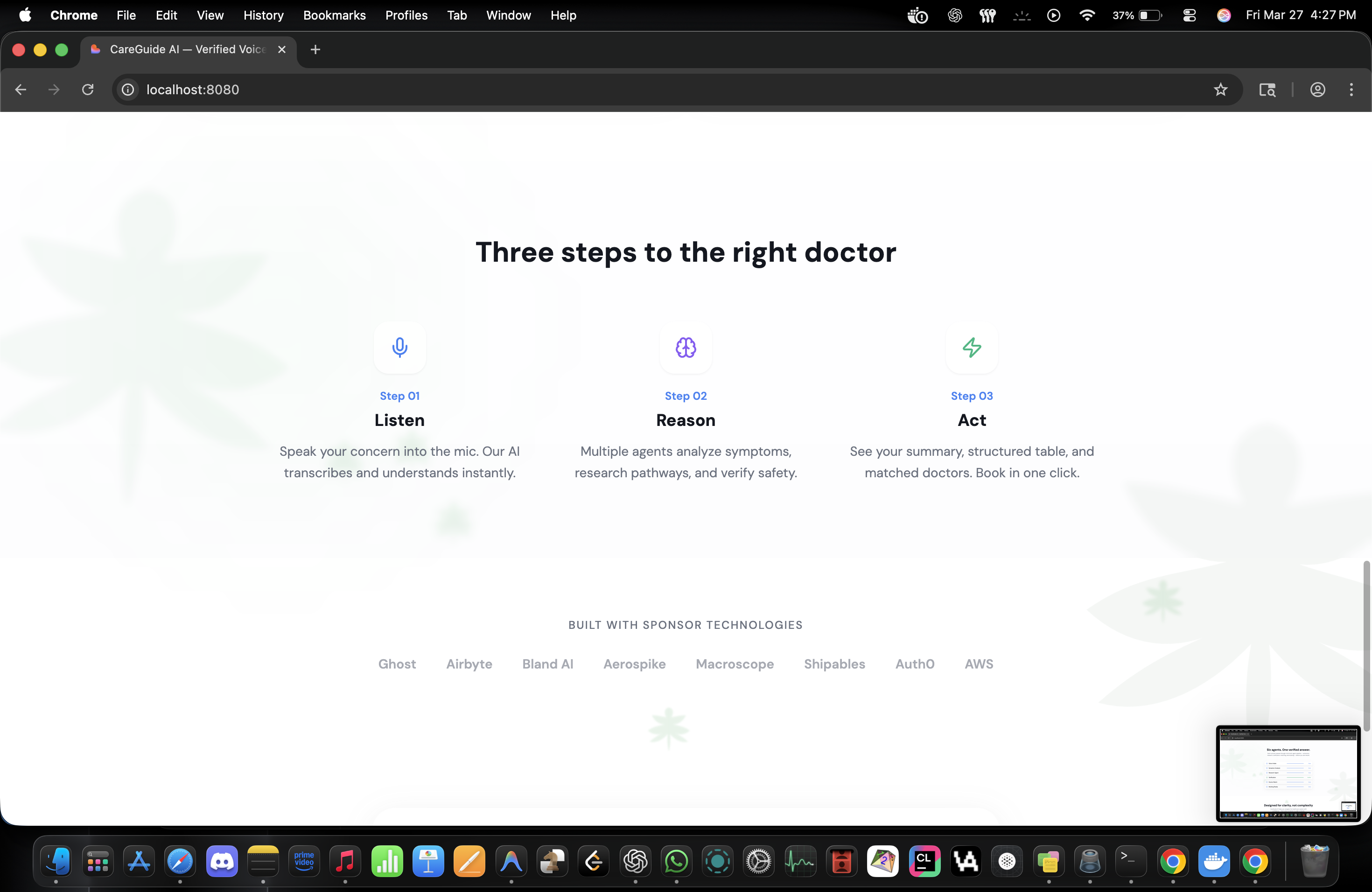
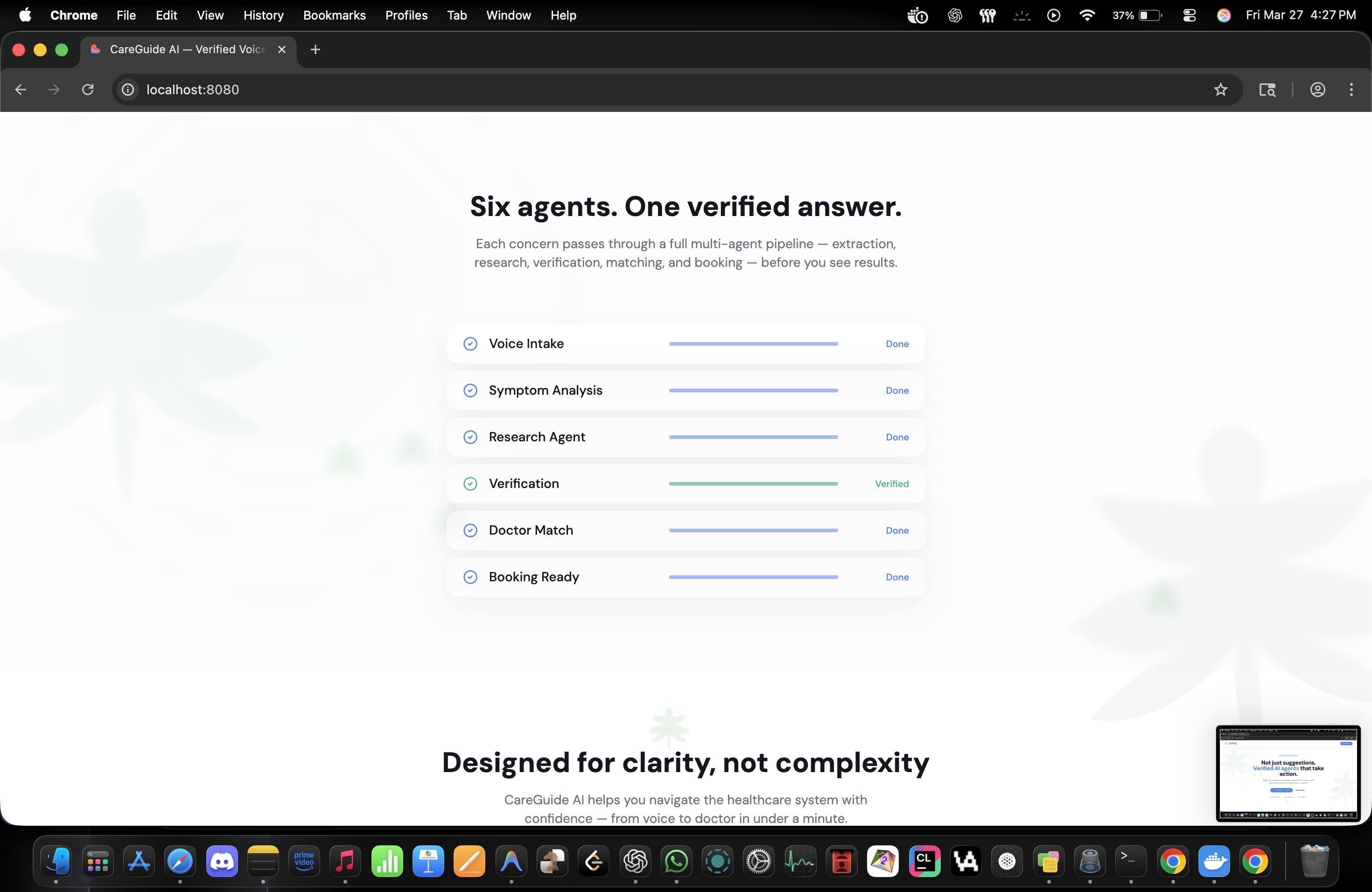
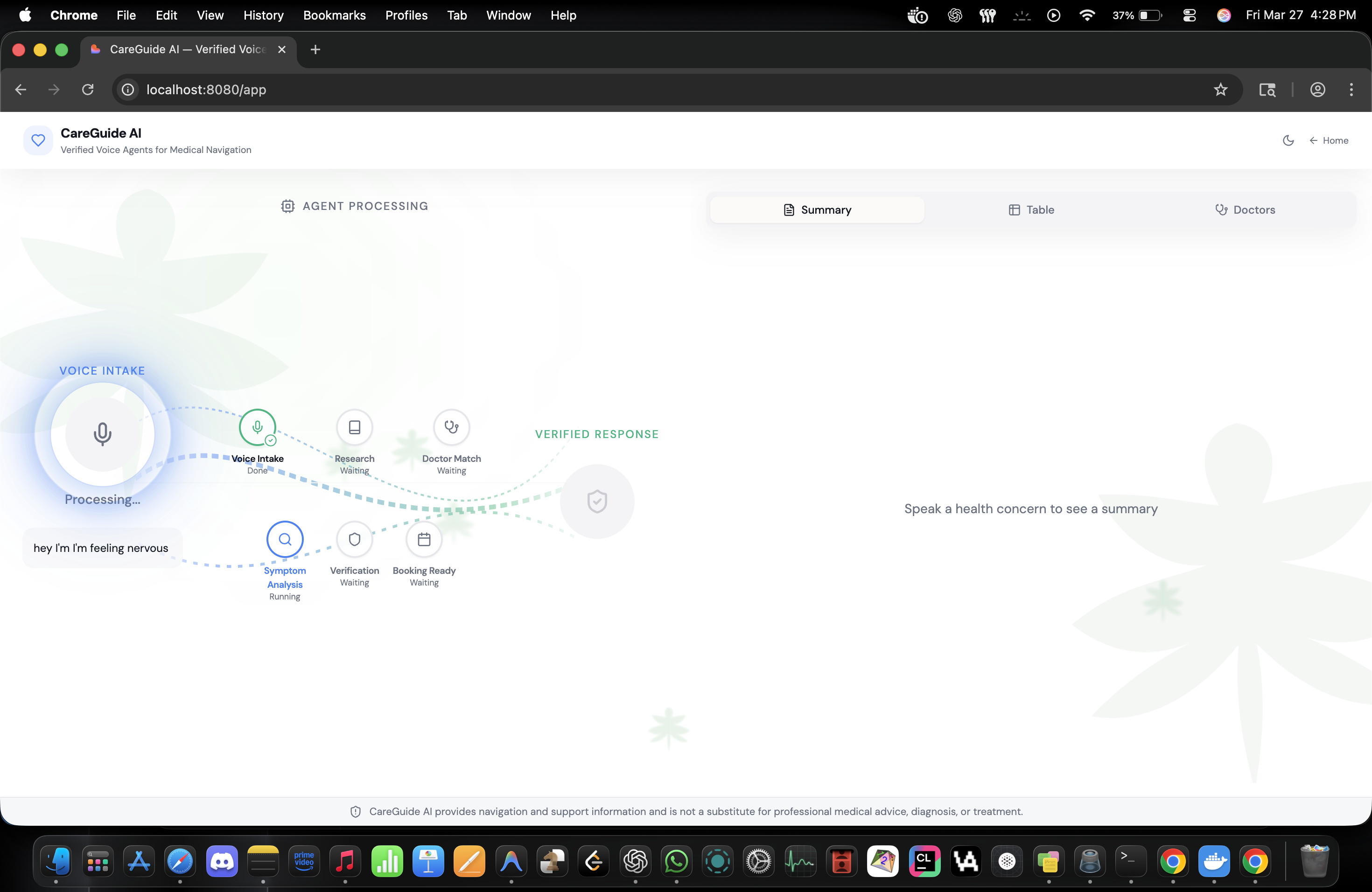
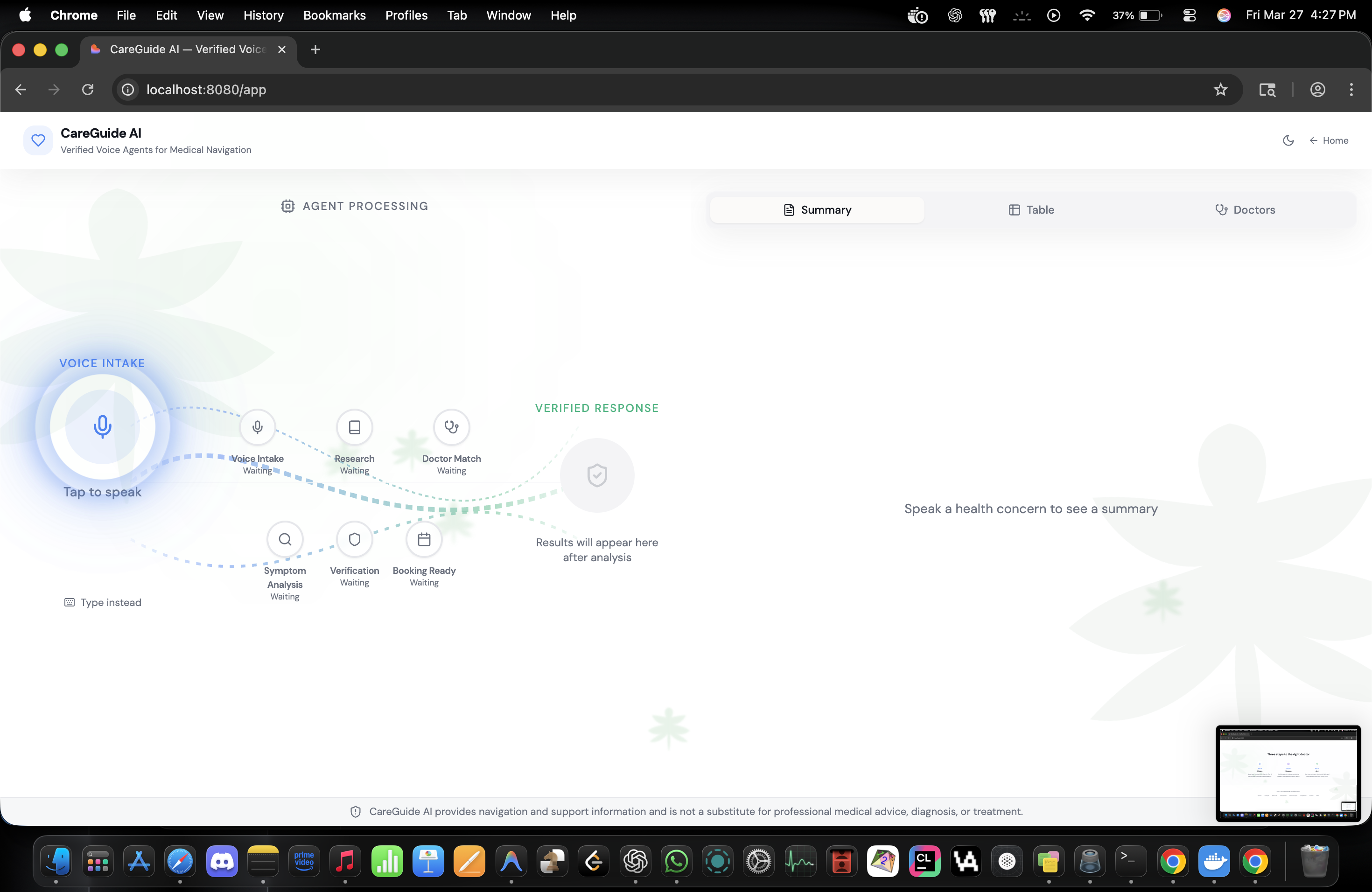
What it does CareGuide AI is a voice-first, multi-agent medical navigation platform. You simply speak your health concern into the mic (or call a phone number via Bland AI). Behind the scenes, six specialized AI agents work in parallel:
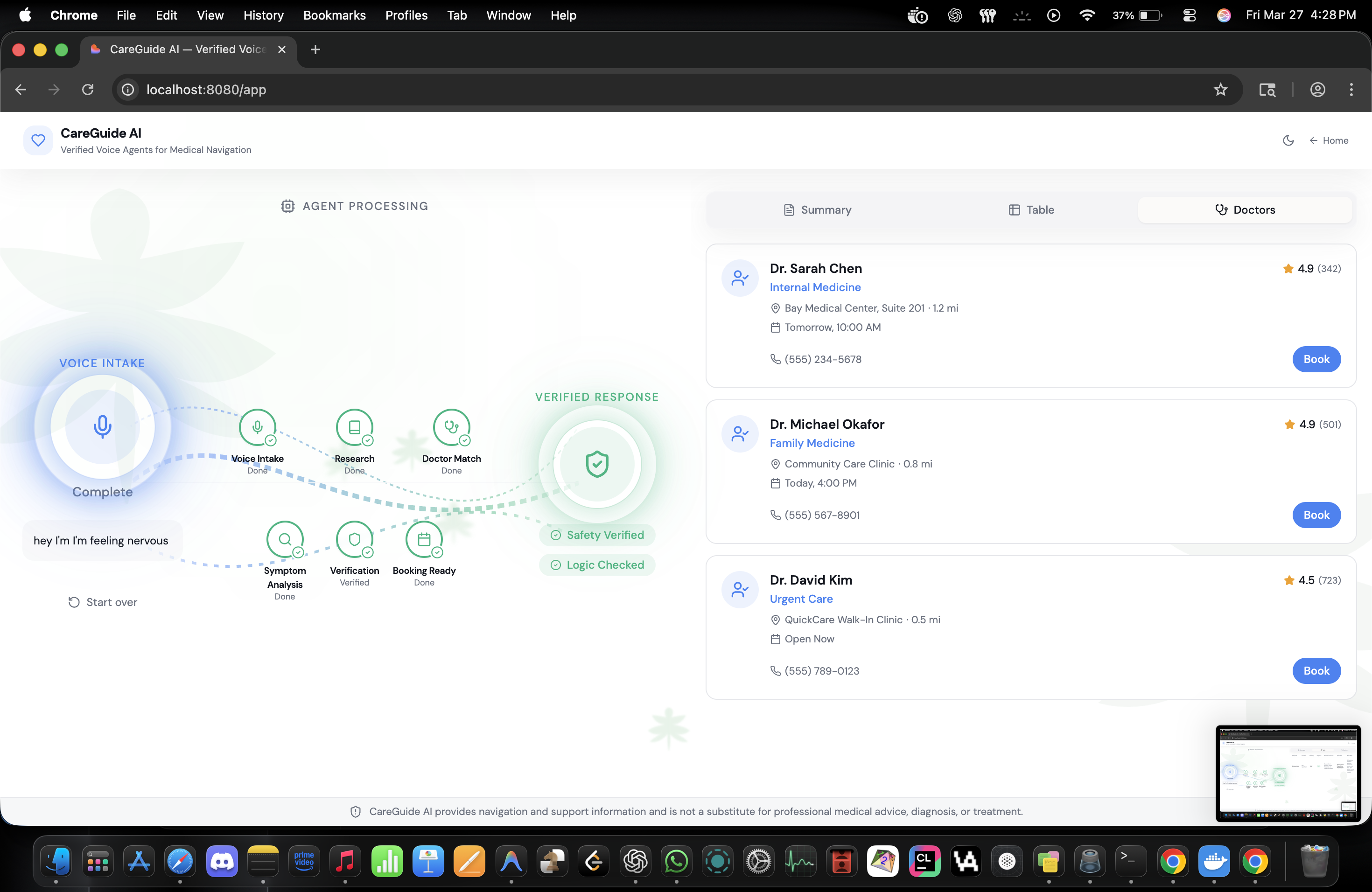
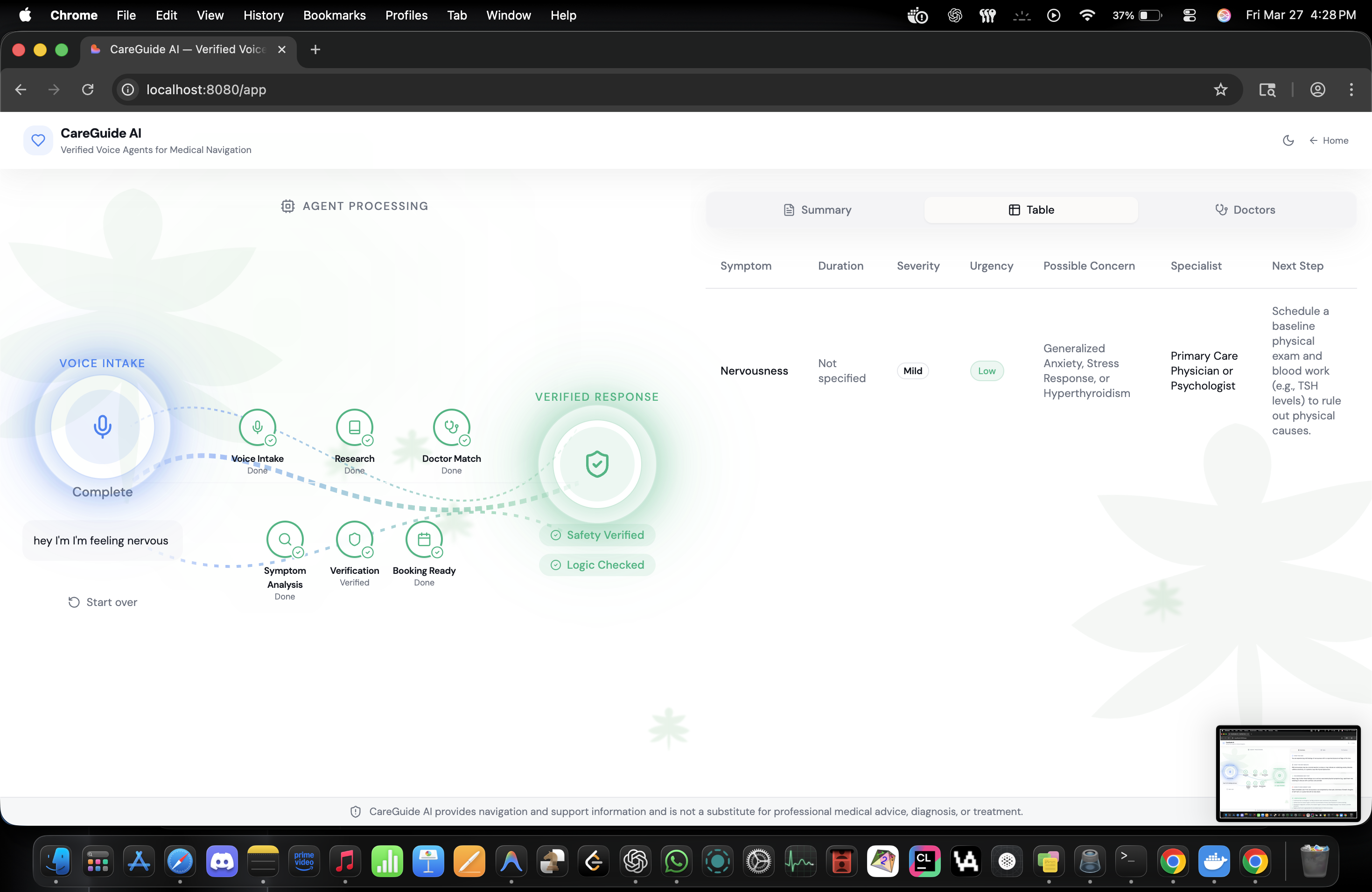
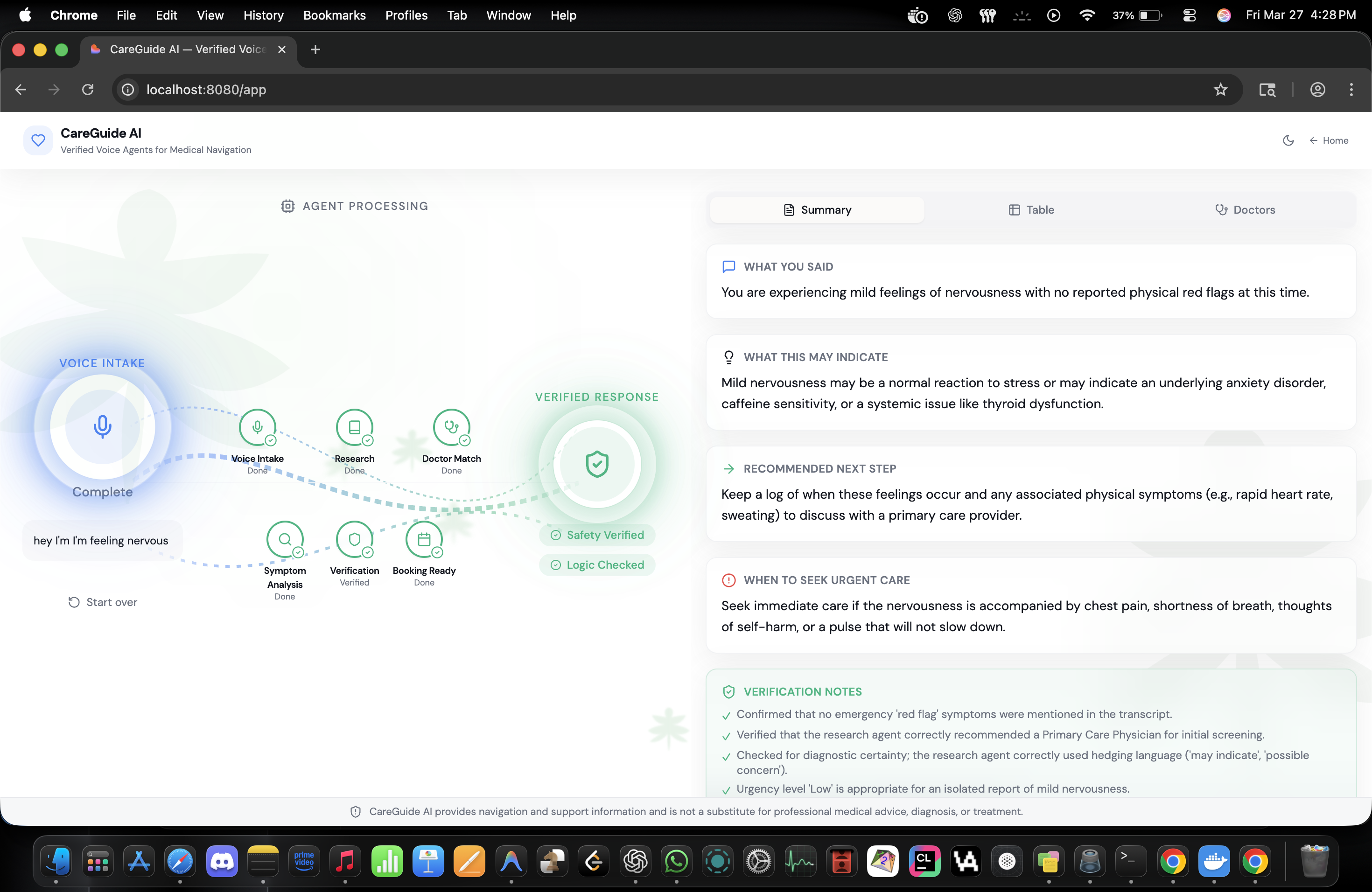
Voice Intake — Captures and transcribes your spoken concern Symptom Extractor — Uses AWS Bedrock (Claude 3) to extract structured symptom data Research Agent — Analyzes care pathways and possible conditions Safety Verifier — An independent AI agent that cross-checks for missed red flags and emergency escalation Doctor Matcher — Queries Aerospike in real-time to find top-rated specialists matching your symptoms Booking Agent — Prepares appointment readiness with matched providers The result is a verified summary, a structured symptom table, and matched doctors you can book — all presented in a beautiful glassmorphic UI with animated tropical leaf backgrounds.
How we built it Frontend: React + TypeScript + Vite with Tailwind CSS and Framer Motion for a premium glassmorphic design. We used the Web Speech API for browser-based voice input and Bland AI for phone-based intake.
Backend: Python FastAPI server with three core AI agents. AWS Bedrock (Claude 3 Haiku) powers the symptom extraction and safety verification via structured JSON prompting. Each agent has a keyword-based fallback so the system works even without cloud credentials.
Data Layer: Aerospike serves as our real-time doctor database with sub-millisecond lookups via secondary indexes. Airbyte pipelines sync provider directory data into Aerospike. A local JSON fallback ensures the demo always works.
Observability: Overmind tracks every agent run — duration, token usage, success/failure — with fire-and-forget async reporting so it never blocks the user flow.
Identity: Auth0 protects the application route, ensuring patient interactions are tied to authenticated sessions.
Deployment: TrueFoundry manifests and Docker containers make the backend production-ready with autoscaling, health checks, and secret management.
Challenges we ran into Multi-agent coordination: Getting six agents to run in sequence while streaming progressive status updates to the frontend required careful state management with abort handling for mid-pipeline resets. Safety-critical AI: The Safety Verifier agent had to be truly independent — it never sees Agent 1's raw LLM response, only its structured output, to avoid confirmation bias. Designing this "adversarial verification" pattern was challenging but essential for medical use. Graceful degradation: Every service (Bedrock, Aerospike, Auth0) can be unavailable, so we built keyword-based fallbacks and local JSON datasets to ensure the demo always works end-to-end. Merge coordination: Two developers working simultaneously on frontend UI and backend infrastructure required careful Git merge strategies to avoid conflicts. Accomplishments that we're proud of A genuine multi-agent architecture where an independent Safety Verifier can escalate urgency and override other agents — not just a single LLM call wrapped in a fancy UI. The entire system works offline with zero API keys configured, thanks to our layered fallback design. A premium glassmorphic UI with animated tropical leaf backgrounds that makes a medical tool feel approachable and calming.
What we learned How to orchestrate multiple AI agents with independent verification for safety-critical applications. Practical experience with AWS Bedrock's Converse API, Aerospike secondary indexes, and Airbyte data pipelines. The importance of designing for failure — every external dependency needs a local fallback in a hackathon demo. What's next for CareGuide AI Real-time doctor availability via live API integrations with health systems Multi-language voice support for accessibility HIPAA-compliant patient history storage with Auth0 identity linking Continuous agent optimization via Overmind performance tracking Mobile-first PWA for on-the-go medical navigation
Built With
- aerospike
- airbyte
- api
- auth0
- aws-bedrock-(claude-3)
- bland-ai
- docker
- fastapi
- framer-motion
- kiro
- macroscope
- overmind
- python
- speech
- supabase
- tailwind-css
- truefoundry
- typescript
- vite
- web

Log in or sign up for Devpost to join the conversation.