-
-
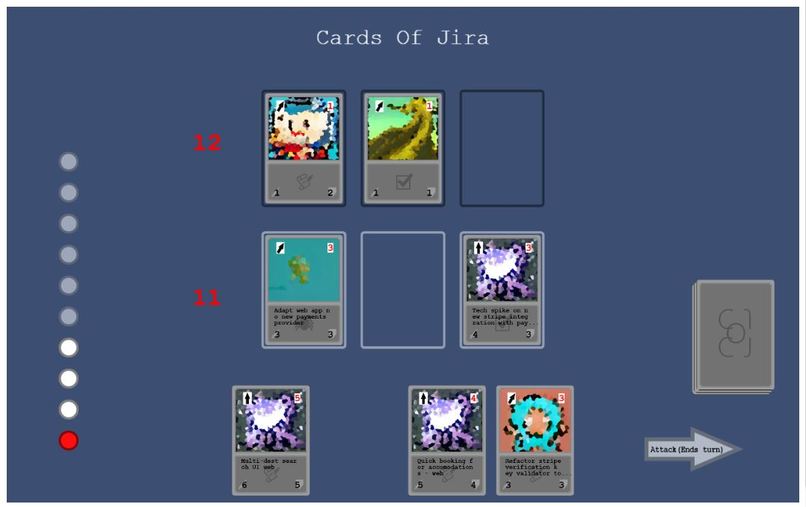
Gameboard 1
-
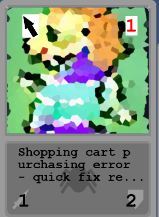
Card
-
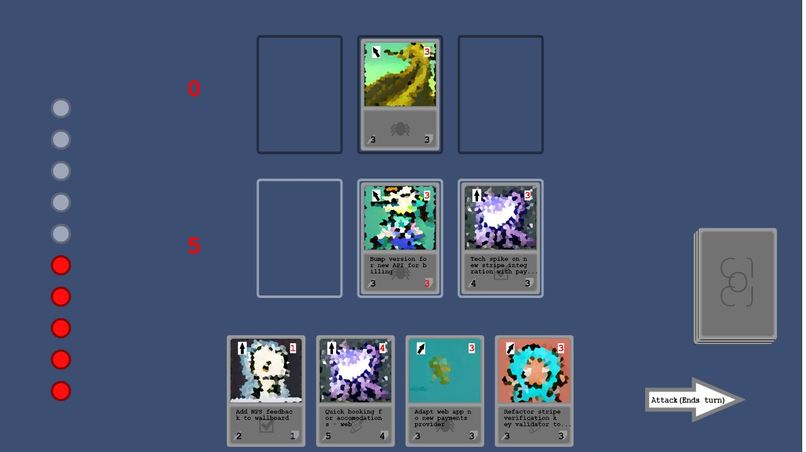
Gameboard 2
Inspiration
I was initially inspired to participate in the hackathon due to wanting to learn how to build JIRA integrations for my work. I often make small games or tech demos in my spare time so a hackathon that combined the two was a match made in heaven.
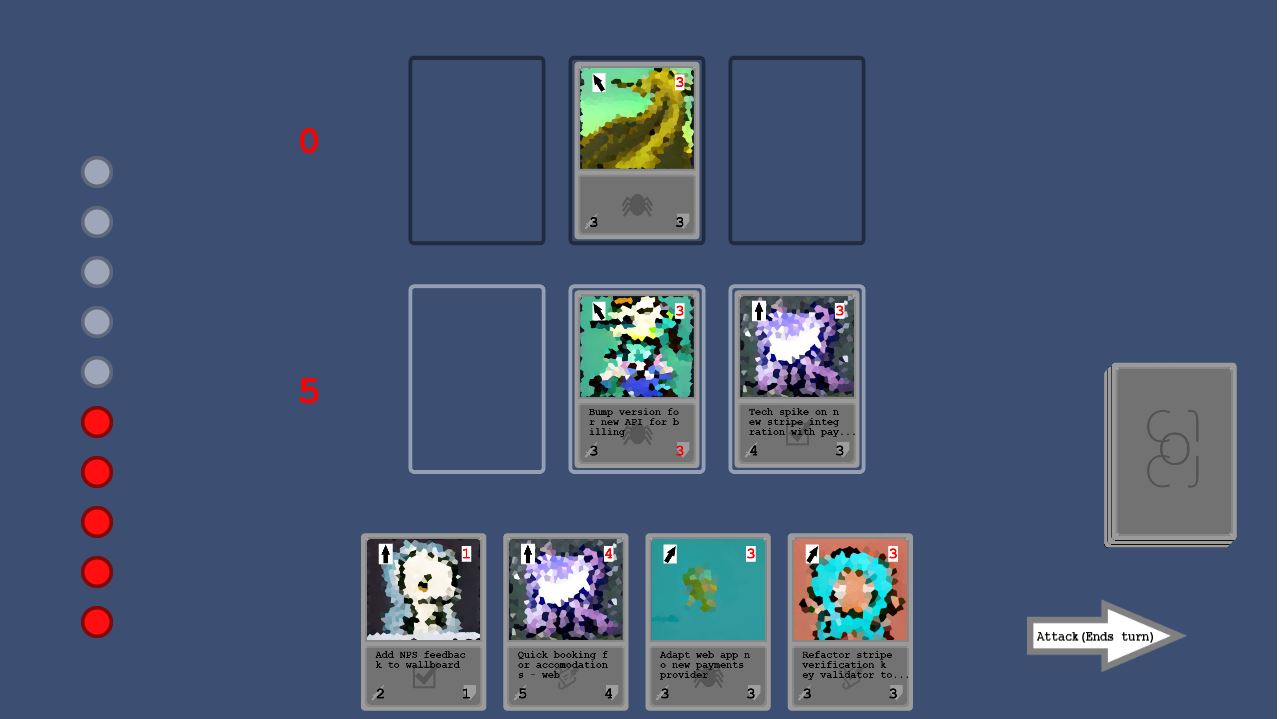
I have drawn inspiration from existing deck building/card collecting games(CCG) such as Hearthstone, Slay the Spire, Magic the gathering and more to create "Cards of Jira". A basic CCG that uses the tasks, stories and bugs in an active sprint to generate a deck of cards for the player to use.
The idea to make my submission a CCG came to me immediatly as I started considering the many similarities between a JIRA issue and a card in one of these game, having similair components like cost and storypoints or issue type and card types. The more I thought about it I realised that there are also similarities between building a good deck for a CCG and "building" a good sprint for a software project. I then set out to make a game that would draw on these similarities to hopefully build something that would help small teams or solo developers create appropriate sprints simply by trying to build a good CCG deck.
What it does
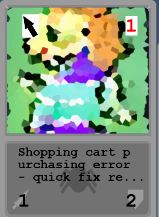
Cards of Jira scans an active sprint and uses the tasks, bugs and stories it finds there to generate cards with the usual attack and defense and cost values common to other CCGs. All of which is derived in different ways from the storypoints on the JIRA task. Except for this it also adds the attack direction of the card. This is something a bit unique to Cards of Jira's . Each card can only attack in one direction, left, right or straight ahead. Be careful where you place your cards or they wont do any good!
How I built it
Cards of Jira was built using the "starter app for Devs Unleased hackathon" as a base. It is a Forge App and it utilizes the JIRA restApi aswell as Phaser3, a javascript framework for building games.
I worked solo on this hackathon so all code, music and art was made by myself.
Challenges I ran into
I am new to developing with forge so I did run in to quite a bit of challenges early on getting my project set up correctly. Luckily I have a little bit of experience with phaser3 since before and managed to recoup some time there.
Another challenge of working solo over the holidays was that I had way less time to spend on the hackathon than I would have liked. With christmas, new years and more happening it was hard to get the quiet time needed to put my head down and code. But I expect everyone else has had to deal with this same challenge.
Accomplishments that I'm proud of
I am proud of finishing a submission on time, and I am proud of the core idea. Even though what I am submitting is not all I had hoped it would be, I think there is something here to keep building on. Adding in more mechanincs and fine tuning the balance between health and card damage, perhaps adding a leaderboard, I think this game could be really fun for developers to play during their down time.
What I learned
I have learned alot participating in this hackathon, I'm completely new to Forge aswell as integrations to Atlassian products and I definitely feel like I have achieved my initial goal of learning how to integrate with JIRA. I have also learned that even if 30 days sounds like alot, it isn't that much when you consider the time you actually have to spend over those days. My original idea was far to ambitious and I have had to scale it down. Next time I will be more moderate in my initial planning.
What's next for Cards of Jira
Like I mentioned earlier, I think this game could really be fun to play so I would like to keep developing it furhter. First on the agenda would be to add spell/trap cards so it wouldn't just be attacking cards in the decks generated. And then add some type of local leaderboard for all users in the same project/sprint.
Built With
- forge
- javascript
- jira
- phaser.js
- phaser3
- rest


Log in or sign up for Devpost to join the conversation.