-
-
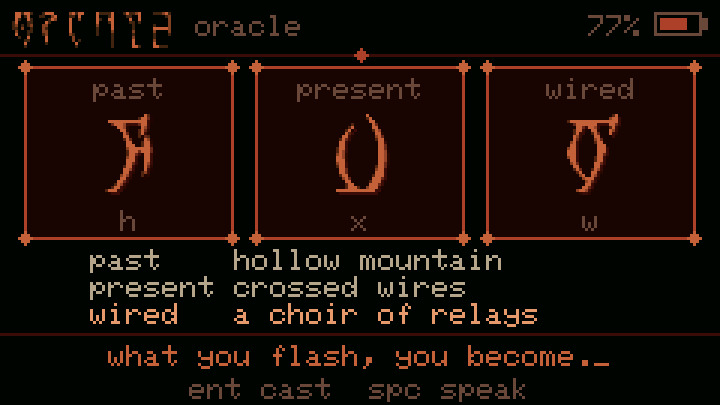
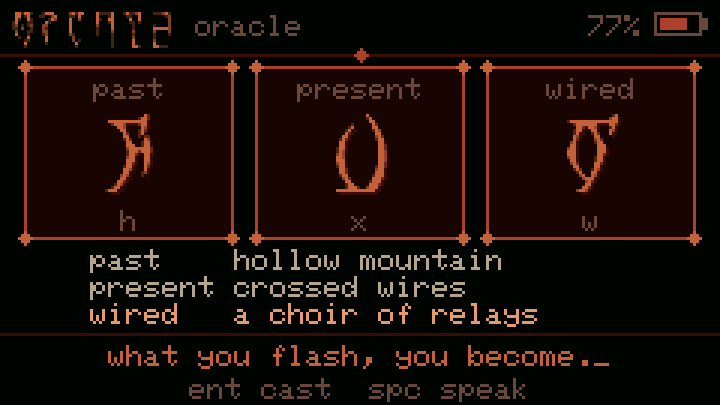
cast the stones, get a pseudo-psychic reading of your future.
-
-
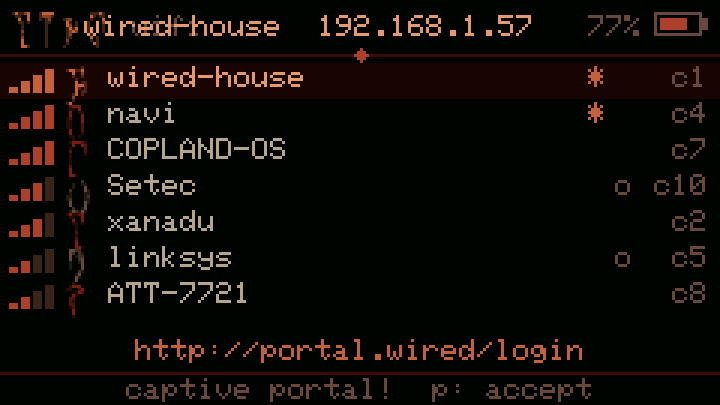
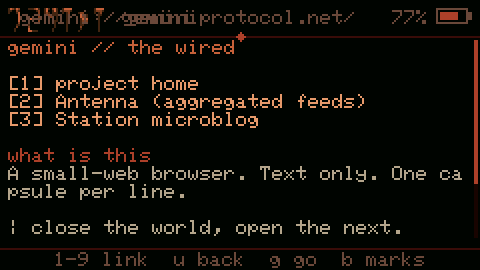
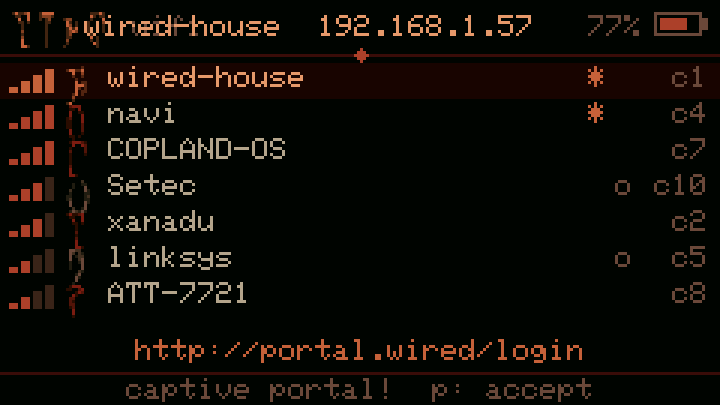
surf the net.
-
-
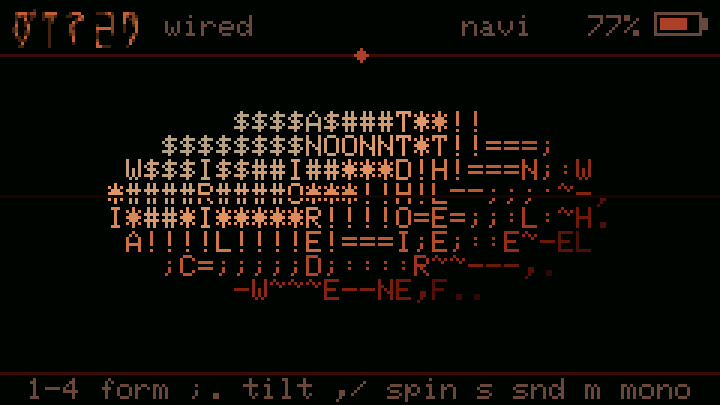
more generative visuals.
-
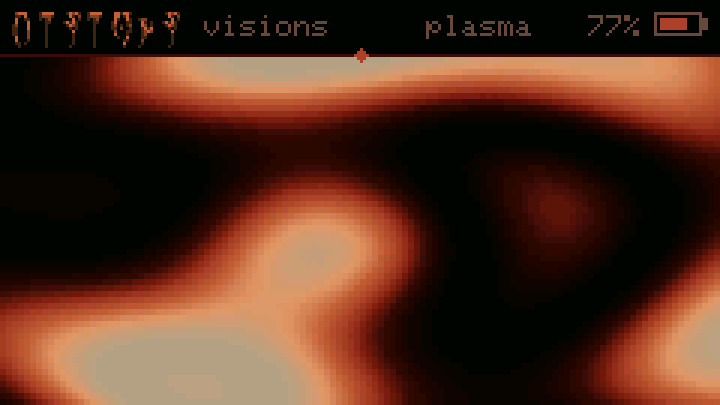
generative visuals, rooted in true entropic randomness.
-
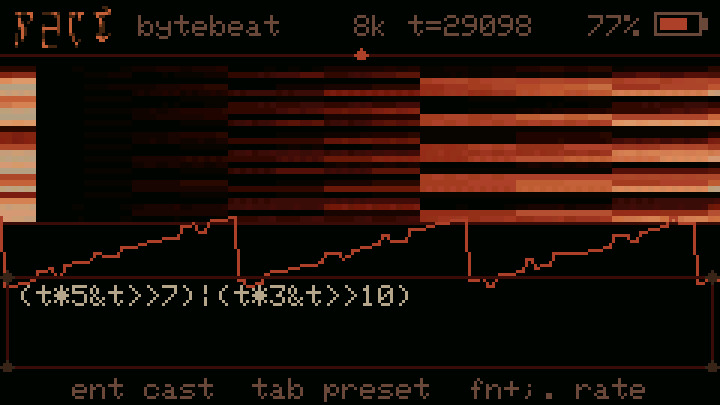
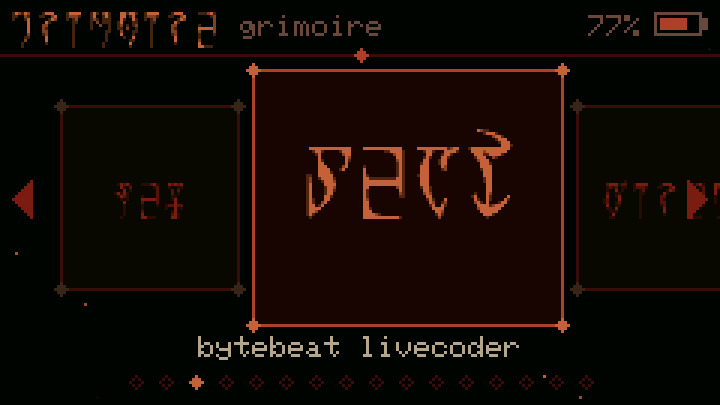
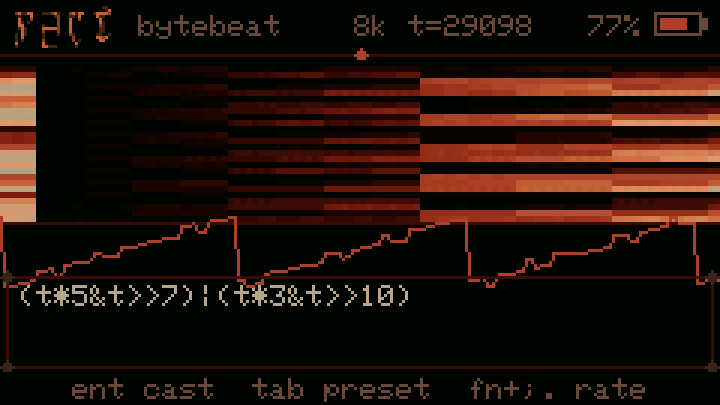
bytebeat livecoding, comes with 6 presets.
-
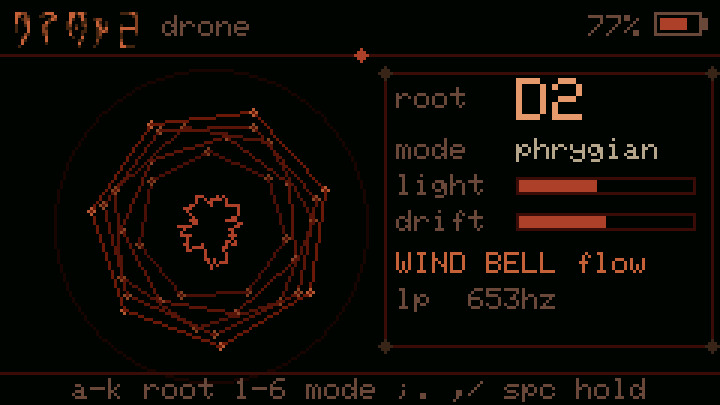
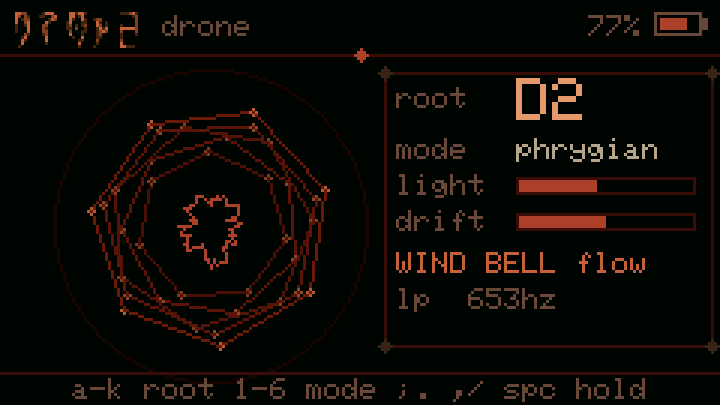
the beautiful generative drone module.
-
 GIF
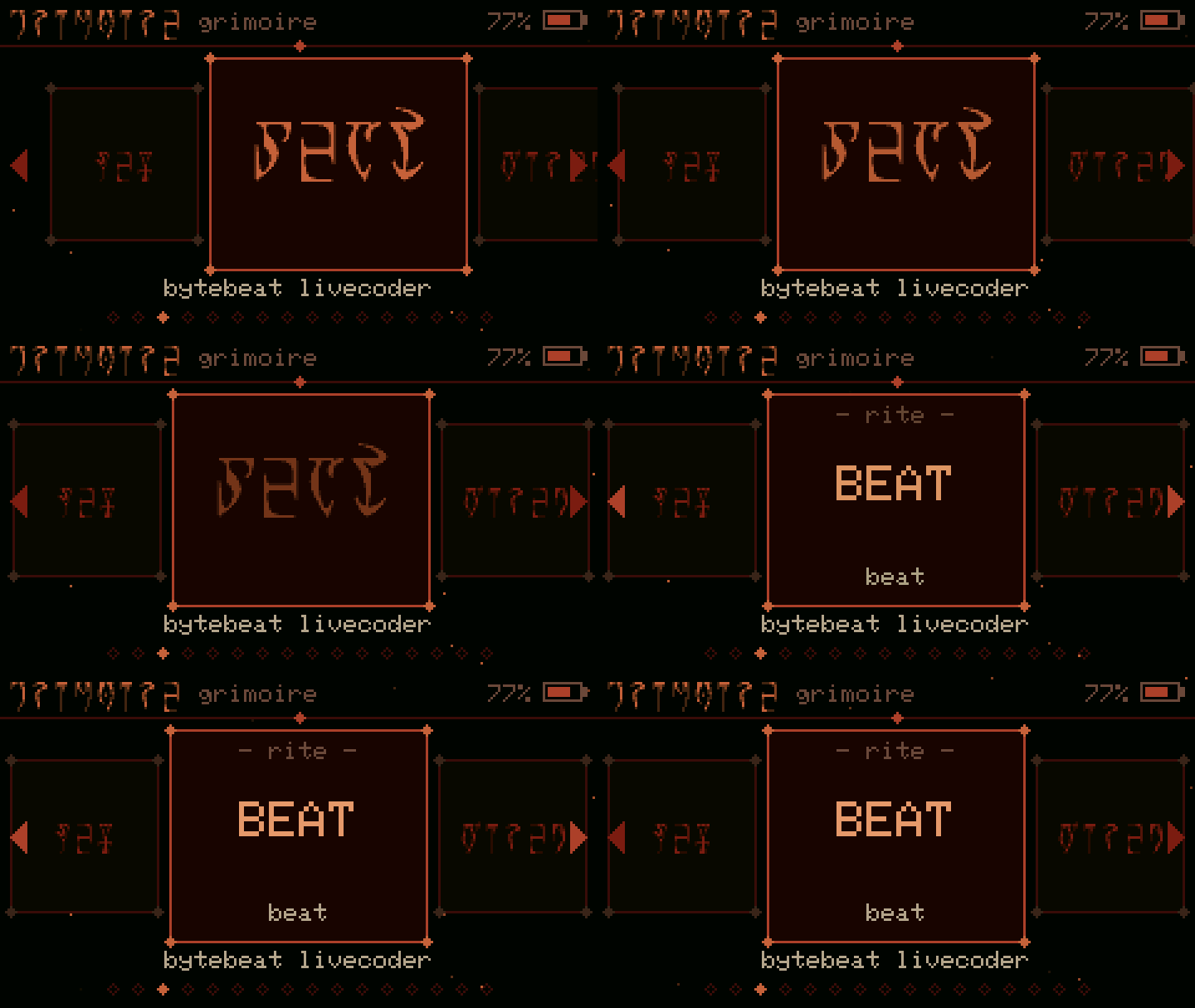
main selection screen, showing how the interface handles visually serving each module choice.
-
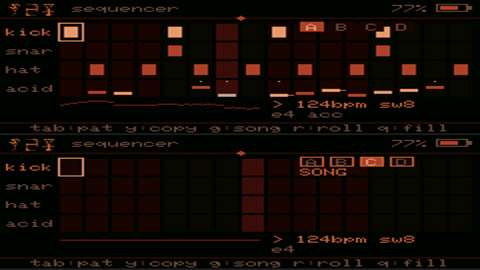
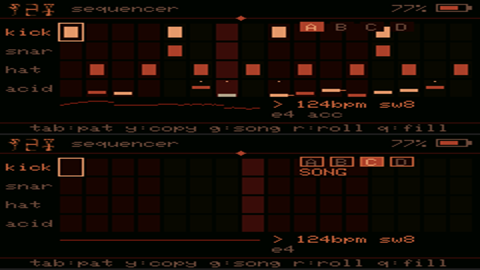
a real, live, and versatile sequencer app.
DIVINER // an occult computing environment for the M5Stack Cardputer ADV
A pocket-sized synthesizer, wireless exploration terminal, generative art machine, and experimental cyberdeck, disguised as a Daedric artifact.
Inspiration
I have always been fascinated by computers that feel like they belong to another world.
Not necessarily more powerful computers, or even particularly practical ones. I'm interested in the strange little machines that have their own identity: early cyberdecks, experimental synthesizers, obscure handheld terminals, demoscene software, and the fictional interfaces scattered throughout science fiction and fantasy.
There is something compelling about hardware that feels like an artifact rather than an appliance.
The M5Stack Cardputer ADV seemed like the perfect platform to explore that idea. It combines an ESP32-S3, a tiny display, a physical keyboard, wireless connectivity, and audio hardware in an unusually compact package. It's a complete little computer, but one with enough limitations to force interesting design decisions.
I wanted to build something that went beyond the typical collection of standalone ESP32 utilities.
My initial inspiration came from several directions:
- The Elder Scrolls III: Morrowind, particularly its Daedric writing systems, occult machinery, and strange interfaces.
- Serial Experiments Lain, with its portrayal of networks as mysterious, almost metaphysical spaces.
- Early demoscene software, where programmers created elaborate audiovisual experiences from extremely constrained hardware.
- Experimental electronic instruments, especially generative synthesizers, trackers, and algorithmic music systems.
- Cyberdeck culture, with its emphasis on unconventional personal computers and purpose-built interfaces.
I kept returning to one question:
What if an embedded firmware environment felt less like a conventional utility menu and more like an operating system discovered inside an ancient, malfunctioning machine?
That became DIVINER.
Rather than calling its applications "apps" or "tools," DIVINER calls them rites. Each one performs a real function, but presents it through a deliberately unusual visual and auditory language.
The goal was never to sacrifice functionality for aesthetics. I wanted the visual identity and the engineering to reinforce one another.
A wireless scanner could become a constellation. A synthesizer could become a ritual instrument. A network monitor could feel like a machine listening for distant signals.
What it does
DIVINER is an open-source C++ firmware environment for the M5Stack Cardputer ADV.
It currently contains 16 interactive applications organized into four domains: sound, sight, the wired, and wards.
Every application shares the same custom interface, including a hand-rasterized Daedric font, blood-and-ember color palette, animated menu transitions, and atmospheric audio feedback.
One of my favorite interface details is the navigation system: application names initially appear in Daedric script, then resolve into readable English when selected.
01 // sound
The sound domain transforms the Cardputer into a miniature electronic music workstation.
DRONE is a five-voice generative ambient synthesizer featuring drifting oscillators, resonant low-pass filtering, wind textures, bells, and dark delay.
It can produce continuously evolving atmospheric sound without requiring conventional note-by-note composition.
SEQ is a compact groovebox with kick, snare, hi-hat, and acid synthesis. It includes Euclidean fills, four pattern banks, song mode, and pattern saving and loading.
BEAT is a bytebeat livecoding instrument. Users enter mathematical expressions in C-style syntax using the variable t, and those expressions are evaluated to produce sound.
Bytebeat was especially interesting to implement because something as simple as a few bitwise operations can generate unexpectedly complicated rhythmic and melodic structures.
02 // sight
The sight domain is devoted to procedural graphics and audiovisual experimentation.
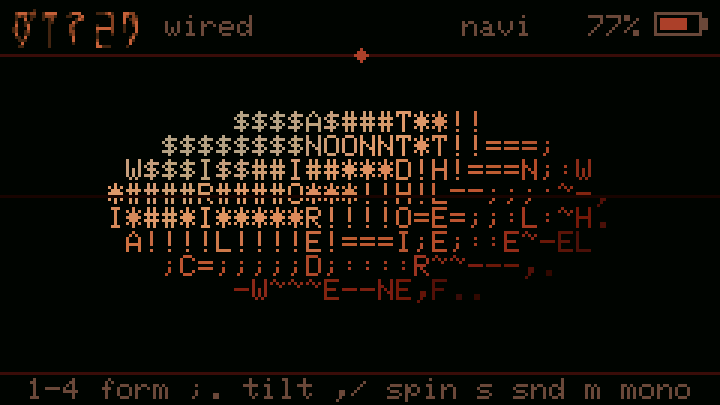
WIRED renders ASCII-style 3D scenes, including rotating toroidal geometry, wireframe solids, tunnels, and a Navi-inspired sphere.
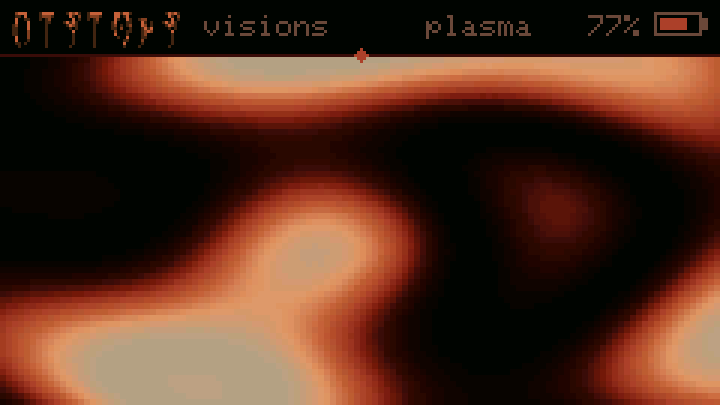
VISIONS generates mathematical visual effects such as plasma patterns, an Oblivion-inspired gate, ash-fire, Daedric glyph rain, and a heptagram kaleidoscope.
ORACLE is an interactive three-rune divination experience with accompanying bell tones.
These applications explore how much visual atmosphere can be generated with relatively little memory and a 240 × 135 display.
03 // the wired
This domain focuses on wireless communication, network discovery, and interacting with external systems.
LINK manages Wi-Fi connections, remembers previously used networks, and supports captive-portal detection and acceptance.
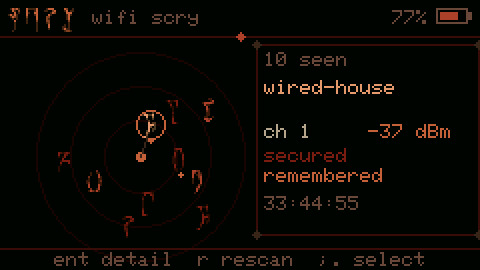
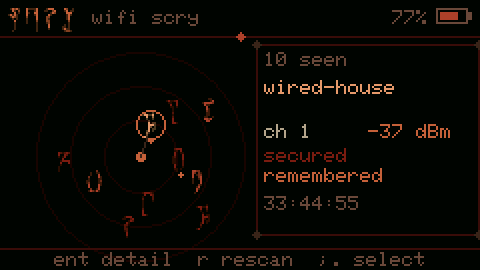
SCRY transforms nearby Wi-Fi networks into a visual constellation.
LISTEN is a receive-only wireless channel monitor with audible feedback.
KIN represents discovered Bluetooth Low Energy devices as drifting electronic familiars.
NET performs local network discovery, identifying hosts, names, and open ports.
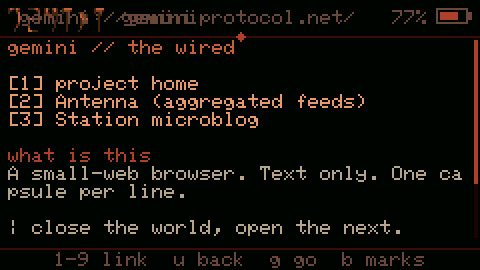
GEMINI is a lightweight Gemtext browser with TLS support and posting functionality.
BANISH provides infrared television power and volume controls across five supported protocol families.
This was one of the most interesting parts of the project because wireless activity is usually invisible. I wanted to explore different ways of giving those signals a visual or auditory presence.
04 // wards
The wards domain contains monitoring and experimental security-oriented utilities.
SENTINEL learns a baseline of nearby devices and alerts when previously unknown devices appear. It also includes heuristic identification of potentially drone-related devices.
PULSE experiments with Wi-Fi Channel State Information (CSI) for motion and presence sensing.
PROBE performs active HTTP reconnaissance and default-credential checks against an explicitly authorized host.
PULSE is experimental and is not intended to function as a calibrated motion detector. Similarly, SENTINEL's drone identification is heuristic rather than definitive.
All network testing functionality is designed for environments and devices the operator owns or has explicit permission to examine. DIVINER deliberately does not implement denial-of-service or phishing attacks.
How I built it
DIVINER is written primarily in C++ using PlatformIO, with the ESP32-S3 serving as its main hardware platform.
The M5Stack Cardputer ADV provides a keyboard, display, audio hardware, Wi-Fi, Bluetooth, and infrared capabilities in a compact form factor.
Instead of writing sixteen isolated programs, I structured DIVINER around a shared application framework.
Hardware abstraction
One of the most important architectural decisions was separating the application logic from the underlying hardware.
The hardware abstraction layer handles device-specific functionality including:
- Display rendering and graphics output
- Keyboard input and navigation
- Audio playback and synthesis
- Hardware initialization
- Device-specific input and output behavior
On the actual Cardputer ADV, this layer interacts with the M5Stack hardware libraries, ES8311 audio codec, and TCA8418 keyboard controller.
The device audio path operates at 24 kHz and includes an overlay for interface sound effects.
This architecture made it possible to develop a second implementation targeting ordinary desktop hardware.
Native desktop simulator
I built a desktop simulator using SDL2 and LovyanGFX.
The simulator reproduces the Cardputer's display environment and supports keyboard interaction and audio output without requiring the physical device to be connected.
This significantly changed my development workflow.
Instead of compiling and reflashing the ESP32-S3 every time I changed a menu animation, rendering routine, or synthesizer parameter, I could test many changes directly on a computer.
The simulator also supports scripted, headless operation, automated screenshot capture, and WAV audio output.
These capabilities are useful for regression testing and generating project documentation.
The simulator's network layer uses simulated data rather than emulating the ESP32-S3's actual wireless hardware, but the application interfaces can still be tested independently.
Audio and DSP
The audio applications required their own digital signal processing components.
I implemented synthesis techniques involving oscillators, resonant filtering, procedural noise, modulation, delay effects, and rhythm generation.
The sequencer combines multiple percussion and synthesizer voices with pattern storage and song arrangement.
The bytebeat engine evaluates compact mathematical expressions to produce audio, turning code itself into a musical instrument.
A major consideration was maintaining consistent playback while the interface continued to handle input and rendering.
Graphics and typography
DIVINER's appearance is not simply a collection of background images.
The interface includes custom typography, shared rendering utilities, procedural effects, and animated transitions.
I incorporated a hand-rasterized Daedric glyph font into the firmware and built the menu around its unusual letterforms.
The visual systems also include software-rendered geometric effects, ASCII 3D, animated glyphs, and mathematical patterns.
The restricted display resolution became part of the aesthetic rather than something to hide.
Networking
The networking layer implements Wi-Fi connectivity, BLE discovery, wireless monitoring, local network scanning, Gemini communication over TLS, and experimental CSI-based sensing.
I separated the networking implementation from the application layer so the individual rites could operate through a consistent interface.
That also allowed the simulator to provide predictable test data without requiring genuine radio hardware.
Building and installing
The project uses PlatformIO environments for both the Cardputer hardware and the native simulator.
To build the device firmware:
pio run -e cardputer
To build the desktop simulator:
pio run -e native
To run the compiled simulator:
.pio/build/native/program
The firmware can be installed using the Cardputer Launcher, including from an SD card.
Because installation on the ADV replaces the factory firmware, backing up the original flash contents first is strongly recommended.
The repository includes the source code, build configuration, screenshots, and additional installation instructions.
Challenges I faced
Making sixteen applications feel like one environment
The biggest architectural challenge was maintaining consistency across applications with very different requirements.
A generative synthesizer, a network scanner, and a procedural graphics engine do not naturally share the same interaction patterns.
I needed a unified system for application lifecycle management, input handling, menu navigation, graphics, and audio feedback.
Separating the individual rites from the hardware abstraction and shared interface components helped make this manageable.
Building a desktop simulator that behaved like the real device
Supporting both embedded hardware and desktop development introduced its own complications.
The keyboard systems are fundamentally different, and certain modifier combinations or simulator shortcuts could interfere with application input.
I had to refine keyboard routing so that simulator controls were handled correctly without consuming input intended for the firmware.
This reinforced how important it is to test the development tools themselves, not just the application being developed.
Managing sound without interrupting the experience
Audio was another significant challenge.
Generative synthesis depends on continuity. Sudden jumps in oscillator pitch, abrupt changes in noise levels, or unrelated interface sounds can make an otherwise atmospheric instrument feel broken.
During development, I encountered problems where navigation feedback interrupted the drone synthesizer.
I improved the behavior by suppressing certain interface sounds while the instrument was active, smoothing pitch changes, and fading the wind layer instead of switching it abruptly.
Small changes like these made a surprisingly large difference.
Working within the display's limitations
The Cardputer's 240 × 135 display doesn't leave much room for conventional interface design.
Long labels, complex network information, editable expressions, and musical controls all need to remain usable at a very small scale.
I had to balance readability against the project's visual identity.
The Daedric-to-English menu reveal became one solution: the interface can preserve its unusual appearance without forcing users to memorize an invented writing system just to operate the device.
Maintaining reliable application state
Switching between applications that use audio, networking, and graphics also creates lifecycle challenges.
Resources have to be initialized, released, or reset correctly when entering and leaving a rite.
Recent development work included hardening application lifecycle behavior, improving Gemini error handling, and refining memory use in the drone synthesizer.
These are less visually exciting than a new animation, but they're essential for making experimental software reliable.
Balancing experimental functionality with accurate expectations
Some features, especially Wi-Fi CSI presence sensing and heuristic device identification, are inherently experimental.
One challenge was deciding how to present them without overstating their accuracy.
I wanted DIVINER to encourage exploration while remaining transparent about what the hardware and software can actually determine.
That meant documenting the limitations and distinguishing genuine sensing capabilities from visualizations, heuristics, and simulated behavior.
What I learned
This project taught me a great deal about the relationship between interface design and embedded systems architecture.
A strong visual identity can be part of the engineering rather than decoration added afterward.
The Daedric typography, menu behavior, application naming, and audio feedback all influenced how the framework was structured.
I also learned that building a native simulator for embedded software is worth the additional complexity.
Being able to test rendering, user input, and audio on a desktop computer made iteration significantly easier and enabled more systematic testing.
On the technical side, I gained experience with:
- ESP32-S3 firmware development and hardware abstraction
- Embedded audio synthesis and digital signal processing
- Real-time graphics and procedural visualization
- Bluetooth Low Energy discovery and Wi-Fi monitoring
- Network protocols, including Gemini over TLS
- SDL2-based desktop simulation
- Application lifecycle management
- Embedded interface design under severe display constraints
- Automated screenshot and audio capture
Perhaps the most interesting lesson was that hardware limitations can become creative constraints rather than obstacles.
The Cardputer cannot compete with a laptop in raw computing power, but its unusual combination of physical controls, wireless capabilities, audio, and a tiny display makes it possible to build an experience that wouldn't feel the same on a conventional computer.
What's next
DIVINER currently implements all sixteen planned rites, but there is still room to refine the environment.
My priorities for future development include:
- Continuing to improve audio synthesis and sequencing behavior
- Refining the interface and keyboard navigation
- Expanding automated testing through the desktop simulator
- Improving the reliability and documentation of experimental wireless features
- Exploring new generative visual and musical interactions
- Improving installation and onboarding for other Cardputer ADV owners
- Incorporating community feedback and contributions
I'm particularly interested in exploring how embedded instruments can combine real environmental signals with procedural music and visualization.
There is something exciting about a tiny device interpreting the invisible systems around it and turning them into something you can see, hear, or interact with.
Final thoughts
DIVINER began as an experiment in combining several interests that don't usually coexist in a single embedded project: fantasy interface design, electronic music, network exploration, and low-level programming.
It became a complete firmware environment with sixteen applications, a shared architecture, a desktop simulator, and a visual identity that deliberately refuses to look like ordinary utility software.
I wanted to build something technically useful that also felt strange, personal, and memorable.
Something that makes a tiny computer feel bigger on the inside.
Sixteen rites. Four domains. One pocket-sized machine.
The source code is available under the MIT license.
GitHub: https://github.com/numbpill3d/cardputer-adv-diviner
Hackaday.io: https://hackaday.io/project/207156-diviner-occult-firmware-for-cardputer-adv
Built With
- cardputer
- creative
- creativecode
- cyberdeck
- diy
- diysynth
- firmware
- instrument
- m5stack
- sequencer
