-
-
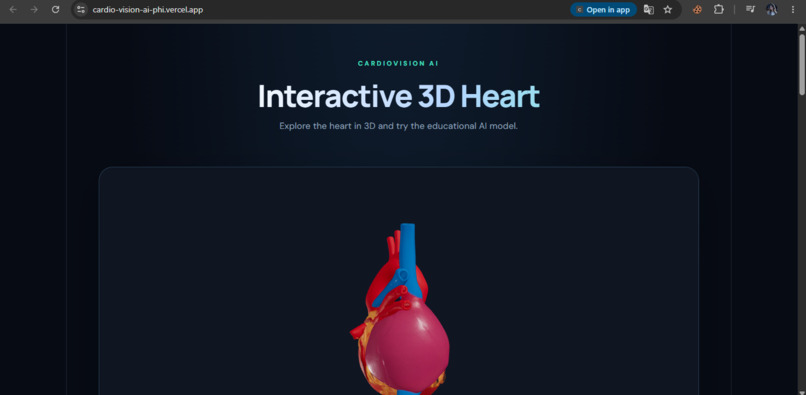
CardioVision AI — Bringing AI and heart health together through cardiovascular risk prediction and interactive visualization.
Inspiration
I wanted to build something that combines AI with a problem that matters in real life. Heart health is something many people worry about, but medical information can often be difficult to understand. That inspired me to create CardioVision AI, a project that explores how AI can help make cardiovascular risk information easier to understand through predictions and visualizations.
What it does
CardioVision AI is an AI-powered platform designed to predict the risk of coronary artery disease (CAD) using patient-related data. It also explores artery-specific stenosis predictions for the LAD, LCX, and RCA arteries.
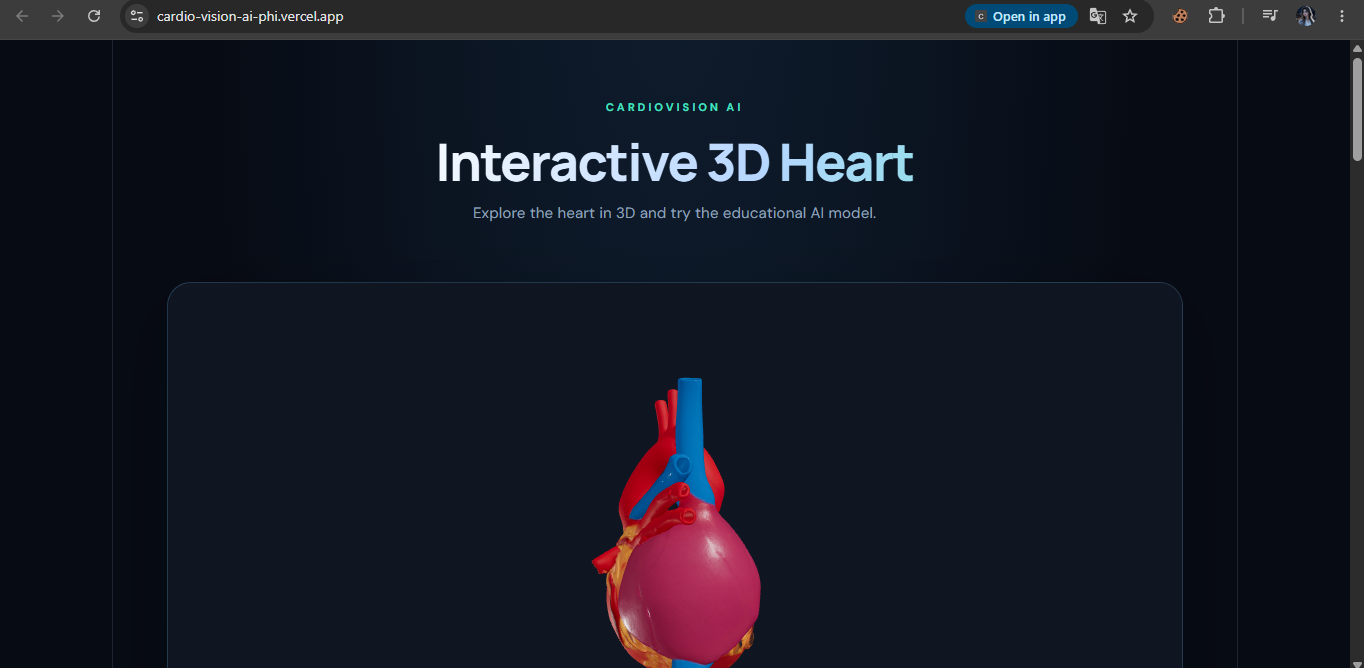
Along with the predictions, the platform aims to make the results more understandable through an interactive interface and heart-related visualizations. Instead of showing only numbers, I wanted to create something that helps users see and understand the information more clearly.
This is an educational prototype, not a medical diagnostic tool, and its predictions should not be used to make clinical decisions.
How I built it
I built CardioVision AI using a combination of machine learning and web development. The backend uses Python and FastAPI to handle prediction requests, while the frontend is built with React and Vite to provide an interactive user experience.
I also worked with a cardiovascular dataset to explore the input features and prepare the prediction workflow. The project includes separate trained models for CAD, LAD, LCX, and RCA predictions.
For deployment, I used Render for the backend API and Vercel for the frontend. This helped me understand how the different parts of an AI application connect and work together beyond my local development environment.
Challenges I faced
One of the biggest challenges was connecting the frontend and backend properly. Even when the API worked on its own, getting the deployed website to communicate with it required additional debugging.
I also had to work through dataset handling, model integration, API configuration, deployment settings, and CORS issues. These challenges taught me that building an AI application is not just about training a model. It also requires making the entire system work together reliably.
What I learned
While working on CardioVision AI, I learned more about integrating machine learning models into a real web application, building APIs with FastAPI, connecting a React frontend to a backend, and deploying an application online.
More importantly, I learned to approach problems step by step, test each component, and keep improving when something does not work as expected.
What's next
I would like to improve the prediction workflow, validate the models more thoroughly, enhance the interactive heart visualization, and make the interface easier to understand.
My goal with CardioVision AI is to keep exploring how AI and visualization can make complex cardiovascular information more accessible, while being clear about the limitations of the technology.
Built With
- api
- artificial
- data
- fastapi
- intelligence
- javascript
- learning
- machine
- python
- react
- rest
- scikit-learn
- vite

Log in or sign up for Devpost to join the conversation.