Inspiration
ardioVerse AI — The Future of Intelligent Heart Health 💡 What Inspired Us?
Cardiovascular diseases are among the leading causes of death worldwide. Many people lack access to tools that help them understand their cardiovascular risk factors.
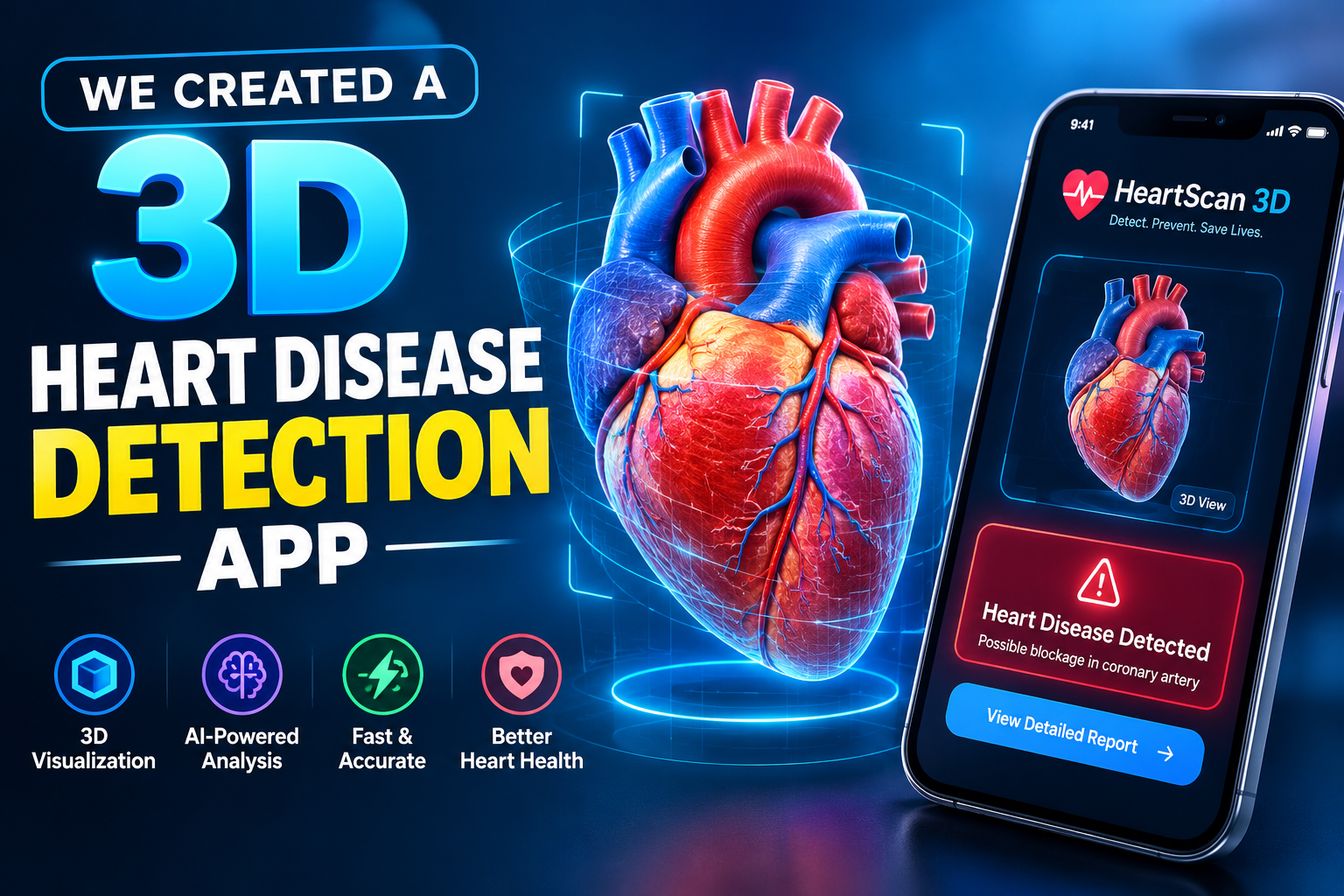
This inspired us to develop CardioVerse AI, an intelligent cardiovascular risk screening platform that combines Machine Learning, Explainable AI (XAI), and Interactive 3D Visualization.
Our vision was to make cardiovascular risk assessment more accessible, understandable, and visually engaging.
Rather than simply displaying a prediction, we wanted users to understand why the AI generated a particular result.
🚧 Challenges We Faced
- Integrating Machine Learning with a Modern Frontend
Connecting our Python-based machine learning model with a React frontend required careful API development, data validation, and reliable communication between FastAPI and the dashboard.
- Building an Interactive 3D Heart
Creating a realistic anatomical heart visualization using Three.js and React Three Fiber was challenging.
We encountered runtime errors involving React Three Fiber hooks, component rendering, and WebGL integration. Resolving these issues required debugging the 3D component hierarchy and optimizing rendering.
- Making AI Predictions Explainable
We wanted CardioVerse AI to provide more than a simple risk percentage.
Our logistic regression model estimates cardiovascular risk using:
$$ P(y=1\mid X)=\frac{1}{1+e^{-(w^TX+b)}} $$
Where:
(X) represents patient health features. (w) represents learned feature weights. (b) represents the model bias. (P(y=1\mid X)) represents the predicted probability of the positive class.
We integrated feature-contribution explanations to help users understand how different inputs influence predictions.
- Creating a Premium Medical Dashboard
Designing a futuristic interface while maintaining usability and performance was another major challenge.
We incorporated cinematic lighting, holographic effects, animated cardiac visualizations, interactive controls, and responsive glassmorphism components.
- Full-Stack Deployment
Deploying a React/Vite frontend alongside a Python FastAPI backend required configuring separate hosting environments, production dependencies, API endpoints, and cross-origin communication.
🚀 What We Learned
Through CardioVerse AI, we strengthened our understanding of:
Machine Learning: Cardiovascular risk prediction using logistic regression. Explainable AI: Interpreting model predictions through feature contributions. 3D Web Development: Three.js, React Three Fiber, and interactive visualization. Full-Stack Engineering: React, FastAPI, REST APIs, and deployment. Problem-Solving: Debugging complex runtime errors and integrating multiple technologies. 🌟 Our Vision
CardioVerse AI represents our vision of making artificial intelligence more transparent, interactive, and accessible in healthcare.
We aim to bridge the gap between complex machine learning predictions and human understanding through intuitive design and explainable insights.
CardioVerse AI is an educational and research-oriented screening demonstration, not a clinically validated diagnostic tool.
What it does
How we built it
Challenges we ran into
Accomplishments that we're proud of
What we learned
What's next for Cardioverse-ai
Built With
- algorithms
- antigravity
- blender
- claude
- css3
- html5
- javascript
- machine-learning
- react
- vite


Log in or sign up for Devpost to join the conversation.