-
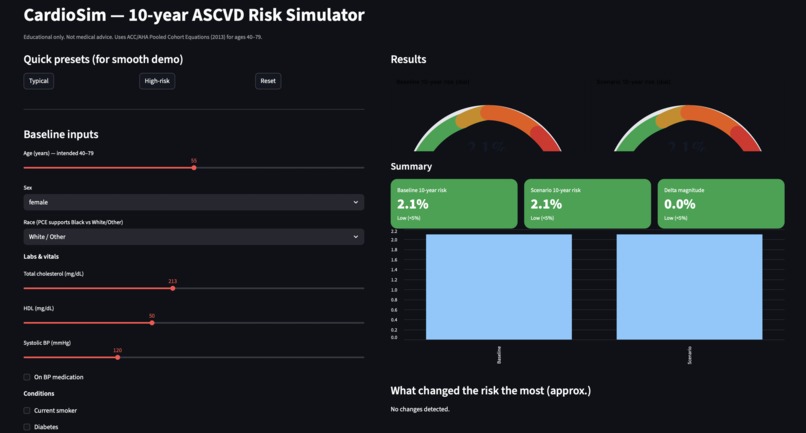
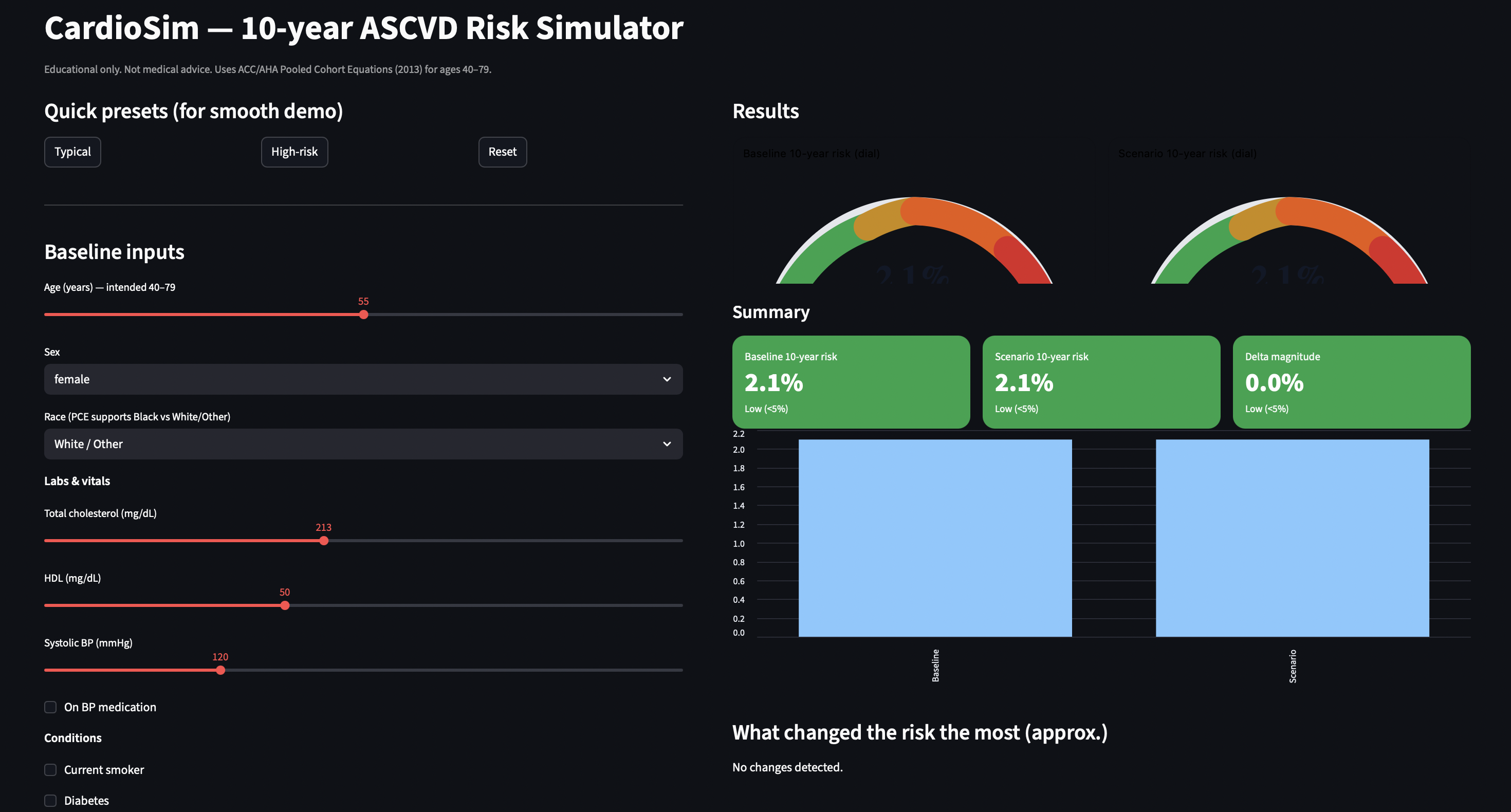
Interactive 10-Year ASCVD Risk Simulator — Real-time modeling of cardiovascular risk with scenario-based intervention analysis.
-
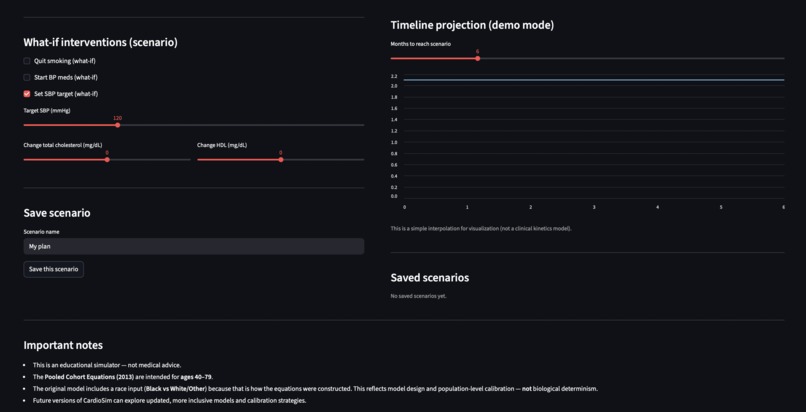
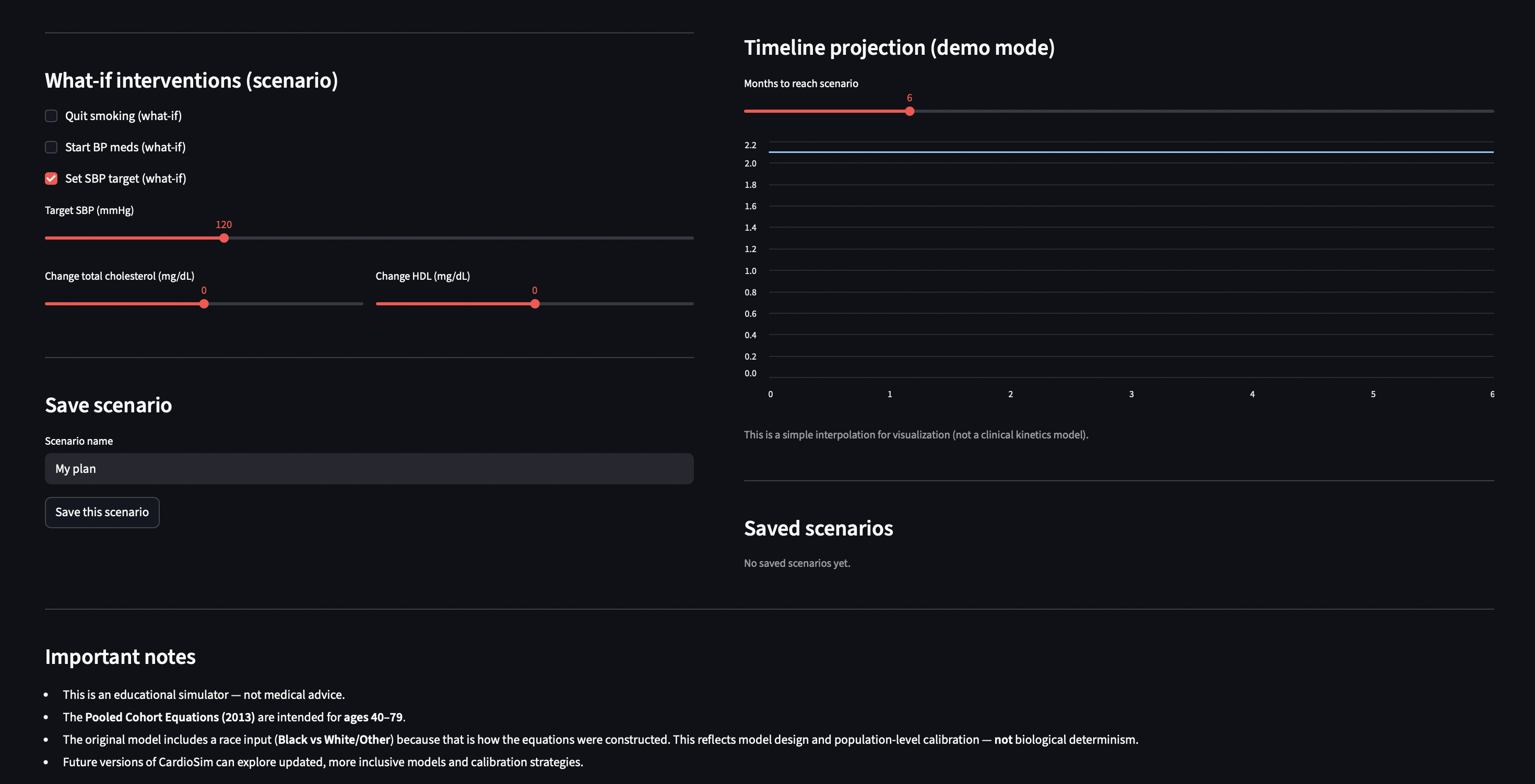
Preventative What-If Engine — Quantifies how lifestyle and clinical changes reduce long-term cardiovascular risk over time.
Inspiration
The inspiration for CardioSim came from the stark reality that cardiovascular disease remains the leading cause of death worldwide. After doing our research, we learned that:
- In 2021 alone, this disease accounted for 20.5 million deaths, approximately one-third of all global deaths.
- In the United States, one person dies every 34 seconds from cardiovascular disease.
- Heart disease is costly. The cost of health care services and medication amounted to over $168 billion from 2021 to 2022.
This is a serious problem, but what if we could work towards preventative care? Despite being such a prevalent disease, many of its risk factors - high blood pressure, obesity, elevated cholesterol, etc. - are modifiable through lifestyle changes. We understand clinical risk calculators are already at play, but they often present results as static, non-explainable scores that are difficult for individuals to interpret or act upon. This is why we want to build CardioSim, an interactive risk simulator as a preventative decision tool that allows users to see how improving lifestyle factors could change their predicted risk.
Our mission: to empower individuals with clearer insight into their cardiovascular health data and encourage proactive, data-driven preventive care.
What it does
CardioSim is an interactive cardiovascular risk simulator that allows users to:
- Input core health metrics (age, blood pressure, cholesterol levels, BMI, smoking status, etc.)
- Instantly receive a personalized 10-year cardiovascular risk estimate
- Adjust lifestyle variables in real time
- Visualize how small changes impact long-term risk
Instead of returning a static number, CardioSim models risk as a probabilistic function: $$R = f(A, SBP, TC, HDL, BMI, S, D)$$ where:
- \(A\) = Age
- \(SBP\) = Systolic Blood Pressure
- \(TC\) = Total Cholesterol
- \(HDL\) = HDL Cholesterol
- \(BMI\) = Body Mass Index
- \(S\) = Smoking Status
- \(D\) = Diabetes Status
We also approximate cardiovascular event probability using a logistic risk formulation: $$P(CVD) = \frac{1}{1+e^{-z}}$$ where: $$Z = \beta_0 + \sum_{i=1}^{n} \beta_i x_i$$ This structure allows dynamic recomputation as users modify inputs.
Interactive Simulation
For example:
- Reduce systolic blood pressure by 10 mmHg
- Increase HDL by 5 mg/dL
- Quit smoking
The model recomputes: $$\Delta P = P_{\text{baseline}} - P_{\text{improved}}$$ And users immediately see projected risk reduction.
Visual Outputs
CardioSim presents:
- Risk percentage over 10 years
- Before/after comparison bars
- Sensitivity charts showing which variables drive the most risk
- Plain-language explanations of why the risk changed
Instead of saying: “Your 10-year risk is 18.2%”
We say: “Reducing systolic blood pressure by 10 mmHg lowers your predicted 10-year risk by 2.4 percentage points.”
This transforms abstract statistics into actionable insight.
How we built it
Risk Modeling Layer
- Logistic regression-based probability estimation
- Calibrated coefficients from publicly available cardiovascular datasets
- Sensitivity analysis via partial derivatives: $$\frac{\partial P}{\partial x_i} = P(1 - P)\beta_i$$ This allows us to quantify which variables most influence risk.
Backend
- Python-based risk engine
- Real-time recalculation on parameter adjustment
- Monte Carlo simulation to account for uncertainty: $$\hat{P} = \frac{1}{N} \sum_{j=1}^{N} P_j$$
Frontend
- Interactive sliders for modifiable risk factors
- Instant visual feedback
- Clean dashboard design focused on interpretability
Explainability Module
We incorporated:
- Variable contribution breakdown
- Ranked risk drivers
- Plain-language summaries generated from model coefficients
This bridges the gap between machine learning output and human understanding.
Challenges we ran into
1. Translating Clinical Models Into An Interactive Tool
Most clinical risk calculators are static and not designed for real-time simulation. We had to restructure the model into a continuously recalculating probabilistic engine.
2. Interpretability vs. Accuracy
More complex models (e.g., gradient boosting) improved predictive performance but reduced interpretability. We prioritized a transparent logistic structure to preserve explainability.
3. Risk Communication
Communicating probabilities is difficult. A “15% risk” can be misunderstood. We redesigned outputs to show risk change, not just baseline risk.
4. Ethical Considerations
Health tools require careful framing. CardioSim explicitly avoids diagnostic claims and positions itself as a preventive educational simulator, not a medical device.
Accomplishments that we're proud of
- Built a fully interactive real-time risk simulator
- Implemented explainable AI principles in healthcare
- Designed a sensitivity-based contribution engine
- Created clear before/after risk visualization
- Balanced technical modeling with accessibility
- Transformed a static medical probability into an intuitive decision-support tool!
What we learned
- Preventive health is as much a communication problem as a modeling problem.
- Explainability dramatically increases trust in AI systems.
- Small lifestyle improvements can produce measurable probabilistic changes.
- AI systems must prioritize clarity when deployed in health contexts.
We also gained deeper insight into how logistic risk models behave under parameter perturbation and how sensitivity scales with: $$P(1-P)$$ Meaning risk changes most dramatically at intermediate probability levels.
What's next for CardioSim: Explainable Preventive Health Risk Simulator
CardioSim is just the beginning. For our future roadmap, we hope to include:
1. Personalized longitudinal tracking
$$R_t = f(X_t)$$ Allows users to track risk trends over time.
2. Integration with Wearables
- Heart Rate
- Activity Levels
- Sleep metrics
3. Population-Level Scenario Modeling
Aggregate anonymized data to simulate public health improvements.
4. Advanced ML with Interpretable layers
Explore SHAP-based explainability while maintaining transparency.
5. Clinical Validation
Partner with research institutions to validate predictive calibration
Long-Term Vision
CardioSim aims to shift healthcare from reactive to preventive.
If individuals can visualize how lifestyle changes impact risk before disease onset, we can reduce: $$\text{Expected Events} = N \cdot P(CVD)$$ Even a small reduction in \(P\) across large populations results in massive public health impact.
CardioSim reimagines cardiovascular risk not as a static number — but as a controllable trajectory.

Log in or sign up for Devpost to join the conversation.