🛡️ CardioShield — Project Story ❤️ Inspiration
Cardiovascular Disease (CVD) is still the number one killer worldwide, accounting for almost 18 million deaths annually. It was not only the magnitude of the problem that impressed us during our research, but also the fact that many cardiac incidents can be prevented if they are caught early.
Unfortunately, existing risk estimation frameworks are highly dependent on static clinical biomarkers such as blood pressure, cholesterol levels, and lifestyle factors. These frameworks tend to overlook one of the most informative indicators of heart conditions: electrocardiography (ECG).
We posed a simple yet profound question:
What if we could merge clinical information and cardiac electrical activity into a single, comprehensive AI framework for early cardiovascular intelligence?
This question gave birth to CardioShield.
🧠 What We Learned
During the course of this project, we delved into a variety of interdisciplinary areas:
Machine Learning for clinical risk prediction
Deep Learning for biomedical signal processing
ECG waveform analysis
Unsupervised anomaly detection
Explainable AI (XAI)
Healthcare AI deployment
We also learned how to develop end-to-end AI systems, not just models, including preprocessing, multimodal fusion, and real-time visualization.
⚙️ How We Built CardioShield
CardioShield is a multimodal cardiovascular intelligence system that combines:
Clinical biomarkers
ECG electrophysiological signals
Explainable AI insights
1️⃣ Clinical Risk Modeling
We trained a variety of machine learning models on anonymous cardiovascular datasets, including:
Gradient Boosting
XGBoost
LightGBM
LightGBM performed the best, with:
Accuracy ≈ 0.74
ROC-AUC ≈ 0.80
The most important predictive biomarkers were:
Systolic Blood Pressure
Age × Cholesterol interactions
BMI
Physical activity
2️⃣ ECG Deep Learning Intelligence
The ECG dataset consisted of raw waveform data without any labeled diagnoses. Rather than ignoring the rich signal information, we chose to apply an unsupervised deep learning method.
We created a 1D Convolutional Autoencoder to learn to reproduce normal ECG waveforms.
Pipeline:
Signal normalization
Fixed-size windowing
CNN encoding → latent compression
Signal reconstruction
Large error values indicate electrophysiological dysfunction such as arrhythmias or irregular cardiac spikes.
3️⃣ Multimodal Fusion Engine
To integrate both intelligence levels, we created the CardioShield Risk Index.
We combined: Clinical risk probability ECG anomaly score Final Risk= Clinical Risk+ECG Risk
This allows for comprehensive cardiovascular risk assessment by integrating physiological and electrophysiological knowledge.
4️⃣ Explainability & Visualization
Healthcare AI requires interpretability.
We applied:
Clinical Explainability
SHAP feature importance analysis
ECG Explainability
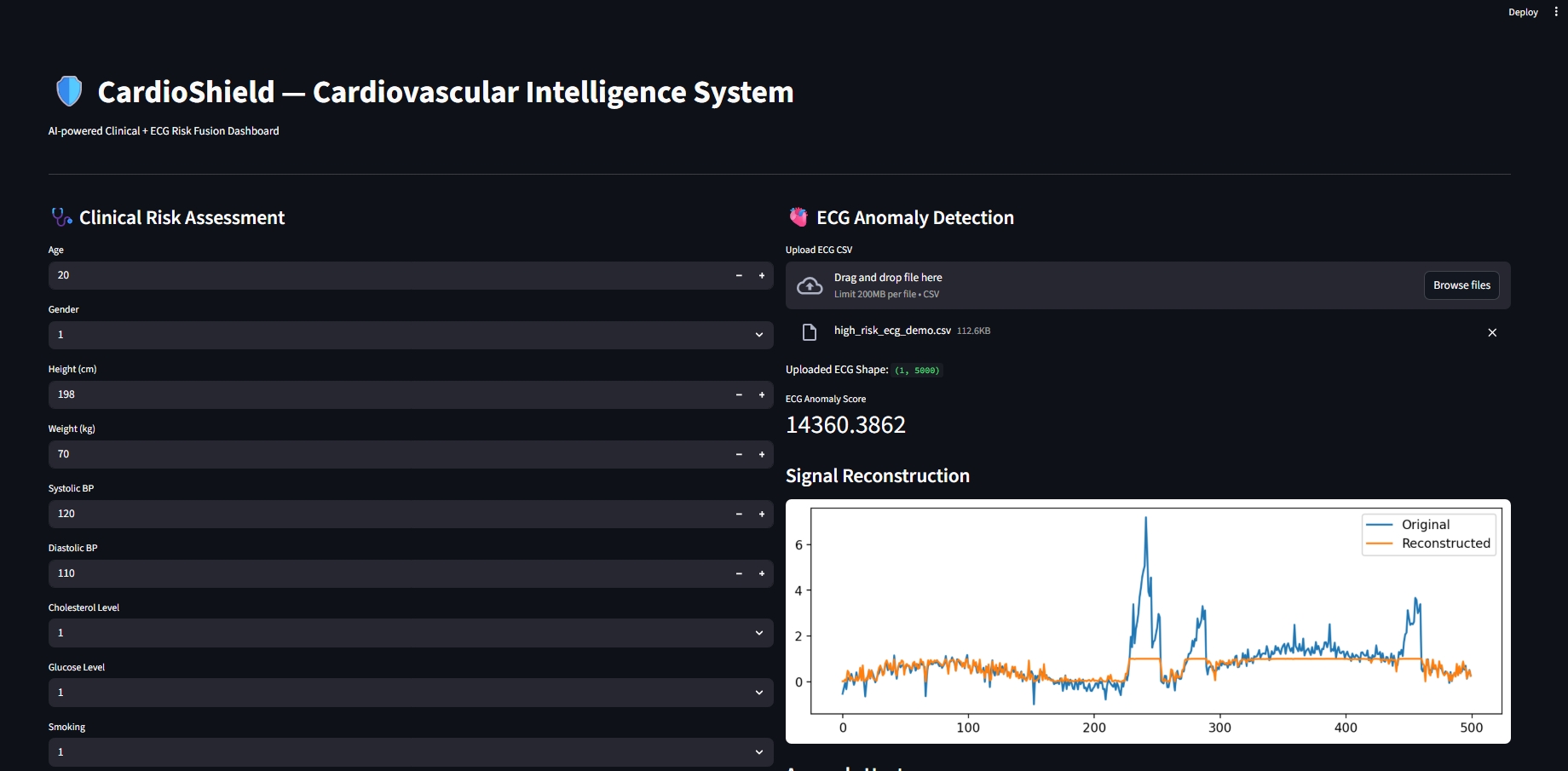
Signal reconstruction overlays
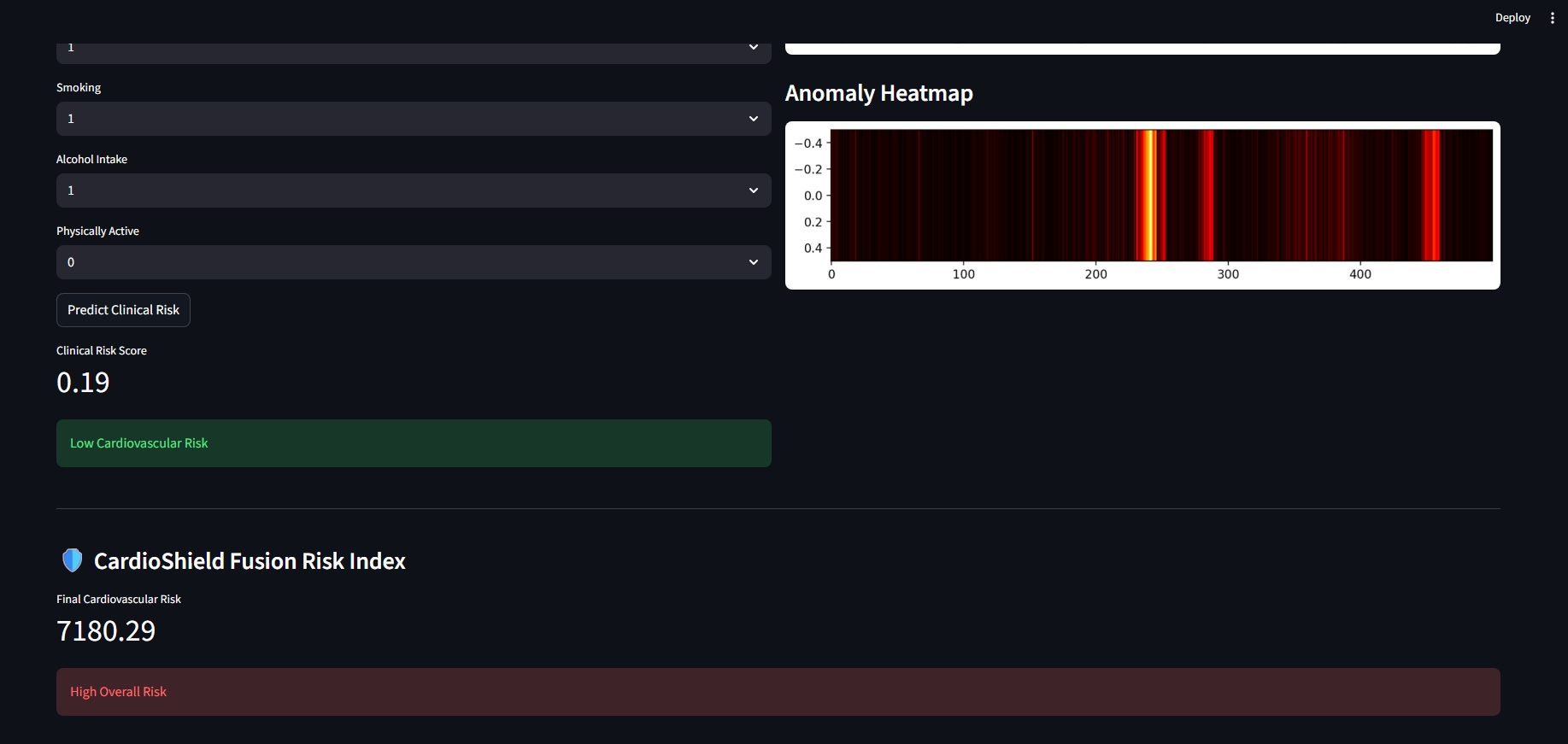
Anomaly heatmaps
Error spike localization
These visualizations enable clinicians to see why a particular patient is identified as high risk.
5️⃣ Deployment Dashboard
We created a real-time AI interface with Streamlit.
Features include:
Patient clinical input form
Live risk prediction
ECG CSV upload
Anomaly detection visualization
Heatmap explainability
Fusion risk scoring
This is a simulation of a deployable clinical decision support system.
🚧 Challenges We Faced 1️⃣ Multimodal Data Integration
Handling clinical tabular data and ECG time-series data required entirely different modeling strategies. Developing a comprehensive fusion strategy was not straightforward.
2️⃣ Unlabeled ECG Signals
The ECG dataset was unannotated. This was addressed by developing unsupervised anomaly detection with autoencoders.
3️⃣ Signal Length Variability
The ECG signals had very long waveforms (~123k timesteps). This was addressed by developing segmentation and padding pipelines to normalize inputs.
4️⃣ Deployment Engineering
Integrating notebook models with a functional UI required:
Model serialization
Scaler alignment
Feature schema matching
Real-time inference optimization
🏥 Impact & Applications
CardioShield has significant real-world applications in:
Preventive cardiology
Remote patient monitoring
Wearable ECG analytics
Hospital triage systems
Rural healthcare screening
The system could have helped decrease cardiac mortality rates by enabling early detection and intervention.
🔮 Future Work
We would like to extend CardioShield to include:
Multi-lead ECG modeling
Arrhythmia classification
Real-time ECG streaming
Electronic Health Record integration
Federated hospital training
🛡️ Conclusion
CardioShield is a testament to the capabilities of multimodal AI in healthcare.
By integrating clinical biomarkers and electrophysiological intelligence, and developing explainable predictions, we created a scalable cardiovascular risk intelligence system for early detection, prevention, and clinical effectiveness.
Built With
- google-colab
- joblib
- jupyter-notebook
- keras
- lightgbm
- matplotlib
- model-evaluation
- numpy
- pandas
- python
- scikit-learn
- seaborn
- shap
- streamlit
- tensorflow
- vscode
- xgboost

Log in or sign up for Devpost to join the conversation.