Inspiration
Coronary Artery Disease (CAD) is the world's leading cause of mortality. Most conventional clinical prediction tools provide only a generic, binary "high vs. low risk" score without showing where the arterial blockage lies or why the model reached that conclusion.
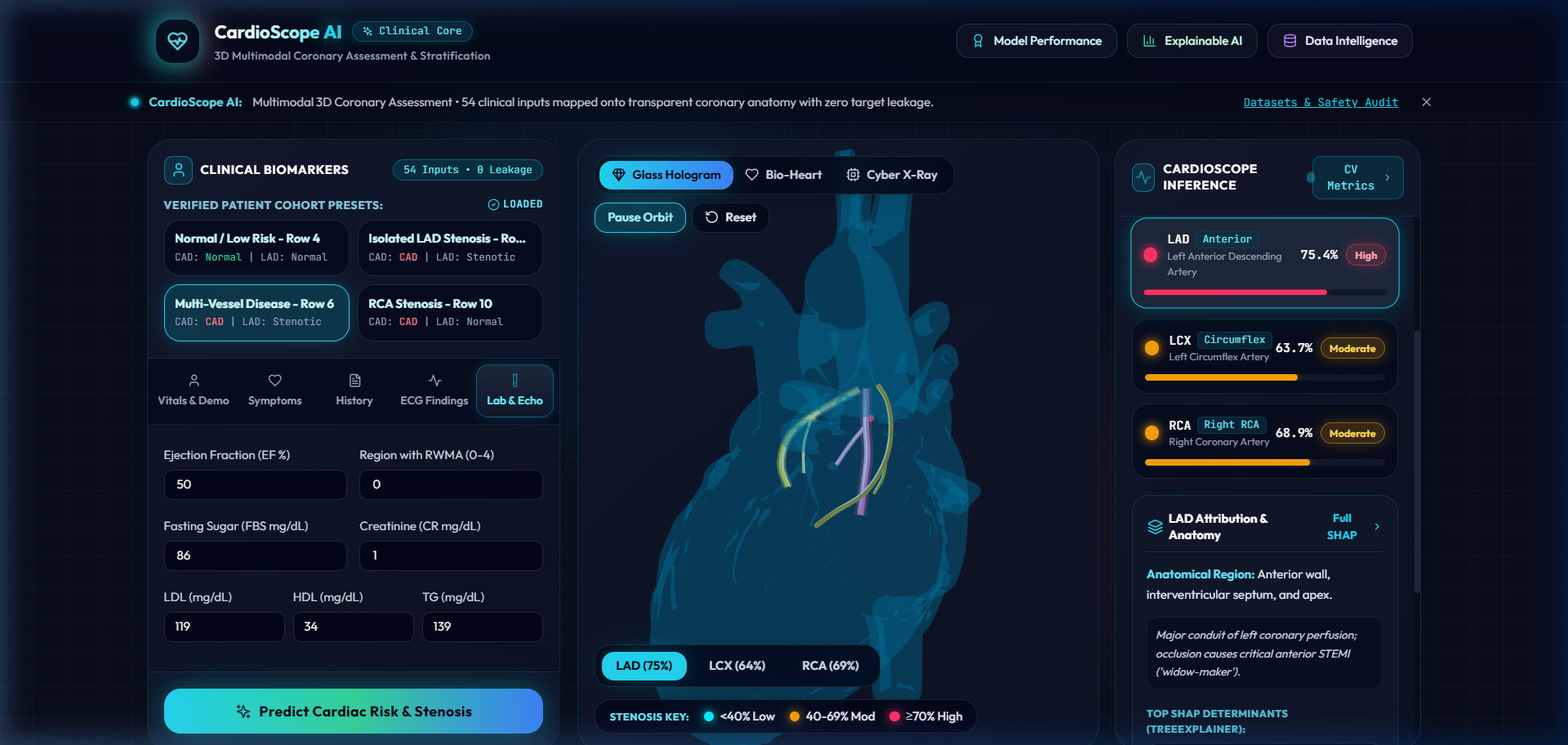
We built CardioScope AI to empower cardiologists with an actionable diagnostic companion that pinpoints vessel-specific stenosis risk (LAD, LCX, RCA) and projects it directly onto an interactive 3D anatomical heart digital twin with complete physiological explainability.
What it does
CardioScope AI transforms patient demographic, laboratory, and ECG parameters into multi-vessel clinical intelligence:
- Multi-Vessel Stenosis Stratification: Predicts overall CAD likelihood along with individualized arterial involvement for the Left Anterior Descending (LAD), Left Circumflex (LCX), and Right Coronary Artery (RCA).
- Interactive 3D Anatomical Digital Twin: Renders a real-time, responsive 3D heart with 3 distinct visualization modes (Holographic, X-Ray, and Bio-Realistic). When an artery is selected or flags high risk, it illuminates with dynamic glow shaders while preserving overall coronary anatomy.
- Explainable AI (TreeSHAP): Generates localized feature attribution waterfalls displaying the exact laboratory and physiological drivers behind each vessel's risk prediction in real time.
- Pre-Loaded Clinical Cohorts: Includes instant one-click clinical presets (High Risk Multi-Vessel, Moderate Ischemia, and Healthy Control) for rapid case demonstration.
How we built it
- Machine Learning & Feature Engineering: Developed with Python, Scikit-Learn, and TreeSHAP. Engineered domain-specific clinical features:
- Atherogenic Lipid Ratio: \( \text{Ratio} = \frac{\text{LDL}}{\text{HDL}} \)
- Metabolic Syndrome Index: \( \text{MSI} = \frac{\text{FBS} \times \text{BMI}}{100} \)
- Composite Ischemic Burden Score: Aggregated ST deviations, T-wave inversions, and angina markers.
- High-Performance Backend: Built with FastAPI, Uvicorn, and Joblib, deployed as a scalable containerized web service on Render.
- Modern 3D Frontend: Developed with React 18, TypeScript, Tailwind CSS, and Three.js / React Three Fiber for hardware-accelerated 60 FPS WebGL rendering, deployed on Vercel.
Challenges we ran into
- Multi-Target Anatomical Imbalance: Mitigating variance across coronary vessels with differing clinical prevalence without overfitting or sacrificing minority class sensitivity.
- Cloud Serialization & Pickling: Resolving Cython loss module bindings (
_loss) and SHAPnumbadependencies when unpickling production model pipelines across headless cloud runtimes. - Synchronous 3D Shader Mapping: Translating tabular statistical probabilities into real-time Three.js mesh emissive glows and multi-artery highlights without dropping render frames.
Accomplishments that we're proud of
- Moving Beyond Binary Risk: Delivering granular, artery-by-artery risk stratification (LAD, LCX, RCA) rather than a single black-box score.
- Clinician-Centric 3D Experience: Crafting an intuitive, futuristic 3D digital twin that bridges complex statistical modeling and visual anatomical intuition.
- Sub-150ms Full Inference Pipeline: Serving full multi-target predictions and localized SHAP attribution values in under 150ms.
- Production-Grade Decoupled Deployment: Live frontend on Vercel seamlessly integrated with a live inference microservice on Render.
What we learned
- In healthcare AI, explainability and anatomical grounding are just as vital as raw accuracy—clinicians must understand and verify predictions before acting on them.
- Specialized physiological feature engineering often yields higher diagnostic fidelity than feeding raw parameters into deeper, uncalibrated architectures.
- Interactive 3D WebGL visualizations can turn abstract risk numbers into compelling, intuitive clinical communication tools.
Built With
- fastapi
- numpy
- pandas
- python
- react
- scikit-learn
- shap
- tailwind
- three.js
- typescript

Log in or sign up for Devpost to join the conversation.